Tag Archives: Road Scholar

Yellowstone, Yellowstone, and More Yellowstone.

7 Oct

Eight years ago, my husband and I visited Yellowstone National Park for one day.  We, along with eight others, toured the park for about 12 hours. It was exhausting. But after that experienced I vowed to go back and spend at least two nights in the park. (See blog below.). I exceeded my desires, as we spent four nights and five days exploring Yellowstone National Park on a Road Scholar educational adventure.  Along with 21 others we learned so much more about the Park and its wonderous sights, sounds, smells, wildlife and natural beauty. 

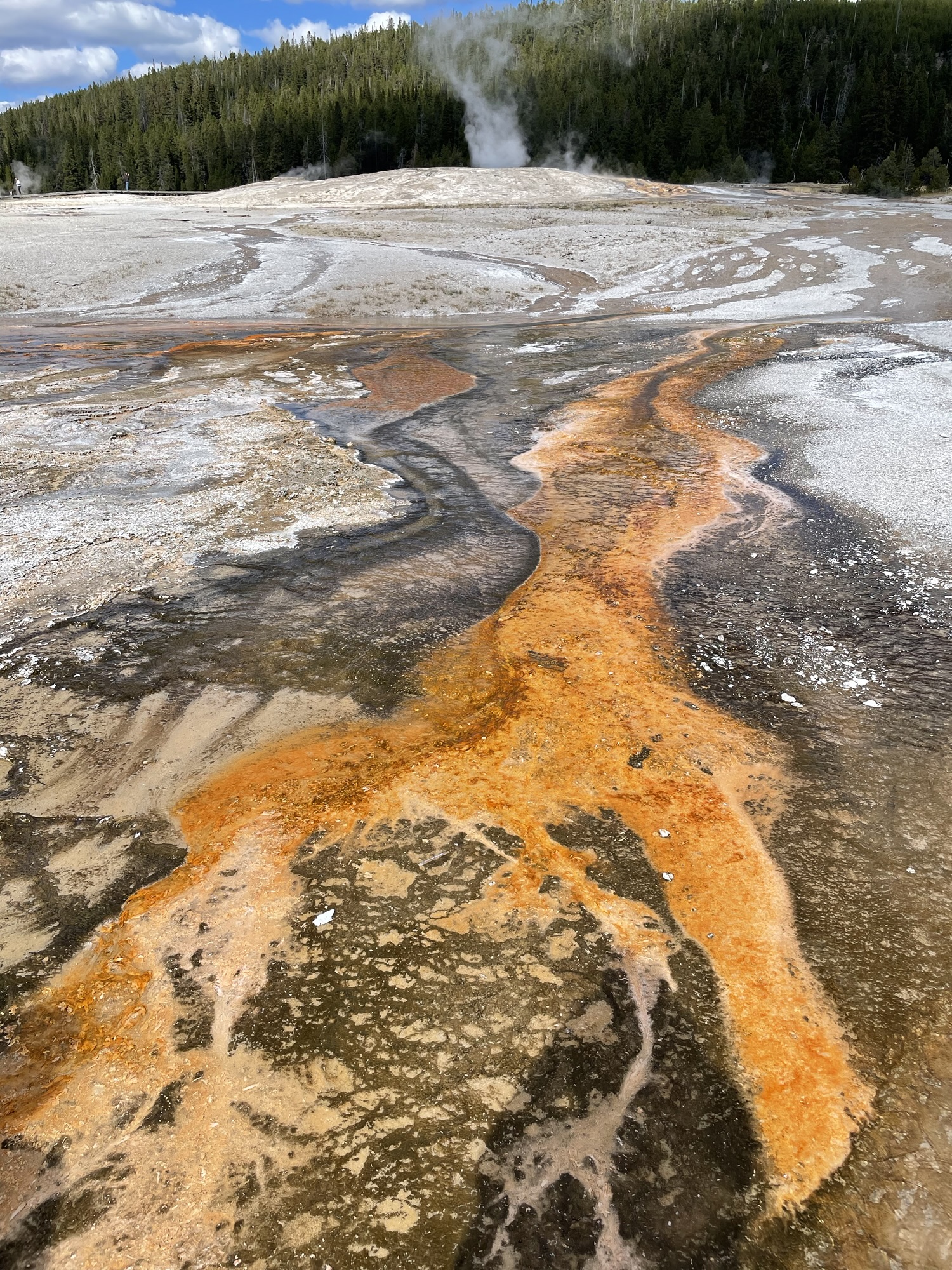
Everyone talks about the geysers of Yellowstone. The one most people see exploding upwards is Old Faithful, one of dozens of geysers that are part of the Geyser Basins, along with fumaroles (steam vents) and very hot springs and other hydrothermal features. The first time I saw this area we only had time to see Old Faithful expel its heated waters and steam and eat lunch at the Old Faithful Inn, an experience in itself. We could see other geysers in the distance erupting water and steam. But we did not have the time to walk around and explore.  This trip we had more than enough time.

We spent two nights at the Old Faithful Snow Lodge, one of three hotels that are in the geyser basin area.  The Snow Lodge is the only one that is open throughout the winter, as it has heat and is built for the cold weather.   The Old Faithful Inn and the Old Faithful Lodge, two historic buildings from the early days of the Park, are only open until late October.  The Visitor’s Center and the Tribal Culture Lodge, as well as the General Store were open when we visited.
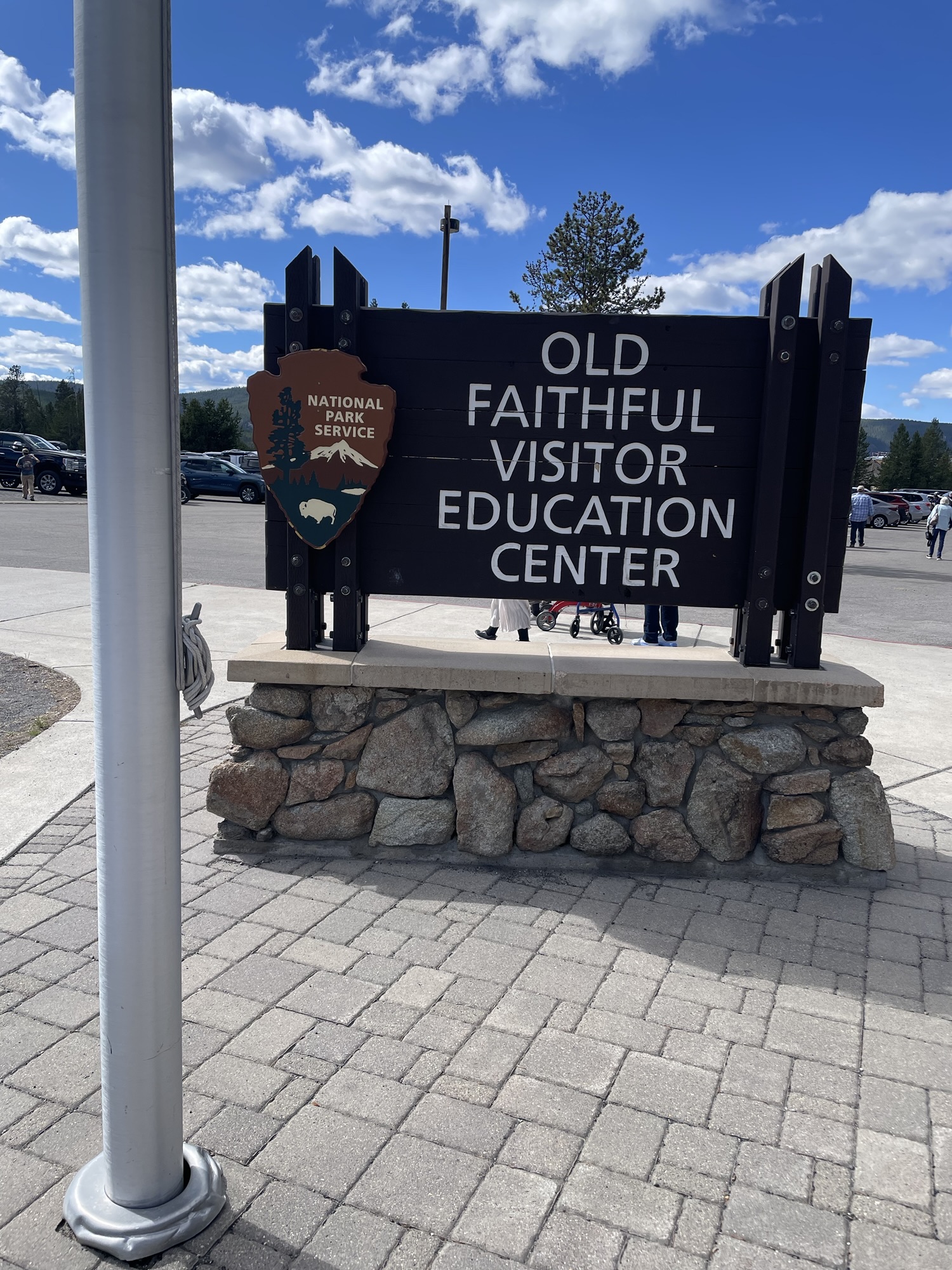
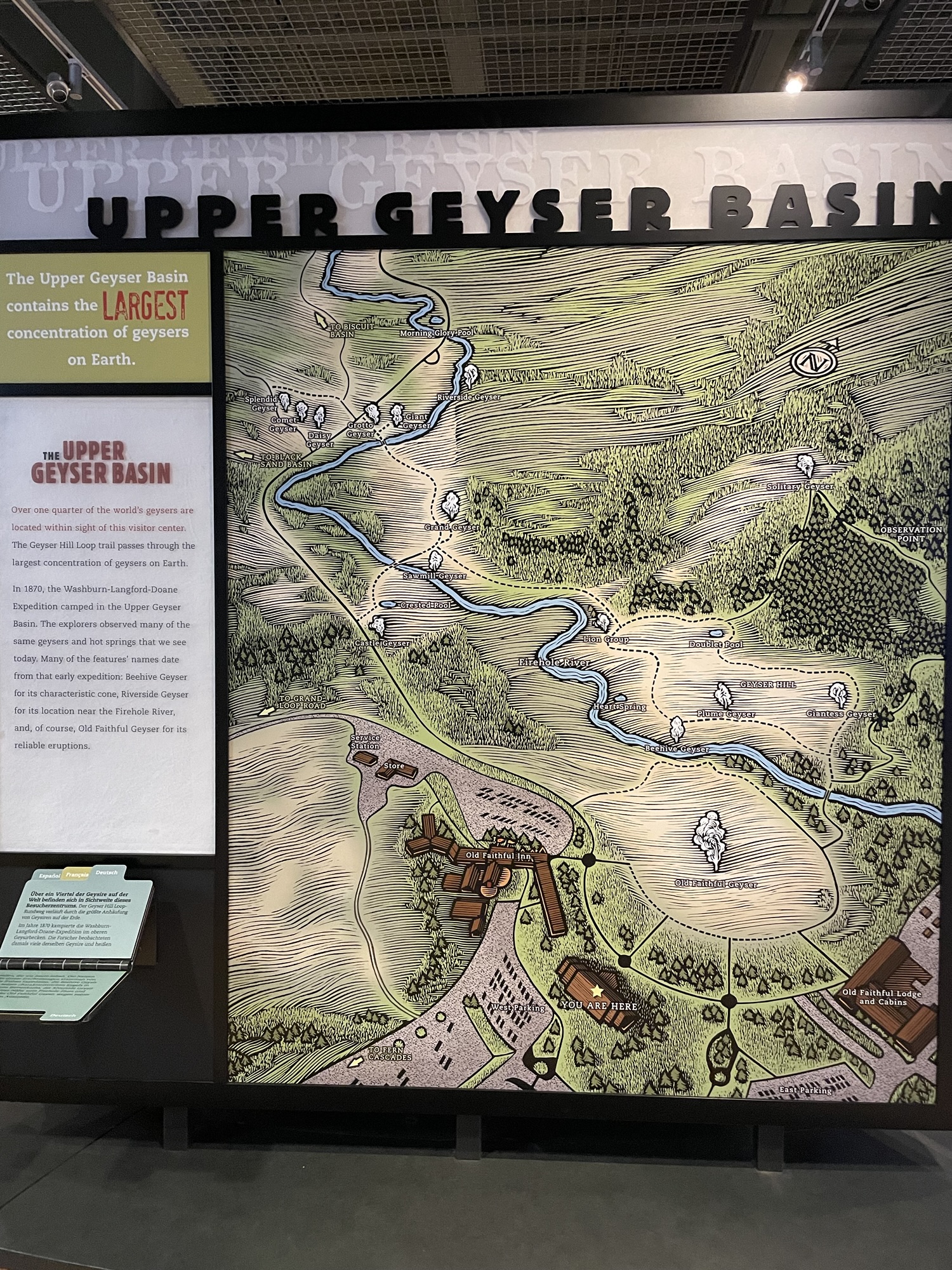
Since we had lots of time to explore while at Old Faithful, I visited the Visitor Center and spent time reading the information and watching the two movies.  I also checked out the beautiful historic hotels, Old Faithful Inn and Old Faithful Lodge.  At the Tribal Culture Center I watched two native American artists work, one carving an arrowhead, while the other worked on beading.  There was lots of opportunity to shop in the general store, the Visitor Center and the Tribal Culture Center. We enjoyed that as well.  It was a wonderful day of sightseeing, learning and relaxing.

Over our 40 hours in the Old Faithful area, I saw Old Faithful explode about 8 times, from all different directions.  Each time its steam and water shot up in slightly different ways. It really is an amazing sight.  But what is also amazing was our guided walk around the lower basin and seeing all the other geysers and their eruptions.  In some places there are three geysers right next to each other, like the Lionesses.  When one goes off it can either trigger another one to erupt, or actually draw water away from one that is already erupting.  The Anemone Geyser doesn’t really erupt at all, instead it slowly fills a basin with hot steamy water then suddenly all the water flushes downward like a whirlpool or a flushing toilet.

There are lovely hot springs to look at, like the Heart Spring, that looks just like a heart. But the temperature in these springs often rise to over 160 degrees, enough to cook anything that falls in. 

The land around these features is often brittle and baked.  You see the silicon deposits around them and the bacteria growing in the warm moisture.  The geyser basins are just one of the impressive sights of Yellowstone. 
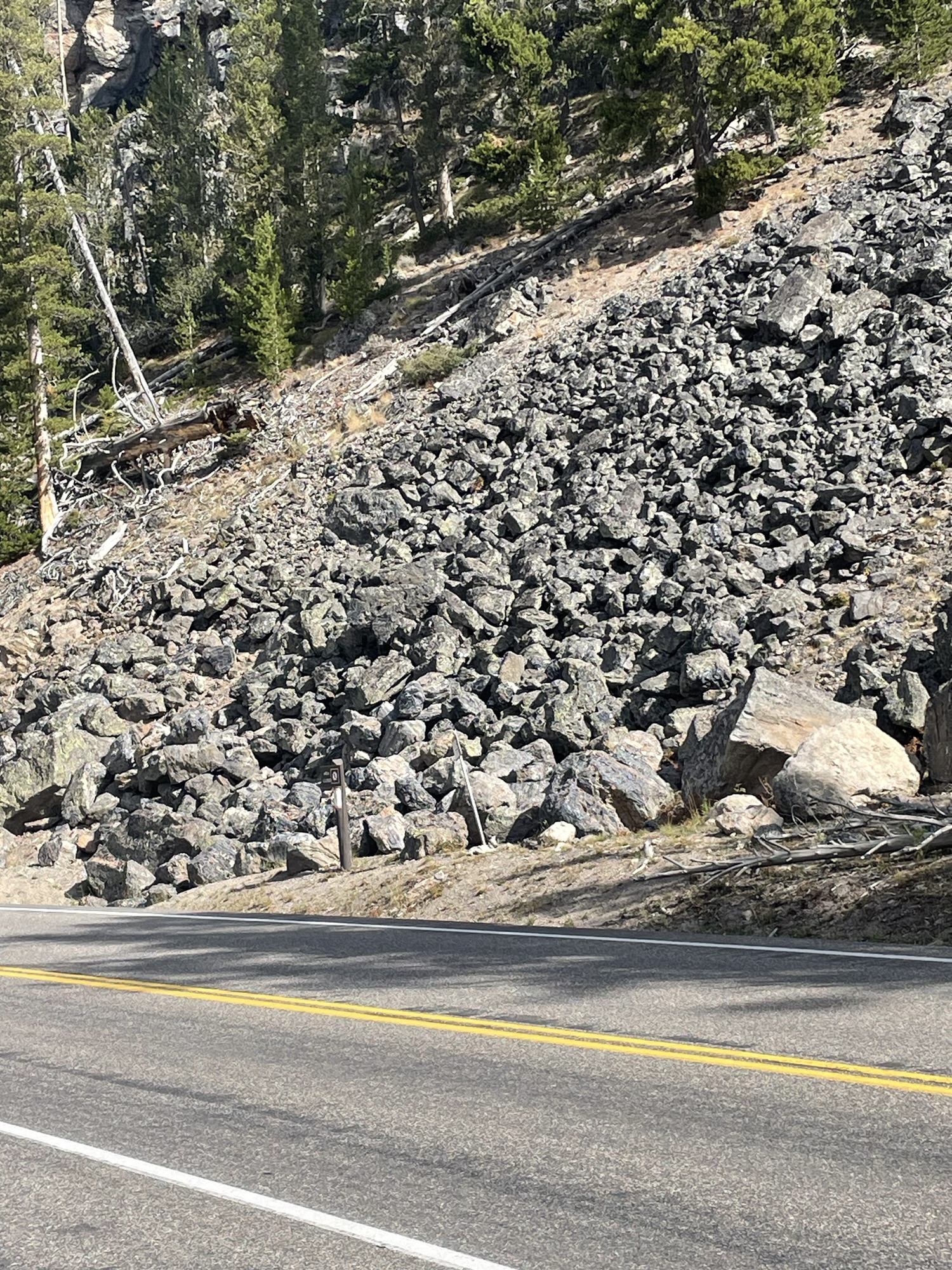
Once we left the geyser basins, there were so much more to see. We visited a mountain entirely composed of obsidian, the black glass made from an ancient volcanic eruption. This mountain is sacred to the native tribes that once inhabited the park.  They used it to make arrowheads and knives. You are not allowed to take any obsidian out of the park. But you can hold this cold, sharp glass.

Every day we ate a sack lunch in the park. The day we went to the hill of obsidian, we ate lunch at this lovely creek and picnic area. I did not want to leave!

Roaring Mountain, is unusual smoking mountain, where fumarole vents have killed off  the trees and caused the mountain to look like something out of a Lord of the Rings movie.

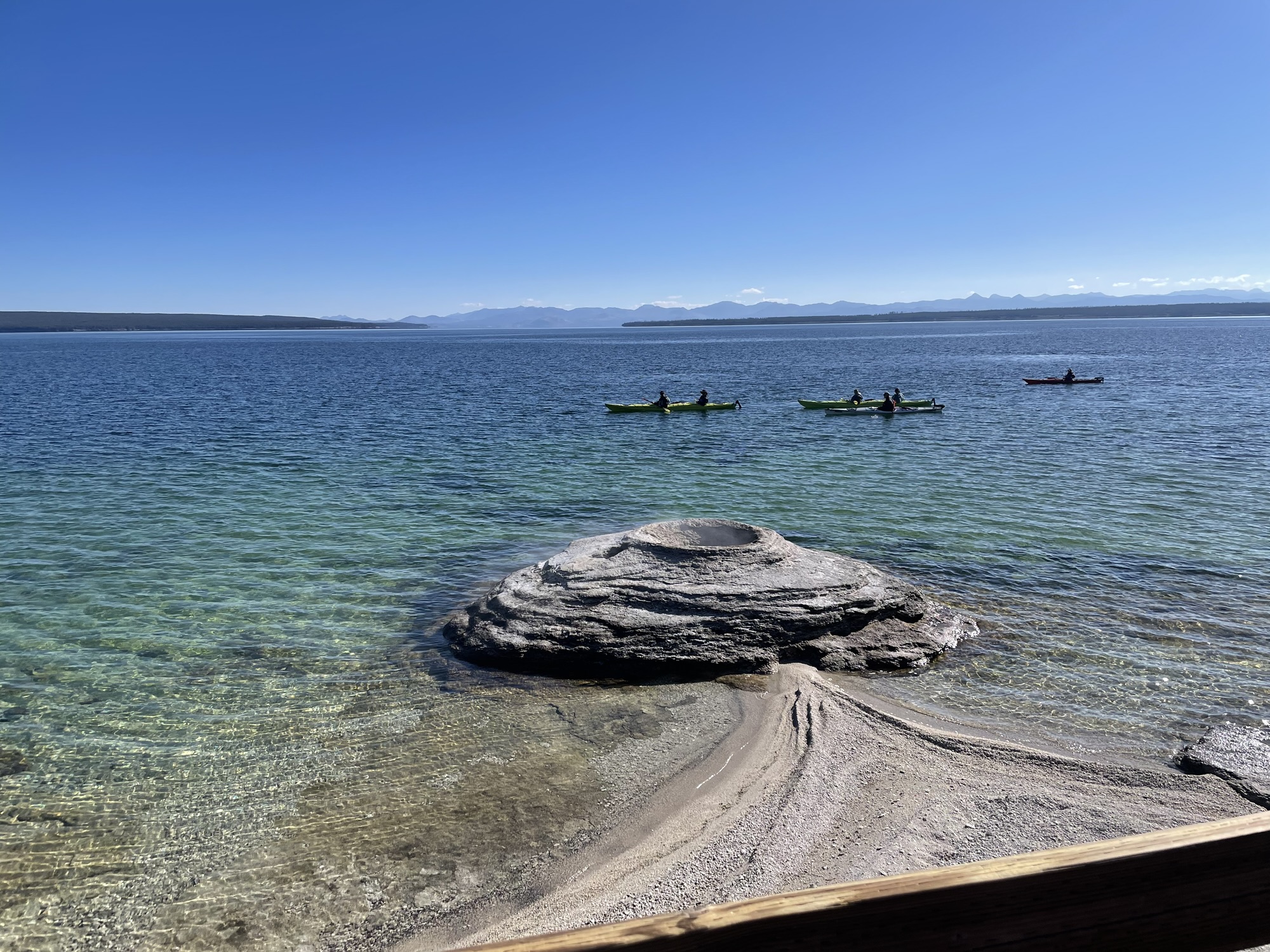
The West Thumb part of Yellowstone Lake, where geysers can be seen right on the edge of the lake and also bubbling up in the lake. And I cannot forget the bubbling mudpots where hots springs and bacteria cause the mud to actually boil.  Talking of mudpots, we also visited Fountain Paint Pots where you can see hot springs, geysers, mudpots and fumaroles all within a short circular walk.  While there we saw many small geysers erupt.  It was a good introduction to our later experience at the two geyser basins near Old Faithful.
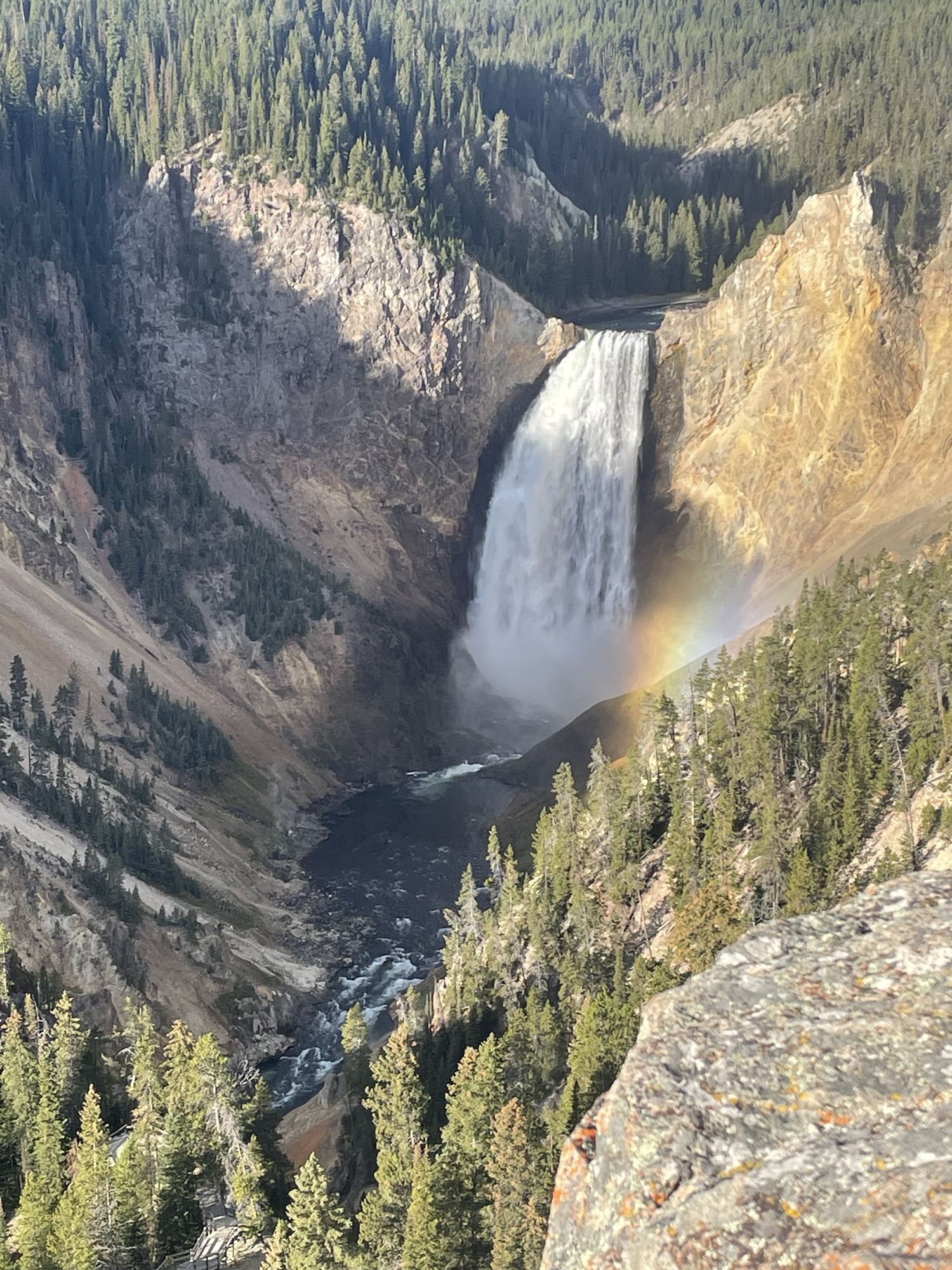
The Grand Canyon of the Yellowstone River with its canyon walls of many colors and its tremendous waterfalls, the Upper Falls and the Lower Falls, are thunderous and stunning. But also along the walls of the canyon you can see the steam from the vents rising as the heat bakes the canyon walls and helps to destroy them.

What surprised me is that the bison, elk and other animals will walk along the heated ground, and sometimes even lie down on it for warmth.  We saw this at Mammoth Falls where a bull elk and his harem decided to hang out on the day we were there.

Just mentioning Mammoth Falls Hot Springs brings back the vision of the water cascading down these travertine terraces that look manmade, but they are not. Photos cannot capture the sparkling essence of these terraces.

Of course I have not mentioned the wildlife.  Black bears, grizzly bears, Wolf packs, Trumpeter swans, Clark nutcrackers, elk, moose, mountain goats, pronghorn (which are not deer!), bison – lots of bison, and so much more to see and experience from a distance. In fact the bison are not buffalo, but people still refer to them that way.  And pronghorns are not antelope, but people still refer to them that way.  As our guide, Shauna, commented, it is impossible to change the song from “Where the buffalos roam, and the deer and the antelope play; to where the bison roam, and the deer and the pronghorn play.”

 Every spot we visited in Yellowstone is amazing. When you think that you are walking in the middle of a giant volcanic caldera, it really changes your view of the world.. These objects that nature has created here is inspiring. You realize that we, humans, are just tiny specks in the world, because in reality, nature is in control. I understand how the First Peoples of the Northern Hemisphere and the early explorers who walked these lands were stunned.  This was sacred land to the First People and should be sacred lands to us. 

I am so glad that in 1872 President Ulysess S. Grant declared it the first National Park.  Yellowstone is not only a national treasure. It is a world treasure.

I think everyone should come here to visit and learn. Having a guide lead us on this journey made it so much more meaningful. I have to thank Shauna, our guide; Bryan, our fearless bus driver; and Louis, our director of all (food, keys, directions, etc.); and Road Scholar. We will never forget this experience.

Counting the Hogans Leads Us to Learning More About The Navajo People

28 Mar

As part of our Road Scholar trip we were often on the road in a bus going from one place to another.   I need activity.  I remember when my children were young finding something to count along the way: water towers, yellow cars, different license plates, helped.   Soon I found myself counting the hogans.  Joining me was my partner in anxious inactivity, we traveled with another couple, and the husband and I share this trait.  We sat by the windows and started counting.  I must say that I was better at discerning the shape of hogans better than he.

What is a hogan and why count them, you might ask?  I am glad to explain.

A hogan is a Navajo hut/home.  Originally there were two types.  The simple, smaller, tipi style Hogan was called a male hogan. They are made of wood covered in mud. These were usually used and lived in by single men.  But anyone could live in them.  It is not gender assigned in that sense.

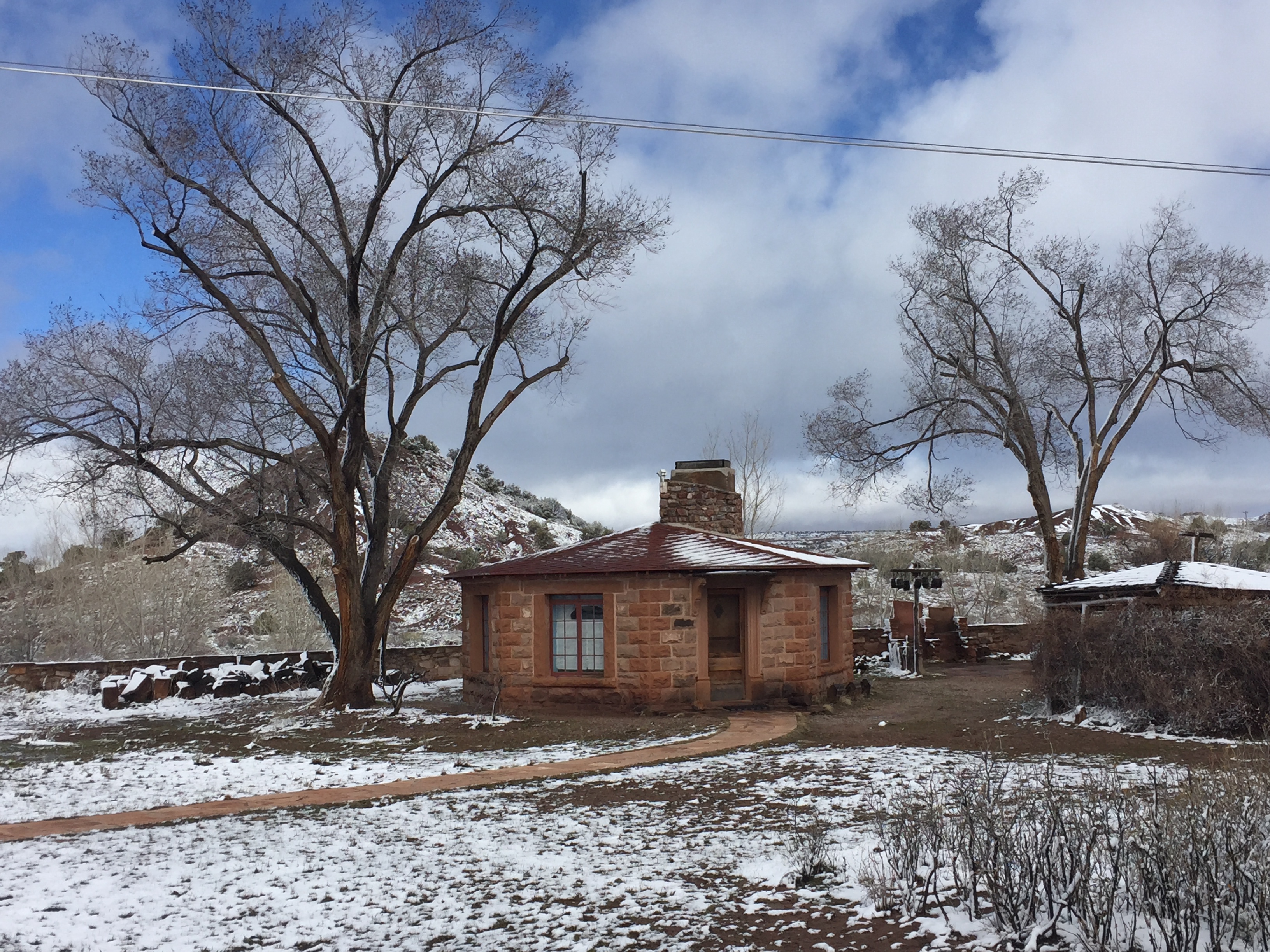
A beautiful stone Hogan on the grounds of the Hubbell Trading Post.

The other, female hogan is much larger.  It is often multi-sided ranging from 6 to 9 sides, with differing explanations why. But one guide told us a nine-sided hogan is to represent the nine months of pregnancy.   Both males and females can live in a hogan.

The opening of a hogan always faces east to welcome the morning sun.

Although many Navajo families still have a hogan on their property for ceremonial reasons, most no longer live in hogans.  However, that is not an absolute.  They are inhabited as well.  They can also look different now.  No longer are they just mud-covered beams of tree trunks and branches, they can be made of brick, stone, wood, shingles and siding.   We saw it all.  Some have had additions put on to make them bigger.  Others stand alone and silent, somewhat decaying.  Others have had windows installed — no longer with just an opening in the east and on the ceiling to let the smoke from the stove or fire vent.

We saw our first hogan in the Heard Museum in Phoenix.  The guide explained to use how they were built and why they were used.  Being that it was inside and enclosed in the museum, it did not face the elements ,and you really could not tell that it was facing east.  But it was interesting to see.

img_2281

Hogan at Canyon De Chelly

The second hogan we entered was at the entrance to the Canyon De Chelly National Monument on the grounds of the Welcome Center. This hogan was outside.  Our guide told us stories about his family and what his grandmother told him about the meaning in parts of the hogan.  Much we had heard from our guide at the museum, but his tellings were more authentic.  Our Road Scholar guide explained later that different families have slightly different opinions. And she did correct one bit of information he gave us.  Thank you Azalia!

img_0078

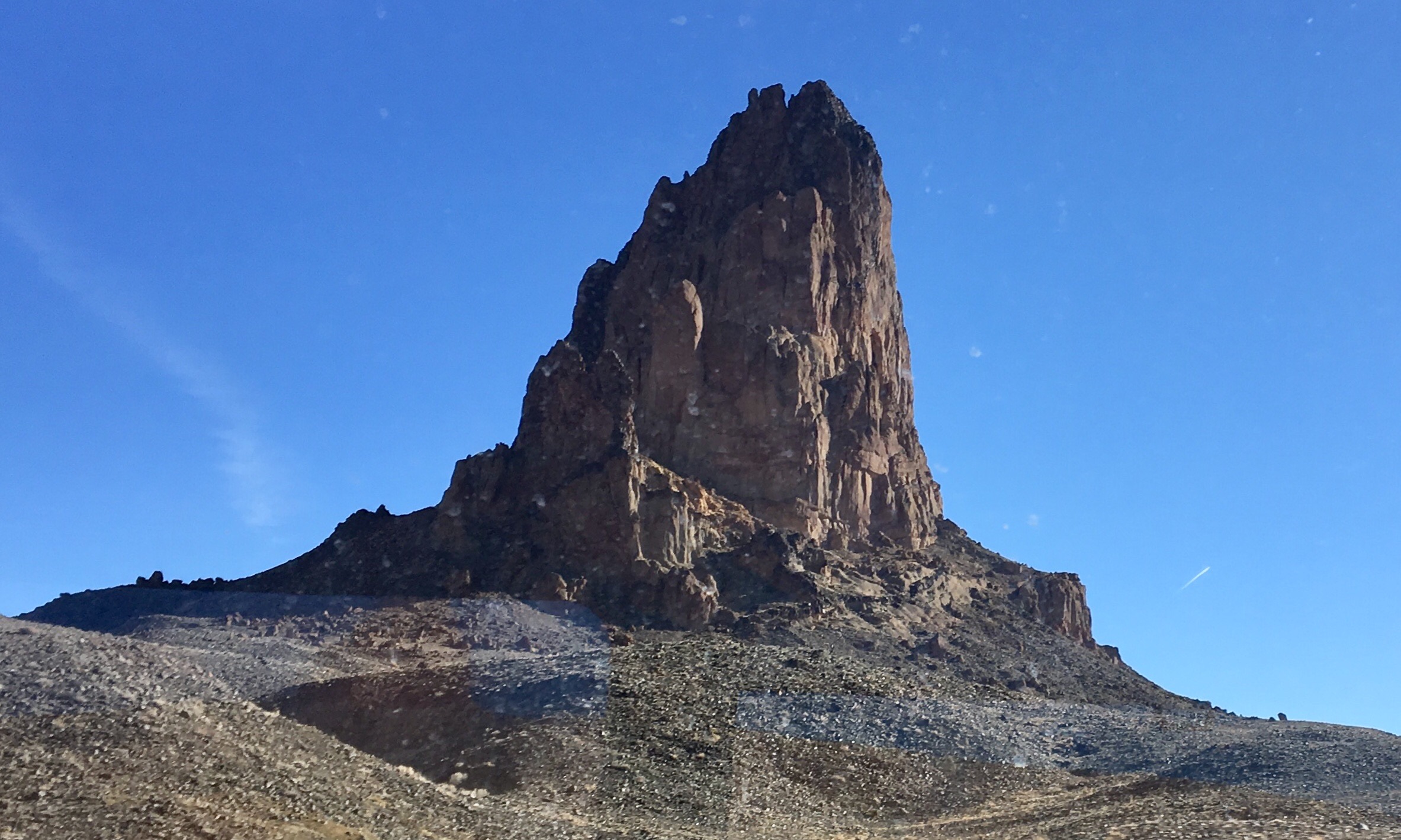
Agathla Peak or El Capitan 

Our third entrance to a hogan was at a rest stop near El Capitan.  First the beauty of the surrounding area as we drew closer to Monument Canyon was stunning.  Seeing El Capitan, or Agathla Peak, an ancient volcanic plug in the horizon was amazing.  We eventually got much closer to it.  So at first I did not notice the hogans, but there they were with some information about them.

The rest stop featured two hogans, both the male and the female.  Thus for the first time we could enter the smaller one and see how it was made. I loved seeing how the interlocking forked branches and tree trunks formed the top of the male hogan.  To be honest, it was quite small, and I can see why it has gone out of use.  Unless you are camping or living off by yourself, there is not much room but to sleep and take shelter, so it is not a great living situation.

The female hogan is much better for families or daily living. The way the logs were formed for these is much more intricate, with layers of logs forming a design in the ceiling.  Some female hogans have the side logs layered horizontally. Other are formed by longs standing upright, vertically around the exterior.

So why count hogans? Well as we drove through the Navajo reservation, we had plenty of time on the bus.  And although much of the scenery was breathtaking, there were also many areas where we drove through empty dessert, except every so often we would see a group of homes where a family had its compound.  And there, among the more modern homes was often an original or remodeled hogan.   So we did what any child would do on a long trip, we found something to count and to discuss.  We counted 15 hogans.  They were a variety of colors, symmetry, materials, and shapes as we saw several connected to other additions.

Counting hogans led us to discuss what we were seeing.  How do people live out here in the middle of nowhere?  We found that solar panels have helped with electricity.   That water has to be brought in.   That addresses are basically non-existent.  Residents of these isolated compounds tell visitors to go to a certain highway marker and turn either left or right and follow a dirt road to get to their homes.

I am glad we started counting hogans because this led us to learn more about the Navajo people and their life on the reservation.


Pueblo Grande and the Heard Museum Starts Our Quest into Native Cultures

19 Mar

We recently went on a Road Scholar program to learn about the Hopi Mesas and Navajo Lands of Canyon de Chelly.  Our first stop on this journey was Phoenix, Arizona, where we met up with the group of 34 including our two guides.

Before it started, my husband and I discovered the Pueblo Grande Museum and archeological park.  We arrived hours before our first program was to start, so decided to walk from our hotel to a restaurant nearby.  Right across the street from this museum.  What a delightful accident.

First stop, when entering the museum was a short movie about the Hohokam people and this site. It helped to adjust our minds back in time to the lives of those who lived here.  The museum showed us what was found in the site and explained more the way of life.

After we exited the back door, we walked through the grounds and the 2/3 mile loop around the ancient platform mound, which dates to the 1400.  We saw the evidence of the Hohokam people’s irrigation canals and homes.  We were amazed by the large oval ballcourt that was used, they believe from 750 – 1200 AD.    This court was my favorite part of the archeological site, but for many it was the mound. Later in our trip, after I had been on the tops of the Mesa’s where the Hopi live, I could imagine that this platform was built to imitate the mesas.  I don’t know if this is true, but it is my vision of the site.

This was a wonderful way to learn the history of the Pueblo people, the ancestors of both the Hopi and Navajo.

Later that evening, our official program began.  We would go in the morning to our first stop on the official agenda, the Heard Museum in Phoenix.  I had been there before, but without the help of a museum docent.  Having this knowledge helped us understand what we were looking at during the tour of the arts and history of the Navajo people, which is highlighted at the museum.

We saw the pottery, weaving, baskets, wood carvings and jewelry made and designed by the native peoples of Arizona.  I cannot say one was more beautiful than another because each type of art was magnificent in its own way.

img_2131
The walls filled with Kachina/Katsina spirit carvings opened my eyes to how these carvings changed over the centuries. And the history behind them revealed part of the culture, how they were used to teach young girls about the spirits that bring rain and information.

img_2123

Seeing the multitude of baskets and pottery and rugs along the walls of the museum, showed me how these home arts went from useful and decorative to now works of art.  The workmanship in the making of these crafts amazes.

Finally, the silver and turquoise and coral jewelry that the Navajo peoples make is stunning.  This is a skill that they learned after the Long Walk, when the people of the Navajo needed to rebuild their community. And the tools and skills they learned in blacksmithing helped them to turn these skills to jewelry design. While the turquoise was considered good fortune as it connected to the blue of the sky.

After our time with the docent, many of us went upstairs to an older section of the museum to view the newly redesigned exhibit on Native peoples and the boarding schools they went to in the late 1800s, early 1900s. These schools were seen as a way to assimilate the children into the Anglo-European culture.   Many still go to boarding schools today, as the people in the reservations are so spread out.  But no longer are they told to not express their own culture.

Day one ended with a long bus ride to the Hopi Reservation and then a two-day stay at the Hopi Indian Cultural Center on the Second Mesa.

Canyon De Chelly, The Most Lovely Grand Canyon

18 Mar

Visiting Canyons seems to be my newest craze.  I have written about seeing three grand canyons in the blog below.  This past week I visited what I think is one of the loveliest canyons: Canyon De Chelly, a National Monument and National Historic Place, located in Arizona on the Navajo Reservation.

Covering over 131 square miles in three canyons that merge together, Canyon De Chelly has been the home of the Navajo people, or Dine, for hundreds of years.  The Canyon itself ranges from 30 feet deep, where you can enter it near the town of Chinle, to over 1000 feet deep.  Its red sandstone cliffs are amazing to see.  The ancient pueblo homes of the original inhabitants can be viewed from the top of the Canyon as well as some by tours to the bottom.

There is more than just beautiful scenery and astonishing sites to be seen, there is the history of the Navajo to be learned.

img_2297

Spider Rock

We visited the rim alongside Spider Rock, where the Navajo believe that the Dine emerged into this world. She helped her people learn skills and protected them.  The Spider Rock is an amazing natural stone structure. To see its reach to the sky from the bottom of the canyon helps to envision the Navajo legends about the Spider Woman who lived there.  How else could one get up there?  It is just majestic as it reaches over 800 feet from the bottom.

Pueblo dwellers also lived in the Canyon.  You can still see the remains of their structures at White House and the Mummy Cave, as well as at other spots.  We viewed these two sites.  And they are amazing that so many centuries later the buildings are still recognizable and seem to exist outside of time.

But it is not only the formations and the ancient pueblos that make Canyon De Chelly special, it is also the history.  Navajo peoples have lived in the valley for centuries. It is here that they had their orchards and their farms.  It is here that Kt Carson, under the auspices of the US government, invaded the canyon to remove the Navajo. He used a scorched earth policy to destroy and starve the people in the Canyon. In an act of terror and misguided desire to cleanse the canyon of its native peoples, thousands were killed and rounded up for a long and treacherous march to New Mexico in 1864, where the Dine were kept prisoner at Fort Sumner for four years.

Finally, in 1868, the Navajo people were allowed to return home to their Canyon and try to rebuild their lives on what was now a protected Reservation. They were not returned to all their lands, but part of them.  This beautiful site still carries the memories of those who did not survive.  Some families still have claim to the land in the canyon’s valley. They still farm there and live there in the summer months.  To learn what happened to the Navajo/Dine people was depressing.  To see how harsh the US was on the first peoples made me want to cringe. But I felt some lightness of spirit to see that the canyon has been returned.

We visited the Canyon in March, where it was not supposed to be snowing, on a Road Scholar educational program.  It was informative and wonderful.  I must say the snow enhanced the beauty of the stone and the canyon.  Although we were unable to go to tour the bottom of the canyon as planned, due to the water and mud, seeing what we did was more than enough to make us deem this the loveliest of the Canyon’s we had seen.

I am glad that we decided to not just go to the Canyon De Chelly, but to have two excellent guides, one Navajo and one Hopi, from the Road Scholar program, who guided us through the two reservations and explained the history of their peoples as well as the magical and beautiful places we visited.

My Third Grand Canyon: Waimea Canyon, Kauai