Tag Archives: memories

The Chicago Marathon as a Spectator Sport

12 Oct
The non-elite runners lined up to start the Chicago marathon.

The non-elite runners lined up to start the Chicago marathon.

My husband is running the Chicago Marathon for the 8th time in ten years. When he turned 50 he decided he wanted to run a marathon. So he started training and at age 51 ran his first full marathon.   Over the years he had to miss two Chicago Marathons due to travel or injury. But he continues to train. And this year, at age 60, he is running again. I also prepared, for my role as a marathon spectator.

This year was different. In January my husband herniated a disk in his spine.   It was at the most inconvenient location, but with the miracle of surgery, he was able to have a microdiscectomy and recovered. However there were some issues he had to battle. First with no exercise for eight weeks, his right leg muscles had atrophied. He battled to get his leg back into shape. Even with all he did, that leg is still a bit weaker than it was before and his training took a bit of a hit.

Second he is a drop slower than he was before. As I watch his progress in the marathon on text message alerts, I can see that he is running about 20 seconds a mile slower than he did last year at the beginning of the race. Not a major difference, but when you are going 26 miles…that adds minutes. And as the marathon progresses, I know he will slow down. So I am a bit worried in my role as spectator.

I do not run marathons. I do not run. I walk. I enjoy walking. I try to walk 2.5 to 3 miles daily. Yesterday, as we are in Chicago I walked 8.9 miles all along the waterfront, in the Field Museum and along Michigan Avenue. Over 17,000 steps, but that is my limit. I have no desire at all to go 26 miles. In fact, to a degree, I think my husband is mildly insane. As is his friend who is running the marathon as well.

The night before I went online and set up text messaging alerts so I would know when they started, hit 10 k, half way, 30 k and finished. It is important as a spectator to know when these events occur. I will admit, this year the notices were much more timely than they have been in the past.

They started out together this morning. At 7:00 in the morning, they left the condo and walked to the corrals. I got up for a few minutes to take their annual pre-marathon photo. Then they left. They would start about the same time, but since his friend runs much quicker, (his starting pace was 10:41 per mile), he will be done at least an hour earlier than my husband if he keeps this pace.

They prepared for this. They trained for this. They ate their pasta dinner last night. They have their special shoes, socks, clothes, their energy foods and drinks. They want to run. But at age 60 and one week; and age 59 and 10 ½ months, the training and the running take a toll.

Before my husband ran this year, his cardiologist ran a new test. And my husband’s heart was fine. The doctor turned to me and said, “I wanted to tell him he could not run this year. But he looks great.” And that is all my husband needed. He brings me doctor reports each year to prove all is okay, because I am nervous about this 26.2 mile run. But as a spectator, I had to go along with the doctor’s decision.

I fill out the back of my husband’s number bib with emergency numbers. I go to watch to make sure all is okay. They both know not to rush and to stop if it is too much. But with the weather as nice as it is, I know they will both finish this year.

As a marathon spectator, I cheer on everyone I can. If I see someone with their name emblazed across their shirt, I scream for them. I figure if they put their name on they want the encouragement. I love watching for those who are newly married or engaged. They often wear veils or announcements on their shirts. This year was not different. I saw a couple wearing bright yellow shirts. One said “she said yes.” The other, “Newly engaged.” This year I saw someone wearing a Royals t-shirt. Of course I cheered him on. As a citizen of the Kansas City metro area, we are all Royals right now.

There were people dressed as comic book heroes, Superman, Batman and Wonder Woman. There were people wearing capes, skirts and costumes. There was a man juggling as he walked.

Some were running, some were walking, some were stretching, some were drinking energy drinks. All were intent on their goal.

My friend and I always wait about the 16-mile marker to cheer our husbands on their trek. This year was a bit different. Usually we are part of a crowd of their children, spouses and a grandma. This year they all could not come. So it was just my friend and I. But we kept tradition. We waited till both of our husbands ran past. We gave them extra energy food and water. We provided each with encouragement. Then we completed another marathon tradition for us as spectators and walked to Athena Restaurant in Greek town for a delicious lunch.

We had roasted lamb and potatoes. And talked about our children and our husbands. Then we slowly walked back to the condo. Along the way I congratulated everyone we saw who was wearing a medal or a silver blanket. I figured if they ran that marathon they deserved a little praise. They all responded with a “thank you.”

I took a photo for a young couple who were taking photos of each other. Of course they wanted a photo together with their medals and silver blankets, so I took it for them.

When we returned to the condo we waited. The first text arrived. My friend’s husband was done. An hour later he returned. Tired, but happy. A short time later the other text arrived. My husband had completed the marathon. With his arrival back the marathon was officially over.

They both ran faster than they had the year before and were both pleased with their run. They were tired and sore. But had a great sense of accomplishment.

Now they start the plans for next year and another marathon. And I am ready to continue my role as marathon spectator. A job I enjoy!
Hidden Memories, They Do Exist!

10 Oct

Lately in the Kansas City area we are hearing much about ‘recovered’ memories due to a trial concerning the Catholic Church and a man who alleges he was sexually abused by a priest when he was a child. The man says he repressed that memory until he was an adult and a friend told him about another child who was abused.

And I believe him, because about three years, I had a similar event. Memories that I had repressed and forgotten were uncovered because of a conversation.

It started simply enough. My husband and I were meeting a friend of ours for lunch and then we were going to the movies. My husband was going to a movie he wanted to see, and my friend and I were going to a ‘chick flick.’ But that is not what ended up happening.

When we met for lunch, my friend told us that she would not go to the movies, because another friend called and needed help with a party. My husband was annoyed. He said, “Well that takes care of that. No movie today.”

“Why not?” My friend asked. “You can still go to the movies.”

“No,” my husband responded. “Ellen does not go to the movies by herself.”

“You don’t!” My friend was surprised. “Why not?”

This is when I entered the conversation. I had never really thought about the fact that I never went to the movies by myself. I know lots of people who do, but I never ever went into a movie by myself.

“I don’t know,” I said. “I just don’t go to the movies by myself.”

My friend wanted answers, but I had none for her at that moment. But

as we ate lunch my brain kept thinking about it. Why don’t I go to the movies? There are many movies I want to see. When I go out of town, my husband always goes to the movies he wants to see that he knows I won’t go to. But I never do that. I have friends who go on their own in the afternoon. But I never do that. I wait till my husband or a friend will go with me. Why don’t I go to the movies by myself. It was really beginning to bother me.

Suddenly, I had a memory from my childhood, from a Saturday afternoon at the Embassy Theater in North Bergen. I remembered a bad thing.

“I think something happened in a theater when I was little,” I said. “I need to speak to my brother. He would know, because he was there.”

And that is where it ended. After lunch we went home because I really do not go to the movies by myself.

A few weeks later I flew to New Jersey to see my Dad. My brother picked me up at the airport. As he drove, I told him the story about not going to the movies alone and my memory of a man in the dark movie theater, sitting next to me, doing something nasty.

“Yes,” my brother told me. “It happened. “ And for the very first time that I remember, we talked about that day.

When we lived on Third Avenue, we went to the movies almost every weekend. There was an older boy, someone’s brother, who would take a group of us to the movies. About 8 to 10 of us would go each week. Sometimes we walked to the Embassy Theater and sometimes the fathers drove us. The older boy, a teenager, would sit in the middle of the group. My brother said the older boy was about 14; the rest of us ranged in age from about 7 to 10.

This one time, I had to go to the bathroom before the movie. My brother waited for me in the lobby. And then we went in. Because we were late, instead of sitting next to my girlfriend in the middle, I was sitting on the far left side. My brother was to my right next to the group. There was an empty seat to my left. When the movie started a man sat down next to me. He never touched me, but he exposed himself and touched himself.

I grabbed my brother on the arm. I was too scared to talk. I was about 7 or 8. At first he tried to push me off. But then he looked over and saw what was happening. My brother took my hand and pulled me to the older boy in the middle. He whispered in his ear. Everyone moved down and I was put next to the older boy.

I do not remember if he got the manager. I do not remember ever telling my parents what happened. I honestly did not remember the incident in my active brain at all. All I knew is that I do not go to the movies by myself. And I NEVER, EVER allowed my children to go alone to the movies until they were teens and driving, I always went to the movies with them. Even to movies I did not want to see!

When I go to the movies, I always sit to the right of my husband. So when I look to the left he is there. There is never a stranger next to me on the left. And I try to keep anyone I do not know from sitting next to me on the right.

My brother told me it was time to get over it, when he finished telling me what he remembered. Perhaps my brother is right. Perhaps it is the time to get over it.

But I do know that memories can remain uncover for years. That it is possible to forget something but still be impacted by actions that occurred when we were young.   And I know that an event or a converstaion can trigger the memory.

To be honest for a while I thought perhaps I was imagining it. Did this really happen to me? I did not want to ask my brother over the phone, because I thought he would laugh at me. I wanted to ask in person. I was lucky that my brother could confirm the memory. He was there. It did happen. I had a legitimate reason to be afraid.

Has my habits changed in the three years since I found out what happened? NO. I still cannot go to the movies by myself.


Traditions Survive Across Generations

4 Oct

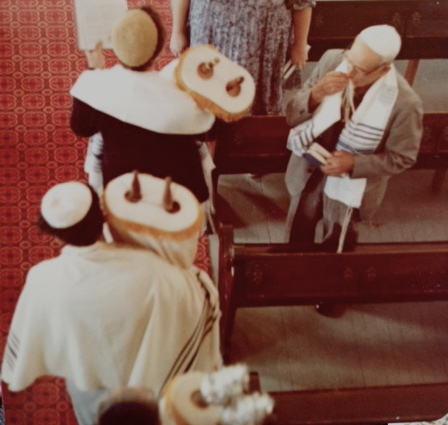
My grandfather was a Cohen. Born in Poland, he took this role seriously. Cohanim lead off the aliyot at synagogue; they have to be present at a “pinyon ha ben,” the ceremony for the redemption of the first born. They cannot marry a divorced woman. They do not go to the cemetery or funeral except for a very close relative. And for me the most intriguing, they lead the dukhanen on the high holidays

When I was a little girl I loved to go sit with Grandpa in shul. He had a large tallit ( prayer shawl) and would wrap me into it as I sat next to him. Whenever the Shema was said, he would lift his tallit so it covered his head and face. “Why do you do that?” I asked. Most of the other men just kept their tallit on their shoulders.

“When I say the Shema I speak to G-d,” he told me. “When you say the Shema you have to cover your eyes, ” he told me, “and think about the prayer .” To this day whenever I say the Shema I put my right thumb on one eyelid and my forefinger on my other eyelid to keep my eyes closed, just as Grandpa taught me. And I think about the words I am saying. I taught this to my children.

Because Grandpa was a Cohen on special holy days he would perform the priest prayer, the dukhanen, with other Cohanim descendants. They would be dressed in white kittals, robes, over which they wore their tallit. When they entered the sanctuary they stood at the front if the congregation and covered their heads with their tallit.

At this point my Mom told me to look away. “When the Cohanim chant this prayer they speak to G-d and his light comes. If you look once, you will go blind in one eye. If you look twice you will go blind. If you look the third time you will die,” she said.

How can you possibly die if you are already blind? Okay she admitted you cannot die, but still you must turn your face away and not watch. To this day I do turn away. I still cover my eyes. But sometimes I sneak a peek. And I said the same thing to my children.

Many congregations no longer do the dukhanen , but my congregation continues this tradition. At Rosh Hashannah this year, as I watched the Cohanim walk in and prepare for their chant I remembered my grandfather. In my mind I could see him walking to the front of the room.

My father was not a Cohen. As an Israelite, he had no special role, but he loved his Judaism and his congregation. My Dad was president of his synagogue for 11 years. A record I am sure. He worked to pass his love of Judaism to his grandchildren. Before each of my children’s bar/bat mitzvah, my parents came to stay with me. My Dad studied with them each day for the week before the service, listening to them chant Torah, helping. He was so proud as each of his six grandchildren reached this important day.

Grandpa kissing his tallit after touching the Torah.

Grandpa kissing his tallit after touching the Torah.

As the Torah comes through the aisles before being returned to its resting place behind the curtains and the doors, beneath the everlasting light,  I touch it with my siddur.  My Mother taught me to do this, as I watch the men touch it with the fringe of their tallit.  This I also taught to my children.

When I go to shul, I am never alone. Even if my husband is not with me, in my mind I see my grandparents and parents. When I chant the Amidah, standing with my feet together, I gently sway back and forth, Schukling. My children would sway with me when they were little. Sometimes my children would lose my rhythm and sway into me. Now just my husband is with me. And he sways into me sometimes with a lilt in his eye.

My husband is a Levi.  Although he does not participate in the dukanen itself, he is called out before it to help the Cohanim prepare.   Many times, he does not have to do anything, because there are more Levi than Cohanim. But he goes, he says for the exercise.  But I know that it is a tradition that remains.

When we daven together, I feel the bond lasts across the generations.
As I recently stood to say Yahrzeit for my Dad, my son was with me. He now wears my Dad’s tallit. On his head was one of my Dad’s caps. As I stood, he lean my Dad’s hat against my hand. When I sat, he turned and said,” I thought you would want Grandpa near to you.” And I did.

But when I am in shul they are always with me. Their voices swirl among the other voices chanting.

Misty Lakes and Cold Mornings Were Wonderful In The Summertime

1 Oct

Those who think climate change is not a reality did not spend their summers in the Catskills during the late 1950s and 1960s! Those brisk summer mornings made waking up and getting out of bed a little difficult at times. The summer mornings do not seem as cold now!

We slept under feather beds and quilts, and always put our clothing under our pillows to warm them up during the night. Sometimes your nose would be so cold that you would put the covers over your head as well. And everyone wore ‘footsie’ pajamas!

In the mornings we would all get dressed while still lying under our blankets. First came layer one, underwear; then layer two, shorts and t-shirt; then layer three, jeans and a long sleeve shirt. Socks went on as well. And with no heat, those bungalows were cold! . You could sometimes see your breath in the mornings, so dressing while still in bed made sense!

My sister and I would wait to see who could hold their bladder the longest. No one wanted to be the first to sit on the cold toilet seat. My brother was lucky; he could stand up!!! But finally one would have to jump out of bed and start the day.

Mom would be making breakfast for us. And soon she would shoo us out of the bungalow. But first we had to put on sweaters or lightweight jackets.

When we looked across the street form our bungalow, we could see Kauneonga Lake. In the early morning the mist would rise from the warm water into the cool air of the July or August day. It was the most beautiful view.

The lake water was much warmer than the outside air. Some early mornings, my grandmother would take me to the lake. I would have my bathing suit on and a large towel wrapped around me. We would slip into the lake from our dock and settle into the warm water. She would wash my hair and her hair with ivory soap. She had very long hair that she usually kept braided on the top of her head. But these mornings, she would have it hanging down.

Grandma grew up in Poland. She told that lake water was the best to wash your hair. She would tell me stories about washing her hair in the water near her house when she was a little girl.

Sometimes through the mist we could see rowboats and fishermen. That was before everyone had motorboats and the lake water had gasoline and oil in it.

The water felt so warm and wonderful, until it was time to get out. Grandma would make me sit on the steps while she got out and dried off. Then, as I – shivering – exited the water, she would wrap me in the towels. We would return to the bungalows as quickly as possible to get into warm, dry clothes. This was a special treat.

Usually, after breakfast my sibling and I would go outside to play with all the other children.   There was a fence around the colony that was to keep us inside. We knew better than to go beyond the perimeter without a mother’s permission.

My family and friends in Kauneonga Lake.

My family and friends in Kauneonga Lake.

As the day went on and it warmed up, we would slowly shed clothes. First off the sweater, then the long –sleeved shirt, and finally the jeans.   At lunch time we would start begging, “Can we swim today? Can we? Is this a good day?” I think the Moms decided as a group. We had to wait at least an hour till the food digested. (What I now know was a bubbameister, we really did not need to wait.) Then around 3 or 4 in the afternoon, if the weather was nice, we changed into our bathing suits and went swimming in the lake: all the moms, grandmas and children. On the weekends the dads were there as well!

We would all go to the dock with our towels, carefully crossing the street under our Moms’ observant eyes. The older children holding the hands of the younger, we would run to the dock.

The lake water was wonderful in the afternoon. I liked to stay where the bottom was sandy, where most people usually went. To either side was mush, or as we called it the gush, …seaweeds. And hidden in the mush were fish that nibbled your feet and snapping turtles. Sometimes, like always, the older boys tried to push the younger children into the mush. The screaming would begin. But nothing really bad ever happened because all the Moms and Grandmas were watching. We would spend a wonderful hour or two swimming and playing, until the Moms said, “Done. Get out of the water, Now.”   We hated that. But eventually we would all return to the dock and dry off.

We would clean up after swimming and before dinner. It was too cold after dinner to shower and clean up. And to be honest, if we went swimming we were considered clean enough. There was no need to take a bath!!!

As the day ended, the reverse would occur. Soon the jeans went back on, then the long-sleeved shirt and finally a sweater. Sometimes after dinner we would just put our pajamas on and stay in the bungalow. Other times we would all sit outside and just visit. It was quiet time, and it was the Moms time. Several nights each week, a different mom would host the gin rummy or mah jong game in her bungalow.

There were three ‘grandpas’ at the colony (two were mine), as well as at least one dad. Each week a different dad would take his vacation and spend time with all the families. And while the Moms played their games at night, the grandpas were always on bungalow control. They would walk from bungalow to bungalow to make sure all the children were asleep and everyone was safe.

One year one my sister started sleepwalking. The first time it happened my grandpa was so upset when he saw her running around the front lawn. After that they put a clothespin in the door to make it more difficult to get out. But we still could get out in an emergency.

Those cool summer nights and morning were so delightful. It was a time before air conditioning, and the City was hot and dirty. Misty lakes and cold mornings were wonderful summertime gifts from our parents.

The Beauty of the Palisades Needs to Remain

29 Sep

Although I no longer live in New Jersey, in my heart I carry a love for the city I grew up in, North Bergen, and the beautiful view of the Hudson River and New York City I had every day from the Palisades. I was so lucky to grow up just a few houses in from Boulevard East and the Palisades, just a block away from Hudson County Park, now known as James Braddock Park.

But over the last ten years, I have noticed a terrible change in my town and the areas along the Palisades. Each year more and more of the solid rock has been carved by giant machines to make way for more businesses and apartment buildings springing up at the bottom of the Palisades along River Road. They are destroying this natural beauty. Destroying rock that has stood for centuries.

As they destroy the cliffs, they often build high-rise buildings that block the views of people who have lived on the top of the Palisades. They block the view of people who want to walk and see the view. They are destroying such a lovely sight.

It did not start just ten years ago. But I have noticed an increase in destruction over the past ten years.

When I was a child, River Road was a small two-lane street that meandered along the bottom of the Palisades and looked out over the Hudson River. It is now a four-lane thoroughfare in many places. And the view of the River is gone, blocked by apartments that have been built on landfill. I know that people need places to live. So I am not against homes being built. But I wish that more green and open spaces were left for people to enjoy.

There are organizations that have sprung up to save the Palisades, but in typical New Jersey fashion, many of the politicians and the planning boards are not listening. They only see the opportunity of more stores and more homes and so more tax income.   All the time they are damaging what makes New Jersey so beautiful and so popular, the Palisades.

Growing up near the park and the boulevard gave my siblings, friends and I lots of opportunity to climb down the cliffs. Of course our parents did not want us to do this. But the thrill called. The wall along Boulevard East was not in great repair, so we were able to slip through breaks in the wall and go down. And some places had intentional gaps.

Palisades, Suicide bridge May 2013

Palisades, Suicide bridge May 2013

See how much of the mountain has been carved away from the May photo.

See how much of the mountain has been carved away from the May photo.

We lived very close to Suicide Bridge. The view from the bridge is magnificent. We often went for a short walk to look over the top.

When I crossed the boundary and scampered through the wall, I stayed near the top. Sitting on boulders, walking along old terraced areas. But I have found out that my sister and her friends would often climb down along the terraced hill almost to the bottom. They would play among old stone walls and a stone staircase. I was shocked to hear that, as that was a definite “NO,” in our parent’s view. She would have been in big trouble if my parents knew!

Me early 1970s in HC Park

Early 1970s, I am sitting on my favorite boulders.

I loved just to go through the wall and just sit on the boulders and look over to New York City. It was and still is a wonderful view.   From here we watch the World Trade Towers, the Twin Towers go up; we saw the famous black outs of 1965 and 1977; we watched fireworks from the Palisades. They were such a part of our lives.

Some days I would just sit and watch the traffic across the River, thinking about how long it might take my Dad to get home from work. When I close my eyes I still see that wonderful view.

I still enjoy the drive along the Palisades Interstate Parkway (PIP).  And I will always remember stopping at one of the overlook sites to see the Hudson River, the Palisades and New York.

The Palisades are one of New Jersey’s and nature’s loveliest cliffs.I hope those who still live in North Bergen and other cities along the Hudson and throughout New Jersey would keep working to keep the Palisades available to all and not destroyed by more developers. I know there are many who are doing this in an effort from having large corporate offices be built on pristine land.  And those of us who moved away need to join our voices to save the cliffs that provided us so much beauty.


http://en.wikipedia.org/wiki/The_Palisades_(Hudson_River)

https://www.facebook.com/ProtectThePalisades


“We Have a Bingo!” The Happiest Words at Bingo Night!

26 Sep

Although my grandparent’s bungalow colony was quite small, we were able to take advantage of many of the amenities provided by other Kauneonga Lake institutions.   One of my favorites was Bingo Night at the White Lake Estate homes.

Deep in the middle of the homes, between Hilltop Road and West Shore Drive, was the large round clubhouse, sitting next to a pool. The only time I usually walked by it was when we had to walk past it to get to Amber Lake.   We loved walking around Amber Lake. Before Donnefeld Drive was built up, it was a great place to find salamanders. But after houses were built there, Amber Lake was the place to go to discover all sorts of amphibians.

However, once a week was Bingo Night!!!   Anyone could go to the clubhouse to play. Or I assume so. But it might also have been the fact that my grandparents had many friends who lived in White Lake Estates homes. And now that I think of it, we usually sat near them when we went to play.

We walked along West Shore Road to Donnefeld Drive to West Shore Drive on our way to pay bingo. It was daylight when we walked there, but on the way home it was a very dark journey. At the time there were barely any homes on Donnefeld Drive, so we walked carrying flashlights to help on the way home. That was part of the adventure!

My brother often told us scary stories, as we walked, ones he had heard at Boy Scout camp. The scariest was about Cropsey. Oh my! He set my sister and I up for fear. He told us one day that Cropsey always came to get you after you saw a can swinging in a tree branch. Then, one day before we left for the bingo game, he hung a can on a tree on our path to bingo! As we passed the swinging can on our way, he pointed it out to us, to tell us it was a sign that Cropsey would come! That night when we got home and went to bed, he jumped up at our window with a mask and ax, screaming. I still cannot look outside into a dark night. I do not think I slept for a week!

But that was just an added and usual Catskills sibling event. The main attraction was Bingo Night.   My Grandma and Mom usually went with us for Bingo Night. Sometimes, just my Grandma. I think it was a time for my Mom to have a bit of peace and quiet. We were three very active children. And Grandma liked to go because she sat with her friend Nan. Sometimes one or more of our friends went with us as well. The more the merrier for bingo!

We carried our money carefully in our pockets. It was so exciting to enter the filled hall and stand on line to buy our cards. I cannot remember the price. But it was not expensive. We would buy a drink and a snack before we found seats. Now came the best part: the bingo games.

I remember the angst and excitement when we would be one away from bingo. Would we win? Or would someone else get the last number first? And what if two people won? We all knew not to move the see-through red buttons off our card until the caller yelled, “We have a Bingo!” That was the best call, especially if one of us was the winner. I will be honest that did not happen very often. But when it did! Wow!

The worst thing to happen was to accidentally move your card and have the red markers move. That was a disaster because it was really hard to recreate exactly what numbers had been called. Everyone would help, but it made for a sad game.

I always loved the last game of the evening, the all over board. You had to fill every single number on your card to win this one. And it usually had a bigger prize, perhaps $5.00 instead of the usual $1.00 or $2.00 prize. As I would get closer and closer to filling my card, my heart would begin to pound. I so wanted to win that prize! When a friend or a sibling won, I would be happy. But not the same type of happy I would feel if I actually won.

The joy of bingo stayed with me even as an adult. My mother-in-law, Lee, loved bingo. I remember going to St. Louis and going to her bingo game with her. It was always held in the same church, and was a fundraiser. Lee had a special bingo bag with colored markers and other paraphernalia.   By this time you would buy throw-away, thin paper cards that you marked with a colored marker. You no longer had to worry about the little round buttons moving. When Lee died, way too early at 59, I remember finding that bag and wondering what we should do with it. She loved bingo so much. I kept that bag for a while. But eventually the markers dried out, and I threw it all away.

In Kansas I never found a bingo game. But I have found that on cruises, there are often big bingo events. I actually won bingo on a cruise ship. The pay off is much bigger. I received $150 for winning! That was exciting!!

My daughter and I with our Minnesota bingo winnings.  My friend and her son also won that night!

My daughter and I with our Minnesota bingo winnings. My friend and her son also won that night!

But it was not as exciting as taking my children to play bingo at a resort in Minnesota. We spent a week at the resort with friends and their children. There was a Bingo Night. It brought back so many happy memories. Between the two families we won four hands of bingo. I could not believe it. We even took a photo of the event holding up our winning bingo cards. This was the closest I have come as an adult to the excitement and joy of the Bingo Nights in the Catskills.

We always had something to do in the Catskills. It did not matter that there was not television and no transportation most of the week. Walking to Bingo Night, being with friends and family was enough to bring enjoyment in the Catskills.


http://cropseylegend.com/urban-legends

The Moves of Summer Result in New Beginnings

23 Sep

With the arrival of autumn, I look back on a hectic summer. Four members of the next generation of my family moved this summer, while at the same time my siblings and I did the final cleaning of the Catskill home that once belonged to our grandparents and parents. It was a summer of change.

One nephew spent the summer in Tulsa, Oklahoma, training for the “Teach for America” program. After traveling from New Jersey, he meet up with 100s of other college graduates to begin this adventure in Oklahoma. On his way back to Indiana, where he is teaching, he and a friend stopped overnight at my home in Kansas.

He wanted to see his cousins, especially my daughter, who lives in Israel and was visiting. We had a great time. His presence helped my daughter as she frantically packed, and he quietly played the guitar.

But in the morning, before he and his friend left, there was a slight issue. Would they be able to fit everything back in the car? And still have room for two 6’3” young men. Before they left Tulsa, they had just thrown everything in. Now it needed to be a bit more organized.

My nephew's car before he left for Indiana.

My nephew’s car before he left for Indiana.


That was my job, and I was happy to help. My family would tell you that I am a bit OCD about having things fit in place. I have a map in my brain that cannot be stopped. Spatial relationships work for me. No one loads my dishwasher, but me. And when I buy groceries, no one puts them away but me. I have a program, a diagram in my mind.

In any case, when they drove off, I will not say with room to spare, because there was none. But they had some legroom.

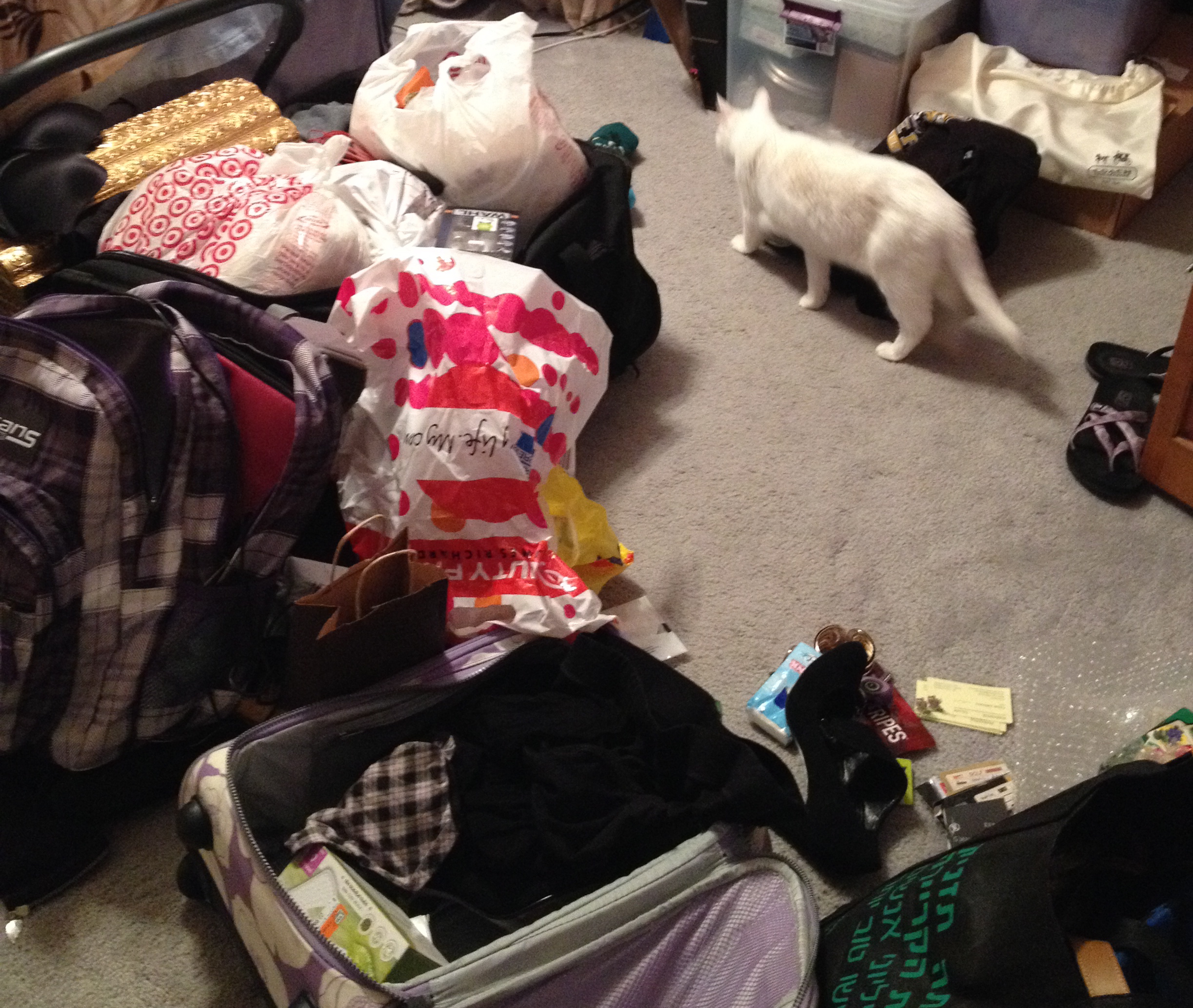
Next was my daughter, she was flying back to Israel. She had come with two, basically empty suitcases, her carryon packed inside the other, larger bag. She was returning with three, all full. I did not have to help her pack. She has my talent for fitting things in, even more so! I just had to judge weight. I am really good at judging the 50-pound limit.

My daughter's room in the middle of the packing mess.

My daughter’s room in the middle of the packing mess.

Then she was off! When she returned to Israel, she was also moving into a new apartment. Some of the items she took back with her were to decorate her new home.

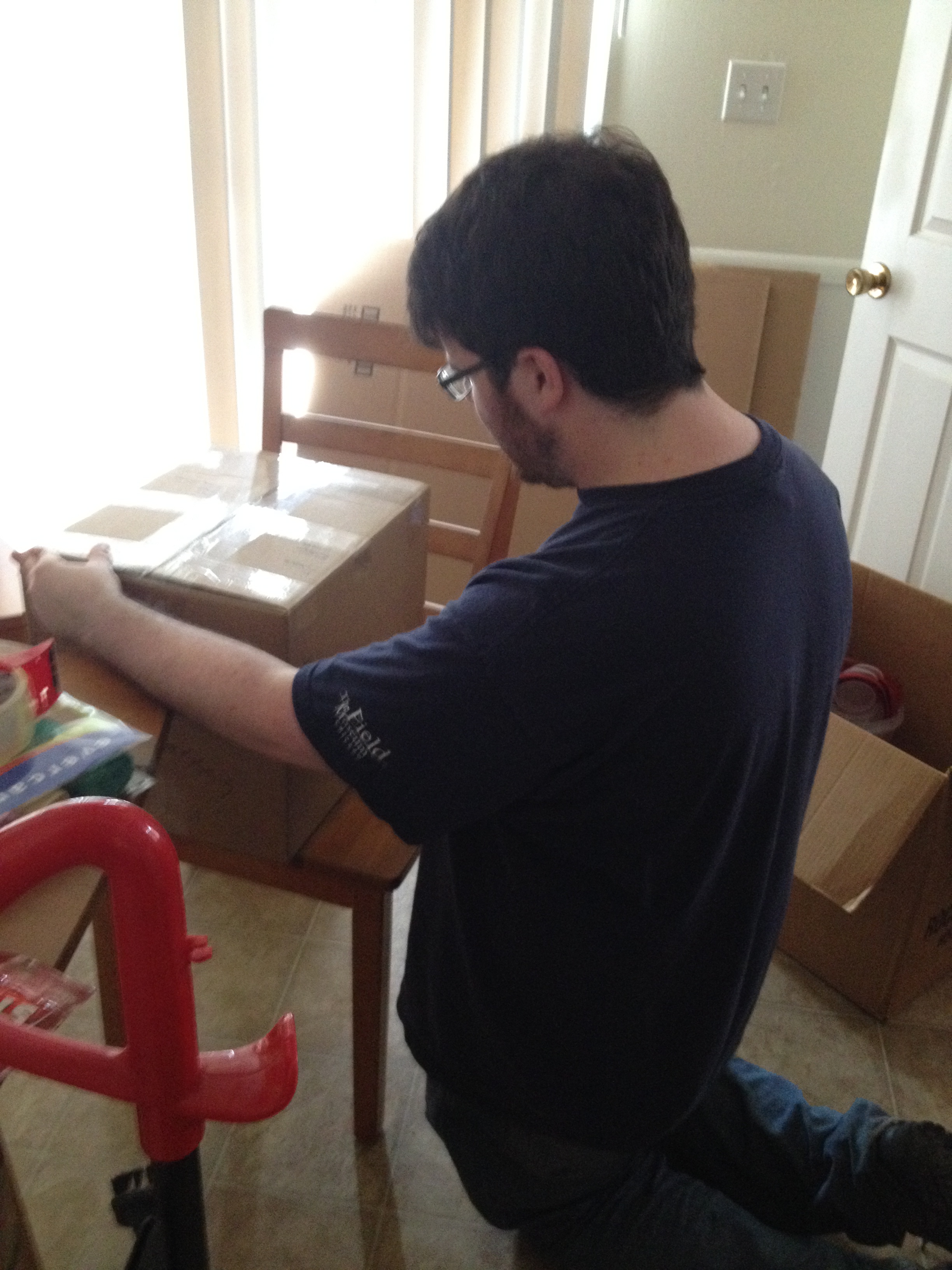
My other nephew called me a few weeks later, on a Thursday. He lived in Lawrence, Kansas, where he earned a master’s degree in math…with honors.   His request, the movers were coming on Monday morning, and he needed help packing. I was glad to assist. My husband and I drove out to his apartment of three years on Sunday.

“Do you have boxes?” I asked. His entire kitchen needed to be packed. He did not. We left my husband at the apartment while we went off to purchase boxes. On the way we had the following conversation:

“I might have to give some of my clothing away,” he stated disappointedly.

“Why?” I asked.

“Well in the three years I have lived here, I have purchased new clothing, and they don’t all fit into my suitcases,” he replied.

I did not laugh out loud. I kept calm and said, “That is why we buy boxes.”

“You can put clothing in boxes?” He asked.

“Yes, I will show you later.”

And we went into the store and purchased boxes, tape and packing supplies. I had bought lots of bubble wrap and newspapers with me, but I needed a few extra items.

My husband put the boxes together as I packed the kitchen. I had four boxes sitting on the floor as I analyzed where to place what items and how to pack most successfully without breakage. I gave my nephew four Tupperware containers to put in a box. He threw them in. “No,” I cried. “Put one inside the other. They take less space.”

“How do you figure out where to put what?” He asked.

At this point my husband looked up from his e-book and spoke out, “Think of it as a mathematical problem. That is what she is doing.”

One nephew taped boxes after I packed them.

One nephew taped boxes after I packed them.

It helped, that is when my nephew saw a little light in understanding on how to pack.

After I finished the kitchen, and we had packed other items, I had one large box left. “Bring me your clothes now.   Keep them on the hangers,” I told my nephew.

“ON the hanger?” He was stunned. “How will you fit them all in the box?

As I folded the clothes in half and put them in the box, I looked up at him. “Bring me more!”

He was elated. “They compress,” he said. And they do. The clothes compress and they all fit in the box.

“This is great,” he exclaimed.   “I can just hang them up in the closet when I get there.”

I was laughing at loud at this point. I even tried to text my sister, but I was laughing too much to send a coherent sentence.

He came and lived with us for a few days before driving to Florida with a friend. He is going to study for his PhD in math.   Before they left, I analytically loaded his car so everything fit including the two young men. Success.  My organizing talents were coming in to good use!

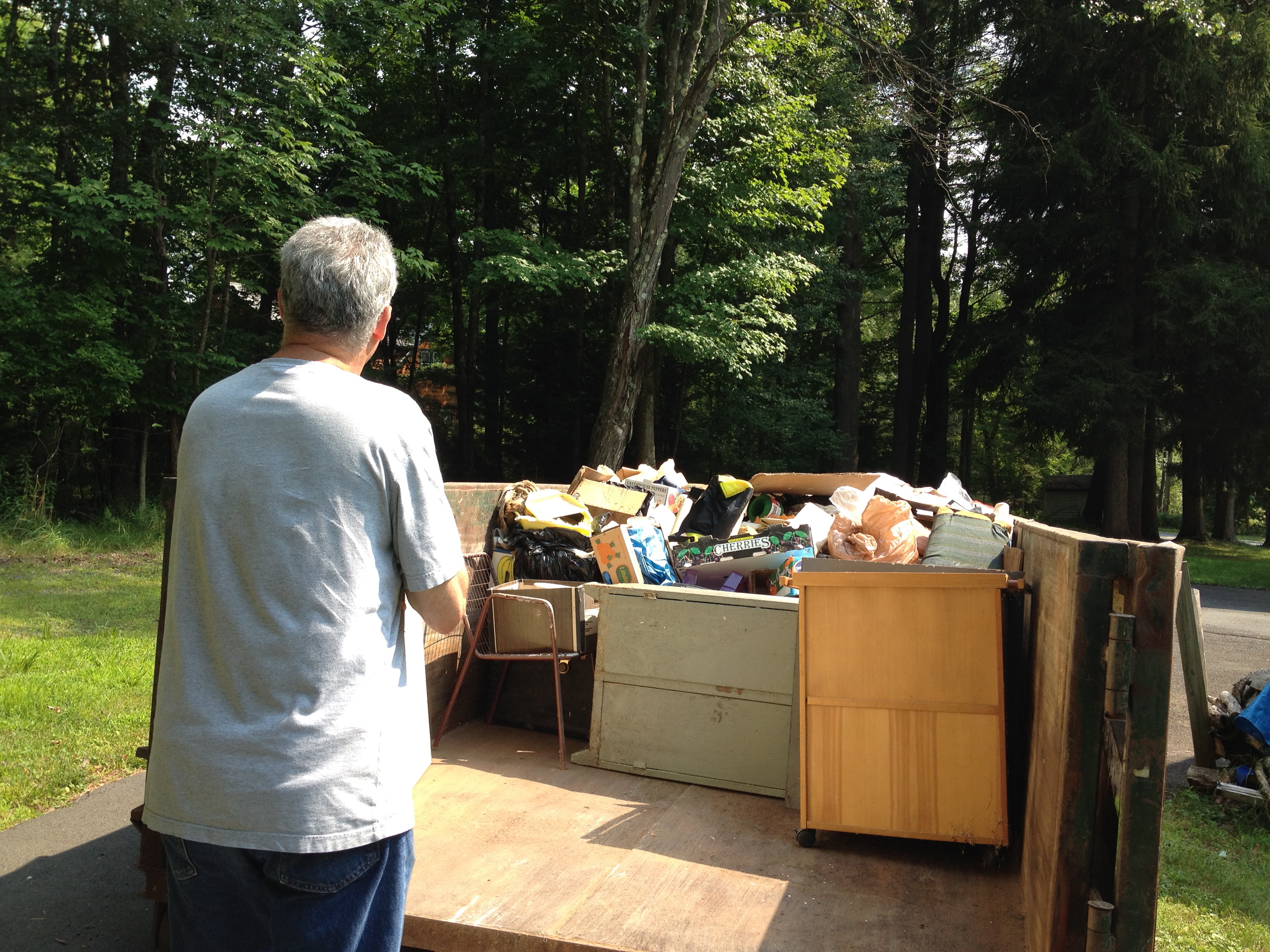
I left a few days after he left to visit my sister in New Jersey for a week. We went up to our Catskills home and met up with our brother. He had ordered a 20-cubic yard dumpster to be delivered. “We cannot leave till this is filled.” He said.

My brother filling the dumpster.

My brother filling the dumpster.

I thought, “No way.” But we filled it!

We emptied out the basement, garage and attic of all the junk accumulated over 52 year. What amazed me is that we had been slowly cleaning this house out for two years, in bits and pieces. But I never imaged we had that much more that needed to be ousted from the bowels and hiding places. Now the house is ready for life again. We will be spending more time up there. And all the junk is gone; the dumpster was filled!  (Do not worry, anything that can be recycled, will be.  The items that could be used were given away!)

I returned home from New Jersey and New York, to my son’s move. He left his small one bedroom apartment to move in with a college friend. This move was a little smoother. He and his girlfriend had been packing while I was gone. And he was just moving across the parking lot to a two-bedroom place.

Setting up the kitchen in my son's apartment.

Setting up the kitchen in my son’s apartment.


My son, three friends and his girlfriend did all the moving. I stayed in the new apartment and put the kitchen together; lined shelves, put away dishes, glassware, utensils and food. Then I loaded books, videos and games into bookcases. I also directed the boys and where to place the furniture. We got it mostly done in about four hours on a Friday. WOW.   His roommate moved in on Sunday. I was exhausted and did not have to help with his move.

Four moves and a house cleansing — sort of like four weddings and a funeral. The moves are all new beginnings for my nephews, son and daughter. Cleaning the house was, in a way, like a funeral. As we cleaned away the items in the attic, basement and garage, we found treasures that brought back wonderful memories. We sat and talked.  My sister, nieces and I shared memories.  My brother said we were doing the harder work, looking at all the memorabilia.

New beginnings for our children and for us as we celebrate a new year with sweetness and joy.

My Family’s Holocaust History Impacts My Observance of Rosh Hashannah

13 Sep

As Rosh Hashannah approaches, I have a new view of my family’s heritage, a new reality that will impact my observance and prayers this year and in all future years.

It started with a Facebook Group called, “Tracing the Tribe.” I actually was able to find a family member due to a blog I posted about my grandfather’s family history and his town in Austia/Galecia called Mielec. I met Susan when I was in New Jersey this summer. It is actually her husband who was related to me.

We spoke about the family and how we might be related. I actually found the connection. My great grandfather and her husband’s great grandmother are probably brother and sister.

She emailed me a testimonial written by her husband’s first cousin, “E”, about her Holocaust experience. “E” survived the Holocaust and settled in the USA. In this memoir, “E” recounts a story about the Jews of Mielec and how they died. She wrote that 600 were rounded up and burned alive in their synagogue. She received this information from relatives in Mielec.

What! I was somewhat stunned. No one had ever mentioned this to me before. Whenever there was discussion about our family who died, we were told that they were burned alive in the fires of the Holocaust; or that some had died in Auschwitz; or that my great grandmother had been hidden and then murdered by the people who had stolen the family farm. But this story was never mentioned. Never.

But I remember thinking, when my Mom would tell me that our family was burned alive, that in the crematorium, the people were dead before they were burned. Weren’t they? So why would I be told that they were burned alive? Could this be what happened?

My Grandfather never talked about his family. He lost almost everyone who still lived in Europe: his parents, siblings, nieces and nephews, aunts and uncles, cousins. Everyone! Only a few cousins survived. When I finally got him to talk to me and tell me about his family, he was vague when talking about the Holocaust. He would tell me a little about life when he was a boy. But he did not like to mention the names of the dead.

When I found out that Germany was giving money to those who could prove they had owned property, I suggested that he apply to get money for the family’s farm.

He was furious. “Will this money bring back my mother and my father?” He yelled at me. “Will this money bring back my brothers and my sisters and their families? NO! NO! I don’t want their blood money! Let them keep their blood money!”

I can still hear him yelling at me. So I stopped. I never asked again.

My mother told me that a relative, Zissle Feuer, came from Europe and told my grandfather what had happened. And then my Grandfather contacted the Red Cross. Everyone was confirmed dead. My mother was about 16 when they found out that everyone died. She said that every morning when my Grandpa came upstairs from the bakery she would hear him cry while sitting at the kitchen table; sobbing over the loss of his family.

Now I read this testimonial. What is the truth? How did they die? “E” was not there. She only heard about it. So I looked through all the papers I had gathered through the years. And I found one document that I guess I never read entirely. I just read the part about the city of Mielec before the war. I never read the section that was call Holocaust Years. Because there it states, halfway down the page, that on September 13, 1939, on the eve of Rosh Hashannah, 20 Jewish were pushed into a burning synagogue. If they tried to escape they were shot. Then the German soldiers put Jews into a slaughterhouse and set it on fire. Then they went to the Mikveh and killed Jews there. On the second day of Rosh Hashannah a second synagogue was set on fire.

So many burned alive on Rosh Hashannah. I do not know if it was 600, but even one is too many. What a horrible death!

How can I ever see Rosh Hashannah in the same way again? How can I understand that on this holiday my family might have been murdered, burned alive. Up until September of 1939 there were 4,000 Jews living in Mielec. When they were deported in March 1942 only 2,000 were still alive.

Did 600 get burned alive in the four buildings set ablaze during Rosh Hashannah of 1939? Did my great aunts, great uncles and cousins suffer in those flames? Did my great grandfather die there? Is this why my Grandfather could never talk about it? Did he know that is how most of his family perished? When my mother said they were burned alive, did she know as well?

Was it just too horrible to tell us?

Mielec, the home of my family, was one of the first to be totally depleted of its Jews. This report said only 200 Jewish people survived the war: 200 out of 4000. I know that four of them were cousins of my grandfather. I met them all: one settled in Montana; one in England; two in Israel. They have all since passed away.

On Rosh Hashannah we chant the Unetanah Tokef.   It is a prayer that has always made an impact on me. But this time when I read “who by water and who by fire,” I will be wondering: “Who died this way? Who?”

And I will chant Kaddish.

A Day Like No Others; We Can Bring Back Light

9 Sep

It was my Dad’s 73rd birthday, ten days after the death of my father-in-law. I planned to call my Dad when I got home from the gym and have a nice long chat with him while my children were in school. But the day did not go as planned.

It was September 11, 2001.

I never made it to the gym, while driving there a special alert came on the radio. A plane had flown into the World Trade Tower. I turned my car around and went home. I grew up in New Jersey. My entire family, except for one cousin, lived in the metropolitan New York City area. So many worked and lived in Manhattan. I was a little scared.

My sister worked near to the Towers, and that was where her subway station was located.   It was about 9:40 am NY time. And I needed to hear her voice.

A photo taken by my father on 9/11.

A photo taken by my father on 9/11.

My first call was to my parents. They were watching the Towers from their apartment window. My father was beside himself. We had watched the Towers be built in NYC from the Jersey side. He loved them. In fact, my daughter thought my Dad owned the Towers, he talked about them so much when we drove to their apartment from Newark Airport.

But now he was watching in horror and fear. I told my Mom to give him a camera. The photo you see here of that day was taken by my Dad from their apartment. He never saw the photos he took. He gave me the unexposed film on the Thanksgiving after the Towers were destroyed. He said, “Here, I did what you asked. But I never want to see it again.”

As for my sister, I did not get to speak to her right away. She was in the City, trying to get home.   And all the cell phones were out since the Towers fell. I spoke briefly to my brother in law. He was beyond upset. His anxiety oozed through the phone lines.

So I sat in my house with a neighbor, another New York area transplant. We watched the news, and over and over again watched the Towers fall. We were united in fear, until we heard that both of our sisters were safe.

Then I called the high school where my daughter was a sophomore. “Are they watching this?” I asked the school secretary. “It is on in every classroom,” she told me.

“Then I need to get a note to my daughter. Can I do that today?” I asked. “Tell her that my sister is alive, she is fine.”

“I will send the note right away,” the secretary said.

It wasn’t till 11 that evening that my Dad called to say everyone in my family was accounted for and safe. Not all families had such good news.

A piece of metal from the World Trade Towers in Overland Park, Kansas.

A piece of metal from the World Trade Towers in Overland Park, Kansas.

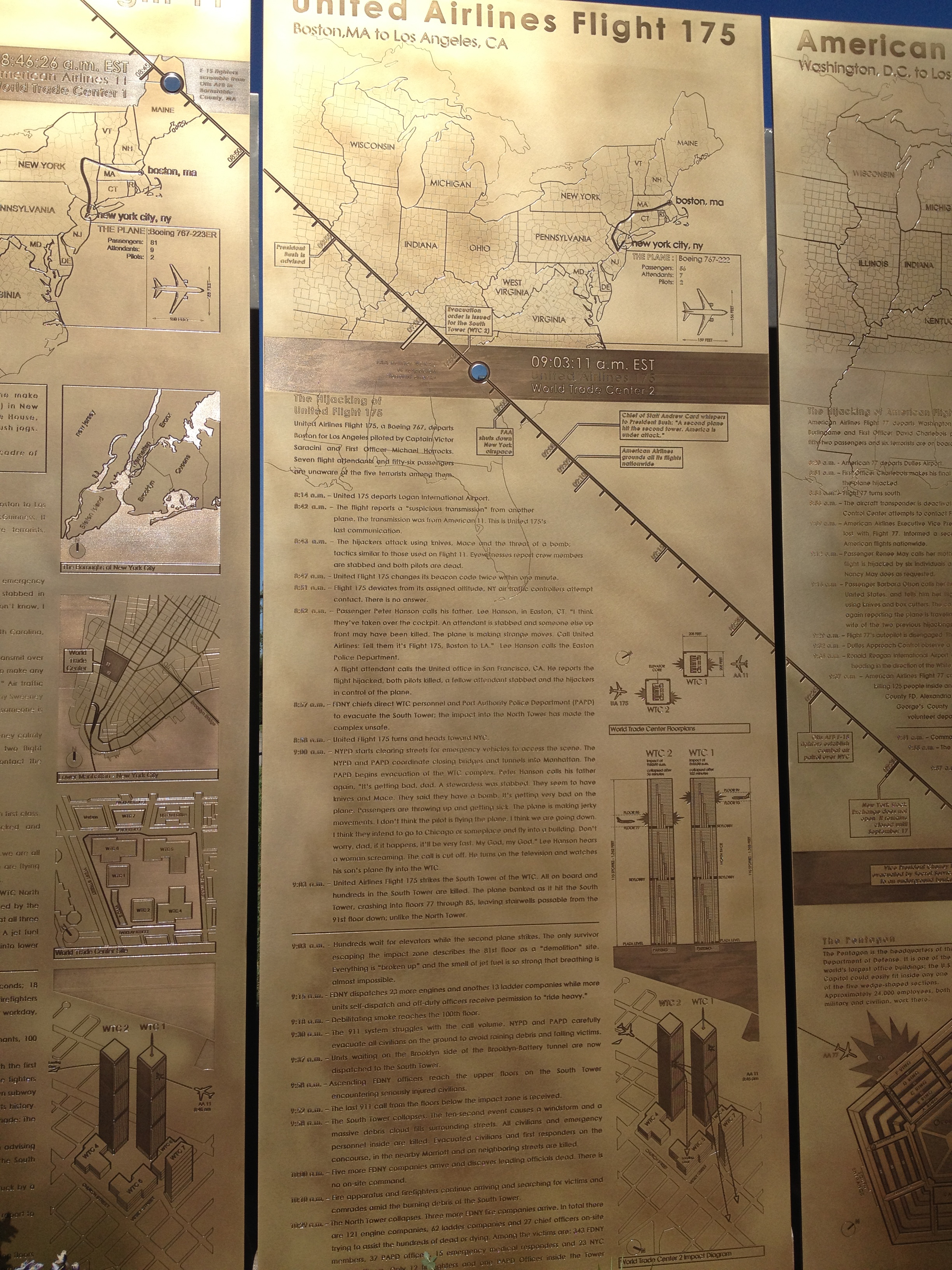
In Overland Park we have a 9/11 memorial. It has a piece of a steel beam from the towers that were destroyed. Since it opened two years ago, I go on September 11 and sit there for a while and think about my Dad and the changes in NYC and in the USA since the attacks.

The 9/11 Memorial in Kansas tells the story.

The 9/11 Memorial in Kansas tells the story.

They have a ceremony there on September 11. I do not go for that. I wait till everyone is gone. Then I sit and think. I remember my Dad and his love of the Twin Towers, and I think about the changes in the world since the horrid events that day.

This past summer, when I made my annual visit to New Jersey and New York, I went back to the site of the towers. We have many good memories concerning the site, including eating dinner at the Windows on the World restaurant the night before my sister got married.

The imprint of one of the towers.  A fountain of tears.

The imprint of one of the towers. A fountain of tears.

But as I looked into the giant fountains of tears, the footprints of the towers, as I read the names of those who perished, as I saw the beautiful white roses left in the names of victims, I was hushed like all the others who were there.

I did go into the Memorial Museum. I went by myself. It was a mistake. I really think you need to go with someone to be able to share the sorrow. And parents, do not take young children behind the glass doors into the area that advises you not to take children in. No child needs to listen to the voices of those who no longer live or to see the videos of people falling. It was almost too much for me to bear. I did not linger in that area.

As you go down, down, down into the bowels of the ground between the footprints of the towers, you can only imagine the fear of those who were there that day.

It was a day like no other, leading to a world that had changed in a flash of fire. September 11 will never just be another day.

While I add September 11 to days I will never forget, and I think of all those who perished, I also know that we need to stand united.

There are people in the world who are filled with hatred. But I do not believe we should bend to their will. We remember what happen, but we also reach forward to life.

As Anne Frank stated, ““Look at how a single candle can both defy and define the darkness.”

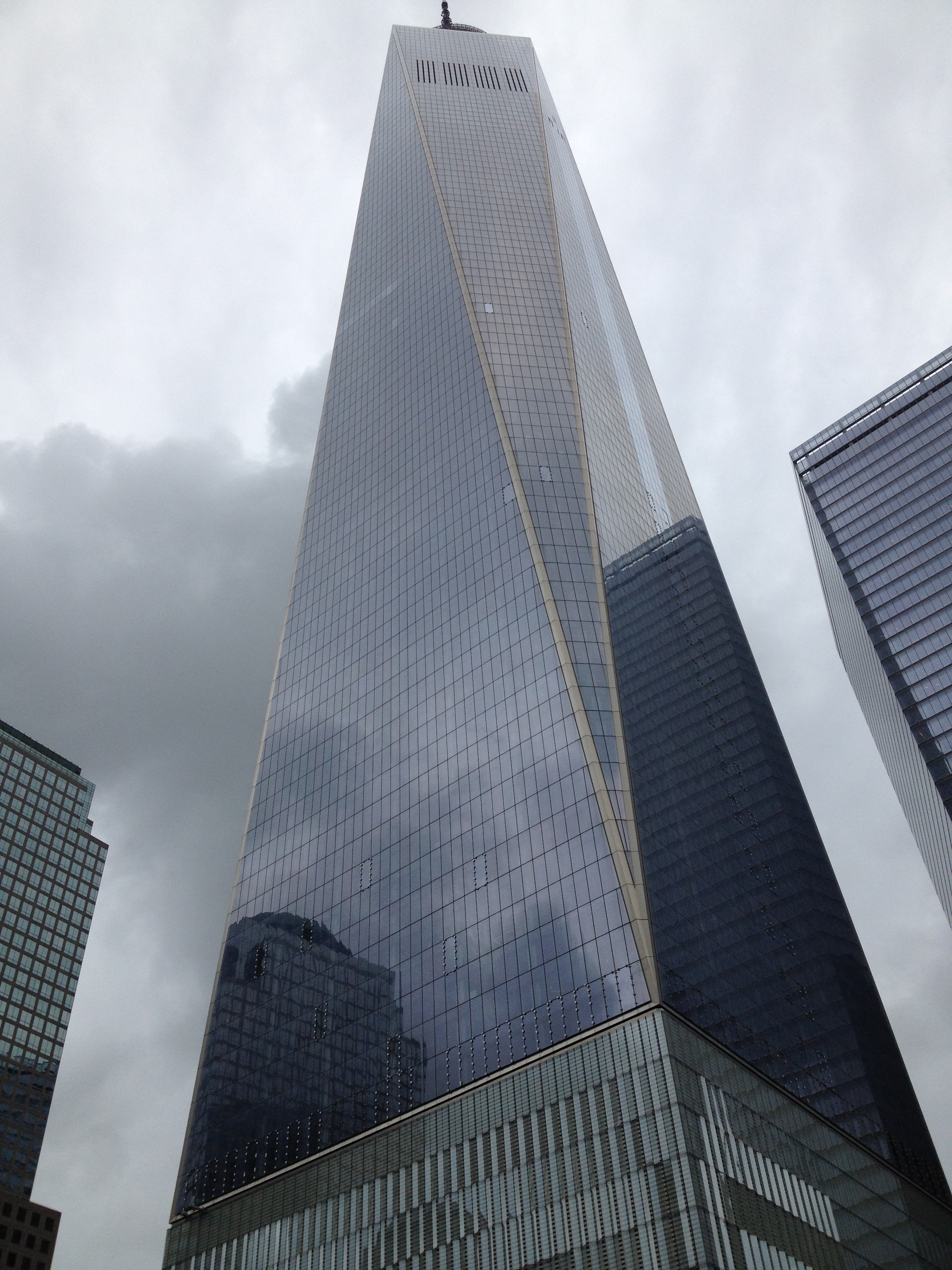
Freedom Tower

We must, in memories of the Towers and those who perished, be candles defying darkness. As the new Freedom Tower nears completion, we know that we can bring back light.

Sharing Yiddish and Superstitions in Kansas

8 Sep

One of the most difficult adjustments I made when I moved to Kansas is to stop speaking Yiddish. In New York and New Jersey it seems even those who are not Jewish know the most important Jewish words: schlep, gonif, meshuganah, punim, shayna, tottale, madelah, gor nish, keppi, kibbitz, yenta, mishpocha and more!

I never had a problem slipping in a work of Yiddish when I was talking with friends. But then I moved to the Midwest. And I realized that even Jewish people here did not speak Yiddish. Not even the English/Yiddish I spoke.

The little bit of Yiddish I spoke to my own children was about all I heard most of the time, except when I made my yearly journey back East to visit family.

So when I discovered someone with my knowledge base I was thrilled. It was actually someone I knew for years, but we just did not speak about our childhoods and our American/European Yiddish upbringings.

We not only had the Yiddish in common, we had the superstitions.

One of the early indications that she and I spoke the same language had to do with a bindle. That red thread you wear to keep the evil eye, the ayin hora, away. We discussed bindles an entire evening. I told her about the red bindles I had placed on my children’s cribs. I told her that when I was pregnant with my first child, the only thing my Grandfather asked me to do was to put a bindle on the crib. And so I did. I also put one on the highchair, the car seat and playpen.

To this day I have bindles on our cars. There are the bindles I put on each of the kitchen chairs. One of my friends, who heard the conversation, said, “I thought those ribbons were for the cats to play with. “ Nope, there were all red. Whenever we get a gift with red ribbon, it goes somewhere in the house to act as a bindle. I figure if someone gave me a gift, the red ribbon has positive energy.

My friend made her son wear a bindle when his wife was pregnant. I carried a bindle when my husband had surgery. It doesn’t hurt! And I believe it helps. And for extra good fortune or ‘mazel,’ I tied 18 knots in to the red yarn, as did my friend’s son!

I told her that the one on my son’s car had fallen off, and I had not put a new one on yet. She encouraged me to do it soon. And I did. A few weeks later he had a tire problem. It started on the highway, but did not get bad till he got home. The bindle worked! So I am keeping it there.

But do not worry, even when his car did not have a bindle, my son’s car did have 18 cents to keep it safe. Now it is just double safe.

Which brings me to money in cars. Last summer my husband and I sold two of our cars to neighbors. Each car had multiples of 18 cents in them. In Hebrew the word for life are the two letters that add up to the number 18, so multiples of 18 are considered lucky. When we sold the cars, I left the money in the glove compartments. The boy next door brought me back all the things he found in my car that I did not get out before he took it, including the money. I gave the money back. I have known him since he was three years old. I want him safe as well.

The other neighbor, who bought my other car, I exchanged the ‘gelt’ (money). My parents had given me the 36 cents in that car. And since they are no longer alive, I wanted to keep their coins. I gave my friend an equal amount to keep in her car. My two non-Jewish, Kansas neighbors are happily driving around with good luck money in their cars!

Yes, we are a little superstitious in our Yiddish beliefs. But they are important!

Which is obvious about our next Yiddish/European Jewish belief. One day, at a holiday meal, my friend asked me, in front of her son, “What did your Mom do when you got your period for the first time?” My answer, “It wasn’t my Mom, it was my grandma and she slapped my face.”

”I knew you would know!” She exclaimed. “I knew it.” She then told me her somewhat sad story. I will not repeat it because it is her story. But I will say, I felt badly for her when I heard what happened.

Our conversation went downhill for her son. He left. Even though he is a doctor, he just did not want to listen to this discussion. But my friend and I had a great time talking superstitions and Yiddish.

Of course she grew up in New York and spent her summers in the Catskills. I grew up in New Jersey and spent my summers in the Catskills. We cannot help but share many experiences about growing up that people who grew up in Kansas and Missouri just do not understand.

We can spend hours talking about our childhoods. And we have! Our discussions bring back so many happy memories.

I think we need to spend a day speaking about Yiddish expressions. My grandparents would say, “Hock mir nicht ein Chinok,” to mean stop bothering me.   It really means ‘don’t bang the tea kettle,’ but it makes sense. My favorite was “Ge Loch in kupf in Vald.” I might not be spelling it correctly. But it means go bang your head against the wall. That was their favorite saying when we said we were bored.

As my children in their 20s and are dating now, I remember my grandfather telling me that there is a “‘lid for every pot.” And I say “From Your Mouth to God’s Ears,” to a friend who has just made a prediction that I would like to happen, when I want something good to happen.

The Jewish superstitions, Yiddish sayings and language will always be with me, wherever I live. But it is nice to have someone to share Yiddish and superstitions in Kansas.