Tag Archives: Izabela Sekulska

The Tavern in Trzciana Comes To Life

29 Jul

I vividly remember when the movie version of “Fiddler on The Roof” was released.  It was the first Broadway show I had seen in person as a child.  So seeing it again in the movie theater reminded me of the special trip into New York City with my parents and the delight I felt while listening to the songs and learning about Anatevka.  One of my favorite scenes occurs in a tavern where the Polish and the Jewish citizens end up in riotous dance!

The tavern scene has so much more meaning to me now.  I was with my maternal grandfather the first time he saw the movie.  Grandpa was from a small town in Austria/Poland called Trzciana.  When he watched the tavern scene, he turned to me and said, “My family had a tavern just like that.  It looked just like that.”  Anatevka/Tzrciana taverns were interchangeable in my grandfather’s eyes. He said the movie brought back memories of his childhood.

Grandpa did not often speak freely about his family.  Stories came in bits and pieces of memories.  But it was not something you asked about.  It was something that he had to offer because Grandpa’s family all perished in the Shoah.  His parents, his siblings, his aunts and uncles, his cousins, everyone who was in Europe died, except for three.  (See blogs below.)

But that tavern memory has so much more meaning because now I know more about it thanks to the research of Izabela Sekulska who started the Mayn Shtetele Mielec Facebook group.   Izabela has been helping me find out information about my family for about a year now. The documents she finds make the stories I was told by Grandpa come to life.

Izabela recently found a document from the Chamber of Commerce and Industry that  brings the family tavern to life.
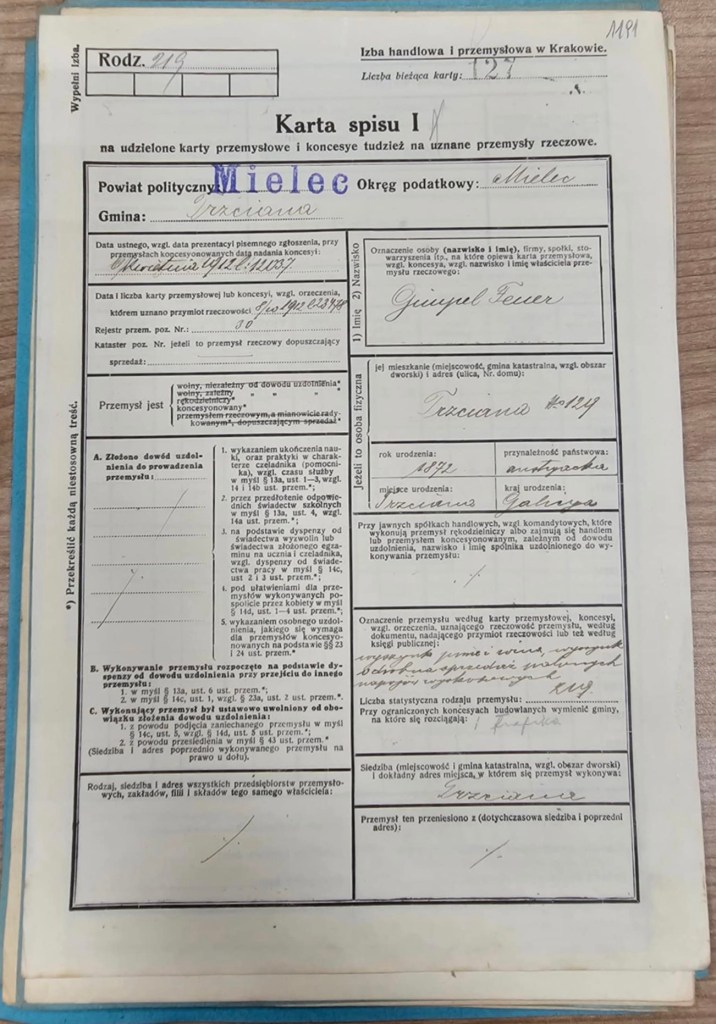
My great grandfather Gimple Feuer applied to open a tavern on April 10, 1912, when my grandfather was just over 12 years old.  My Grandpa did grow up with a tavern in his life.  This document from the Chamber of Commerce and Industry states that the location was in Trzciana, Galicia, which was then part of Austria as Poland.  Throughout his life Grandpa said he was Austrian as that part of Galicia became part of Poland after the war. 

At my family’s tavern they sold beer, wine, other alcoholic beverages and tobacco according to this document.  I knew my great grandfather had a farm that included a crop of  grains and grain silos to store the grain.  So having a tavern makes sense, he had the grain to brew the beer.

Grandpa told us stories about cleaning out grain silos and how one time he and his cousin became intoxicated on the fumes from the silo.  They actually became sick and ran to a nearby stream/creek to drink the water and wash the fumes away. He said they almost drowned, they were so drunk.  
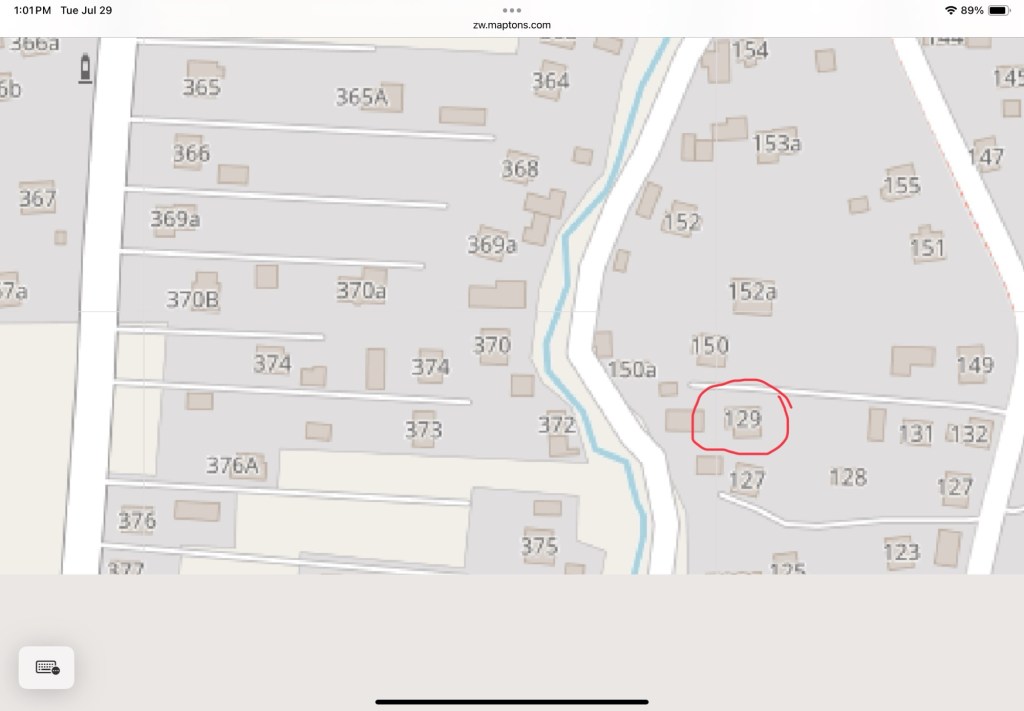
As I remembered this story, I  looked for  a map of current day Trzciana online and saw where the Cichawka stream goes through the town.

Thanks to Izabela, I know that there were no street names in Tzrciana, the homes and buildings  were just numbered during the time my grandfather lived there..  And the number of the tavern was 129.   

On the map that  I found online all the buildings are numbered.  There is one numbered 129 close to the creek. Could this be when my great grandfather had his tavern?  I am not sure, but it perhaps the numbers remain the same. 

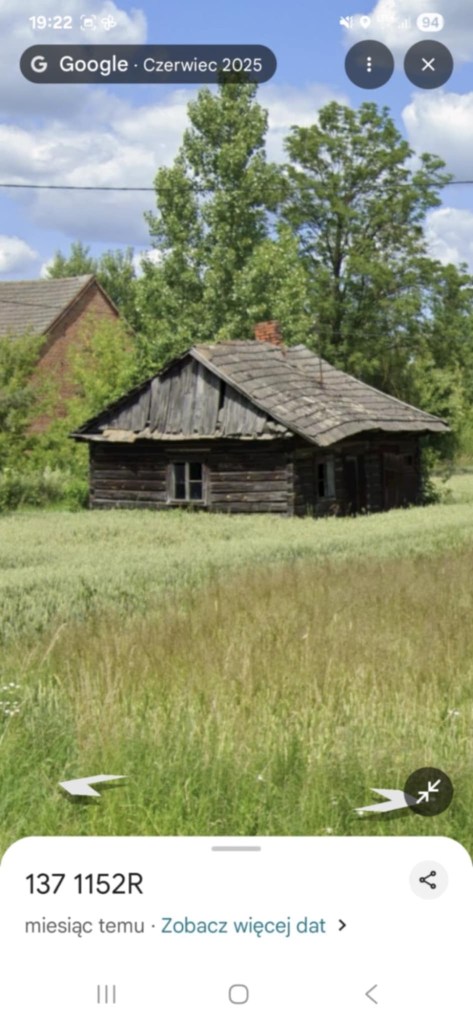
Now there are addresses and streets. So perhaps with this information we can one day find out exactly where the tavern was located in the town. Perhaps this address is where the family lived, and the tavern was located on their farmland?   

Izabela has asked for help in finding out where this location is now in Trzciana in the Facebook group.  That would make this amazing find so much more amazing.  And it might be that the number 129 is in the same place. And the numbers around it are the places where the other members of my family lived before the war.

Knowing my great grandparents had a tavern, perhaps explains to me why there was actually a trial after the war concerning the murder of my great grandmother during the Shoah.  Perhaps their standing in the community created lasting friendships that existed after the war and lead to people actually testifying about her death. (See blog below.)

No matter what I find about where the tavern actually stood in Trzciana, I do know that from now on whenever I see the story of Anatevka and see the tavern scene, I will think of my grandfather and his family that perished, but I will also remember how they lived.

 

Renewing A Family Connection: My Mother’s Day Gift

Zissel and Shalom: Survivors and Heroes

11 Jun

This is the most important blog I will write about my distant cousins Shalom Hollander and  (Lieb) Zissel Feuer.  They are true Jewish heroes. They did not give up. They lived through the Shoah and they helped those who also survived.  And I feel so honored to know that I am part of their family. I know that I just wrote about my renewed contact with their family, but I believe I need to just put it all in one place!

I have mentioned in other blogs that I met Zissel and Shalom when I was 19//20 years old studying at Hebrew University in 1974-75.  When I met them, I knew about the Shoah, but I also knew it was not something you asked about. If someone told you something you listened, but you did not interrupt.  You kept quiet.  The 1970s they were only just beginning to open up about what happened to them.

To me Zissel was someone my grandparents wanted me to meet.  Grandma had known him in 1931/32 when she took my mother and uncle to Europe.  Zissel stole a pearl necklace from her. And now over 40 years later, he wanted to make amends.  I was sent to collect the money and to listen to his story.  I liked Zissel. He reminded me of my grandfather. He worked in a bakery, my grandfather owned a bakery.  So from that point forward whenever I went to Tel Aviv, I visited Zissel.    I did not ask questions about his past.

Shalom I only met once. When my grandmother and I traveled to Israel in January 1976, we met up with Shalom in Haifa.  He and grandmother spent two hours speaking in Yiddish about what had happened in the war. About everyone who died.  

Ziseel and Shalom had been married to sisters, my grandfather’s first cousins. They and all the rest of the family was murdered. (Except one of the sisters’ brothers and those who had already left .) Some were buried in mass graves; some died in concentration camps; some died in a ghetto; some died in the death camp Belzec.  Shalom was saved by Schindler.  Zissel survived hiding in the forest nearby as part of the Amsterdam group, a partisan group all members of my family who hoped to survive in the forest.

After the war they both returned to Mielec to find other survivors.  They lived together in a house in town.  Thanks to Izabela Sekulska of Mayn Shtetele Mielec,  I now know what they did there.  They saved lives.  They testified against evil.  They worked to keep the memory of the dead alive.

First they saved lives.  Izabella told me that people were angry at Zissel. They said he lied and took money.  Well maybe he did. I have a different view.  The land of the Jews was now empty. The Jews were not coming back, or very few. Out of 5000 about 200 returned.  Zissel became the head of the Jewish community of Mielec.  Shalom was his deputy.  They did not just let the Poles take the land that had belong to the Jews. They told them that the survivors who came back, those who had lived through hell, had owned those lands. And they made the Polish people who wanted the lands to pay the Jews.  It makes sense to me.  They had nothing. No Home. No clothes. No family. NOTHING.  At least they could get some money to start a new life.  And they did.

Second thing they did. They testified.  They testified FOR the people who had helped the Jews. But they also Testified AGAINST many who had murdered the Jews. Including my great grandmother, who was also their aunt by marriage.  They wrote out testimonies and they signed their names to them.

Third thing they did. They protected the site of a mass burial. The spot where the Germans killed 800 Jews on March 9, 1942, Shalom purchased the land and put up a monument to his parents who are among those who are buried there, probably along with my great aunts and uncle.  They also built a wall around the Jewish cemetery.

Fourth, they helped an orphan Jewish girl who had been hidden and kept by a Polish woman during the war.  Shalom remarried after the war to another survivor of the Shoah. They adopted the girl and brought her to Israel with them when they left Poland. They went on to have three more children.

Fifth.  Shalom wrote testimonies for almost 40 people to be kept at Yad vShem, including for my great grandparents and my great uncle.  As well as his wife, children, parents, in laws, and Zissel’s wife.

Sixth.  Zissel came to America to see his brother in the early 1950s.  He visited my grandparents and told my grandfather how his family died.  My grandmother called him the Angel of Death, because he brought this horrific news into our family.

Seventh.  They survived.  They helped to settle the new Israel.  They worked. They remained close.  Shalom had a new family, new wife, children and grandchildren.  Zissel never remarried, but he also had a life and a relationship with Shalom’s children.

I am honored that I knew them.  I wish I had been braver and asked questions.  I wish had written down what they did tell me.  I wish I was not so timid then. But I am glad that I can close my eyes and still see them. Especially Zissel, who I spent so much time with 50 years ago.

I hope to keep their names and memories a blessing for my family.

There are many blogs about both Zissel and Shalom. You can find them on my blog site.

A Small Beacon of Hope On Yom HaShoah

27 Apr

My husband loves to assign movies to holidays that impact us.  For Fourth of July, we watched 1776; for Ground Hogs Day, we watch Ground Hogs Day; for Israel Independence, we watch Exodus; and for Yom HaShoah, we watch Schindler’s List.

I have known for several years now that one of my grandfather’s cousins, one of the very few who survived the Shoah, was on Schindler’s List and survived as a member of his work force.  It made me think of this movie in a different light, because now one of those working and surviving was someone I once knew. 

But this year, my view of the movie will change even more.  For the first time, I now know that my grandfather’s cousin, Shalom, was one of the people who served as a pallbearer for Oscar Schindler at his funeral.  And for the first time, I have found out that my distant cousin was one of at least 10 people from his community who were saved by Schindler.

(Many thanks to Izabela Sekulska and Mayn Shtetele Mielec for discovering this information.)

I had to wonder, did they know each other?  There were about 5,000 Jewish souls who lived in the area of Mielec.  Only 100-200 survived.  Once they became part of the Schindler work force, of course they new each other. But did they work together to survive?  Did they become part of this unusual group together?

I know of one other story like Schindler’s list. My good friend’s mother and grandmother survived the Shoah with about 100 other women who worked making clothes and shoes for the German army.  The man who ran this factory saved them several times.  Once keeping them at the factory even over night when there was typhus disease raging through the camp.  A second time he actually went to the camp and getting his workers out from a transport to a death camp, saying he did not want to train new workers.  

Did he do this because he was emotionally attached to his workers?  Did he really work to save them?  We will never know. But my friend’s mother and grandmother survived. I knew them as well.  Their story can be found at the San Antonio’s Holocaust Memorial Museum. 

So on this Yom HaShoah, I will have a small beacon of light thinking about my grandfather’s cousin, Shalom; my girlfriend’s mother, Anna, who were saved by their work in a factory.  And I will have hope because people like Izabela in today’s Poland work to keep the Jewish cemeteries in good order and to find out what happened to the Jewish people who disappeared over 80 years ago.