Tag Archives: grandparents

Sweet Remembrances of Rosh HaShanah in Kauneonga Lake

20 Sep

From the time I was seven or eight we spent every Rosh HaShanah in Kauneonga Lake, Sullivan County, NY. Unlike most people who left their summer bungalows to return to the ‘City’ on Labor Day weekend and did not return until the next summer, we always came back to celebrate the holiday.

My grandparents owned a small bungalow colony in Kauneonga Lake. This meant that after the season ended, the bungalows had to be closed for the winter. Water drained; windows covered; everything locked up. My Mom and Dad would help my grandparents perform many of these chores. And when we got older, my siblings and I would also help out.

Since my grandparents owned a ‘real’ house in Kauneonga Lake, we always had a place to stay. The house was sub-divided into four apartments by the woman who owned it before my grandparents. After they purchased it in 1962, my grandparents returned it into one home, with four bedrooms, and lots of spaces to sleep. There was also an attached apartment that they remodeled.

Over the years the house has seen many additions and upgrades. But the most important part was that it had heat and was livable all year. So for Rosh HaShanah, the five of us always went to stay with my grandparents to celebrate the holiday and the start of a sweet and wonderful year.

Our home was located about a mile and a half from the synagogue, Congregation Temple Beth El. This meant no heels for my Mom or Grandma. It was a long walk in a dress and nice shoes. We had to make our new finery stay in good shape as we walked. Along the way we often met up with others who were going to shul.

When the holidays were close to Labor Day, there were many more who stayed to celebrate. Some even kept their boats on the Lake for the extra weekend. It could be very warm when it was early in September, but sometimes, later in the month, it could be extremely cold on Rosh HaShanah.

Going to shul was a treat and fun. Everyone knew my grandparents and, of course, us. The shul was full. Men sat downstairs; women sat upstairs in the balcony, except for the few elderly women who sat in the two rows of seats behind the mehitzah on the first floor.  (See blog below for more about Beth El.)

I liked it when I was very young and could sit with my grandfather in the main floor, and he would cover me with his tallit. But eventually, that ended. My Mom, sister and I would climb the narrow staircase, and sit with the other women.
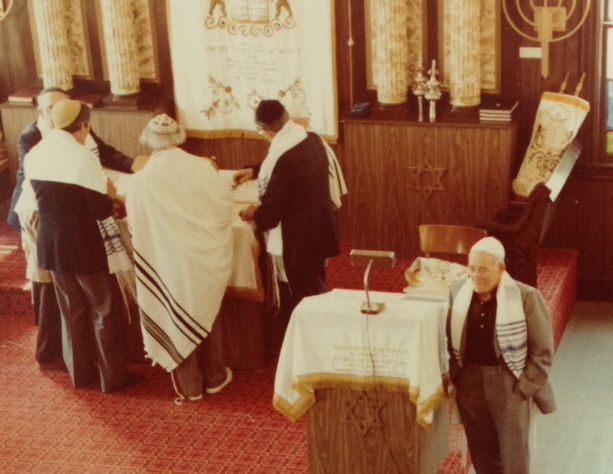
My Cousin took this photo from the women's balcony, at least 26 years ago. My Grandfather is standing on the right, walking away from the bima. My Cousin took this photo from the women’s balcony, at least 26 years ago. My Grandfather is standing on the right, walking away from the bima.

It was different in the balcony. We could see everything that was going on down below. We watched the men with the torah and listened to the chanting. I loved to watch when the Cohanim went forward to do the dukhanen, my grandfather among them. While upstairs, we did pray, but we could also chat and visit. As I got older, I began to resent being upstairs. But it was I tradition I was so used to that I never argued.

We went both days of the holiday and stayed till about 1 pm. Then would come the long walk back to the house after the Kiddish. I could not wait to get home. There was always fresh raisin challah baked by my grandfather. I loved eating the raisin challah for breakfast schmeared with cream cheese. YUM!

For lunch there always was warm soup made by my grandmother. Grandma was not a great cook, but her soup was wonderful: chicken soup, with delicious chicken feet filled with fat immersed in the brew. And if it was mushroom barley soup there were always knee bones to thicken the broth.

Grandma and I were the ones who loved to nibble around these items!

My Grandma made the best homemade egg noodles as well. She would put towels on all the chairs and hang the cooked noodles on them to dry. These were usually for Pesach, but I begged her to make them for Rosh Hashanah as well. I loved making them with her.

When I became a teen, and my friends were up for the holidays, the routine changed.   We often walked to shul together. One stayed at the Indian Lake House for Rosh HaShanah. Her family rented a bungalow from my grandparents, but by the holiday the bungalows were all closed for the season. So her family rented rooms at this bed and breakfast on West Shore Road. The other’s grandmother lived on West Shore Road, and his parents had a home in the White Lake Estates. We would visit on the terrace of the synagogue before services.

After services and after lunch with our families, we would meet. If it was early in September, the one friend always had his family’s boat for us to go out on. We would bring our homework, and take a boat ride to Camp Hi Li’s raft. We would sit on the platform raft doing our homework on the lake. What a great place to study!

As my grandparents aged, they could no longer walk all the way to the synagogue, so my Grandpa would drive most of the way. He would park his car across from Sylvia’s S & G, ‘shlock’ store. I remember saying, “Grandpa, why don’t you just park at the shul? It is just over the hill!”

He looked at my like I was crazy. “You walk to shul on the holidays!” He said. He was from Europe. And traditions were very important. Grandpa was a Cohan. He had rules that he had to follow and obligations that he had to keep.

When I was very young, there was a deli, Elfenbaum’s, almost directly across from the synagogue. We would stock up on special treats there. It closed when I was about 10. I still miss that deli. I remember going there on Sunday mornings with my Dad during the summer and then right before Rosh HaShanah to have delicacies for the holiday.

We usually spent Yom Kippur at our synagogue in New Jersey, unless the holiday was very early in September and on a weekend.   Then we would go back to the Catskills. But Yom Kippur was much more strict. Although, we, the children, were allowed to eat, I always felt the sadness of this holiday more when I was with my grandparents. Of course, when we were older and fasting, that walk back home seem to take forever!

But still I loved going to the shul on the hill. We loved sitting outside on the terrace before services began, or coming outside to take a break when it got too hot upstairs.

I see myself standing in the balcony. And as I am leaving the synagogue, as it empties, I call down to a friend. It is only the two us left. Every one else is out.   Rosh HaShanah is over.   “See you next summer. Next year in Kauneonga Lake.”

Our Shul in the Catskills


Sometimes Rainy Days Were the Best Days In the Catskills

17 Sep

There is something special about a rainy day.

Perhaps it is my memories of summer time respites. On rainy days we were not expected to run around outside, we could stay in and read a book. I still love reading a book on a rainy day! It brings me such joy.

My friend and I were diehard Nancy Drew readers one summer. I remember wonderful rainy day afternoons lying on her bed near the window with our Nancy Drew books. We wanted to read every single one! I think we got close to accomplishing our goal.

Other days we worked on art projects. She wanted to be a dress designer and was always making paper doll dresses. Designing her own special dresses to fit the paper dolls we had. Hundreds of dresses were produced on the kitchen table during summer rains. And yes, she did study fashion design in college!

But for me the love was reading. I love murder mysteries and I am sure that this love started on those rainy summer days. I loved when our fathers came up on the weekends, especially if they brought along another yellowed-spine Nancy Drew book. However, I was not that picky, I read my brother’s Hardy Boy mystery books as well.

On those miserably cold rainy days that occurred in the 1960s in the Catskills, my grandfather would bake. That was a joy. The smell of fresh bread and cookies in the house was wonderful. He had an entire bakery shop set up in his basement, the remains of his bakery, which he had sold in the early 1960s. The giant mixer, the pans, the cooling shelves were all there. We would help him braid challah and shape cookies. Then we would run up and down the stairs with the pans for my Grandma and Mom to put into the oven. Sometimes we had three ovens going: in the house, in the bungalow and in the apartment where my friend stayed. It was a great rainy day event, especially since we knew we were going to have treats to eat!

My Mom did not always like rainy days, especially if there were clothes hanging on the line. We had no dryer then!   When the rain started we often ran as fast as we could to get the items off the line and hang them around the bungalow. This was especially important in summers when there was a lot of rain. We sometimes would run out of dry clothing.

One summer we actually did run out of clothes. I remember my Mom telling my brother to stay out of the lake! My brother was known for ‘falling’ in the lake. (Although one of my cousins admits helping my brother ‘fall in’ a few times.) Well you can imagine what happened. He was in the lake with his last dry pants. I do not really remember what happened. But I think he had to stay in the bungalow for a day or two in pajamas!

It was on rainy days that I learned to knit and crochet. I would sit with my Mom and Grandmas and all the other women knitting away in someone’s bungalow while having tea. While they knit sweaters, I and the other younger ‘girls’ had easier projects to work on. Those sweaters lasted forever. There are still some in the family.

Mahjong, gin rummy and canasta were important rainy day events for the Moms and Grandmas. While we played our board games, sitting on the floor; they played their games at the kitchen table. As soon as my sister and I were old enough, we were introduced to the importance of Mahjong.

It is true that on sunny days we were outside riding our bicycles, swimming, picking blueberries, running around, playing on the swings, and just having adventures. But sometimes a rainy day was really the best day in the Catskills. It gave us a chance to recharge and relax. Actually, I guess every day in the Catskills was truly the best day ever.

My Family’s Holocaust History Impacts My Observance of Rosh Hashannah

13 Sep

As Rosh Hashannah approaches, I have a new view of my family’s heritage, a new reality that will impact my observance and prayers this year and in all future years.

It started with a Facebook Group called, “Tracing the Tribe.” I actually was able to find a family member due to a blog I posted about my grandfather’s family history and his town in Austia/Galecia called Mielec. I met Susan when I was in New Jersey this summer. It is actually her husband who was related to me.

We spoke about the family and how we might be related. I actually found the connection. My great grandfather and her husband’s great grandmother are probably brother and sister.

She emailed me a testimonial written by her husband’s first cousin, “E”, about her Holocaust experience. “E” survived the Holocaust and settled in the USA. In this memoir, “E” recounts a story about the Jews of Mielec and how they died. She wrote that 600 were rounded up and burned alive in their synagogue. She received this information from relatives in Mielec.

What! I was somewhat stunned. No one had ever mentioned this to me before. Whenever there was discussion about our family who died, we were told that they were burned alive in the fires of the Holocaust; or that some had died in Auschwitz; or that my great grandmother had been hidden and then murdered by the people who had stolen the family farm. But this story was never mentioned. Never.

But I remember thinking, when my Mom would tell me that our family was burned alive, that in the crematorium, the people were dead before they were burned. Weren’t they? So why would I be told that they were burned alive? Could this be what happened?

My Grandfather never talked about his family. He lost almost everyone who still lived in Europe: his parents, siblings, nieces and nephews, aunts and uncles, cousins. Everyone! Only a few cousins survived. When I finally got him to talk to me and tell me about his family, he was vague when talking about the Holocaust. He would tell me a little about life when he was a boy. But he did not like to mention the names of the dead.

When I found out that Germany was giving money to those who could prove they had owned property, I suggested that he apply to get money for the family’s farm.

He was furious. “Will this money bring back my mother and my father?” He yelled at me. “Will this money bring back my brothers and my sisters and their families? NO! NO! I don’t want their blood money! Let them keep their blood money!”

I can still hear him yelling at me. So I stopped. I never asked again.

My mother told me that a relative, Zissle Feuer, came from Europe and told my grandfather what had happened. And then my Grandfather contacted the Red Cross. Everyone was confirmed dead. My mother was about 16 when they found out that everyone died. She said that every morning when my Grandpa came upstairs from the bakery she would hear him cry while sitting at the kitchen table; sobbing over the loss of his family.

Now I read this testimonial. What is the truth? How did they die? “E” was not there. She only heard about it. So I looked through all the papers I had gathered through the years. And I found one document that I guess I never read entirely. I just read the part about the city of Mielec before the war. I never read the section that was call Holocaust Years. Because there it states, halfway down the page, that on September 13, 1939, on the eve of Rosh Hashannah, 20 Jewish were pushed into a burning synagogue. If they tried to escape they were shot. Then the German soldiers put Jews into a slaughterhouse and set it on fire. Then they went to the Mikveh and killed Jews there. On the second day of Rosh Hashannah a second synagogue was set on fire.

So many burned alive on Rosh Hashannah. I do not know if it was 600, but even one is too many. What a horrible death!

How can I ever see Rosh Hashannah in the same way again? How can I understand that on this holiday my family might have been murdered, burned alive. Up until September of 1939 there were 4,000 Jews living in Mielec. When they were deported in March 1942 only 2,000 were still alive.

Did 600 get burned alive in the four buildings set ablaze during Rosh Hashannah of 1939? Did my great aunts, great uncles and cousins suffer in those flames? Did my great grandfather die there? Is this why my Grandfather could never talk about it? Did he know that is how most of his family perished? When my mother said they were burned alive, did she know as well?

Was it just too horrible to tell us?

Mielec, the home of my family, was one of the first to be totally depleted of its Jews. This report said only 200 Jewish people survived the war: 200 out of 4000. I know that four of them were cousins of my grandfather. I met them all: one settled in Montana; one in England; two in Israel. They have all since passed away.

On Rosh Hashannah we chant the Unetanah Tokef.   It is a prayer that has always made an impact on me. But this time when I read “who by water and who by fire,” I will be wondering: “Who died this way? Who?”

And I will chant Kaddish.

Sharing Yiddish and Superstitions in Kansas

8 Sep

One of the most difficult adjustments I made when I moved to Kansas is to stop speaking Yiddish. In New York and New Jersey it seems even those who are not Jewish know the most important Jewish words: schlep, gonif, meshuganah, punim, shayna, tottale, madelah, gor nish, keppi, kibbitz, yenta, mishpocha and more!

I never had a problem slipping in a work of Yiddish when I was talking with friends. But then I moved to the Midwest. And I realized that even Jewish people here did not speak Yiddish. Not even the English/Yiddish I spoke.

The little bit of Yiddish I spoke to my own children was about all I heard most of the time, except when I made my yearly journey back East to visit family.

So when I discovered someone with my knowledge base I was thrilled. It was actually someone I knew for years, but we just did not speak about our childhoods and our American/European Yiddish upbringings.

We not only had the Yiddish in common, we had the superstitions.

One of the early indications that she and I spoke the same language had to do with a bindle. That red thread you wear to keep the evil eye, the ayin hora, away. We discussed bindles an entire evening. I told her about the red bindles I had placed on my children’s cribs. I told her that when I was pregnant with my first child, the only thing my Grandfather asked me to do was to put a bindle on the crib. And so I did. I also put one on the highchair, the car seat and playpen.

To this day I have bindles on our cars. There are the bindles I put on each of the kitchen chairs. One of my friends, who heard the conversation, said, “I thought those ribbons were for the cats to play with. “ Nope, there were all red. Whenever we get a gift with red ribbon, it goes somewhere in the house to act as a bindle. I figure if someone gave me a gift, the red ribbon has positive energy.

My friend made her son wear a bindle when his wife was pregnant. I carried a bindle when my husband had surgery. It doesn’t hurt! And I believe it helps. And for extra good fortune or ‘mazel,’ I tied 18 knots in to the red yarn, as did my friend’s son!

I told her that the one on my son’s car had fallen off, and I had not put a new one on yet. She encouraged me to do it soon. And I did. A few weeks later he had a tire problem. It started on the highway, but did not get bad till he got home. The bindle worked! So I am keeping it there.

But do not worry, even when his car did not have a bindle, my son’s car did have 18 cents to keep it safe. Now it is just double safe.

Which brings me to money in cars. Last summer my husband and I sold two of our cars to neighbors. Each car had multiples of 18 cents in them. In Hebrew the word for life are the two letters that add up to the number 18, so multiples of 18 are considered lucky. When we sold the cars, I left the money in the glove compartments. The boy next door brought me back all the things he found in my car that I did not get out before he took it, including the money. I gave the money back. I have known him since he was three years old. I want him safe as well.

The other neighbor, who bought my other car, I exchanged the ‘gelt’ (money). My parents had given me the 36 cents in that car. And since they are no longer alive, I wanted to keep their coins. I gave my friend an equal amount to keep in her car. My two non-Jewish, Kansas neighbors are happily driving around with good luck money in their cars!

Yes, we are a little superstitious in our Yiddish beliefs. But they are important!

Which is obvious about our next Yiddish/European Jewish belief. One day, at a holiday meal, my friend asked me, in front of her son, “What did your Mom do when you got your period for the first time?” My answer, “It wasn’t my Mom, it was my grandma and she slapped my face.”

”I knew you would know!” She exclaimed. “I knew it.” She then told me her somewhat sad story. I will not repeat it because it is her story. But I will say, I felt badly for her when I heard what happened.

Our conversation went downhill for her son. He left. Even though he is a doctor, he just did not want to listen to this discussion. But my friend and I had a great time talking superstitions and Yiddish.

Of course she grew up in New York and spent her summers in the Catskills. I grew up in New Jersey and spent my summers in the Catskills. We cannot help but share many experiences about growing up that people who grew up in Kansas and Missouri just do not understand.

We can spend hours talking about our childhoods. And we have! Our discussions bring back so many happy memories.

I think we need to spend a day speaking about Yiddish expressions. My grandparents would say, “Hock mir nicht ein Chinok,” to mean stop bothering me.   It really means ‘don’t bang the tea kettle,’ but it makes sense. My favorite was “Ge Loch in kupf in Vald.” I might not be spelling it correctly. But it means go bang your head against the wall. That was their favorite saying when we said we were bored.

As my children in their 20s and are dating now, I remember my grandfather telling me that there is a “‘lid for every pot.” And I say “From Your Mouth to God’s Ears,” to a friend who has just made a prediction that I would like to happen, when I want something good to happen.

The Jewish superstitions, Yiddish sayings and language will always be with me, wherever I live. But it is nice to have someone to share Yiddish and superstitions in Kansas.

Remember The Corner Candy Store; It Was Not Just for Candy

30 Aug

Children of today are missing out on so much fun due to parental fears and lack of neighborhood stores. But one of the most important things they are missing is the corner candy store!

From the time I was 3 until fourth grade, I lived in a three-family home on Third Avenue in North Bergen. It was great living there, but most important the owners of the house also owned the candy store on 85th Street that I passed every day one the way to and from school.

I lived on the second floor.  The owners also owned the corner candy store on 85th Street.

I lived on the second floor. The owners also owned the corner candy store on 85th Street.

Every afternoon I stopped into the store with my treat money. You could get many different penny candies: candy buttons on a paper strip, licorice, sugar water in waxed bottles, candy necklaces and so much more.

These candies bring back so many good and gooey memories. The candy necklaces would get wet and slimy around your neck as you ate off pieces of candy. The button candy on the paper was difficult to eat without eating some of the paper. One of my childhood friends remembers being yelled at by her mom for eating too much paper.   Pixie Stix were a favorite. They were straws filled with flavored sugar. I delighted in eating those!! The little mini bottles of wax with the sugar water came in many colors. I liked to mush the wax into balls after drinking the water. My sister remembers eating the wax and getting into trouble for that action. She also squashed the used bottles into shapes. We had hours of fun with penny candy!

An extra special part of going to that candy store was that the owners knew us so well that often they would give us some extra candy to eat on the way home. Some times they had candy behind the counter for us: items that came in with a broken wrapper or some little flaw. My sister would stand on the step stool, an old wooden milk carton, sometimes to look over the counter to see if anything was there! We would chose our candy and the store owner would put the prices on a brown paper bag and add them up to tell us what we owed.  Then we would put the candy in little brown bags and snack on the rest of the walk home. We usually had enough to eat that we had some left even when we got home.

When I was in third grade, I started going to religious school in the afternoons after finishing Horace Mann. Before going to the synagogue, Temple Beth Abraham, for religious school, we found the candy store a very popular spot. I always would first go to the candy store for a snack and would meet many of my friends in there also getting something to eat. We always needed a snack between school and religious school!

Besides the candy, the most important part of the candy store for me was the comic books. I think every candy store had a comic book section. Each week new comic books would come out, the cost five or ten cents each. And sometimes there was a special one that cost a quarter. I loved getting the comic books. I loved browsing through them. Some of the boys loved to buy the baseball cards as well.

When we moved away from Third Avenue to 78th Street, I was desolate, partly because of the lost of the candy store. But I found out I really had no worries. Even though I did not know the owner at first, I did find another corner candy store to walk pass on my way home from school. It was on either on 77 or 76 and Broadway, if I remember correctly. It also had all the penny candy and the comic books. The only thing missing was the free candy I used to get.

But I did not totally miss out on free candy. My grandparents owned a bakery on Palisades Avenue in West New York. A few doors down from them was a corner candy store. Sometimes when I spent the weekend, my grandma would give me a dime and send me to the candy store….not for food. We had lots of candy and bakery goods at the bakery. But I could go buy a comic book. Yay Grandma! She knew I loved to read them.

There was no candy store within easy walking to our summer home in the Catskills. Oh, wait, I take that back, when I was really little there was a small store that sold candy and ice cream across from the lake on the way to town on the corner of West Shore Road and 55. It closed when I was very young. Now there is a private home where the store used to be.

But we had substitutes. We could walk into the town of Kauneonga Lake, to a small grocery store, Vassmer’s; or to the pharmacy, Newman’s. In one of those stores we could either get candy and comics, or go to the fountain at Newman’s and get ice cream or a soda. It was fun! I remember when I was a teen, I walked into Newman’s one day and there was my brother with his girlfriend having a milk shake…if I remember correctly there was one shake and two straws.

Next to the Ritz Movie Theater in White Lake was a candy store as well. Before we would go into the movie, we would go to the candy store to pick out our treats. How wonderful was that? Very wonderful!

Children today do not have the joy of going into a little corner store by themselves and choosing any little candy or comic. Now you have to drive to the supermarket or a convenience store. The neighborhood candy store seems to be gone forever. And I miss it! Going to a corner candy store every day was a part of the daily routine. And forget penny candy! I do not believe it exists anymore!

I thnk going to the corner candy store also taught us about money. There was only so much you could spend. Would it be a comic book or candy? How much did you need to save from your allowance to get exactly what you wanted? You could plan. The candy store owners knew you! They would hold back your favorite comic, knowing what you wanted to read each week. And if you did not have enough money, they would wait till you came back.

The corner candy store was a gathering place for children and adults. It was a community space, a place for neighbors to visit.  Penny candy and comics gave us so much joy.  I think that is why the corner candy store was so important in my life.

There actually is still a store there: https://www.google.com/maps/place/North+Bergen,+NJ/@40.806574,-74.007579,3a,75y,199.76h,96.03t/data=!3m4!1e1!3m2!1s0C9V1gOMRYvBYne8nYQNwg!2e0!4m2!3m1!1s0x89c25804d4293b57:0x5efe2629bb9f9381

Small Maple Table Reminds Me of When My Sister Was Born

28 Aug
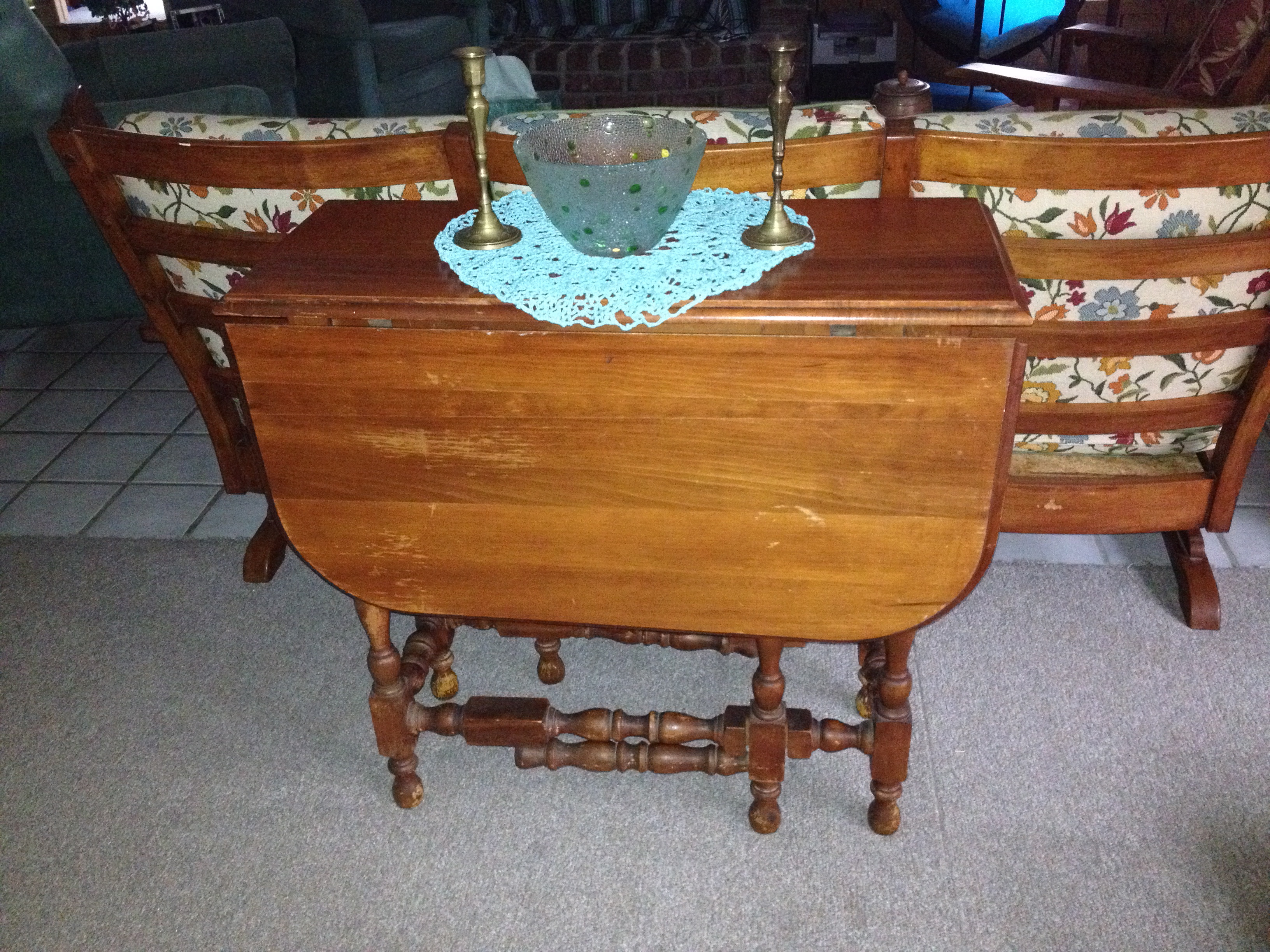
The table in my basement family room in fall 2013.

The table in my basement family room in fall 2013.

When my siblings and I divided up the furniture and personal items we wanted to each keep from our parents and grandparents, I chose a small maple table from the kitchen in our house in the Catskills. It is not in great shape. But it expands to sit 6 people if you need extra seating. The legs are a little wobbly. The top is a little scratched. But for some reason, I love this table. So it became mine.

It arrived safely last fall. I immediately cleaned it and put furniture cream on it, as it had been really uncared for in the few years since our parents had passed away. We had not spent a lot of time in the Catskills after they passed, and all the furniture up there had been unattended. But now that is changing.

I knew this table once belonged to my grandparents, then it became my parents, all that time it had stayed in the Catskills. But now it is mine and away from the Catskills at my home in Kansas. I had no idea how long it was in the family. However, this table called out to me. It was something comfortable. It seemed to always be around.

A few weeks after the furniture arrived, I was looking at photos that my brother also had shipped out to me. And I found a special photo. Wow! There is part of the table next to my brother and me. We are about 4 and 3 standing in our grandparent’s bungalow before a birthday party in 1958.

With the maple table in the Catskills, summer of 1958.

With the maple table in the Catskills, summer of 1958.

My brother and I are very dressed up for the Catskills. I know it is a party because I have found other photos with my cousins and grandfather. I think it was my oldest cousin’s fifth or sixth birthday. And it could have been a double party because I have two cousins whose birthdays are just a few weeks apart, and they are the same age.

My Mom was very pregnant that summer. (I actually have a photo of her as well!) Soon after this picture was taken, my cousin’s birthday was in July, my parents left for the City. They needed to be near the doctors and hospital. So we, my brother and I stayed with my grandparents.

Finding that photo of my brother and I was wonderful! I have always loved this table, but this photo makes me even more aware of its family history.

I have become a bit obsessive about my parents and grandparents furniture. My sister might say, crazed. My brother would call me loony. And I accept these type comments. How can I not? I am. Part of me wants everything to go back the way it was when our parents and grandparents were alive. I realize I cannot do that. But in a little way, I try.

An example?   I have my grandmother/mother’s baby grand piano.   I have had it for 29 years. I love it. I played the piano as a child and adult. My daughter took piano lesson on this piano. Friends have enjoyed its lovely tone.

My Mom played as well. She studied at Julliard all through high school, but my grandfather would not let her go there for college. She went to what became “Douglass” instead to be a teacher. As a teacher she would always have a job, but not as a musician.

After my parents passed away I wanted two items that my grandparents kept on the piano. We have photos of that as well. And my siblings did not argue, they let me have them. The metronome made sense. It should be by the piano. But my grandmother always kept a vase from Japan on the piano. I believe my Dad brought it back when he returned from his service in the Korean War. Now I have both items on the piano as well.

For some reason, when I see these two items on my piano, mixed in with my items, I have a sense that all is right in the world.   I remember these two items from my childhood and it brings a sense of security. Finding the old photos reinforces memories I had, and brings back memories I had forgotten.

The photo of my brother and I with the little maple table comes from a time of my earliest memories. All my first memories come from that summer, the summer before my sister was born.   I remember my Mom pregnant and leaving to stay in the city till the baby was born. I remember staying with my grandparents in the Catskills and all my cousins. I remember my Dad coming to get us after my sister was born in early September, and my mom was back home.

I remember seeing my sister for the very first time. I remember thinking that she was really small and was not going to be able to play with us.

From that moment forward I have so many memories. So to see my brother and I with the table from that summer is an amazing find. The table brings back so many happy memories. I hope it provides my children with happy memories as well.

Woodstock Memories: A Walk On West Shore Road

30 Jul
The hoards of people walking towards Woodstock toward Hurd Road on West Shore Road. The hoards of people walking towards Woodstock toward Hurd Road on West Shore Road.

How does one write about the Woodstock Festival of 1969? Forty-five years have passed, but when I close my eyes I can see the chaos of thousands, hundreds of thousands of people on roads not made to carry them. I can hear the music and the constant noise. I can feel the vibration of the ground of the bass drums. I hear the loudspeakers telling people what is happening. I smell the rain and the pot.

I was 14 when Woodstock came to me.  It was a weekend that I am unable to ever forget.

I worked at the bakery in Kauneonga Lake. Located next to the Post Office, it was only opened on the weekends usually in the mornings. But sometimes I worked till 3 pm. This weekend was to be like all others. My Dad drove me to work, as the store was about a mile and a half from our bungalow, and I was running late that morning as cousins had come to visit the night before, and I had to be at work by 8 am.

However, the day did not progress as normal. More and more people were coming into town. And then the woman I worked with said, “Someone has paid for all the food in the store, so we can give it away for free to all these hippies.”

And there were lots of young people, who looked like hippies. I always thought it was strange that the food was paid for, and then a crew with a camera came into the store to film as hundreds of people tried to come in and get free food. It was chaotic. We were working like crazy to give the food away. Put it in bags. I turned away from the camera.   It was hectic and somewhat scary for me. It was not a big room, and people were squashed inside against the display cabinets. And I was very shy.

When the food was all gone, and the people emptied out. And the camera crew left. We put a closed sign on the door and locked it. I called my Dad. “I can’t come and get you. The roads are a mess. You will have to walk home. Be Careful,” my Dad said. “Stop at the colony if you need to.”

The bungalow colony my grandparents owned was about two-thirds of the way to our bungalow, which was further up West Shore Road, one of the two main roads that led to the Woodstock concert held on Max Yasgur’s farm on the corner of West Shore Road and Hurd Road. I had relatives staying at the bungalow colony. I knew I would be safe there, if needed.

After I got off the phone, I looked outside. Cars were just stopped in the middle of the street. The center of town was overrun. People were abandoning their cars and walking, walking up to Woodstock, to Yasgur’s farm.

A few moments later there was a knock at the door. A black man from town, whom we all knew, said,  “I am going to walk you home. You cannot go walking alone in this mess.” I think my Grandpa must have called him, because how else would he know that I needed to walk home? So off we went. He was holding my hand and guiding me through the throngs of people.

“Don’t worry,” he said. “I will get you home.”

I know everyone talks about how wonderful Woodstock was and how it was the peaceful event that brought together music, love and drugs. How everyone lived in harmony for three days. But on that walk, I saw an ugly side to Woodstock. Sorry, but this is my memory.

As we walked down the road people were yelling at each other. The town people who wanted the cars to move. The people in the cars who wanted to move their cars. Then there were also the hordes of people who were just walking and laughing. They seemed to be having a somewhat good time.

I was calming down, until we came upon a little Volkswagon ‘beetle’ car. Inside a white man was punching a white woman in the face. They were probably in their 20s. Blood was running down her face. The man with me, pulled open the car door and grabbed the man’s hand. And he yelled at the girl, “Get out of the car!”

“But it’s my car!” She cried.

“It is not going anyway,” my now hero yelled. “Get out of the car.”

We were right in front of my grandparent’s bungalow colony. I saw my other grandmother and aunt among the women standing there. They opened the gate, and grabbed the young women, towel in hand to wipe the blood off her face and stop the bleeding. “Come with us.” I remember them saying. “We will call your parents.”

My grandmother called over to me. “Are you okay? Can you make it back to the house?”

I nodded yes and pointed. “He is going to walk me home.” She nodded in return. “Okay, I will call and tell them you are on the way.” I think she was a little shocked about who was walking with me.

We continued walking toward Woodstock and home: up the hill past the White Lake Estates, Finks and Top Hill. To my grandparent’s private home, where our bungalow was located.   My Dad and Grandpa were waiting for us at the end of the driveway. They shook my companion’s hand.

“Thank you,” my Grandpa said. “Come up to the house for something to eat and a schnapps.”

]Our property looked different. Grandpa and Dad had let four cars or campers park along the driveway. They had run a hose down from the house to the end of the long driveway. It ended in a large aluminum basin. A sign said, “Free Water.” Cups floated in the water, when they were not being used by the people walking by.

“Where are their mothers?” My Grandpa said while holding his head and staring at the endless line of young adults walking by. Some of the girls looked very young.  It was these girls that brought on my Grandpa’s lament, “Where are their mothers?”

Then he walked back to the house for lunch and schnapps with my Dad and my walking companion. My Grandpa really needed a libation that day!

I remember much more of Woodstock. I remember sitting on our front lawn and just watching the people go by. Woodstock itself was another mile or so up the road.   I remember listening to the music. We could hear it from our home.  I remember that the noise went on all night long.  We heard either the sound of music or sounds of people in the usually still Catskill’s nights.

My brother and his friend; my cousins and many others I knew walked up the hill to the concert. I did not. My parents said no!  My brother, who was a year older was allowed to go, but not me.  It did not really matter, in a way we were in the middle of the concert anyway.

And then you know, the rain started. My brother talked about sliding down the hillside. My cousin took all the food my mom packed, not realizing my brother and cousin would never be able to meet up at the concert. We always teased my cousin about ending up with the food! The blankets disappeared into the mud of the hill. The humans did not disappeared, but when they came home Sunday night/ Monday morning, they were all muddy messes.

For weeks after,  the cleanup continued. Poor Max Yasgur, he became a pariah – a scapegoat in town. There were lots of very angry people.

The view from the Hurd Road Woodstock Monument. Looking toward West Shore Road.

598.jpg”> The view from the Hurd Road Woodstock Monument. Looking toward West Shore Road.

Woodstock. It was something special for many people. I changed after that weekend. I saw the world in a different light. I saw the worst in people, as the man beating a woman; yelling and anger.  I saw the best in people, as in my companion on the journey home. I learned the color of skin meant nothing. The person inside is the most important. A lesson I have carried with me my entire life.


The big metal container is what we filled with water. This is our driveway. My Dad let some people park along the sides of it.
People walking from Kauneonga Lake. My Dad is with the camera.

https://zicharonot.wordpress.com/2014/08/11/taking-a-walk-up-to-hurd-road-to-the-woodstock-site/

http://www.mapquest.com/maps?city=Kauneonga%20Lake&state=NY

http://en.wikipedia.org/wiki/Woodstock

http://www.bethelwoodscenter.org/the-museum

http://www.britannica.com/EBchecked/topic/647675/The-Woodstock-Music-and-Art-Fair

http://en.wikipedia.org/wiki/Max_Yasgur

A Strand of Pearls is Not Just Jewelry, It is a Circle of Love

6 Jul


To me wearing my pearls infuses them with love.

To me wearing my pearls infuses them with love.

I wear two strands of pearls to every family wedding. One strand, the longer one, belonged to my mother-in-law, Lee. She died when she was only 59, but I know that she would want to be at every wedding of her grandchildren and family members. The other strand, is slightly shorter, but has a lovely clasp. It belonged to my Mom, Fran. She also loved weddings and would want to be at every family wedding! Amazingly both strands of pearls have the same size pearls. And they look so good together.

Last night I wore the pearls to the latest family wedding, our niece. The pearls came up in conversation, and I told my brother-in-law, and another nephew and niece, why I wore two strands. My brother-in-law said, “I know they are here.” And my nephew and niece, who knew my Mom but not his own Grandma, said, “Your Mom would have loved the weddings.” And it is true.

It makes me feel as if these two wonderful women were there with us when I wear these necklaces. Pearls are so warm. And to me their glow sends off the warmth of love.

Pearls have much meaning in my family. My grandmother had opera length pearls. And my mother had them made into three necklaces, once for each of her granddaughters. As they turned 18, each girl was presented with the pearl necklace from my mother.

Unfortunately she passed away a few months before the youngest turned 18.   My Dad had us present the pearls to my niece in the hospital where my mother was soon to die. I know it was a difficult time for my niece. But I hope as time has passed she realizes how much her grandparents loved her and how important it was for my Dad, her Grandpa, that she get the pearls while Grandma was still alive.

My Great grandmother, for whom I am named, gave my Grandma a strand of pearls in Europe in 1932. They would have been mine. But another relative stole the pearls while she was in Europe. She always suspected who had taken them.

Over 40 years later he wrote her a letter. He had survived the Shoah, but his entire family had been killed, his wife and his children. He blamed himself. He believed that if he had not stolen the pearls, they would have lived.

I know this because I met him. I was living in Israel at the time. My Grandma Thelma wrote to me to meet up with “the goniff.” He was going to give me 400 lira…about $100 at the time. I was to take some of the money and buy myself something and give the rest of the money to my great uncle.

I met Zissel and he told me his story. He was a sad, sad man. He told me how his family had died and the horrible things that occurred to him. He told me how he had stolen the pearls.

“Your grandmother went into the bathroom to bath. When she came out the pearls were on the sink. I thought, she lives in America; she is rich. I can use these pearls more than she can. And I took them. Now everyone is dead, and it is my fault.” Zissel and I both cried as he told me the story. I was only 19 years old. The pain of that day lives with me. He believed if he paid my Grandma back, it would take away some of the guilt. I hope it did.

I began to visit him whenever I was in Tel Aviv. He worked in a bakery across from the giant shuk. I would meet him there, get a pastry and tea and talk to him Sometimes I would go back to his apartment.

When my parents came to visit me in Israel, I took them to see Zissel as well. His Yiddish was much better than his Hebrew. So when my parents came, he spoke mainly to them in Yiddish. He told more stories. And my mother and I cried along with him. I hope that his sad soul found peace.

The pearls were a bond between Zissel and me.

And so for me pearls, any pearls, have a story to tell. My mother-in-law’s
pearls and my mother’s pearls will be filled with joy as they experience only happy events. Every wedding will bring happiness to these pearls. And the sadness of the pearls that Zissel took will be wiped away.

The pearls my daughter and nieces have are also filled with love. And when I see them wearing my mother’s/grandmother’s pearls, their great-grandma, I know that the love of these two women are surrounding them.

A strand of pearls is not just a piece of jewelry, it is a circle of love.


How World War I Saved My Family or My Grandpa Was A Draft Dodger

25 Jun

World War I changed the world! One hundred years ago, Europe became a place of desolation and devastation. Young men from both sides were killed. Millions perished. From all I have read, it was horrible. The use of gases so horrific that laws were later passed banning the use of these and all future chemical weapons. We know that sometimes they are still used. But the world peoples are united against them.

For my family, World War I actually saved my branch of a family. My Grandpa Nat, you see, was a draft dodger.   As he would explain it to me, Jews in Galicia did not really have a chance in the military. They were often put in the worst positions, meant to die. And if they survived, they were conscripted for 25 years. So they never were able to live a Jewish life or return to their families again.

In 1918, when my Grandpa was about 18, his life changed; he received the dreaded notice that he was to report for military duty. It sent his family into action. Nissan, as he was known in Europe, had to be smuggled out of Galicia to save his life.

Thus began my Grandpa’s two-year journey to salvation and survival. He left his home in the middle of the night with just those things he could carry and wear. His intention was to get to British Mandate of Palestine and join the efforts to create a Jewish homeland. But his first goal was to get to his cousins in Belgium.

He wandered through Europe during the battles of 1918 and the aftermath of the war. Slowly making his way to Belgium. He had no real passport. Instead he was using the passport of a dead cousin.

Eventually he made it to Belgium and his cousins. Their reaction to his wish to travel to Palestine was, “Why go to Palestine? It is a desert! Go to the United States, to the Golden Medina. You have an Uncle there. He will help.”

So my Grandpa contacted his Uncle Julius, known as Uncle Yidel to us all, his mother’s brother. Uncle Yidel agreed to sponsor Grandpa to the United States.  But he had one problem, he had been robbed along the way and had to work to earn the money to pay for his trip to the United States.  But finally, after about nine months, the last leg of his journey began. Fortunately for him, his uncle did sponsor him, because when he arrived in the port of New York City, and the immigration site of Ellis Island, he had just a nickel. Without a sponsor he would have been sent back to Europe.

Grandpa often would tell us that we could be whatever we wanted to be. “Look at me,” he would say. “I came to this country with just a nickel in my pocket. And look at what I have.” So we learned early on not to complain to Grandpa and to never give up!

I tried finding my Grandpa’s immigration information from the Ellis Island sites, but could find nothing. My Grandma’s was easy to find. So I often wonder what that passport actually said. And how old he was supposed to be? But in 1920, immigration procedures were not as intense and documentation was not as precise as it is now.

Tanta Molly and Uncle Yidel

Tanta Molly and Uncle Yidel

Uncle Yidel and his wife, Tanta Molly (also known as Malchik)  welcomed Grandpa.

Growing up in Europe, my Grandpa had been a yeshiva brocha, a student of Torah. He had a beautiful singing voice, and perhaps might have been a cantor. But instead, somewhere along the way, he learned to be a baker. When he first came to New York, he worked two jobs. One as a butcher, the other as a baker.  But it is as a baker that he prospered in America. He and Uncle Yidel started a bakery eventually owning a building in New York City. (My Grandma told me that when Grandpa proposed he told her he had a place. She thought he rented an apartment. She did not realize he owned the building!)


Grandpa in his bakery in West New York, New Jersey, 1942.

Grandpa in his bakery in West New York, New Jersey, 1942.

They separated the business after my grandparents married, and Grandpa and Grandma opened a new bakery in Linden, New Jersey.  But in the early 1930s, when my grandmother took their children to Europe for six months, Grandpa sold the bakery in Linden and opened a new bakery in West New York, New Jersey.  He kept this bakery for over 35 years.

Grandpa had many cousins in the United States. His parents were first cousins. So he was double cousins to many of the family. They helped him settle in. But Uncle Yidel was the most important. Uncle Yidel and Tanta Molly were always a part of our lives. They had one son, Ezra.

Whenever we went to see them, we were welcomed in Yiddish. Tanta Molly would come running out to hug us. She would call out our Jewish names: “ Tovaleh, Fagaleh, Chavaleh!” I asked my Mom, “Why does she put an ‘aleh’ on all our names?”

“It means little,” my Mom replied. “Well that did not make sense, Tanta Molly is littler than us!” Was my response. “It means she loves us,” Mom laughed as she said that. Later I found out the ‘aleh’ did mean little, but really was an endearment.

My Grandpa always missed the hills of Galicia. He often told me that he bought his property in the Catskills because it made him think of his home and his childhood. Many years latter when I traveled to that part of Europe, I saw he was right. The rolling, low mountains and hills do look like the Catskills.

My Grandpa forever missed his family. World War I did save him. He came to the United States. But his parents, siblings, and many aunts/ uncles/cousins stayed in Galicia. They all perished in the Shoah.

My Grandpa Nat was a draft dodger, but he never stopped fighting for the right to practice his beliefs and to protect his family in the USA. He loved America. He never traveled outside of the United States. When asked, his reply was always:

“Why would I ever want to leave here? It is the best place in the world.”

Our Shul in the Catskills

18 Jun
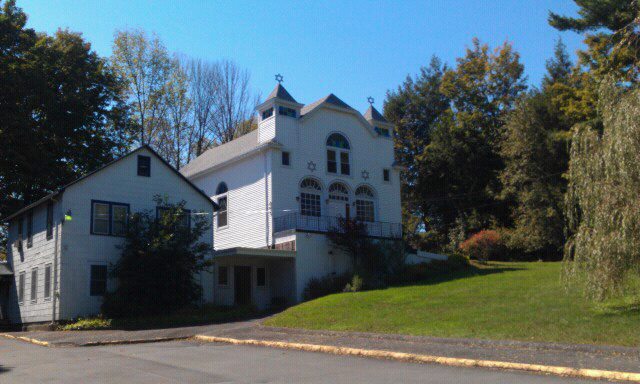
Temple in Kauneonga Lake. Temple in Kauneonga Lake.

(I wrote this a number of years ago. The Congregation is now 100 years old!)

Congregation Temple Beth El in Kauneonga Lake celebrated its 90 anniversary last summer. I only found out because my daughter asked me a question about the shul in the Catskills — the shul that three generations of her family had all attended.

To be honest, I was not sure that it even still held services. I live in Kansas now, and only go up to the Lake once each summer. Even less than I used to. When my parents were alive I would spend 7 to 10 days at our home in Kauneonga Lake with my parents and one or both of my children. But since they passed, at most I have spent a weekend.

So I checked. I went on line, and there it was a website for the congregation! I sent a donation in honor of the anniversary and in memory of my parents. And then I joined the congregation.

It brings back so many memories. The shul was founded in 1923. I think I started going there in the early 1960s. Maybe before. But my memories before then are not very accurate.

We spent every Rosh Hashannah at the shul on the hill in the Catskills. It was an orthodox congregation when I grew up. The women and girls sat upstairs in the balcony, while the men and boys sat downstairs. I actually liked sitting upstairs. We could look down on everyone and see what was going on, while we could be a little less formal.

But my Grandma Thelma and her good friend, Clara Wagner, rebelled one year. They said enough was enough. They did not want to climb the stairs anymore. So the congregation made a mehitzah for the downstairs and made the last three rows of seating for women. Grandma and Clara much happier, and keeping them happy was important. They were both very strong willed women!

I think they would be thrilled to know that there will be a woman rabbi there leading services this summer. Obviously men and women are sitting together and the mehitzah is down.

The shul was where we celebrated special events as well. My parents wedding anniversary was in June. One year, in honor of their anniversary, we held a special kiddish luncheon. My Grandpa Nat, a retired baker, baked plum cake after plum cake. Every oven was filled. Luckily he had saved many of his cooking trays.

The day of the kiddish was special. We were all there, family and congregation members. My Grandma asked Grandpa to sing in Yiddish for us. Grandpa had the best voice. His first song did not make my Mother happy. He sang, “Was is Geven ist Geven it Nitch Du.” My Mom said, “Daddy, why that song?” ‘What was, was and never will be again,’ is not what my Mom wanted to hear on her anniversary. (I think he was reliving her wedding, which occurred when my Dad was in the army on his way to Korea. It was a difficult time for the family, I have been told.)

My Grandpa laughed and then sang Tumbelalika and Schtetla Belz among other songs. There was some singing along, but mainly Grandpa singing to all of us.

We also celebrated my Grandma’s birthday there once or twice. Her birthday was in July. So perhaps her 70 or 75th birthdays were celebrated in the shul.

Grandpa was a cohen. He did not want to go to shul every week, but if no other cohen was available he went. In his younger days he would walk the mile or so to shul. But as he drifted near his 80s and older, he began to drive. He would park at Newman’s or across from Sylvia’s store and then walk the rest of the way. He just could not bring himself to drive all the way to shul on Shabbat.

I remember that a rabbi was hired that was a bit too orthodox for the shul. He put strings up around the syngagoue. As we walked to the shul, my Grandpa stopped and stood so still. “Vas Machts?” He turned to my Grandma. “I haven’t seen that since the shtetl!” He said. (Yes, he said it in Yiddish, but I don’t know how to write the entire sentence.)

I wanted to know what it was; it was an iruv. It makes a wall around the area of the synagogue or community so that people can carry things. You are not supposed to carry on Shabbat, but with an iruv up you can.

My grandparents had many friends at the shul. Among their closests friends were Abe and Clara Wagner. I can still see Abe, a plumber, down in a hole at my grandparents’ bungalow colony asking for some tool.   And my Grandpa laughing hysterically at the sight of the little red haired, highly freckled plumber in a hole.   Abe was so mad, “Stop laughing and hand me the tool.” But they both had a good laugh.

I remember going to their home many times with my Grandma and sitting and talking with Clara.

When Clara passed away, my grandmother was inconsolable for quite awhile. But when Abe remarried, she was welcoming to his new wife.

It was Abe who was there for my Grandpa when my Grandma passed away. We got the phone call from the hospital early on an August morning. My Grandpa refused to go to the hospital. He said, “She is gone, why do I need to go there.” They were worried about him at the hospital as he was in his 80s. So my Mom called Abe.

I can see it as yesterday. Abe spoke to my grandfather briefly, then he pointed at me. “Ellen, you come with me,” he said.

We went to the hospital, and while I signed my grandmother’s name over and over again on documents, Abe said. “Stay with them, I will be back.” At the time the emotion of signing Grandma’s name was all I thought of, nothing else.

We left when he returned. He had a big plastic bag of Grandma’s stuff. As we passed a dumpster, Abe told me throw it all out. “Your Grandpa doesn’t need any of that stuff,” he said.

I then turned to him and said, “Abe, I never saw Grandma.”
“Don’t worry, I took care of it,” He said.

And he did.

Grandma was buried in New Jersey, in our family plot. We, my parents, Grandpa and I, drove back to the Catskills from the cemetery. Grandpa sang, Johnny Mercer’s song, “Autumn Leaves” all the way back. “We promised each other that whoever remained would sing this song,” my Grandpa said. I still cannot bear to hear that song.

When we got to the house, all was ready. There was water by the door. There was a spread of eggs and other dairy items on the table. I am not sure if it was relatives or the Jewish community who prepared everything. But I know that many members of Congregation Temple Beth El came to sit shiva with my Grandpa. They were there for him for the many years he remained living at Kauneonga Lake.

My grandparents and parents always supported Congregation Temple Beth El. And as a community the people of the shul comforted my family.

I am so glad that services are still held at the shul on the hill, and that I have renewed my membership to support it and keep it alive.

http://congregationtemplebethel.org/

http://artists.letssingit.com/johnny-mercer-lyrics-autumn-leaves-wgtz6xc