Tag Archives: Catskills memories

The Final Frantic and Frenetic Search.

20 Mar

“I put it in a safe place.” Seven little words that put dread into our hearts whenever our Mom uttered this sentence. They were always followed by, “but I don’t remember where I put it.” This usually happened right before my parents were going out and she needed a special piece of jewelry to wear.

And it had nothing to do with her age. My Mom started putting her jewelry into a safe place into our apartment in North Bergen when we were young. The problem was that she never remembered the location of the safe place for that item. She could find other items, but never the one she was searching for at that moment.

My Dad, brother, sister and I would jump into action. We would search the house starting with her favorite hiding places. (Places I will not disclose, because maybe someone in my family still uses these places.) It would be a frantic and frenetic search,

Sometimes we found the item, but other times it was lost for almost forever. I say almost, because often, many years later the item would turn up.   My mother had a beautiful silver and semi-precious stone wedding band that disappeared for a decade. It was found in the bottom of her closet, years later by my father, quite accidently. So safe places did work.

I think my Mom got this urge to hide items from her mother. My grandparents grew up in Europe and hid money and jewelry throughout their home in the Catskills.   They had a safe, but they also buried items in the crawl space and within items throughout their home. It was fear that led to this habit. The fear of the need to be able to grab something and run, but still have some money. Luckily they never had to do that in the USA.

They had owned a bakery in West New York, NJ. And my Grandma kept every silver coin that ever came into the store. She once told me that when a silver coin came in, she would put it in her apron pocket and later get a coin from her purse to replace it to make sure the drawer balanced in the evening.

When Grandma passed away, the family was in the Kauneonga Lake for the summer.  I had flown in from Kansas. Under my Grandpa’s instructions, we opened every purse, every shoebox, and checked every coat pocket.  He said, “Don’t throw anything out till you open it. She hid things.”  And he knew his wife. Because Grandma did hide money and jewelry.

We found over 900 silver coins: silver dollars, half dollars, quarters and dimes. Money was hidden everywhere. By the end of the weekend of cleaning, we had bags filled with coins and bills. The coins were divided between her two children and among all the five grandchildren. The money was put into the bank for my Grandpa.

After my Grandpa died, I inherited their bedroom set. My Mom sent it to me with items still inside. She could not bring herself to clean it out. In a small top drawer I found a little purse of my Grandma’s. Inside the purse was $10.00. We missed that! I still have it, put away in a safe place.

My Mom developed this need to hide things, I am sure, from her parents. And so she hid her jewelry throughout their home. It helped the one time we were robbed in North Bergen when I was in high school.   The thieves searched and destroyed my parents’ bedroom. But never found her hidden stash. Her secret and safe place was so good, even the thieves could not find it!

Later, when they moved, her hiding jewelry was so crazy, as they actually had a safe in their apartment. But when she died, the jewelry was missing. It was not in their safe deposit box at the bank. That would have been easy. It was not in the safe in their home, another easy spot. No, Mom had hidden her stash away. And it was our job to do one last search; one last mystery to solve. Thanks Mom!

My sister was frantic. She called me six weeks after Mom died and a few days before I flew out to Jersey to help clean my Mom’s items from the apartment. (In Judaism you do not clean out a person’s items for at least a month. So my sister and I were getting ready to do this.)

“I cannot find Mom’s jewelry,” was her comment. Not said in a calm way at all, kind of an hysterical laughing scream.

“Don’t worry! We will find it,” I replied. I really was not worried. I knew it was in a safe place somewhere in that 1600 square foot apartment.  We would find her hidden stash.

When I got to New Jersey, my sister, nieces, daughter and I started cleaning. We opened every shoebox and every purse. But I knew it was not in those. My Mom was so stressed by what my Grandma had done so many years ago, I did not think she would make us go through the same stress. But we checked everything.

My Mom was more organized. She had a little cloth eyeglass bag that she often put her jewelry in. I started searching all the boxes and bags she had piled around the shelves and floor of the closet. There were many! And then:

EUREKA!

I found the jewelry. My sister was so relieved. She sort of sighed a deep sigh. But I felt sad.

‘I put it in a safe place’ had so much meaning that those words had a safe place in my heart. I can still vividly hear my Mom’s voice saying these seven little words. In a way, finishing the search broke my heart. I knew the last safe place was discovered. The last frantic and frenetic search was completed.

 

A Piece of Crumb Cake or A Crumb Bun Equals Love

15 Mar

Crumb cake and crumb buns, I can still taste them. Eating a crumb cake in my family is like eating love.   As the powdered sugar drips and the crumbs fall, we see and smell happy memories. I can not tell you how many important family discussions were held while we sat around eating crumb cake, but there were many. Crumb cake kept us together and talking.

My Grandpa Nat was a baker. My grandparents owned a kosher bakery in West New York, New Jersey. And among my favorite foods were the crumb buns. I say among my favorites, because I liked other items as well: chocolate chip cookies, black and white cookies and rye bread. But for my Mom, there was really just one love: the crumb buns were always the number one item for her.

She told me that as a little girl she were go down to the bakery in the morning and check out the tray of crumb buns, looking for the best one: the one with the most crumbs; the one with the biggest crumbs. And then my grandmother would cut that crumb bun out for my Mom to eat.

I would like to say that she outgrew this need. But she never did. Even after my grandparents closed their bakery in the late 1960s, my Mom still needed a crumb bun fix. When she could no longer find them in bakeries, she turned to Entenmann’s crumb cake to get her fix! Yes, my Mom was a crumb bun/cake addict.

She would share anything with her children and grandchildren, but when it came to crumb cake, she still had to choose the best piece with the best crumbs for herself. We sometimes ‘fought’ over the best piece, but in the end Mom would get it.

Mom loved to eat crumb cake on a paper towel or napkin. She would put the cake upside down on the paper, and eat the cake first. Saving the crumbs for last, she would eat the biggest crumbs first and slowly work her way to the smallest crumbs. Near the end she would fold the paper towel so that the crumbs would gather together. Then when she had picked up all the pieces she could, she would lick her finger to pick up the last crumbs. I still eat my crumb cake that way.

Her children and grandchildren learned early on that Grandma would steal their crumbs when they weren’t looking. Yes she would. If she saw a crumb on your piece of cake that was extremely large, she would just reach over and take it. In fact, sometimes we would notice that the cake in the box would be missing a few crumbs. Mom had secretly taken those crumbs when no one was around.

But the ‘stealing’ went two ways. Sometimes, after my Mom chose her perfect piece, she would leave the room for a minute. Then my Dad would pounce, and hide her cake. He would act surprised and say something like, “That was yours? Sorry I already ate it.” But she knew it was close by.   And he would give it back to her like a guilty teenager.

Finding the piece of cake with the best crumb ever was an important goal. My sister and I soon realized it was best to be up early in the morning to look for the best piece of crumb cake. But it did not matter, Mom usually beat us to the best piece.  As my sister remembers, and it is true,  sometimes the crumb cake was missing a piece from the middle!  Mom had been there first, claiming the piece with the best crumbs.

Entenmann's Crumb Cake hidden on top of the refrigerator.

Entenmann’s Crumb Cake hidden on top of the refrigerator.

The tradition took on new meaning when the grandchildren arrived. It was wonderful fun eating crumb cake together. The crumb cake, which was kept high on top of the refrigerator, would be taken down. Everyone would gather around to look at it, trying to figure out which piece they would get. The corners, of course, were the best pieces. Mom always got one of those.

In the summer time, the crumb cake tradition was not only for mornings. In the evenings, as we had our tea, someone would always bring the crumb cake down from the refrigerator. The grandchildren would come running to participate in the feast. Sometimes it was just all the girls eating with Grandma. But other times, the boys would join in as well. In my mind’s eye, I see them all giggling around the table having tea and crumb cake.

When I moved to Kansas, I was so excited to see Entenmann’s crumb cakes at the grocery store. I bought one every time my parents came to visit. But more important, I bought one whenever I felt homesick. Having a piece of crumb cake with my children, always made me feel closer to my Mom.

Even when my Mom was at her sickest, she could usually eat a piece of crumb cake. She would get a look of childlike delight when the cake would be put on the table. She still analyzed every piece, looking for the piece she wanted to eat.

For a month, when my Mom was sick, my daughter lived with my parents. My daughter told how each evening, my Mom would ask for her cake. “Find the most crumbs,” my Mom would say. And my daughter would cut my Mom the best piece of crumb cake and bring it to her. It lightened the day.

When my Mom passed away, eating a piece of Entenmann’s crumb cake became even more important. I felt close to her when I ate the crumbs from the paper towel. Sounds silly, I know. But in those first months it did help. However, about six months after she died, the grocery stores in the Kansas City area, where I live, stopped selling the crumb cake. I felt crushed. I was devastated. I no longer could have my crumb cake fix. I no longer could feel that connection with my Mom.

I can still get crumb cake when I go back east to New Jersey and visit my siblings. My sister almost always buys a crumb cake for us to enjoy during my stay.  It helps. That bond with crumb cake is part of our existence.

IMG_1663

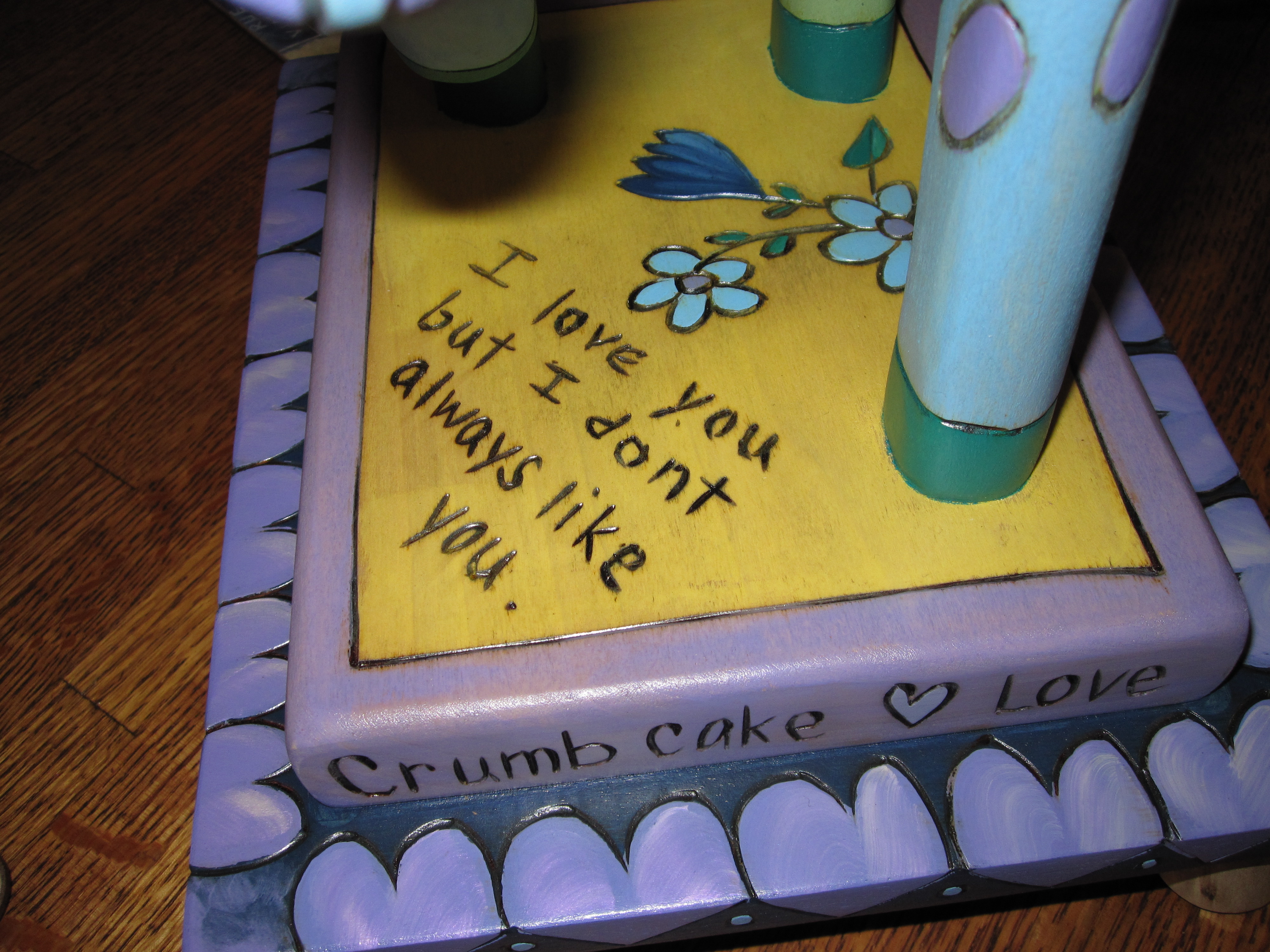
I actually had a lamp made after my mom died that has some of her favorite sayings on it. The Sticks campany, which makes painted furniture, will personalize their items. And so I had something made in memory of Mom. On one side, I had them engrave, “Crumb cake ❤ Love.”


http://www.entenmanns.com/op-prod.cfm/prodId/7203001994#.VQWQLmTF_Ao


www.sticks.com


My Refrigerator Holds Memories in its Magnets

12 Mar

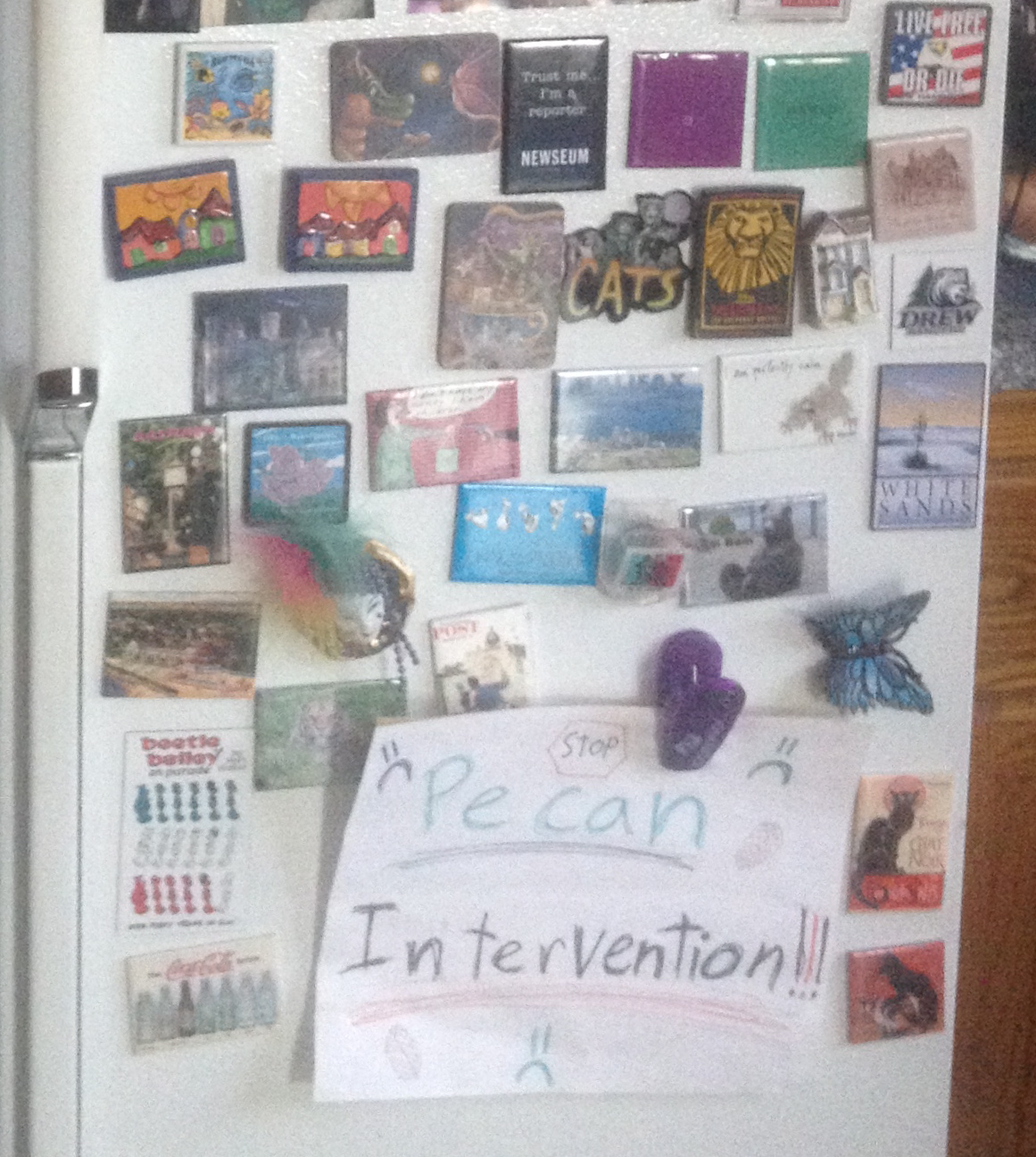
My refrigerator drives my husband crazy. Not the appliance itself, but rather the hundreds of magnets that have been placed on it over the years. Many of my friends have switched to stainless steel refrigerators, but I cannot do that . What would I do with my magnets?

When I see my magnets, I have memories. Many of these magnets I purchased on trips or at events. Some were gifts from a friend. But most hold special memories for me.

Thanks to a chance trip to an IKEA store and a wonderful magnetic board on which I moved many of my magnets, my magnet collection has areas of themes. Instead of a mishmash of magnets all over, I was able to make montages and delineate sections.   Well I think I have.

IMG_4959

There are the three magnets from Kauneonga Lake, NY, that highlight the Woodstock concerts. The oldest I bought at Vassmer’s when they had a little Woodstock museum set up in one of the storefronts.   One is from 1994 and the 25th anniversary of Woodstock. And the final one came from the BethEl Woods Museum, which celebrated the 40th anniversary in 2009.

I close my eyes and I am in Kauneonga Lake reliving that summer. Close to these magnets I keep a photo from the Catskills that includes my grandmothers and great aunt. There are other magnets near by, but it is the Catskills memory that stands out in this montage.

On the front of my refrigerator are all sorts of magnets.   Some from musicals I attended, others from places I visited. Some show sayings that I think are important.   My magnet collection seems very organized now. And it is.   Most of the magnets you see there are square or rectangle in shape creating organized lines upon lines of magnets.

IMG_4960

When I see a magnet from a favorite show, the music runs through my mind. I see the action and dance and the people who attended the show with me. Great memories.  My magnets hold up important notes and pictures written or drawn by my children or a special child friend.  These need a place to stay, and the refrigerator is that place.

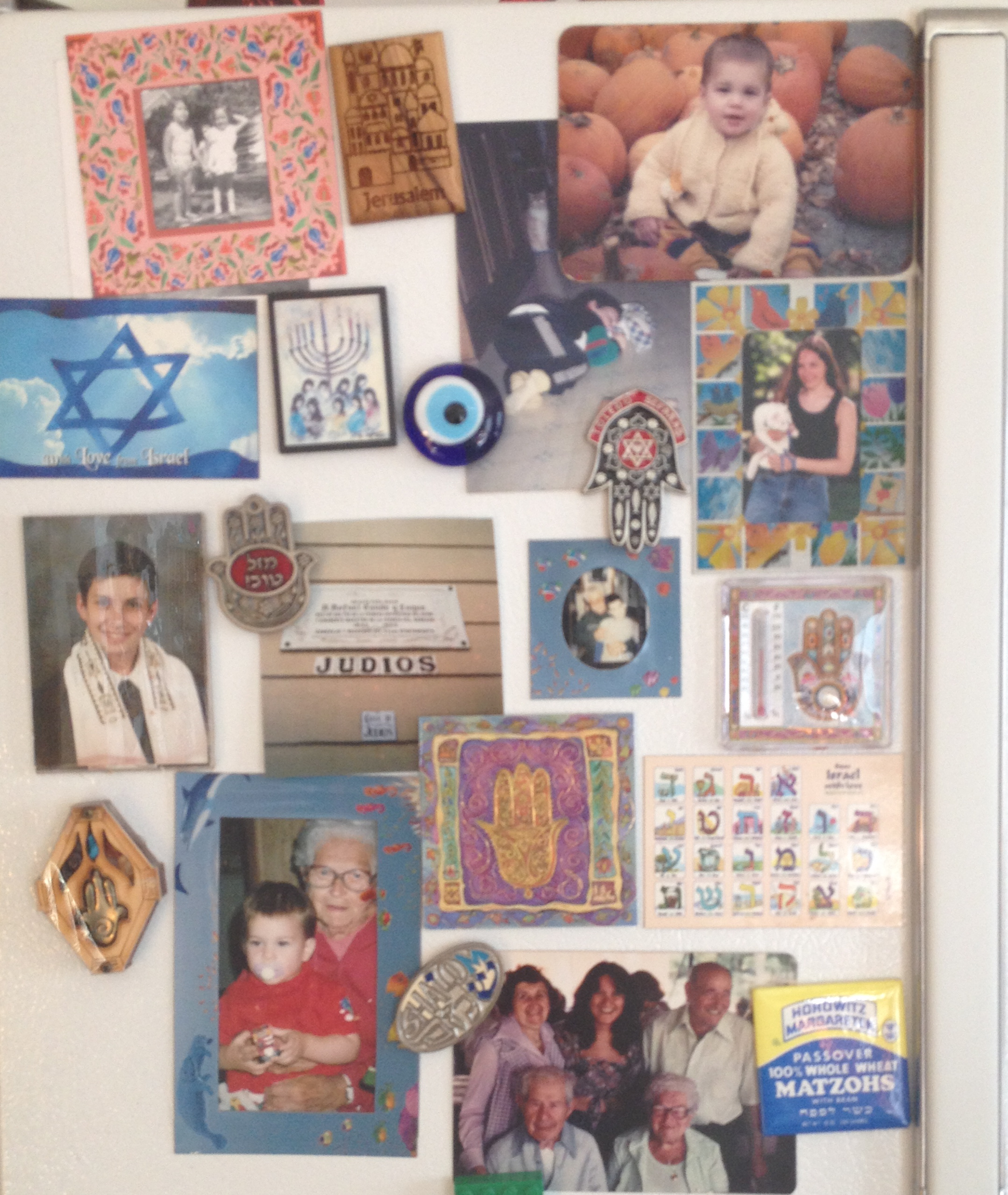
In another corner of the freezer door, I keep my lucky magnets. Hamsas of different shapes and other magnets that I found on trips to Israel and Greece adorn this space.

IMG_4963

Interspersed throughout the magnets and all over the refrigerator are the photos of important people and children: my children, my nieces and nephews, my grandparents, cousins. The magnets hold up the photos, and in some cases the pictures are within magnet frames. All of these pictures hold a special place in my heart.

IMG_4961

The magnetic board I purchased at IKEA contains over 100 magnets from some of my favorite places: Disneyworld, Prince Edward Island and the Anne of Green Gables home, Bahamas, New York City, Aspen, Lego Land, New Orleans, Seattle. Looking at this board gives me joy because I remember so many wonderful places I traveled to with my husband and my family! I can remember the excitement in visiting each new place.

My husband did not appreciate my efforts of magnet organization. He thinks the refrigerator is still overwhelmed by magnets. Perhaps he is right. Perhaps I need to go back to IKEA and buy another magnetic board. The magnets will not disappear. The memories stored in my magnets are too important to me.

Bungalow Life was Ruptured When the Water Heater Blew Up!

26 Feb

Bungalow colony life in the Catskills was peaceful. Each day we knew some of the basics of what would happen.

The mothers played cards and mah jonng on a set schedule. The grandmas played canasta. All the women knitted and crocheted during the day. We went swimming. We played. We picked blueberries. We rode our bicycles. We just had fun. On the weekends, the dads came up. It was simple and quiet, except for the sounds of childhood and the sometimes yells of the moms.

The moms had several important needs. One was hot water.

We needed to shower and the moms needed to do laundry. Without hot water, life at the bungalows would come to a standstill. Children got extremely dirty with all the outdoor activities in the summertime. We could wash off in the lake, but not our clothing. So the moms were always busy with laundry.

People did their laundry on certain days because there were only two washing machines in our colony. I think they might have had a schedule, but I cannot be sure. I do know that the laundry room often had loads of laundry waiting to be done. People would put their baskets in the laundry room, with their detergent on top of the clothes, and as one person finished her load, she would load up the next person’s laundry in the machine and start it.

The wet laundry had to be hung on lines. We did not have dryers at our colony. I am not even sure if clothes dryers were available when I was little. So the clotheslines were always in use. Clothespins were important. I still have some I saved from the Catskills!

This meant that rainy summers were a disaster for the moms. Children would sometimes have to wear the same dirty clothes for another day, if they could not be washed and dried. During rainy summers, we often had laundry hanging all over the bungalow during the week. And it really did not dry that well because it was all so damp. Sometimes my Mom would put the oven on to try to dry out the laundry.

We would visit our friends during rainy summers, and walk through layers of drying laundry! Clean clothes, clean linens, clean towels were important!

So imagine the aggravation it caused when the water heater went out. It did not happen very often. But once in a while the pilot light would go out and the heater would stop making hot water. Usually one of the men would go and light the heater. It usually was no problem. The heater lit easily.

Except for one time. The time my best friend, Vicki’s, Dad went to light the water heater. I cannot remember if someone tried to light it before him. I do not remember if he was the only dad up there, so he got to do it. I do know that usually my dad did all the chores since my grandparent’s own the colony. I do not know why it was Normie who had the job on this particular day. But he did.

Normie and his wife, Wini, in matching sweaters in the center. My grandfather stands behind my grandma.  Wini's parents are the women sitting on the left and the man standing on the right.  At the bungalows in the Catskills in the 1950s.

Normie and his wife, Wini, in matching sweaters in the center. My grandfather stands behind my grandma. Wini’s parents are the women sitting on the left and the man standing on the right. At the bungalows in the Catskills in the 1950s.

His in-laws and my grandparents were best friends. My Mom and his wife were best friends. (A friendship that continued till my Mom passed away.   And still continues with us.) And his daughter, Vicki, and I do not know life without each other. So it made some sense that Normie would take on this responsibility if my Dad or uncle was not there.

But we are not sure why it was Normie who went to light the water heater pilot.

I was just a little girl. But I remember what happened next.

Normie went to light the water heater, it was behind a bungalow.

A moment later there was a big “BOOM” explosion and a blast of fire shooting into the sky.

It was so scary!!! Everyone was momentarily stunned. Then there was chaotic movement.

I vaguely remember Normie walking out from behind the bungalow, dazed. Perhaps burning. Or maybe not! Maybe it was just people rushing towards him to get him away from the fire. There was a lot of screaming; a lot of running around. It is so confused in our memories. But there was good new, he was alive.

Then the Moms gathered the children and made us go inside. I am sure Vicki went with me. All I remember is that we were quickly moved out of the way.

Next thing came the fire engine and ambulance and the volunteer firemen and ambulance/EMT crew. It was amazing how quickly they got to the colony. The fire was soon extinguished. Normie was taken away. The children, me included, were terrified.

My friend Vicki remembers, “I remember going to see him in the hospital. He smelled like A & D ointment or some kind of burn cream he had on.

“I was so devastated that happened to him. I thought he would never come home!”

But Normie did come home. He had no eyebrows or eyelashes, but the fire did not reach his face. He had no chest hair; the fire singed that off. The main damage was to his legs. They were burned.

I remember before the explosion, he had large varicose veins on his legs, but after the fire, you would not really see them.

He often wore a bathing suit in the summer time. And we all got used to seeing his burned, scarred legs.

It was a summer event I cannot forget. To this day I hate when someone has to light a pilot light.   I know that it can explode because of my memories of the day the water heater blew up.


The Littlest Gambler: Learning about Horse Races in the Catskills

18 Feb

It started with a phone call. We were in the Catskills in our bungalow behind my grandparents’ home on West Shore Road. We no longer stayed in their bungalow colony, which was located down the road across from Kauneonga Lake. But my paternal grandparents and my aunt and uncle and cousins still stayed at the colony.

The phone call was either from my father’s sister, my Aunt Leona, or my Grandma Esther. But honestly, I think it was my Aunt, from the way my Dad was talking. His conversation went something like this.

“When did they show up? Did you know they were coming? Okay. Okay, as soon as I can.”

He hung up the phone and turned to my Mom. “My Aunt Hady and Uncle Lenny are at the bungalow colony. We have to go down.”

My Mom was quiet. “They are here? Now?”

Well obviously yes. They were here. But who exactly were they? And why was it a big surprise? I had never heard of an Aunt Hady and Uncle Lenny. But I would soon find out all about them.

Aunt Hady was my paternal grandfather’s sister.   It seems she is the reason that my parents met. Aunt Hady and Uncle Lenny lived across the street from my maternal grandparents in West New York, New Jersey. She often shopped in my grandparents’ bakery and she knew my Mom. She told my Dad that she had the perfect wife for him. And in this case, she was right. Aunt Hady and Uncle Lenny were responsible for my parent’s meeting.

But Aunt Hady and Uncle Lenny were sort of the family black sheep. It seems Uncle Lenny was a gambler. Not a good thing in my paternal grandmother’s eyes. She really did not want them around her grandchildren. I found that out.

You see, I loved Uncle Lenny from moment I met him. Just a few minutes later we went to the bungalow colony, and my siblings and I met our great aunt and uncle for the first time. For me it was joy!

I remember Uncle Lenny’s laughter. I remember sitting on his lap and over the next few weeks learning everything you need to know to bet on the horses at the Monticello Racetrack.

He had these special booklets printed on newsprint that listed all the horses running in each race. In the book were numbers and information about each horse and how much you would get back if you bet on whether they win, place or show (first, second and third place.)

I would sit with him and go through the book each day. He always had pencil in his hand to make marks in the booklets. We would choose the best horses for the night. There were a lot of issues to consider. Had the horse won before? How old was the horse? Had he won against the other horses in this race? Who was the driver (This was a harness racing track.)? All these statistics! I loved it.

We would sit outside at a wooden table on nice days. When it was raining we would sit at the kitchen table and go through the book for each race. Sometimes we forgot about the odds and chose a horse based on its name. Special names were important as well when selecting a winning horse! Each day he let me chose one horse for him to bet on.   If I won, he would give me a dollar.

I think it was the dollar that finally got to Grandma!

I thought it was absolutely wonderful.

My grandmother thought it was absolutely horrible.

Little did I know what was going on! I was only 9 or 10 years old. And I was have a great time. But behind the scenes a war was brewing.

One day I was happily going through the races’ guide with Uncle Lenny. The next day he would barely speak to me.   Soon they disappeared. They stopped coming to the colony.   Their visits diminished. No one would speak about them. I had no idea what happened. Only that they were gone for the summer

I did not know what was happening till years later. Uncle Lenny had passed away and Aunt Hady was living in Monticello. Dad was going to visit her. When I found out, I asked about that summer.

It seems my Grandma Esther was furious that Uncle Lenny was teaching me about gambling, about racing and the horses. It seems the horses and gambling destroyed Uncle Lenny, and there was no way Grandma was going to let him influence me. Enough was enough. Uncle Lenny and Aunt Hady were bad influences. And they would have to go. And go they did. Grandma Esther put her foot down.   And when Grandma got angry, you did what she said!

I never looked at a race schedule again. I did go to the races in Monticello one time with a friend after I turned 21. He spent a few minutes attempting to explain how the races worked to me. But I knew it all. Even 11 years later I still remembered everything that Uncle Lenny had taught me. To be honest, I can still see those listings.

My summer as a gambler ended sadly for me. I missed Uncle Lenny and my gambling lessons. As an adult, when I heard what had happened, I felt terrible. Aunt Hady and Uncle Lenny never had children. I believe Uncle Lenny really liked teaching me about the races and enjoyed our time together. I only ever felt love and joy from him.

I regret that my Grandma was so protective. Even though she demanded that my lessons end, I enjoyed being the littlest gambler for a summer. But I have never had the urge to gamble in my life, so perhaps my Grandma was right!

Remembering a Time Before Vaccines! And Knowing that Vaccinations Save Lives.

12 Feb

Chicken pox, measles, German measles, mumps….I’ve had them all. And I did not like them. I did not like the constant itching of those horrible rashes. I did not like the swelling of my face. When my brother got mumps my parents were frantic…this is a disease that causes young men to become sterile.   Luckily not my brother, but others were impacted by this now obsolete childhood disease, or somewhat obsolete.

I remember the summer we all had chicken pox. It was miserable. We were in the Catskills and could not leave our bungalow. I was the last one to get them. Everyone else was outside playing. And I watched from the porch. My mom was so exhausted by that time that she was sitting outside as well. I know she was happy that there was finally only one sick child, and not three. I remember swinging on the screen door of the porch pushing the envelop of being outside because I wanted so much to be with everyone else.

We got the measles in Jersey during the school year. One week after the other we broke out in these horrible rashes. German measles was the same. I hated them.

Luckily for my children’s generation, there were vaccinations for most diseases, but not for chicken pox. My daughter’s case was horrifying. Her chicken pox were internal. Hardly any showing on the outside, but her mouth and throat was covered. She would cough up and vomit scabs. I freaked out. Luckily my husband is a pediatrician and could deal much better with this. By the time my son had chicken pox, I was much better prepared.

I was so happy that they were not going to get other childhood diseases like whooping cough and diphtheria, both stopped by vaccines. And we cannot forget the important T of the DPT, tetanus. Thank goodness no one ever has to get lock jaw or tetanus anymore. A vaccination will keep you safe.

I remember the small pox vaccine. There was a needle with many little needles that was stuck into me.   I am one of the few who do not carry the scar from this vaccine. But I am so glad I never got small pox.

As for polio, each summer we went to the Catskills for two reasons: first to be with family and friends and second to escape from the city where polio was rampant in the summers.  Those of us who were away for the summer, out of the hot crowded cities were much more likely to avoid this horrible disease.

I still remember standing on a very long line at the public school in North Bergen, New Jersey: so many children and their parents. The line seemed to go on forever. As we reached the front of the line, we were given a sugar cube. Delicious. At the time I did not realize it was soaked in polio vaccine. All I know now is that I walk and I breathe. Thank you for saving so many lives with this amazing discovery.

As we watch the measles reclaim our country, I am stunned. I hear unbelievable comments from politicians who say a parent has a right over his child’s body, I am so amazed. These same politicians tell us that a woman has no right to use birth control or chose to terminate a pregnancy and that the government needs to make laws against it. But at the same time they say that a parent can chose not to vaccinate their child! What type of hypocrisy is this? A major one!

My husband is a pediatric immunologist/allergist. He has devoted his life to helping children. He is amazed that people do not want to vaccinate their children! And do not get mad at the doctor who does not want to treat unvaccinated children and then get mad at a doctor in whose waiting room dozens of children are exposed to measles. It is not the doctor’s fault that people do not have their children vaccinated.

I wonder how far these anti-vaccination people actually go? Do they not have their children vaccinated against polio? Do they understand the ramifications?

And as for our politicians who are supposed to be leading our country and helping its citizens, they need to be voted out of office if you think vaccinations are not necessary. They are a disgrace.

Instead of believing a fraudulent medical study that was disproven years ago, parents have got to realize, Vaccinations Save Lives.

Do not go back to the days of misery that I remember from my childhood.

Come to the Firemen’s Festival! At Kauneonga Lake!

1 Jan

Anyone who stayed in White Lake and Kauneonga Lake in the 1950s, 1960s and early 70s remember the excitement that led up to the Fireman’s Festival. Even as I write these words I can hear the cry of the volunteer firemen as they drove up and down Route 55 and West Shore Road calling out: “Come to the Firemen’s Festival. This weekend! Come support the Firemen’s Festival.”

I still hear how they drew out the words “Fi- re- men’s – Fes-ti-val!” It was a lovely chant! And gave us so much joy when we heard it. The Firemen’s Festival was a highlight of the summer months.

Each year the volunteer firemen hosted a fundraiser on the empty lot in front of the elementary school that bordered the towns of Kauneonga Lake and White Lake. I was always so excited to go!

First were the signs around town telling us when the Firemen’s Festival would be held. Then the week before, the firemen on the truck would go through town letting us know exactly when. We all knew where.

It was an important fundraiser for these very important men (mainly men then) who helped so many!

At the Firemen’s Festival were all sorts of festival games like ring toss and hitting a weight to make it go to the top of the tower. There was a man who guessed your age.   There was food. There were prizes. There were so many people. It was a great time for all. I remember walking around with my parents and meeting up with friends, at which point we deserted our parents.   With a few dollars in your pocket you had enough money for activities to last the day.

The volunteer firemen had a significant role in the community. Now only did they fight fires, but they also came to the rescue of anyone who was in peril of drowning. At least once each summer the sirens would go off and the many trucks and cars of the volunteers headed toward the lake and the fire station. The volunteer firemen stopped whatever they were doing to help. They could not always save the person, but they tried.

They also had the firemen’s beach, which was located next to the ramp where people could put their boats in the lake on the Kauneonga Lake side. It was close to the fire station, just at the edge of the lake. It was where the firemen and their families could come to enjoy the lake.

The Firemen’s Festival was a way for them to raise the money to keep the station going and upgrade equipments as needed. They took no pay. It was just community members coming together to help. The way it is in many small towns.

Their coming together saved my father’s life in the early 1990s. There was no longer a Firemen’s Festival. The fairgrounds are now covered in knee-high weeds. But there is still a volunteer fire department.

In 1991 my Dad decided to cut some branches off the trees lining our driveway. At first my Mom and sister and her husband, Jerry, helped. But after a while, my Mom and sister decided to walk down the road to visit family. By that time the bungalow colony was closed, but people, including some family members had purchased all the bungalows. Jerry, who had poison ivy, took a nap.

Even though my Mom told my Dad to stop cutting while they were all busy, he did not listen. They are high trees. My Dad fell off the ladder and was knocked unconscious with a fractured skull.   When he did not show up to pick up my Mom and sister as planned, they called the house. They woke Jerry, who went outside and found Dad unconscious under a tree. He called 911.

The volunteered firemen responded. My sister said they saw cars flying past the bungalows and knew something was very wrong even before Jerry called them back. My Mom knew it was my Dad. My aunt or perhaps my cousins quickly drove them up to the house, where by this time many firemen and EMTs had gathered to stablize my Dad and get him to a hospital. Their cars lined our driveway.

Although he was first taken to the regional hospital in Harris, near Liberty, where he was further stabilized, his condition was so dire, he had to be taken to another hospital by ambulance. He was unconscious for a week. But he survived for another 18 years. Thanks to the firemen.

So whenever I think of the Firemen’s Festival, I always think of the firemen who years later were still helping those in need. I feel badly that the event to raise money for the firemen is no longer held. The Firemen’s Festival was a wonderful way to raise money and provide a wonderful summer activity. But with the changing nature of the bungalow colonies it was no longer feasible.

The work and the importance of the Volunteer Fire Department should never be undervalued. They deserve our thanks and high praise.

Loudspeakers Often Interrupted Life And the Quiet of the Catskills

30 Dec

Our bungalow colony was very small.   So we did not have loudspeakers to make event announcements and communicate phone calls. We could easily run over to the bungalow and get the needed person. And since we did not have a day camp or a casino or clubhouse, everyone would make plans while visiting during the day.

But we were so close to Fink’s Kauneonga Park, Top Hill, Sheppy’s and Friedmans that we heard all their announcements. To be honest, sometimes they made me crazy.

Phone calls, camp events, activities, emergencies, all were announced; sometimes over and over again. “Mrs. Shirley Katz, bungalow 7, you have a phone call.” The first time it was announced, it was very polite. But after a few minutes, the “Mrs. Katz, bungalow 7, you have a phone call,” had a much more emphatic tone.

Remember though that poor Mrs. Shirley Katz was up in the Catskills by herself. Her children were around. Her husband was not. She had to get everything settled before she ran to get the phone. Usually the couples arranged in advance when they would have the weekly phone call. But sometimes things just did not work out.

One summer, my friend Vicki was in charge of answering the three phones at Fink’s.  I was a mother’s helper that summer, also at Finks.   I took care of a little boy named David about seven hours a day, while his older siblings were in camp and his mom relaxed and played mah jonng. I think I earned $12 a week.

While I got to be outside, Vicki had to sit in the phone room waiting for phone calls. So often I would take the baby and sit with Vicki while she waited for calls. A most boring job except when the phone rang. We would sit on the back steps, play with the baby and visit while she waiting.

When a phone call did come in, Vicki would jump up to answer it. Then she was the voice on the loudspeaker, announcing who had the call and which phone to go to. Fink’s had three phones and people would get calls on the phone closest to their bungalows. Vicki also announced what movies were playing in the clubhouse. I find that amazing now, that a young teen had so much responsibility.

The main three-phone bank was at the main house where the Finks lived. So sometimes Mrs. Fink, who was also a friend of my grandmother, would give us snacks and something to drink. At times, she sat and visited with us or even let us watch television. That was a treat because most people did not have television reception in the Catskills.

If it started to rain, and I could not get back to the bungalow where David’s family lived, I would just stay at the ‘big house,’ until David’s Mom came an got us. She knew that we were safe with Mrs. Fink. So I do not think she ever worried.

I also took the baby to the front lawn and read a book while he sat in my lap. Sometimes I read out loud to him. I often wonder what happened to David. I read him many mysteries. Perhaps he is a lawyer or judge? He has to be about 45 or 46 now. I watched him for two summers, before I got a ‘real’ job. So I was 12 and 13.

The second summer, Vicki no longer answered the phones. She became a mother’s helper as well. I digress, but being a mother’s helper was a popular job for young teen girls and the moms at the colony.

Back to the announcements: Loudspeakers and announcements became part of everyday life. When I was watching David, sometimes I did not even notice that someone was being called. I was intent on what I was doing. Taking care of a baby is hard work! And little David just sat and played. He could ignore the announcements as well. He would just sleep through them when he was napping!

But for the people in the colony the announcements were very important.

“Tomorrow at Camp is color war day! Remember to dress your camper in the correct color T-shirt!”

“Tonight at the casino is bingo night! “

“This weekend the entertainment will be (insert your favorite low cost entertainer)!”

“Tonight’s movie is (insert a favorite from the 60s and70s). It will be shown at 7 pm.”

“Mrs. Levy, bungalow five, your son is at the concession stand. Please come and get him!”

“Alert, our-year old Bruce Gordon is missing. If you find him please take him to his Mother, Mrs. Gordon at bungalow 23! Let me know when he is found!”

“Ladies, the (type of peddler) is here at the main entrance.”

“The Good Humor truck is in front of the pool. Any one who wants a treat should come now!”

There were all sorts of announcements. And with four bungalow colonies nearby making announcements, we heard them all day long. I remember the one that started the day with the National Anthem. I think it was Fink’s for the day camp.   “Good morning campers! Let’s sing the Star Spangled Banner!” I hated that the announcement was so early in the morning, especially on days when I could sleep in!

Oh I cannot forget the overnight camps. Camp HiLi was just across Kauneonga Lake from our colony and our dock. We heard all their announcements as well. Some were food announcements, telling them it was time to go to the dining hall. Sometimes it was activity announcements and other times telling them to get ready for Shabbat. We could see the campers down at the lake and watch them scurry up the hill when certain announcements were made.

The loudest and most interesting of all the announcements, however, came during the weekend of August 15-18, 1969: Woodstock!!! Usually on the weekends there were not as many announcements because the dads were up, the camp was closed and there were not as many phone calls.

But during Woodstock, we heard all of the concert announcements.

“Let’s welcome Joe Cocker (or any other entertainer) to the stage.” Thunderous applause and the ground shook. YES it did shake with the vibration of the music and the bass and the people.

Each act was announced.   Bad drugs were announced. Food distribution was announced. I even remember the rain being announced. But really we all knew it was raining.

I loved hearing the Woodstock announcements. I remember lying in my bungalow listening to the rain, the music (we could hear it from our house) and the announcements. But those were out of the ordinary. Not the boring usual weekday announcements that could make me crazy.

Actually, the peaceful sounds of the Catskills cannot be remembered without also remembering the sounds of the loudspeakers over the quiet summer days.

Thanks to Vicki for remembering with me.   Also all the names of people in the announcements are fictional!

An Actual Announcement:  https://www.youtube.com/embed/lZ4bzu5Qi2U?version=3&rel=1&fs=1&showsearch=0&showinfo=1&iv_load_policy=1&wmode=transparent

Personal Mail Delivery at the Bungalows

27 Dec

Each summer before my brother could have a ‘real’ job, he had a job devised by my grandfather. Since my grandparents owned the small bungalow colony where we stayed each summer, they were responsible for certain amenities. One of these was mail delivery.

It was before the time of email and cell phones. Communications with people who had stayed behind in the City for the summer relied on mail.   And since most people did not have cars at the bungalow colony, someone had to walk into Kauneonga Lake and pick up the mail. It became my brother’s job when he was 10 years old.

Before him, he believes one of our cousins got the mail for a year. My Grandpa gave the job to the boys until they could get a real job. Then it was passed down to the next younger boy.

My brother got the job for several reasons. First, of course, someone did have to get the mail. Second, my brother was a grandchild. Third, my brother was an extremely active child. I think my grandfather was trying to give my Mom a break and also to wear my brother out. But honestly, nothing wore my brother out!

My brother’s morning went something like this.   Get up early. Eat a bowl or two of cereal. Then walk to the bungalows. We lived about 1/3 mile up the road from the colony in a bungalow behind our maternal grandparent’s home.

When he arrived at the bungalow colony he first went to the bungalow where our paternal grandparents and great aunt Minnie stayed to have the second breakfast waiting for him. Usually they had eggs, toast and cookies for him. My Grandma Esther was a great baker.   They had to give him enough energy to finish the walk to get the mail. I think she also gave him a nickel or so because he picked up her newspaper.

He would take the mail that people had given him or my Mom the day before, but first checking to see if anyone left him anything on their front steps, and set off for his journey into town.   Sometimes he was given additional jobs, like buy a newspaper at Vassmer’s.   Or buy stamps. So he always had a little bit of money that he needed to take with him and to keep track of it.

It was about mile or so walk into town. Sometimes he would have company. Another boy would walk with him. But other times he had to go on his own. If it was raining, he did not have to walk into town. The mail could wait. No one wanted him to get sick!

The post office to the left and the fire station to the right, across from the lake side on the other side of the grassy triangle.

The post office to the left and the fire station to the right, across from the lake side on the other side of the grassy triangle.

The town of Kauneonga Lake has a grassy triangle in the middle. Around it are the streets that lead to 17 B, West Shore Road and Swan Lake Road.   On the other side of the street were the stores on one side, the fire station on the other side, along with the buildings for the post office and the bakery.

Once he returned from his two-mile journey he would go to each bungalow and deliver the mail and whatever else they had ordered. It was a lot of work for a young boy, but he had a routine.

After he delivered the mail he would wander over to the bungalow where our Aunt Leona stayed. And, as he says, “If the timing was right I would deliver their mail and have my third breakfast.” That is right, breakfast number three. Goodness knows my aunt did not want him to go hungry! And since she was feeding her three boys, what was one more?

He ended his deliveries with my maternal grandparents. He would walk back up the hill to their home and deliver their mail. And have his fourth breakfast with our Grandfather.   My brother said that was usually burnt rye bread toast and coffee. It was burnt on purpose; Grandpa loved burnt rye bread toast! (Honestly I love it as well.)

Yes, my brother ate three or four breakfasts every single weekday morning.

But after he ate the fourth breakfast, Grandpa Nat would give him a chore to do before he could play: cut the grass, pick up leaves, or even straighten nails.   To be honest he and one of my cousins had the nail straightening job whenever they misbehaved.

He would come back to our bungalow and check in with Mom delivering the last mail of the day to her. I think she always asked him if he was hungry because my parents did not know at first that he was eating so many meals. Once they found out, they were amazed. Where was the food going? Did he have a hollow leg? He was so skinny!!! But he was able to pack it away.   I do not know how he did it.

The most amazing aspect is that he still had room for lunch a couple of hours later.

My brother enjoyed his four summers as the mail delivery service.   After he ‘retired’ and got a real job, I became the part-time mail person. Yes, I was a girl, but by then Grandpa had run out of boys.  So a change was made.

The next summer I worked at the bakery in town three or four days a week, and the bakery was in the building attached to the wooden building that housed the post office. So it made sense that I got the mail when I finished working. I only worked in the mornings. So the mail was delivered by lunch. And no, I did not get four meals!

The first summer I worked at the bakery, Grandma Thelma worked with me. But many days, when the store was not busy, she would just go and visit with Mrs. Driscoll.   In reality the post office was the center of town. You not only got your mail there, you also got all the gossip from Mrs. Driscoll.

I loved going to the post office with my Grandma.

While I walked to the left hallway where all the mailboxes were located, they would continue their discussions about Kauneonga Lake happenings. Sometimes when I got too close to them, they became quiet. So I knew to stay by the mailboxes or make believe I was looking at all the “Wanted” posters, so I could listen to all the gossip of the town.

I continued to get the mail one more summer, when I worked at the bakery by myself. But after that summer people started having cars at the bungalows and opening their own post office boxes. So they went to get their own mail.

We had the same mailbox for over 50 years, Box 792. We no longer have a mailbox in Kauneonga Lake. And of course Mrs. Driscoll and my Grandma are no longer with us. But my brother and I have wonderful memories of the post office and our years as the mail delivery service.

Thank you to my brother for sharing his memories and helping to make this an accurate description of a summer activity.

Giving Tzedekah is Entwined In The Essence of My Soul

22 Dec

For the past week I have been writing checks. It is the time of year when every charity I have ever donated to sends me reminders. Many of them I give to throughout the year. But at the end of the year, as much as my husband and I are able, I give more: to Harvesters, the food bank; to domestic violence shelter, to organizations that help children; to Jewish charities, to schools. The list goes on and on.

I was taught that you have to give to others. Not just money but time. Volunteering is an important part of my life. In the years when I was not working, I volunteered so much that it seemed I had several jobs. Yes I do have favorite organizations I for which I do most of my volunteering. But there are many that I do one-time events when asked by friends.

My favorite volunteer job is chairing a scholarship committee for the Greater Kansas City Section of National Council of Jewish Women. I became a member of NCJW because of scholarship, and I recently realized that I have been on this committee for almost 30 years. WOW.

As chair, I keep my committee going. Our numbers had fallen. But over the past three years, I have been able to have six or seven new members join. And this past year, I have gone after even younger women. We need continuity. Keeping the scholarship committee alive and well is important to me.

Each year we provide college scholarships for almost 30 students. They come to us first as high school seniors. And if they get our scholarship, they can continue it for all four years of college as long as their grades are relatively good and they still have financial need.

Over the years we have provided many scholarships for students who are the first in their family to go to college. And many have had hardships that make the committee members want to cry. As chair I am fortunate to read all the thank you notes that they send. And see the difference we have made in the lives of these students.

I often wondered when did the importance of volunteering and helping others first become so important to me? I honestly cannot remember a time when I was not involved in something. In high school I was a Candy Striper, a hospital volunteer. In college, I chaired and served on many committees to help others, including the first ever Orientation Committee.

Even my jobs have focused on not for profit work. It is in the essence of my soul.

My father was the president of his synagogue for 11 years. I think this has to be a record! My parents helped people and taught us to care for others. It was important to them that we had a ‘gutah neshama,” a good soul. It was important to be a mensch.

A favorite saying of my Dad’s was “You have to be able to get up in the morning at look at yourself in the mirror, and like what you see.”

Giving to others; understanding Tzedakah, righteousness, was important.

My Grandparents in the Catskills in July  around 1954. It was my Grandma's birthday.

My Grandparents in the Catskills in July around 1954. It was my Grandma’s birthday.

Today I received an email that shook me up in a way and made me realize that the need to do tzedakah came not just from my parents, but also my grandparents.

Through this blog I am in contact with several people who I knew as a child in the Catskills. Several have reached out to me over the year and asked if I remember certain people or places. One reached out to me in the past week. It is someone we knew not only in the Catskills, but in New Jersey as well. His mother is still alive. And he sent me this message:

“…she (his mother) was always grateful to your grandfather for helping my parents out when my brother and I were babies:  Even though the rent on the bungalow was ridiculously cheap, my parents were broke and Mr. Amsterdam (as she still calls him) let my parents pay out the summer rent through the entire winter a little bit at  a time. Otherwise we would have been stuck in steamy Hudson County.“

I have to be honest, I cried.   My grandparents were very quiet people. But I already knew that during the Great Depression, they allowed many people to buy groceries and bread from their bakery on credit, even though they knew they would not be paid. My Mom told us the story of people coming back years later to pay their debts.

But I never knew that they had allowed people to pay off the summer rent during the year. This was a major mitzvah. The cities in the early 1950s were not safe for children in the summer time; it was the season of polio.

I always knew my grandparents were righteous people.   And I know now that giving tzedekah is entwined in the essence my soul from my parents and my grandparents.