Tag Archives: art

Niki de Saint Phalle’s Art Is a Joy!

15 Jul

In March when we stayed in San Diego, I noticed the most unusual sculpture from our hotel window.  We overlooked a bridge, the convention center and this giant piece of art.  I told my husband that we had to walk over to it and see about this giant face! The walk was a little longer than I anticipated.  And the sculpture was much bigger than I thought!  In fact, when we got close to it, I could not even take a photo.  I should have done that from a block away.  However, I did see that it was a piece of art called, “Coming Together” by Niki de Saint Phalle.

The sculpture is in the lower right corner. The view from our hotel.

When we got back to the hotel, I looked her up and found out that a retrospective exhibit of her art was going to open at the Nelson Atkins Museum of Art in late April.  Wow, close to where I live.  I needed to go when I went back, because now I was intrigued.  It was as if the sculpture had called my name and now I could find out even more about this woman.

We then went off on a cruise, then home, then another trip, and I sort of forgot about the art exhibit.  However, every so often I would get something from the museum about this exhibit and say to my husband, “We have to go to see that.” But I did not know why.

Finally, last week, just nine days before the exhibit ended, we went to the museum.  I renewed our yearly membership that had just expired, and we just visited the one exhibit. My husband said, “Why do we have to go to this?”  And I said, ”I honestly don’t know, but I have had it in my mind for months.”

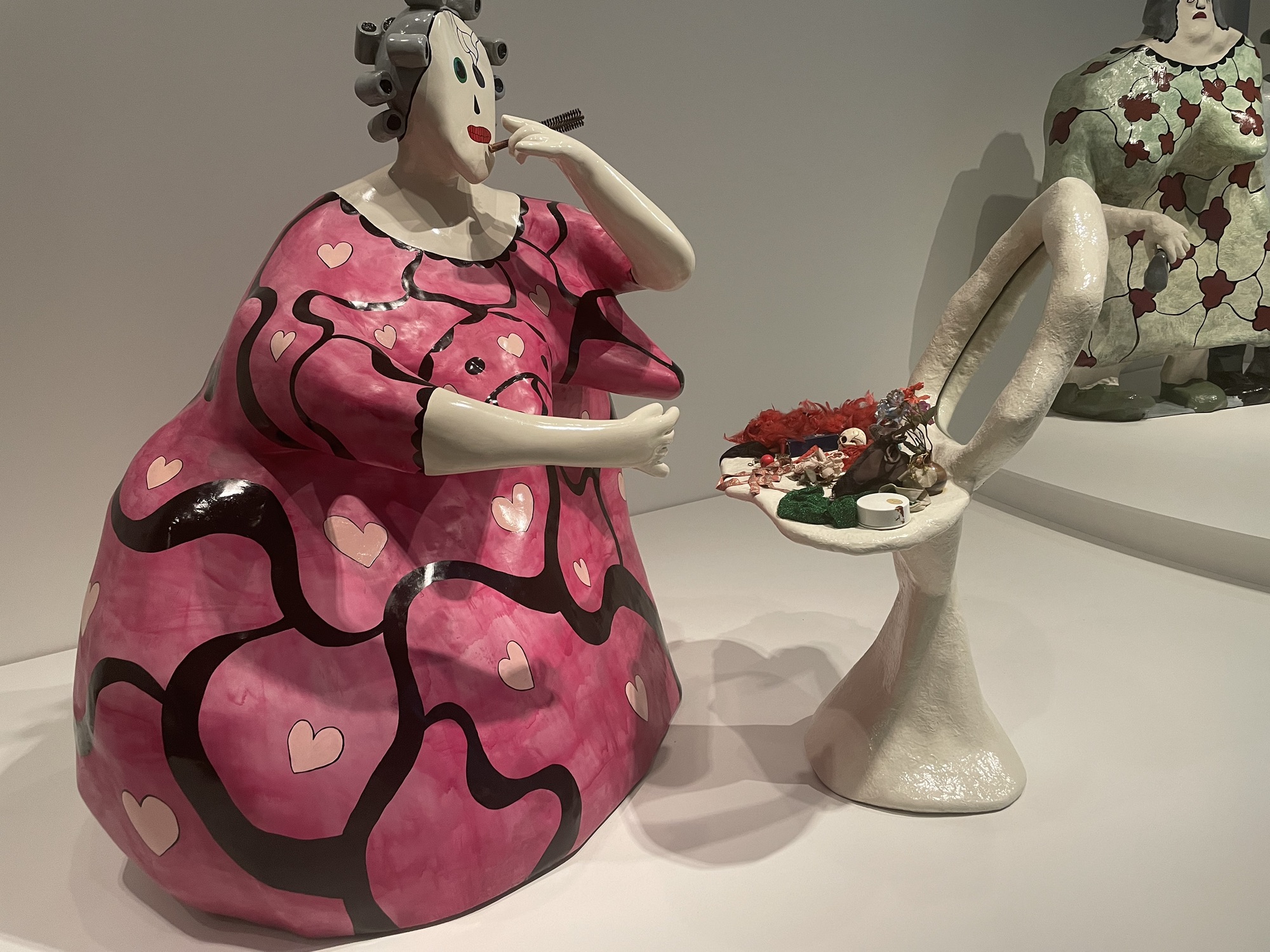
When entered the exhibit, “Niki de Saint Phalle Rebellion and Joy” and saw her first works of art.  I honestly did not like them.  She was an angry young woman who made white paper mâché creations to which she hung balls of paint.  She then took a gun and shot the paint balls so they splattered all over the art. I watched a video of her doing this.  It was not for me. And I really thought I was crazed for wanting to go to this exhibit.
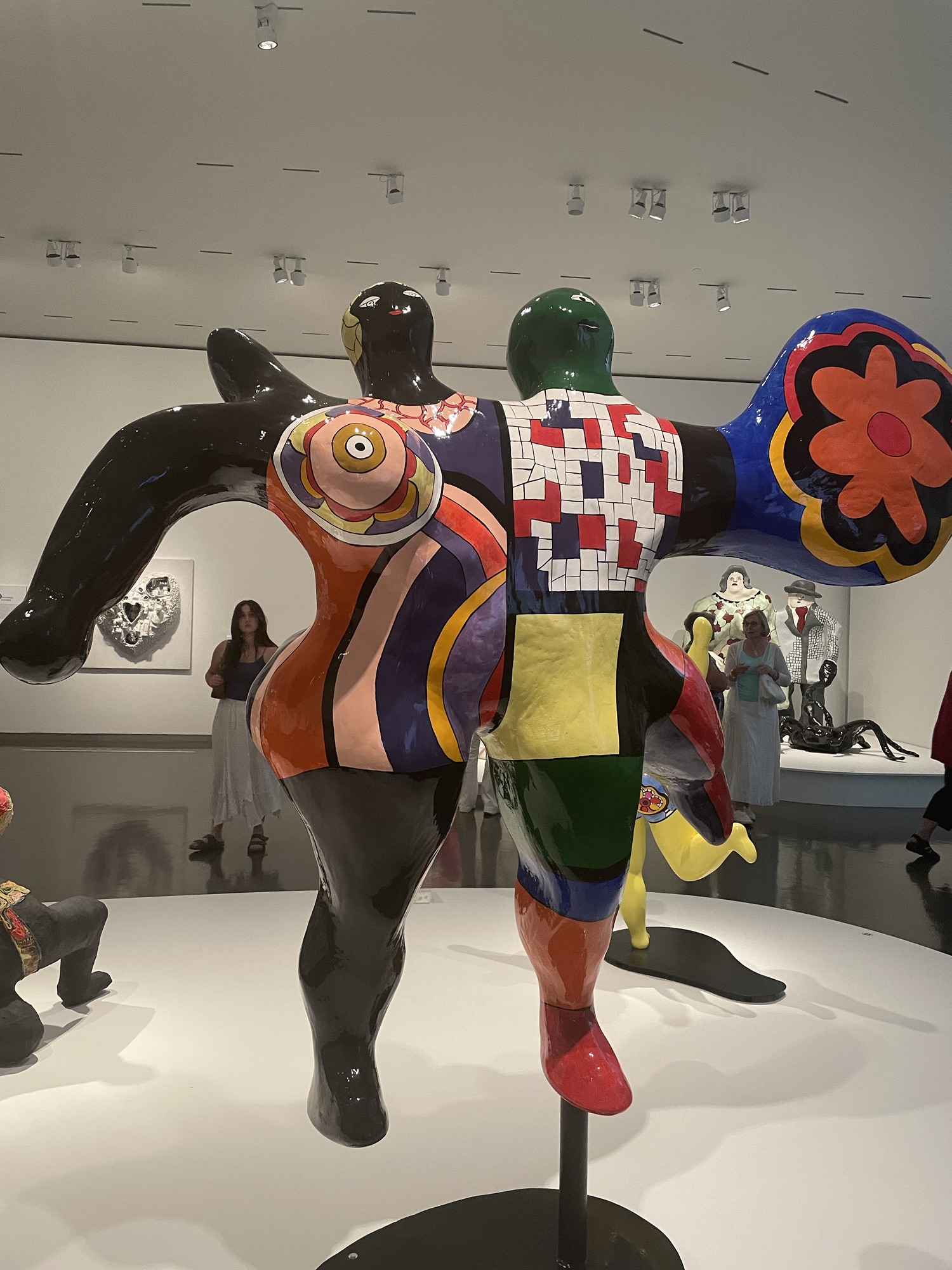
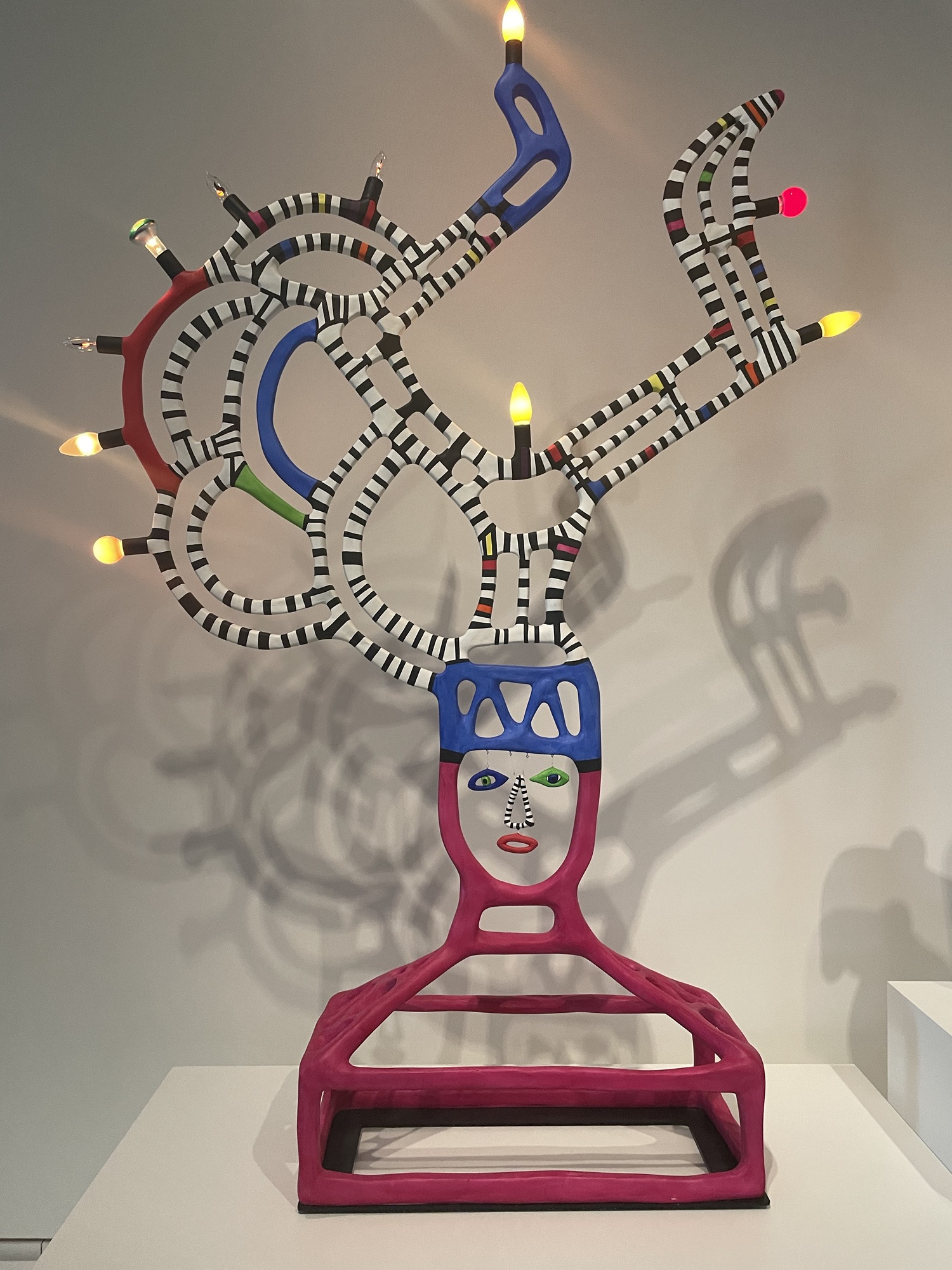
But then we turned a corner.  We saw her ‘nanas’, we saw her ‘skinnies’, we saw large sculptures, we saw maquettes of larger artwork, we saw her paintings, we saw a video of her installations in Tuscany called Tarot Park.  This is a large art installation that made me think about and compare it in a way to Gaudi’s Parc Guell in Barcelona, a place I adore. (See blog below.)

I said, “Ok, Now I know why I wanted to come. This is like the inside of my mind.  It makes me think of Gaudi and Hundertwasser, two of my all time favorite architects and artists. Yes, we had to come here.” (See blog below.)

But I still did not remember the sculpture in San Diego, until I saw her skinnies and read a bit about her life. She lived her last eight years in San Diego and had art installations there. YES. Now it all came back to me. The giant sculpture in San Diego.  It all came together.  I could tell my husband what was going on in my mind.  But by that time he did not mind, he was also enjoying the exhibit.

Niki De Saint Phalle, should never be forgotten.  She believed in Social Justice, Civil rights and support of AIDS patients. In the exhibit it said that she “Strove to create art and environments that inspired hope, freedom, empowerment and imagination.”

Her artworks are fanciful and fun, once she got passed her anger stage.  They brought me much joy to see and explore.  I was so impressed I had to buy “What is Now Known Was Once Only Imagined, An (Auto)biography of Niki de Saint Phalle” By Nicole Rudick.
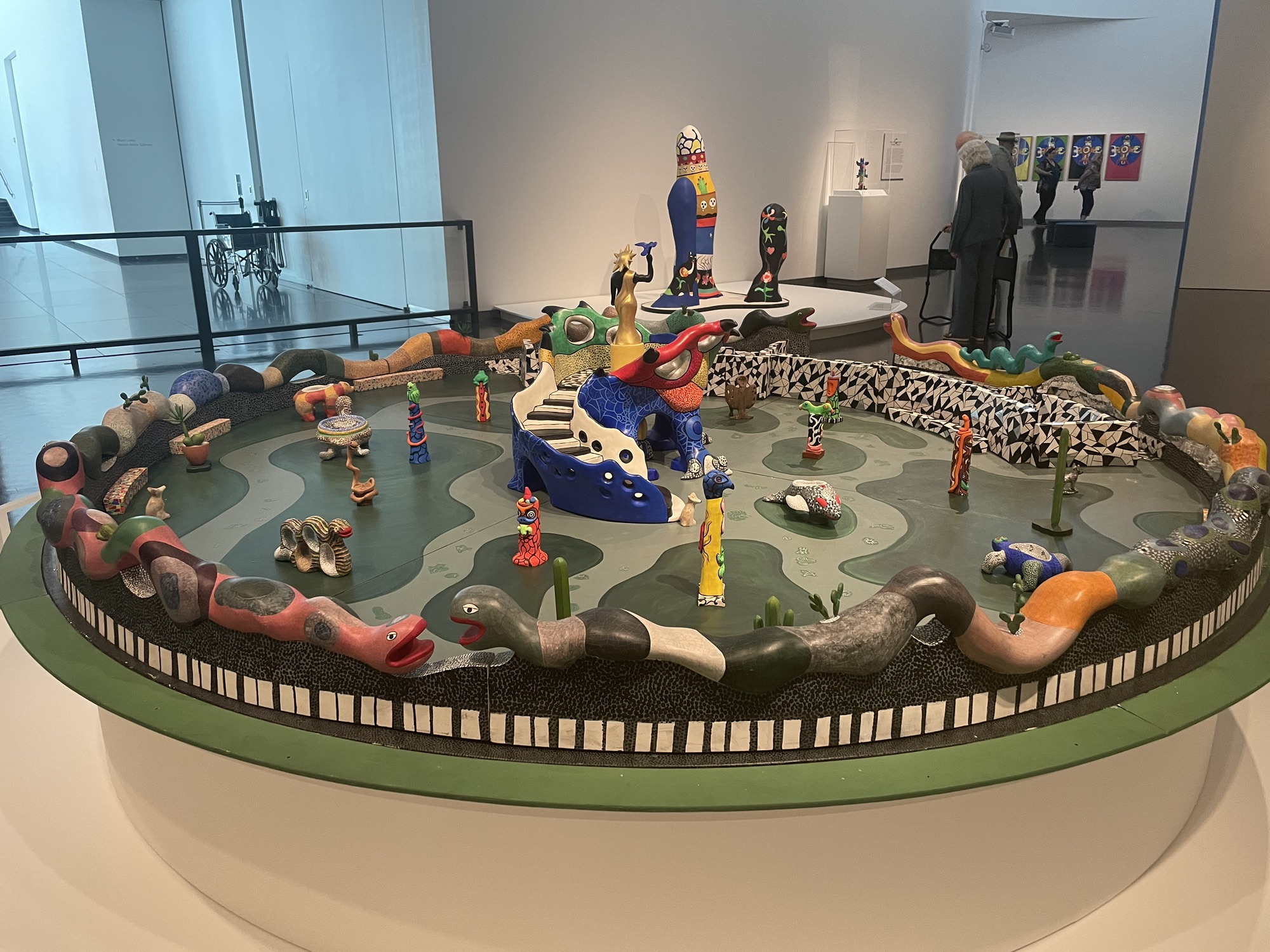
Queen Califia’s Magical Circle marquette.

The exhibit is soon to close. But my interest in her remains.  I am sure that next time I am in the San Diego area, my husband and I will be looking for all of her art installations in the city, and taking side trips to La Jolla and Encino to see more of her works, especially the Queen Califia’s Magical Circle,” of which we saw the marquette at the Nelsom. I also hope I can get to Tuscany one day and see the Tarot Garden!

I thank the Museum of Modern and Contemporary Art in Nice, France, for loaning these works to the Nelson-Atkins! Also thanks to the Niki Charitable Art Foundation in California for sending along some additional pieces. 

https://www.sandiego.org/articles/arts-culture/the-magic-of-niki-de-saint-phalle.aspx

https://en.wikipedia.org/wiki/Tarot_Garden

https://en.wikipedia.org/wiki/Park_G%C3%BCell

What I learned About Hopi Pottery and Navajo Jewelry

21 Mar

As part of our study of the Hopi and the Navajo cultures, we did not just go to museums, we also learned from people who live on the reservation.   Learning about the crafts of Hopi pottery and Navajo silversmithing increased our knowledge about how these crafts passed from generation to generation forming a bond that helped their families survive harsh times.

On the Hopi reservation we met and watched Dorothy Ami as she taught us the art of Hopi pottery. Although her first interest in pottery was just for enjoyment, she eventually apprenticed herself to her cousin, Mark Tahbo, who was a well-known Hopi potter. Both Dorothy and Mark were descendants of Grace Chapella, who learned her craft from one of the original Hopi women who re-introduced pottery to the Hopi Reservation, Nampeyo of Hano.

Our morning with Dorothy was inspiring as we watched her create a pottery bowl; viewed her finished items, and watched her finish painting another bowl.   She spoke to us as she worked explaining the history of Hopi Pottery, about her family, and the way the clay and sandstone come together to form a pot.

Hopi pottery is not spun on a wheel, instead it is made by free hand. She mixes the clay and sandstone, using different colored clay for different types of pottery. She knows when the mixture is ready by tasting it! To make a pot she first forms the first bowl.  She then makes coils of clay and builds the pot, which she then smooths and then burnishes with a river bed rock.

“I let the clay take over,” she told us.  “I cannot force it into a shape.”  After she burnishes a pot that is formed, she thinks about the design for that pot and draws it on a piece of paper.  She knows what each color clay turns when it is fired.  And what the different natural colors that she uses to paint turn as well.

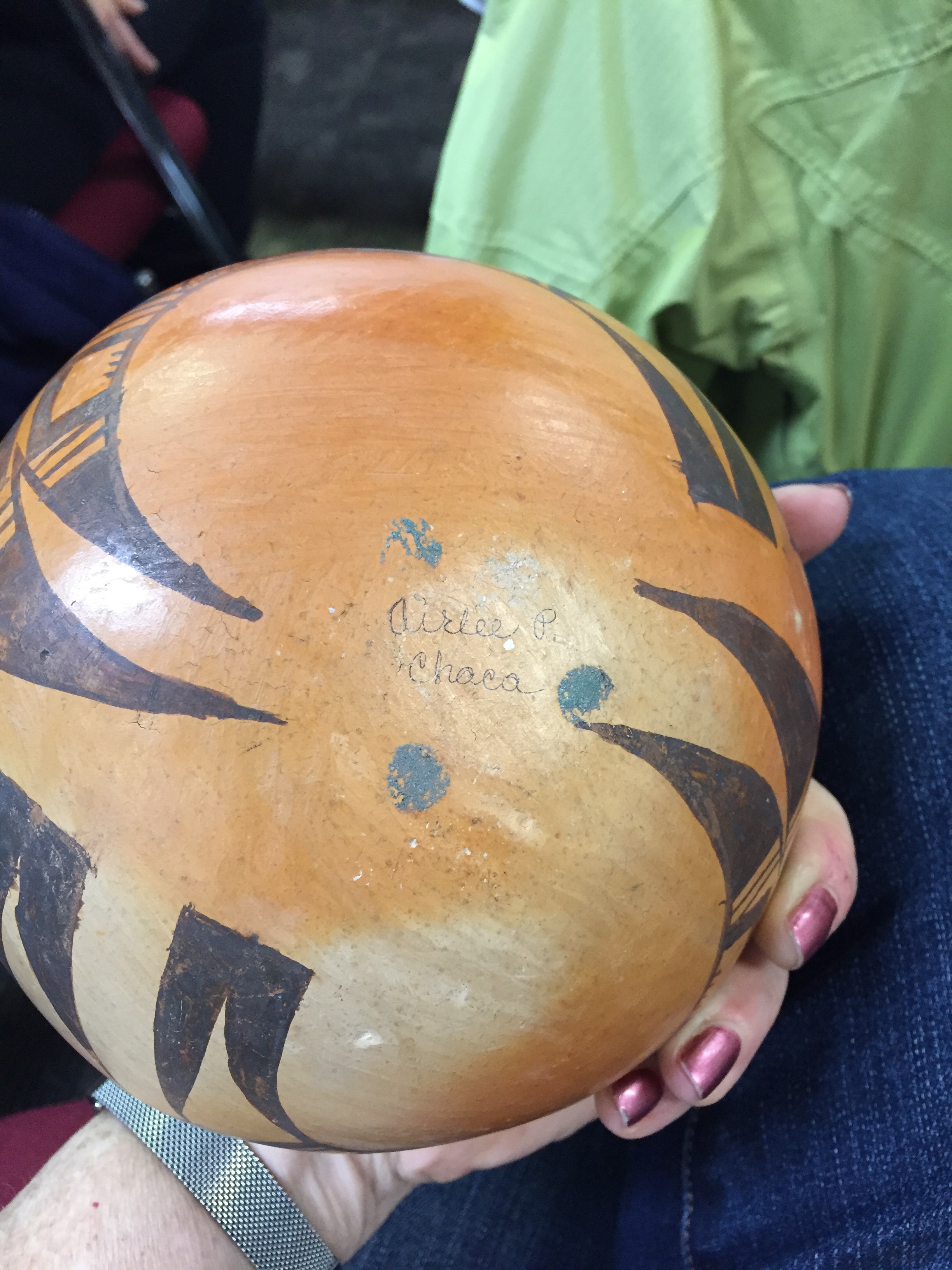
Her pottery pieces were lovely.  To see them in each stage, being formed, burnishing, painting, painted but not fired and then fired, added to my appreciation of what she does and how her art has helped her family survive in a situation where many are unemployed. Hopi pottery making is a skill and a craft that spans generations.  Her children and grandchildren are also now making pots.  And one of her prized possessions is a pot that her grandmother made that she was able to purchase off of EBay!

img_2185

Dorothy’s grandmother’s pot.

Our guide, Azalia Begay, is also an artist.  A member of the Navajo Tribe, Azalia learned the craft of jewelry making from her grandfather who was also a silversmith.  Like those who learn Hopi pottery, the Navajo who learn silversmithing always have an opportunity to have an income in a tight economic situation as exists on the reservations.

For the Navajo people, the art of jewelry making came mainly after they were forced off their lands in the Canyon De Chelly and forced to walk to Fort Sumner in New Mexico.   Many learned the skills of blacksmithing while they were imprisoned for four years at the Fort.  When they returned to Arizona and their Reservation and lands, the skills they learned as blacksmiths became skills that could be used for silversmithing and jewelry making.

The use of turquoise came even later.  The color of turquoise represents the sky to Navajo and it is a symbol of good fortune.  In the late 1800s the Navajo artists combined their silversmithing with the turquoise and an art form was created.  Azalia told us the differences about natural, stabilized, re-constituted and block turquoise.  Don’t ask if it is real.  All of these are real to a degree.  Ask more detailed questions!!!

Azalia uses silver, turquoise and coral to make her lovely designs.  We had the opportunity to watch her make a piece of jewelry as she told us the story of how she learned to make jewelry from her grandfather and the story of the first pendant she made.

After her demonstration, she asked if we would like to see her work.  Of course we did!  There were three pieces that I fell in love with and would like to own.  That was a bit out of reach.  But one piece called my name, and since it was soon to be my wedding anniversary, I thought I needed it.  Azalia makes turquoise and coral into beads.  My necklace is a five-strand turquoise beaded gem!   The other two pieces I loved were also purchased by women on our trip.   We all were delighted with our new original and one of a kind Navajo jewelry.

An added bonus of buying the anniversary necklace was that Azalia helped me search for the perfect pair of earrings to wear with it. We found them from a jewelry vender at the stop in Monument Valley by the John Ford Point, which also has meaning in my life. ( See blog below.)

Learning about a culture includes learning about the crafts that they use to beautify the world around them.  Learning about Hopi pottery and Navajo jewelry enhanced my knowledge about life on the reservations.


 https://zicharonot.com/2019/03/16/monument-valley-invokes-images-of-my-dad/

https://www.adobegallery.com/artist/Mark_Tahbo7775040

https://www.adobegallery.com/artist/Dorothy_Ami196281153

http://aroundtherez.blogspot.com/p/navajo-artist-profile-azalea-begay.html


Chihuly, Stunning

10 Jun

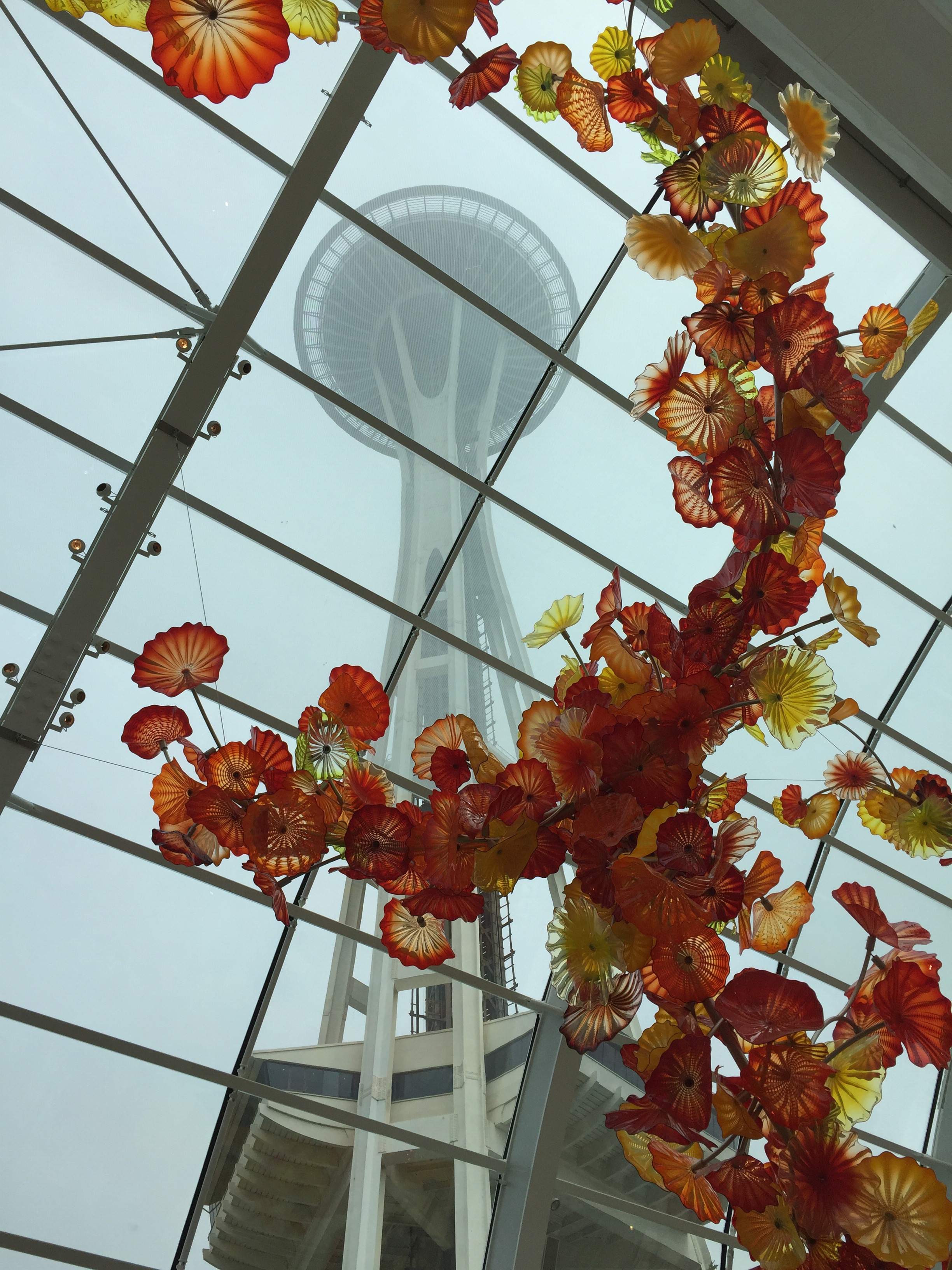
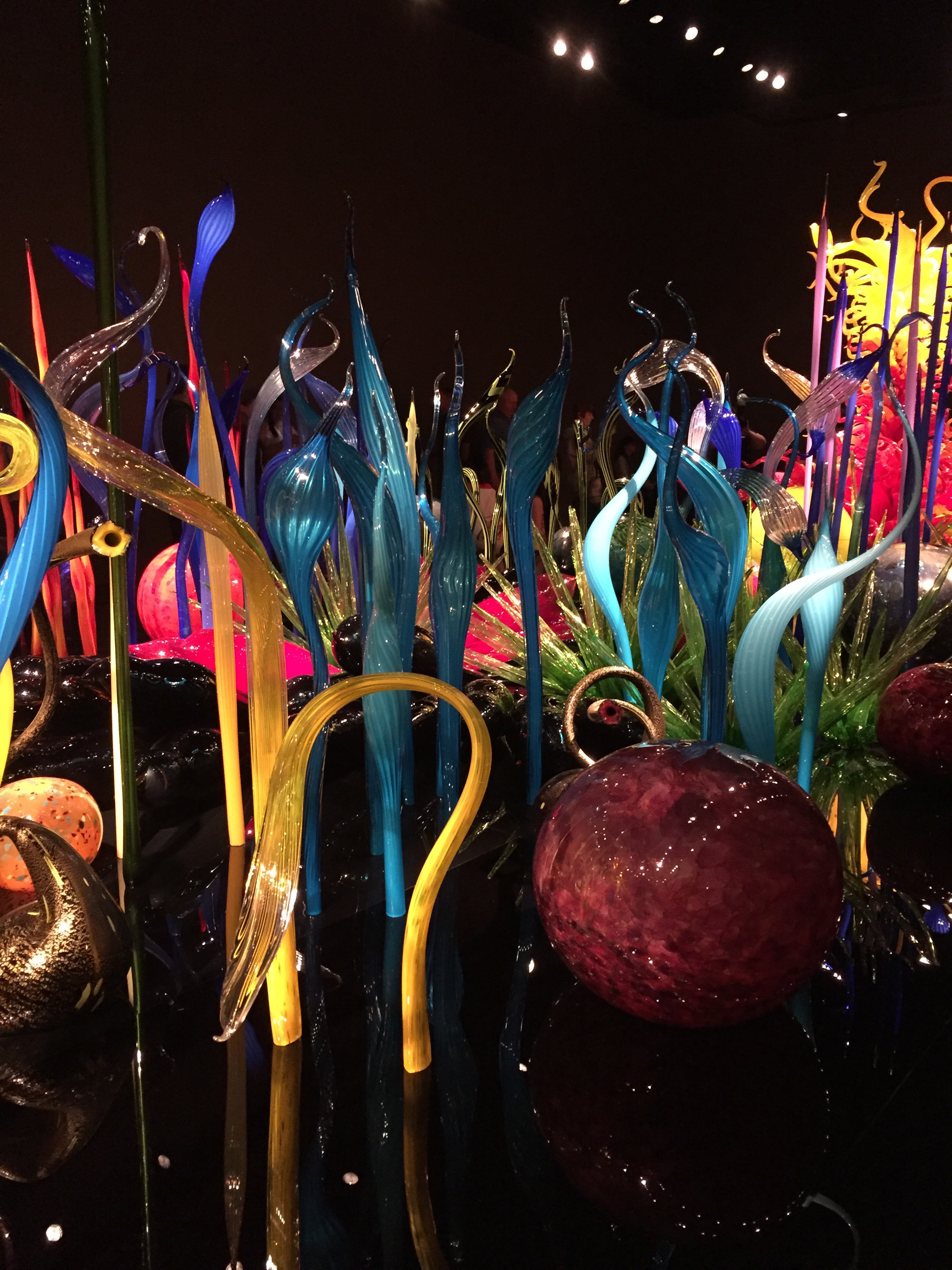
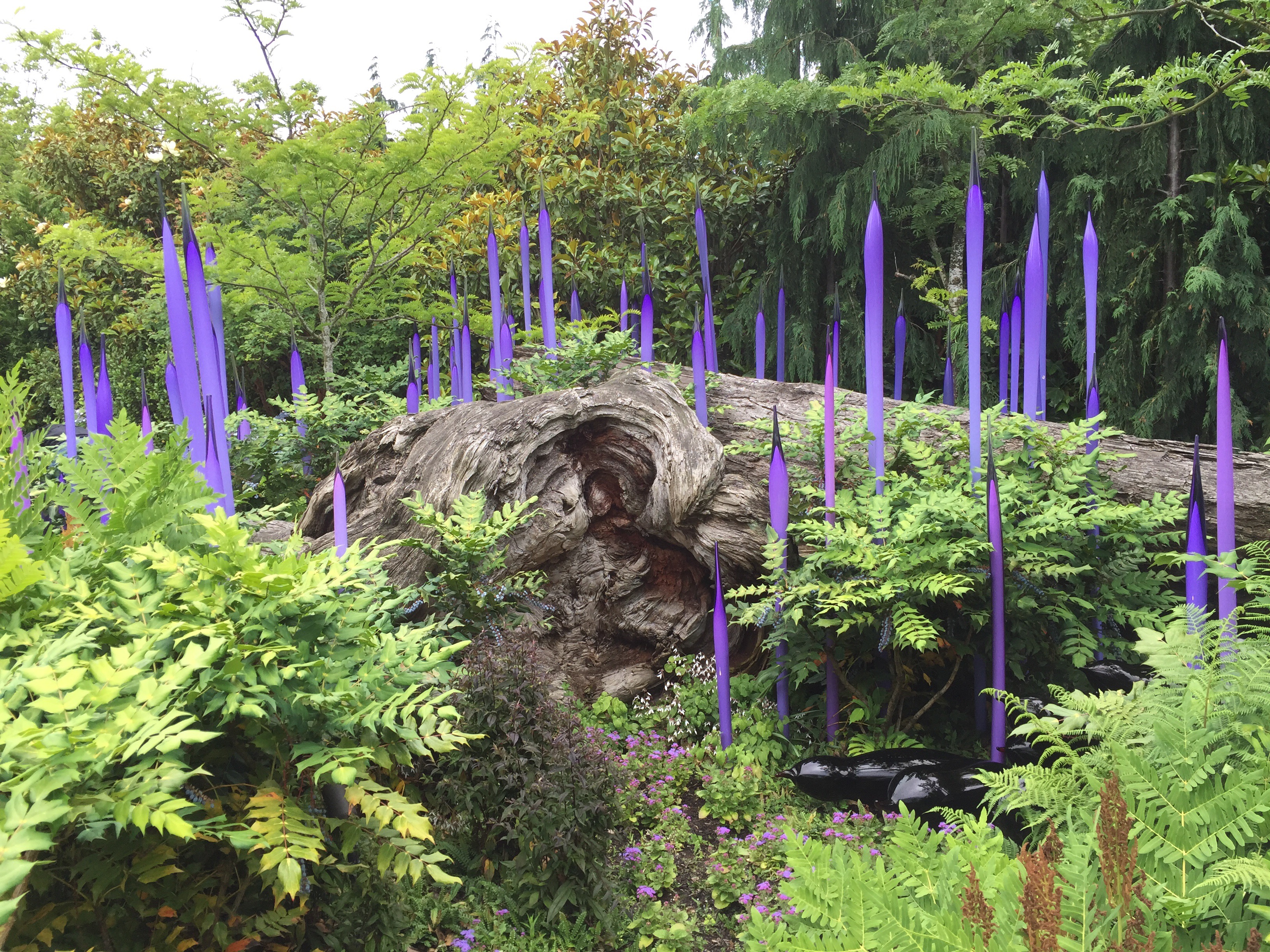
I love the glass art developed by Dale Chihuly. I have seen his art work throughout the United States in Florida, Nevada, Arizona, Arkansas   And finally in his home state of Washington when I visited the Chihuly Garden and Glass museum that shares his name next to the SpacecNeedle in Seattle, Washington. There is something about the vibrant colors and twisted shapes that cheers me. Each of his designs provide me a moment of childhood delights. 


Blues, teals, reds, lilac, violet, orange, gold, black, green, yellow; solids, stripes, mottled; tall, short, rotund, pointed, rounded, spiral, straight, curved.  Is there a descriptive word that cannot be used to describe his work?  I think not. 
For me the glass art of Chihuly is magical! Beautiful, fanciful.


Whether his displays be indoors, within the confines of an exhibition hall, or outside nestled alongside plants or sitting within a pond or creek, each installation is unique and intriguing.  

For those who have not seen his glass sculptures, I entreat you to make the effort. The sparkle of delight will bubble in your soul. At least I hope it will, as it does in mine.