On March 9, it will be the 83rd anniversary of the deportation and mass murder of the Jews of Mielec. The end of the 5000 Jews who lived in the city of Mielec and its surrounding villages, 50 percent of the total population of the area. The home to my grandfather and his family. His father, mother, brothers and sisters were among the Jews were marched out of the town. Some were killed along the way and buried in a mass grave, some sent to death camps where they were murdered. My great grandmother somehow escaped this but died months later, murdered by a German, turned in by her old neighbors. (See blogs below.)
My Great GrandfatherMurdered, but not forgotten. Both photos by Izabela Sekulska.
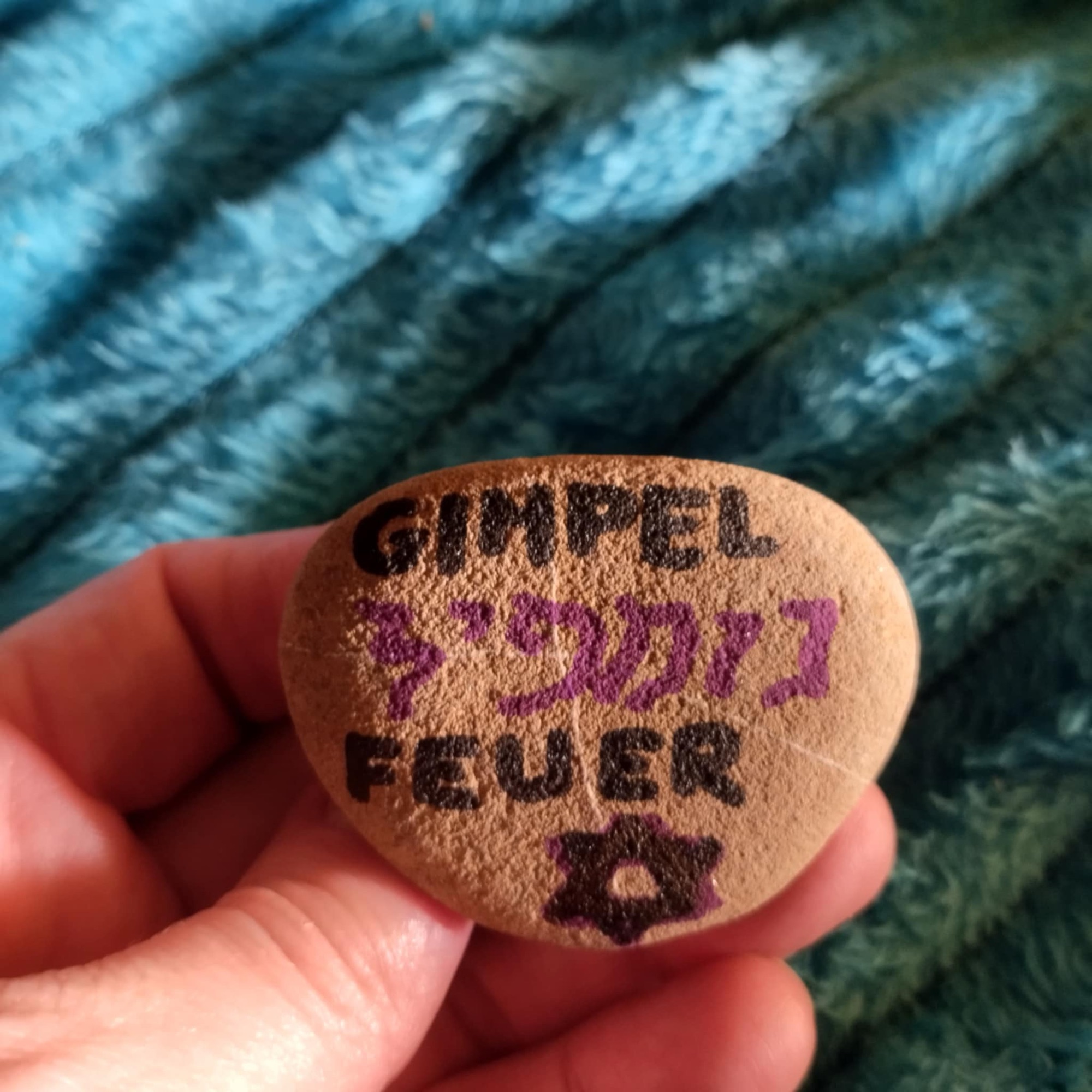
Thanks to the amazing Izabela Sekulska, my family members are now remembered. Since March 9, 2020, a group of Polish people from Mielec remember the deportation of the Jews of Mielec. They will gather once again at the mass grave, read out the names of 105 more people who they now know. So far they have made stones for 1000 Jewish residents who were murdered in the Shoah. Included in this list are eight of my relatives. Gimple Feuer, Chava Amsterdam Feuer, Taube Amsterdam Feuer, Nachum Amsterdam Feuer, Shimon Amsterdam Feuer, Ceia/Tzilia Amsterdam Feuer, as well as Natan Amsterdam and Tauba and Marcus Amsterdam. For each a stone has been painted and will be left on the mass grave. You can learn more about their work on the Facebook Group, Mayn Shtelele Mielec.
I thank those who work to keep their memories alive in Poland. Who do not forget the mass graves of Jews still buried and unknown. In my heart I will be there on March 9 and I remember those who died due to hatred in the past. Now I have a date to say Kaddish for my family.
I will think about those still hostages in Gaza, also murdered and tortured and held against their will while the world is mainly silent. And I will think how once again the Red Cross and the humanitarian agencies did nothing to save them. Just as they did basically nothing during the Shoah.
I will think about the UN, whose voice was silent during the brutal rape and murders of Israelis and others who were caught in in the Hamas murder spree. Who voice was silent for 18 months toward Jewish hostages and Israel, but not silent in still supporting Hamas. I will think about the UN who recently cut off all aid to Yemen after the Houthis took over 20 UN workers hostage. But who did not cut off aid to Hamas after their violent attacks. Double standards for sure.
I will think about college students and professors who turned in support for Hamas and tormented and attacked Jewish students, faculty and administrators. And we now know that Hamas was infiltrating these groups and had a hand in the protests. And I will think about the university administrators who said the words “kill all Jews” had to be taken into context before they could say this was wrong. I am glad that now those who are violent and threatening are beginning to realize this is not free speech and are expelled from their universities. I have nothing against a civil exchange of ideas, but the violence and threats are not that.
I will think about the current administration and its two-sided ideology. On one hand saying it is working to end anti-Semitism, but on the other hand getting rid of DEI initiatives that hurt minorities and the attacks on Hispanic members of our communities using the threats of ICE to scare and threaten them. As well as their attacks and efforts to silence the LGBTQ+ community, just as the Nazis also tortured and murdered those who were homosexual.
I will think about the last two years, the present and the future. I will think about the fact that my husband told me next time I visited our daughter in Israel I should look into getting Israeli citizenship. Is America ever going to be great again for the Jewish citizens? I am not sure. I know many think that the current president supports the Jews. But I see something totally different. A support for Israel because it fits his needs now, while at the same time supporting those who would make the USA a nation with against those of different religions and ideologies.
But I will also think about the helpers. Those in Poland who remember what happened and are trying to make a change. Those in the USA who speak out against baseless hatred. And I will try to have hope that this insidious evil that seems to have arisen will soon slither back in to the underworld where it belongs.
So much information has come my way since Izabela S. contacted me. But the first in-depth story I must tell is about Zissel Feuer, my grandfather’s second cousin, who married my grandfather’s first cousin. I have learned so many details about how he survived and what he did immediately after the war, before he made aliyah to Israel.
Before the war Zissel was married to my grandfather’s first cousin, Dvorah/Deborah. Zissel then used the name Sussel or Zygmunt, the Polish version of his name. His life was intertwined with Schulim/Shalom Hollander because they were married to sisters. Shalom’s wife, Cerla, and Devorah were the daughters of Zacharias, my great grandfather, Gimple’s brother. My grandfather told me that Shalom and Zissel were his second cousins from opposite sides of his family. But since his grandparents/or great grandparents were first cousins, there was much intermingling.
Both Zissel and Shalom and their wives lived on a farms in Trzciana close to where my great grandfather had his farm and both Zacharias, the father of their wives and Shalom’s parents had their farms.
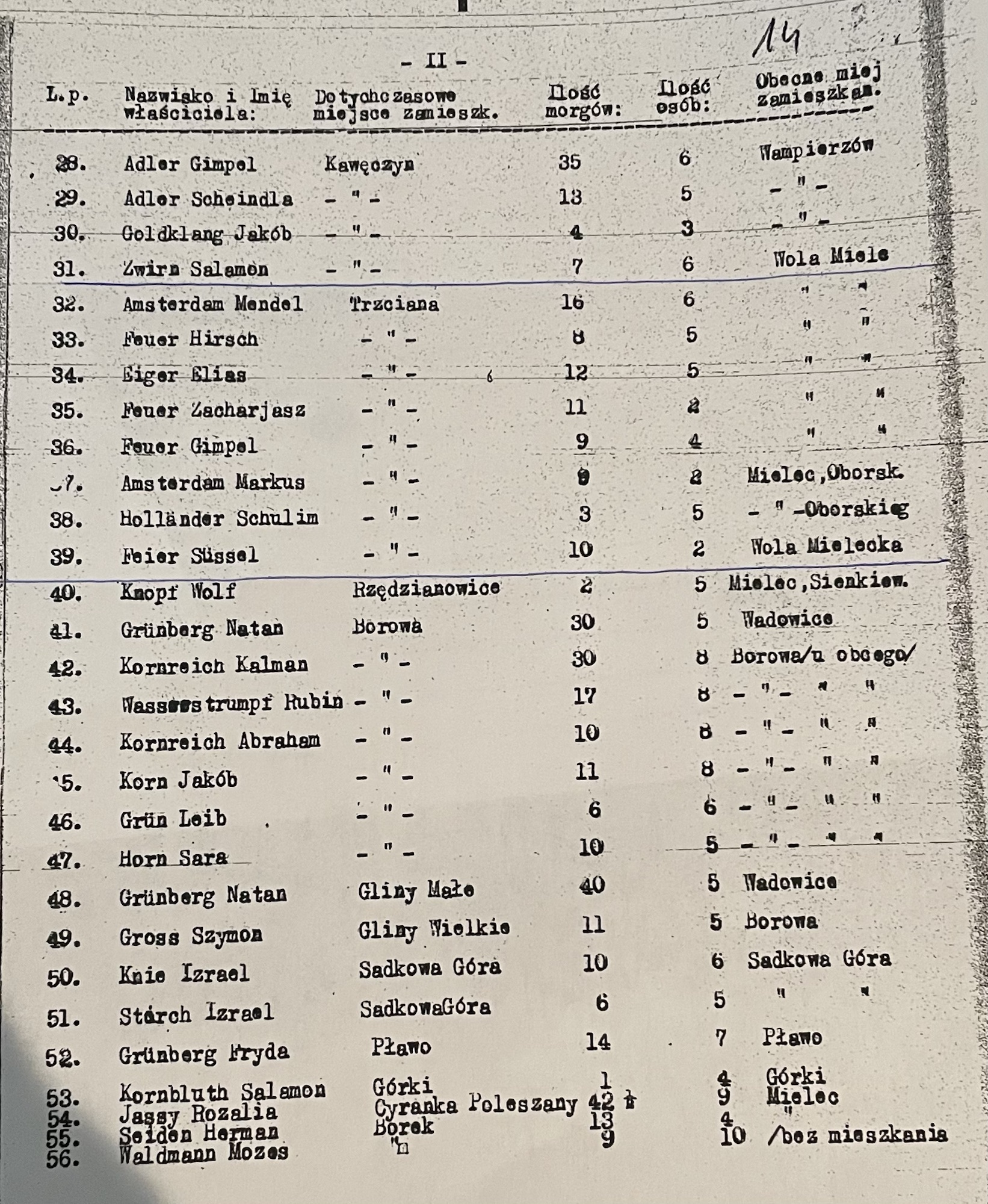
In fact in the document I have, is a list of farms taken from Jewish citizens. The Germans documented everything. Her you can see that seven of my relatives in listed from 32 to 39: Mendel Amsterdam, Hirsch Feuer, Zacharias Feuer (Dvorah and Cerla’s father), Gimple Feuer (my great grandfather), Markus Amsterdam (Shalom’s father), Schulim (Shalom) Hollander, Sussel Feuer. They were all inter-related. My grandfather once told me that this entire plot of land was once owned by his great great grandfather, or even further back. But with each generation the land was split among the sons. There was so much intermarriage as they kept the land within the family.
Zissel was a farmer and a corn merchant. I know that they also had potatoes and other crops on their farms. But it doesn’t matter, they were all forced to turn over their lands to the Germans in 1941.
After they were all forced off their land, Zissel and his wife; Gimple and Chava, my great grandparents; Zacharais, along with other Jewish farmers, were resettled in Wola Mielecka, a nearby village. Shalom and Cerla and his parents were sent to Mielec where they had a home. And then began their efforts to survive. I will let you know in advance, only Shalom, Zissel and one other cousins, the son of Zacharias lived. The rest did not survive.
Much of this information about Zissel comes from the book “Sztetl Mielec. Z Historii mieleckich Zydow” written by Andrzej Krempa that Izabela S. translated for me. (In English, Shtetl Mielec. From The History of the Jews of Mielec.”) Other information came from documents that Izabela has uncovered and translated for me. Part is what Izabela and I have determined through our many email conversations and the research I did and memories I took from my grandfather. I will mix her information with the information I know from my family.
So where was Zissel/Sussel and Dvorah during the war after he was removed from his farm? At first they hid with a man named Stanislaw Wojtusiak in Gliny Male and then with Jozef Padykula in Platkowiec. At some point Zissel’s wife was exposed by a resident of Trzciana, then murdered by the Germans. At this point Zissel had to run. He hid in the Piatkowiec forest near Mielec, near the village of Piatkowiec.
In the meantime, On March 9, 1942 Shalom was sent to a Labor Camp in Mielec. He was then sent to Wieliczka, then to Płaszów. He then became one of the people on Schindler’s List and ended up in Brunnlitz.
My one issue about this, is that Zissel told me he had two children. I do not know where they were or their names. But Izabela told me there is a mass grave near Tarnow where 800 children were murdered and buried. These children came from the Tarnow orphanage and ghetto. Shalom and Cerla’s children, as well as any child Zissel and Dvorah might have had, if they were not taken to a camp with their parents, may be buried here. Or they could have been shot at the Tranow Jewish Cemetery. Or deported. In any case we do not know exactly where the children are buried.
Zissel spent the time from March 9, 1942, the date that the Jews were rounded up for deportation and many murdered, until April 19, 1944, wandering and hiding around the villages near Mielec. For part of this time, he hid in Polaniec (July 25 until October 25, 1942). He left that area after the Jews of Polaniec were deported and returned back to Mielec.
He was able to stay hidden for a while. But starting in April 1943, the Gestapo was looking for him. They knew there was Jewish man hiding in the woods. Honestly, I cannot imagine how he survived for so long, having watched so many of his family die and disappear. But he survived! I know he had to have help, because his freedom was always in doubt. Finally in 1944 he was caught by the Polish Forest Administration and turned over to the Germans. But the slippery and I think smart Zissel, escaped. On his way back from Polaniec he was attacked in the village of Otalezh, which he was stripped and robbed. But he survived.
We know this because he filled out a questionnaire at the Central Committee of Polish Jews after the war. (Izabela says this document is now in the Jewish Historical Institute.)
Some of the Jews who survived. Zissel and Shalom are on this list.
After the war, he returned to Mielec, where he became the President of the Jewish Religions Congregation in Mielec. He was among the 55-70 Jews who survived. Zissel, Shalom and a woman named Chava Amsterdam are listed. Zissel was now using the name Lieb Sussel Feuer. His post war address was Maly Rynek 1. Shalom also lived at this address for a while after the war.
I think they still had battles for survival after the war. Padykula, who helped Sussel was accused after the war for helping in the capture of Zissel. But Shalom Hollander wrote a letter saying this was not true. That he actually helped not only Zissel, but also Shalom’s son Nissan. (This is interesting because in his Yad V’Shem list, he details the names of his five children who died. There was no Nissan. There is also no Nissan mentioned on the list of survivors who returned to Mielec. So perhaps it was someone he took care of during the war.)
Zissel did leave Mielec for six months. He visited his brother, Arthur, in the United States. I never him. But I did know that Zissel visited my grandparents. He is the one who told my grandfather that everyone died during this visit. I know from Izabela, that Zissel is one of the witnesses for my great grandfather, Gimple’s death. I know how difficult this was for my grandfather. My mother once told me that after baking all night my grandfather would come upstairs to their apartment and sit and cry with his head on his arms on the table. Can you imagine, not only finding out that his parents died, but his siblings, his entire family. Of those that stayed in Austria/Poland, I only know of four close cousins who survived. Shalom, Zissel and one of Zacharias’ sons. ( will write about one of the son’s in my next blog.) Shalom moved to Israel and remarried.
Zissel also went to see another brother in Berlin and then on to Israel. He did not stay in Israel, instead he returned to Poland. I really cannot understand why he would return, unless he had unfinished business. Which, from what Izabela told me next, I think I know what he needed to accomplish.
In 1947 he owned an apartment building at 41 Sandomierska Street, where he lived. As President of the Jewish Congregation, he began the work of fencing in the Jewish Cemetery on Jadernych Street. But the Provincial Office stopped the work. This is the Cemetery that Izabela now cares for with a group of volunteers. A few kilometers from the cemetery, at Swierkowa Street, there is another mass grave, where the Holocaust victims from Mielec are burried. In the area of this mass grave, Shalom put a tombstone in memory of his parents Tovah and Marcus/Markus Amsterdam. (Tovah’s maiden name was Hollander). It is possible that my great grandparents are also buried in this mass grave.
Zissel also gave testimony for the Polish people who helped him, by writing letters to document what they had done. I have photos of two of these letters, where he mentions Polish people who defended and saved other Jewish people. Two of them are Loen Wanatowicz and Stanislaw Rebis.
Zissel also testified against those who did evil, included a war criminal named Jek. He testified that Jek beat Jews and humiliated Jewish women by ordering them to strip naked. In the Tarnow ghetto he also killed at least three Jewish men.
Besides these testimonies, Izabela told me that there are still rumors about Zissel stating that he cheated some of the people of Mielec. How so? There were many homes that were now vacant because almost all of the 5000 Jews of Mielec and the surrounding area were murdered in the Shoah. They basically were available for people to move in to without having to pay anyone. Zissel, as the President of the Jewish Congregation, said that those who survived and returned were descendants of people who owned some of the property. Therefore, the Polish people now living on the property and in the homes had to pay the survivors for the homes and or property.
I told Izabela, since the families were so interrelated it could very well be that they were distant relatives. But even more important. They had NOTHING left. Everyone was dead. Their homes were gone. They had suffered. In my mind Zissel had done honorable work. He found a way for these people to get some money to begin their lives anew. Perhaps some of them were not really related to the property owners. But they did not belong to the people now living in them either.
(On a side note, I once asked my grandfather if he had tried to get compensation from Germany after the war for the death of his parents or his property. He became very angry and asked the following questions. “Would getting the money bring my parents back? Would getting the money bring my brothers back, my sisters? Would it bring any of my family back? I don’t want their blood money?” We never discussed it again.)
When Zissel was done with this work, he left Poland for Israel. He started using the name that I knew for him, Zissel: no longer Lieb or Sussul or Zygmunt. I met him in 1974. He was living in an apartment near the center of Tel Aviv with another Holocaust survivor. He worked in a bakery not far from the Shuk HaCarmel, the Carmel Market.
The last time I saw him was in 1976 with my grandmother. Zissel was not a perfect man. He stole from my grandmother. He was a bit of a goniff. But perhaps that is what kept him alive and allowed him to help others after the war.
May his name be for a blessing. May his memory live on from the blogs I have written.
During Covid, I tried to do as many activities that I could from the confines of my home. I took online classes, I attended family life events, I even toured museums and their special exhibits. One of the best ones I toured was the Ruth Bader Ginsburg exhibit at the Illinois Holocaust Museum located in Skokie, Illinois. So when I knew my husband and I were going to Evanston, Illinois, for a wedding, I put visiting this museum in person at the top of my list. It did not disappoint.
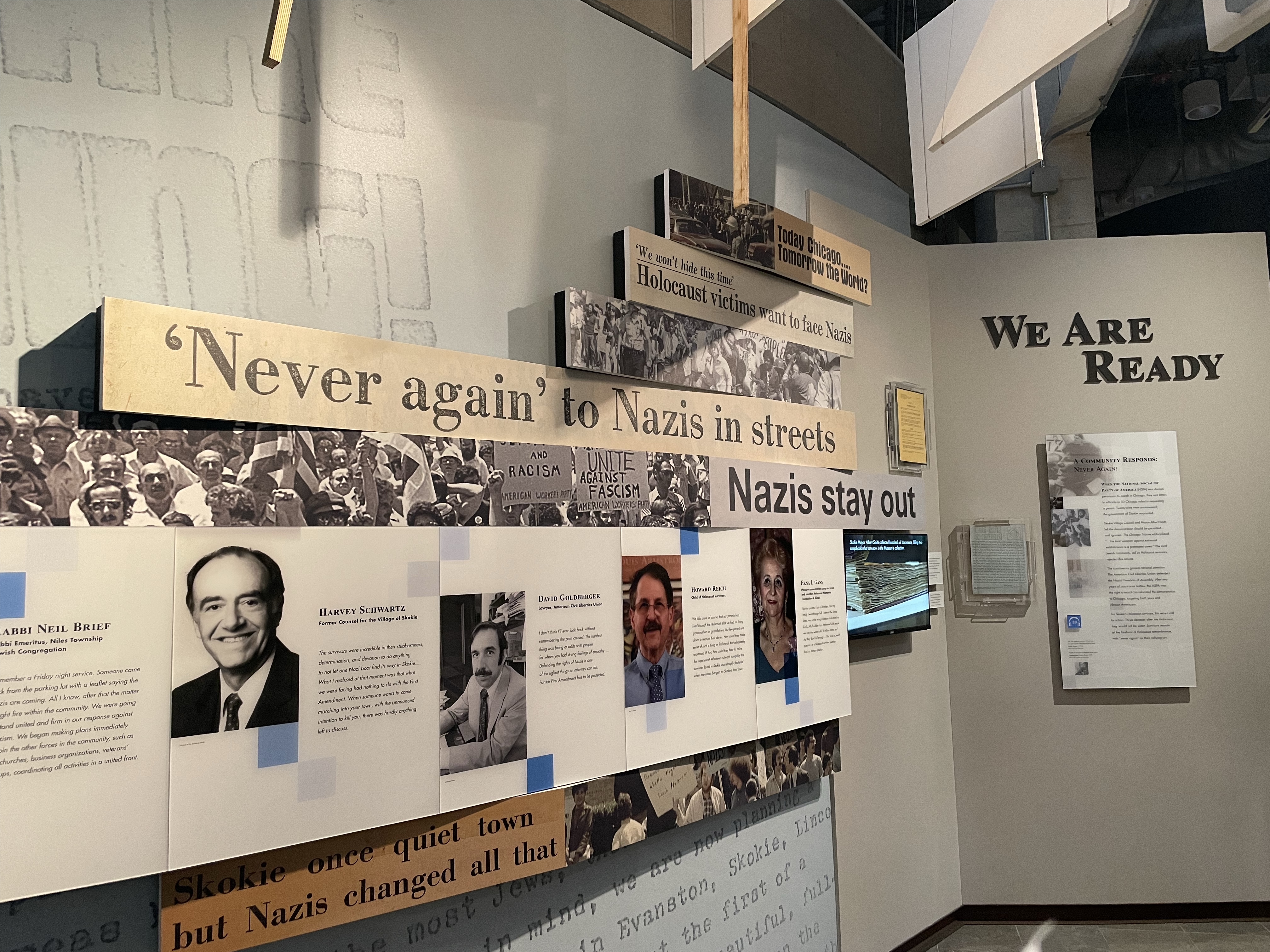
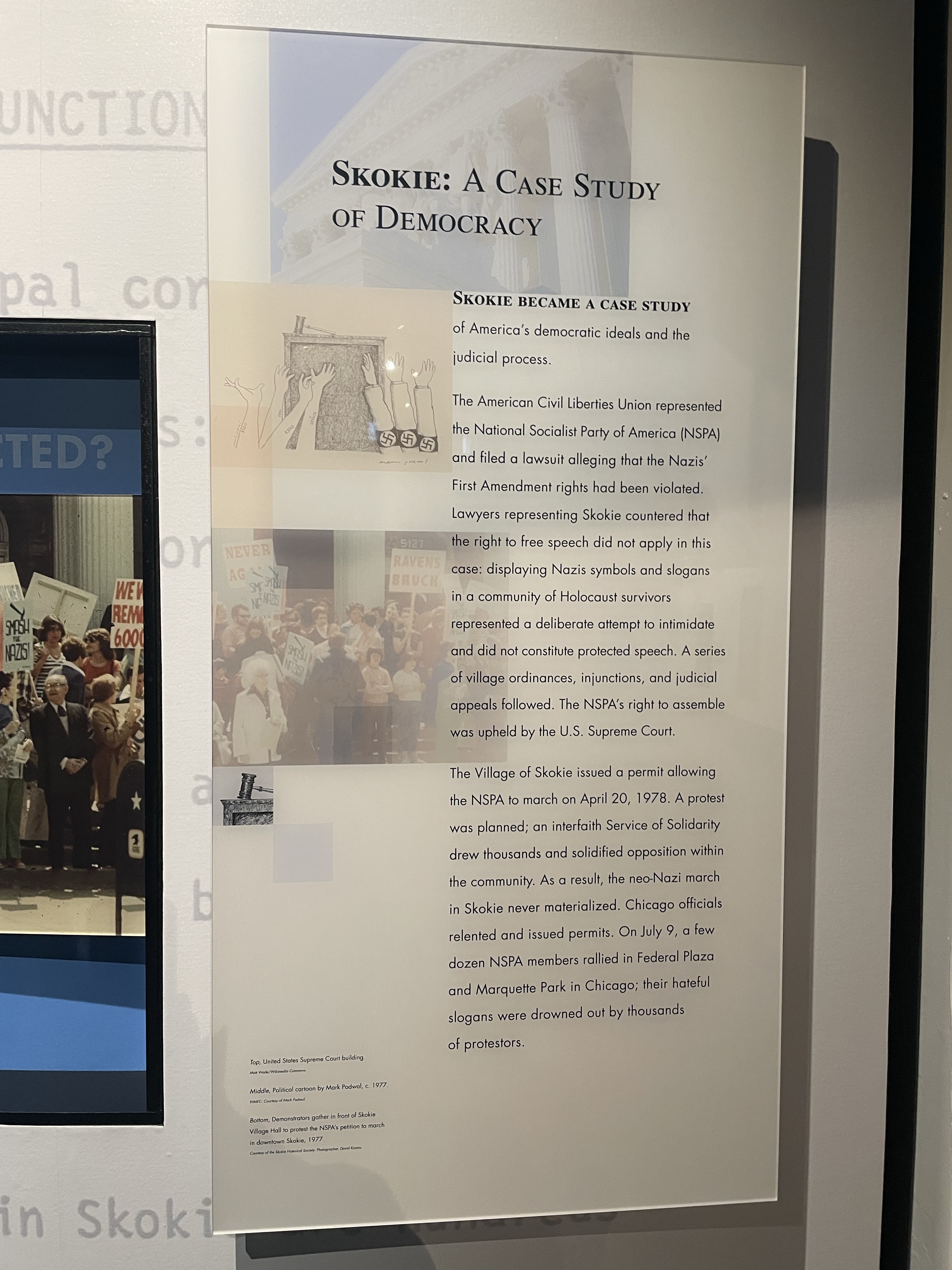
The museum opened in 2009. It was a work in process for 40 years after the Skokie Jewish community was the object of a neo-Nazi group who decided to march through Skokie, a suburb of Chicago that is home to many Jewish residents. The Jewish community started with a small space. But their aim was to fight against anti-Semitism and hatred through education. It looks like they are succeeding in their mission.
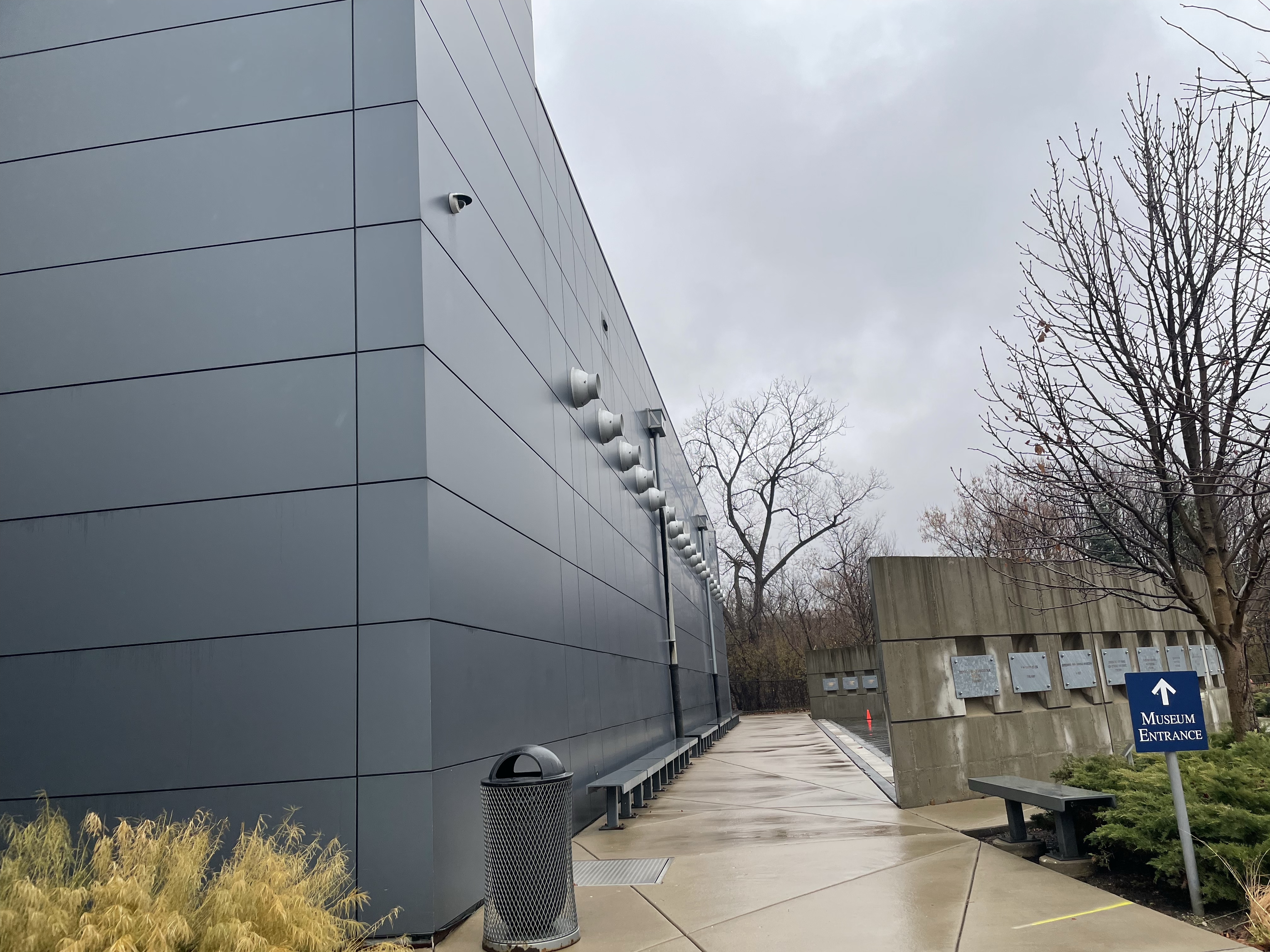
The Illinois Holocaust Museum is worth the visit. It was designed by architect Stanley Tigerman. The building is made is to bring the visitor through the darkness of the Shoah and then back out to the light. As we went through the exhibit we could see this change. The entrance to the exhibit is dark and moody with narrow halls lined with photos, videos and memorabilia. But by the end, when we learned about the resistance and the survivors, the light increased.
While we were there on a Friday morning, there were four different school groups also going through the museum with docents. Every so often the group would fill the space available, so we would stop to hear the discussion. In this time of great turmoil and rise of Jew Hatred, seeing these students and their teachers learning about and basically experiencing what happened was important.
There are many short films/videos and photographs throughout the museum that were taken by the Nazis during their killing spree as well as films taken after the war by survivors and rescuers.
The films are difficult to watch. I saw several students holding their hands and sweaters over their faces as they tried to block the view. I did not want to see it either, even though I have seen these images or ones like them many times.
But this time, I imagined the children on October 7 trying to block the view as they saw the terrorist of Hamas reenacting the hatred of the Nazis and they saw their loved ones murdered and waited for their own deaths. It created harrowing moments for me. I envisioned being held hostage by Hamas underground as if in a camp barracks waiting without food and little hope.
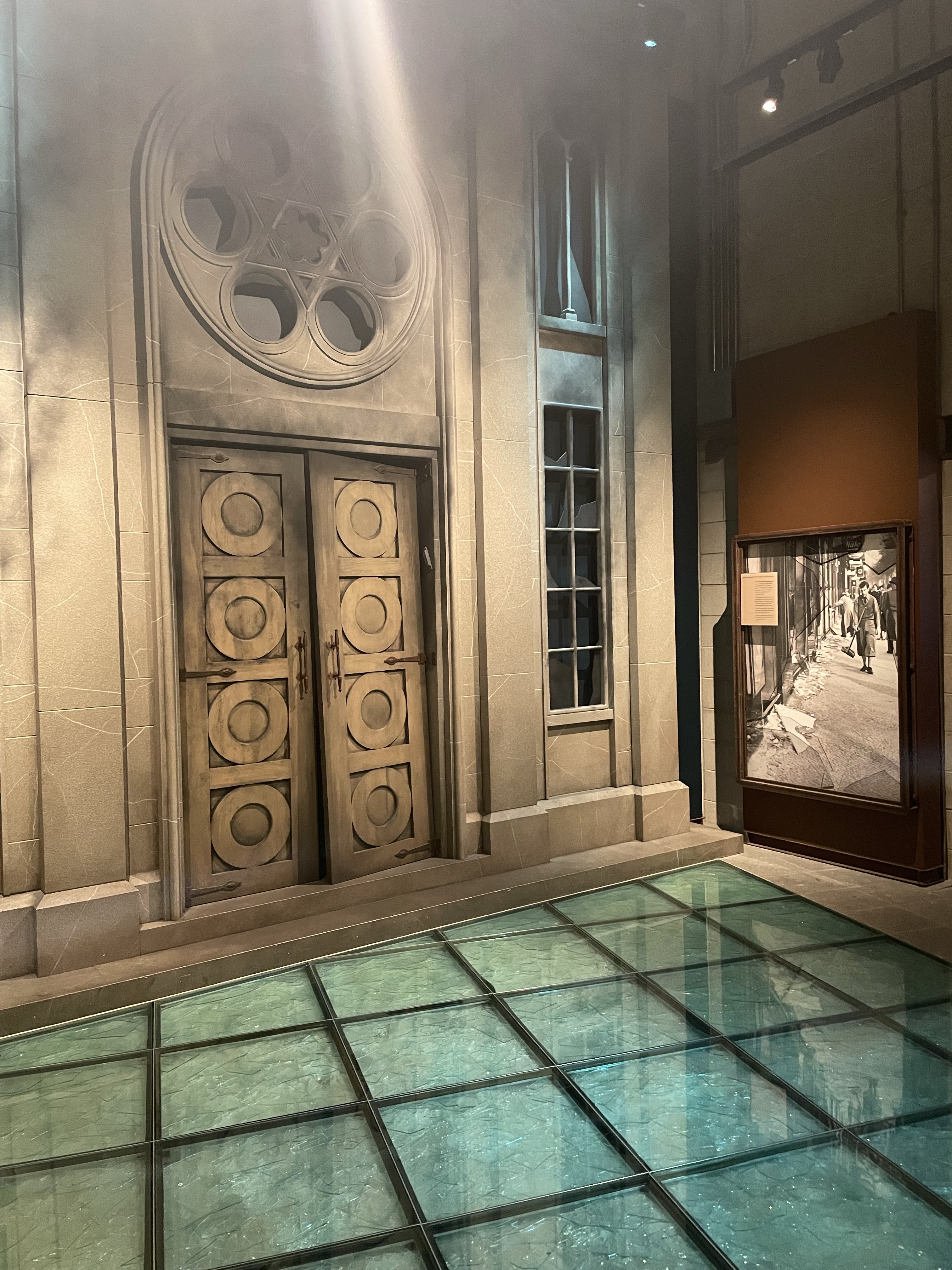
The Holocaust exhibit itself Is well thought out and takes you through all the stages of the Shoah. The moment I saw the Krystal Nacht exhibit, which has a clear floor you walk over with shards of glass underneath, in front is the edifice of a synagogue with broken windows, I knew exactly what you will see next. You can walk into a real cattle car from 1930s Europe. It is an eerie feeling to be standing in that darkened wooden container and think about what it was like for those who were stuffed in and perished. This is not a museum for someone who wants to avoid the past. It puts it right into your vision.
After you weave your way through the seemingly endless horrors of the Shoah, you see a small exhibit about what happened when the Nazis came to Skokie. It puts into ‘context’ what is happening now throughout the USA on college campuses and in some cities. And I will say that calling for the annihilation and extermination of any people is always wrong. No matter what a college president says.
This is emphasized with the movie at the end that discusses both the genocide of the Jews and the continued times others have been targeted like the Tutsi people in Rwanda. We sat with two student groups as we watched the film. It was not easy to watch as people testified about what happened to them during this more recent horror. Many of the students lowered their heads. I think I spent as much time watching the students as I did watching the film.
After we finished the exhibit, we went to the Hologram theater where we spoke with the Hologram of Pinchas Gutter. This is an excellent way to learn about the Shoah. Those brave survivors who spent a week being interviewed and videoed while they told their story have created a way to keep the memory alive.
The museum is not all gloom and depression. There is the good of those who survived. But also when we were there the special exhibit was about delis, “I’ll Have What She’s Having” The Jewish Deli. It was a great way to wash away some of the somber emotions we were having after going through the Shoah.
As a teenager and college student, I worked in a Jewish deli. So for me this was especially joyful as I remember my time behind the counter making sandwiches, cutting lox, deboning white fish and making catering trays. I would almost smell the corned beef, feel the texture of sable fish as I prepared some for a customer, and felt the smooth taste of a potato knish in my mouth.
It was good to end the visit on an upbeat note. But throughout it all I remembered that this museum was founded in response to Jew Hatred. Once again, we are experiencing a major rise Jew Hatred throughout the United States and the rest of the world. There are many who support us. However, when I look at college campuses, I know the work to end anti-semitism and Jew Hatred is far from done. What will be our response globally? In Skokie a museum was created. I am not sure it is enough.
I am a firm believer in the words of wisdom from Mr. Fred Rogers. One of his gems was in times of stress or danger, “look for the helpers.” I have to say that in the last four days, the helpers have been finding me. I did not realize how many helpers there are surrounding me.
Since Saturday, October 7, when the Hamas terrorists attacked Israel and murdered almost 1000 people who were just going about their days and celebrating the Jewish holiday of Shemini Atzeret, I have felt the support of my community.
I have received over 100 text messages, emails, phone calls, and Facebook messages from people, family and friends, living all over the country and Israel. I have heard from friends I have not heard from in several years who want to check in on me. Why me? Because my daughter and her husband live in Israel. And everyone wants to know if they are safe.
My neighbors have called and left me messages. A family member who was traveling overseas, emailed me upon landing in Hungary when she heard about the attacks. My college roommate and high school friends are contacting me. My community in Kansas have reached out. And it is not just me. My husband has received messages and support from his work colleagues and friends.
Our world is so small now. What happens in one community, one country can impact every country. The violence of terrorist has been a bane to many countries: New York, Washington DC and Pennsylvania, USA, Mumbai, India, Paris, France; Buenes Aires, Argentina; and more. The need for security from terrorists/shooters is overwhelming simple things like entering a building, going to school, going to pray.
In most cases the active shooter or the terrorist is easily seen as the one doing evil. It is somewhat disheartening to see on social media and in the news that there are people who are praising the barbaric slaughter of children, women, men, families in their homes, elderly. Many of whom were just at home enjoying a holiday. But not only were they killed but their corpses were mutilated. And many were taken hostage and brutalized and humiliated and hurt. Hamas has shown its true face of evil.
To those who feel that Israel is at fault for this attack, I have to say how would you react if a group of terrorists came over from Mexico and killed 1000 people in El Paso, Texas, and said the USA deserved it because they are treating the South American refugees badly. Would you say the USA deserved once again to be the victim of terrorism? I think not. The citizens of the USA would want revenge, just as we did after 911. It is a war crime to actually target children and non military personal.
According to the United Nations: “The right of civilians not to be arbitrarily deprived of life and the prohibitions against killing or maiming civilians are principles firmly enshrined in international humanitarian law, international human rights law and international jurisprudence. The prohibition of violence to civilians, including children, in particular murder, mutilation, cruel treatment and torture is a principle of customary international law, with universal applicability in all situations of armed conflict.” (See website below.)
I would think that taking children and infants hostage; murdering over 260 teenagers at a party, and murdering families in their homes would be considered a crime against humanity, targeting women, children, civilians is not acceptable in International law. And yes, Israel is now bombing Gaza, and innocents will be killed. And that hurts as well. But as we well know by now that Hamas uses civilians as human shields. Another crime against humanity that must be credited to the evil of Hamas.
Which brings me to another Mr. Rogers quote:
“We live in a world in which we need to share responsibility. It’s easy to say ‘It’s not my child, not my community, not my world, not my problem.’ Then there are those who see the need and respond. I consider those people my heroes.”
When a terrorist attack occurs anywhere in the world, no matter the country, we as the world community need to come together and be the helpers and say this is wrong. We need to help. It is our problem. These attacks do not happen without financial support. The world is aware of where the money comes from to kill. I believe it was due to the process of creating an agreement between Saudi Arabia and Israel that this attacks happened. Hamas and its ally would lose some control if that agreement had occurred.
I know there are those working for peace in the Middle East. I thank them.
For me, I say thank you to all those who have reached out to give me moral support and love during this time of great distress and anxiety for Israel, all of her citizens, my daughter and her husband, my extended family and friends and also for the Palestinian people who are not members of Hamas and who are also suffering due to the terrorists’ unconscionable acts.
May the names and memories of all have been killed be a blessing. May the goodness of the helpers be remembered. I end with one last Mr. Rogers’ quote:








 zicharonot