The Great Rio Grande River Gorge and Taos Pueblo

6 Jun

I wasn’t sure what I would see when we arrived at Taos Pueblo.  Our tour for the morning had been cancelled due to a funeral, but fortunately they were able to reschedule for the afternoon.

Before we even arrived at the Taos Pueblo, we had already visited the city of Taos, where we had time to walk around, see some sites and eat lunch.  We chose to see the Kit Carson home. The most striking bit of information I found there was that Kit Carson’s first wife was Arapaho, as was his oldest daughter, and he had adopted three other native American children who had been orphaned.  These facts made it difficult to reconcile with the same man who was supposedly so cruel to the Navajo people.  However, there is some dispute on what he actually did for and against the Navajo nation. But I digress.

Taos the city, has a nice, small dusty plaza (due to construction), but after being in Santa Fe for five days, it paled in comparison. No matter, I was still glad we had a chance to visit it and see the sites.  After lunch I was ready for our next adventures.  I was not disappointed.

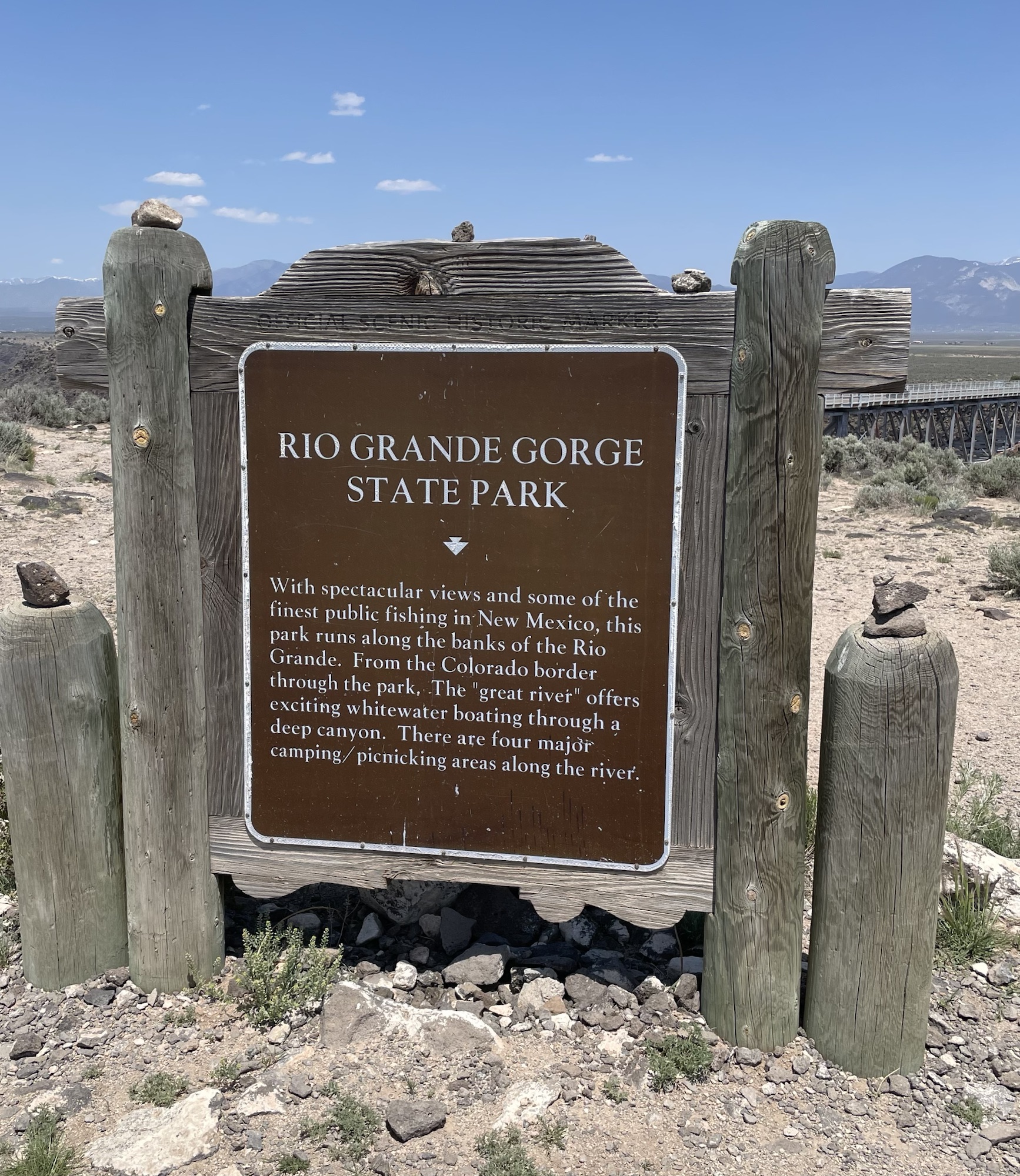
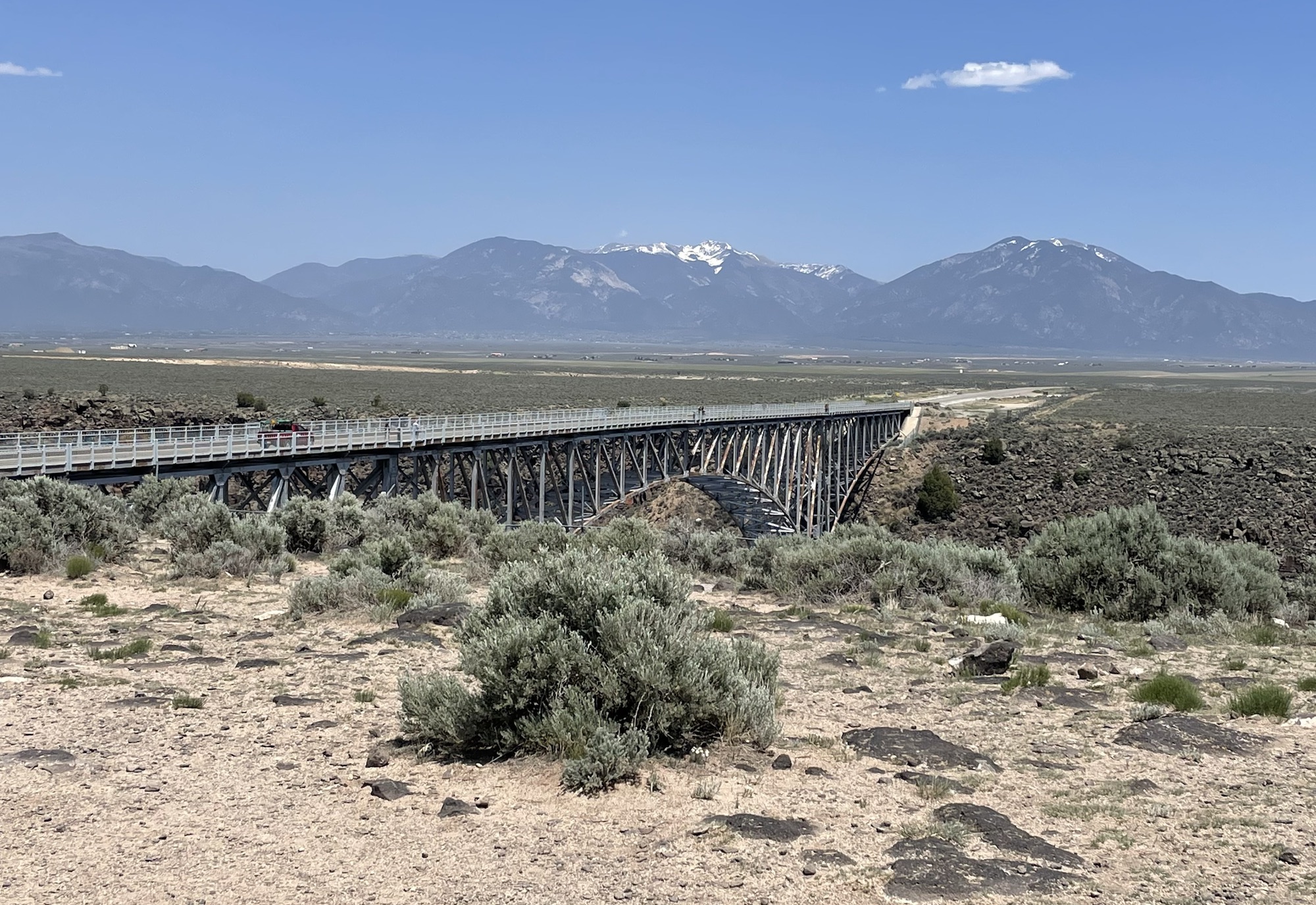
As we drove a bit out of Taos, our tour guide pointed out the flat area we were passing through.  It did look perfectly flat, until it wasn’t!  As I was sitting near the front,  I was among the first to notice a giant rift in the land.  A deep canyon, where at the bottom, ran the Rio Grande River.  Here it did not look so wide, but as we were 600 feet above it, who knows!  As we drove across the bridge, we were amazed that this gorge was here. 

The bus stopped at a overlook area, where others had also come to see the gorge.  Some were students drawing pictures of the bridge and gorge. Some were just looking across in amazement.  Others were shopping for art sold by native artisans.   My husband and I joined the group that traversed over some stones and the barrier to get to the highway and the bridge to view the raging waters from above. Wow! It was well worth going out to see it, even though it was not in our original schedule, making me glad that our trip to Taos Pueblo was changed to the afternoon.

After seeing the depths of the Rio Grande River Gorge, we traveled back towards Taos tothe Taos Pueblo, the home of the Red Willow People.   Since there had been a funeral, there were some places that were off limits. But the main areas of this World Heritage Site were open for us to see. 

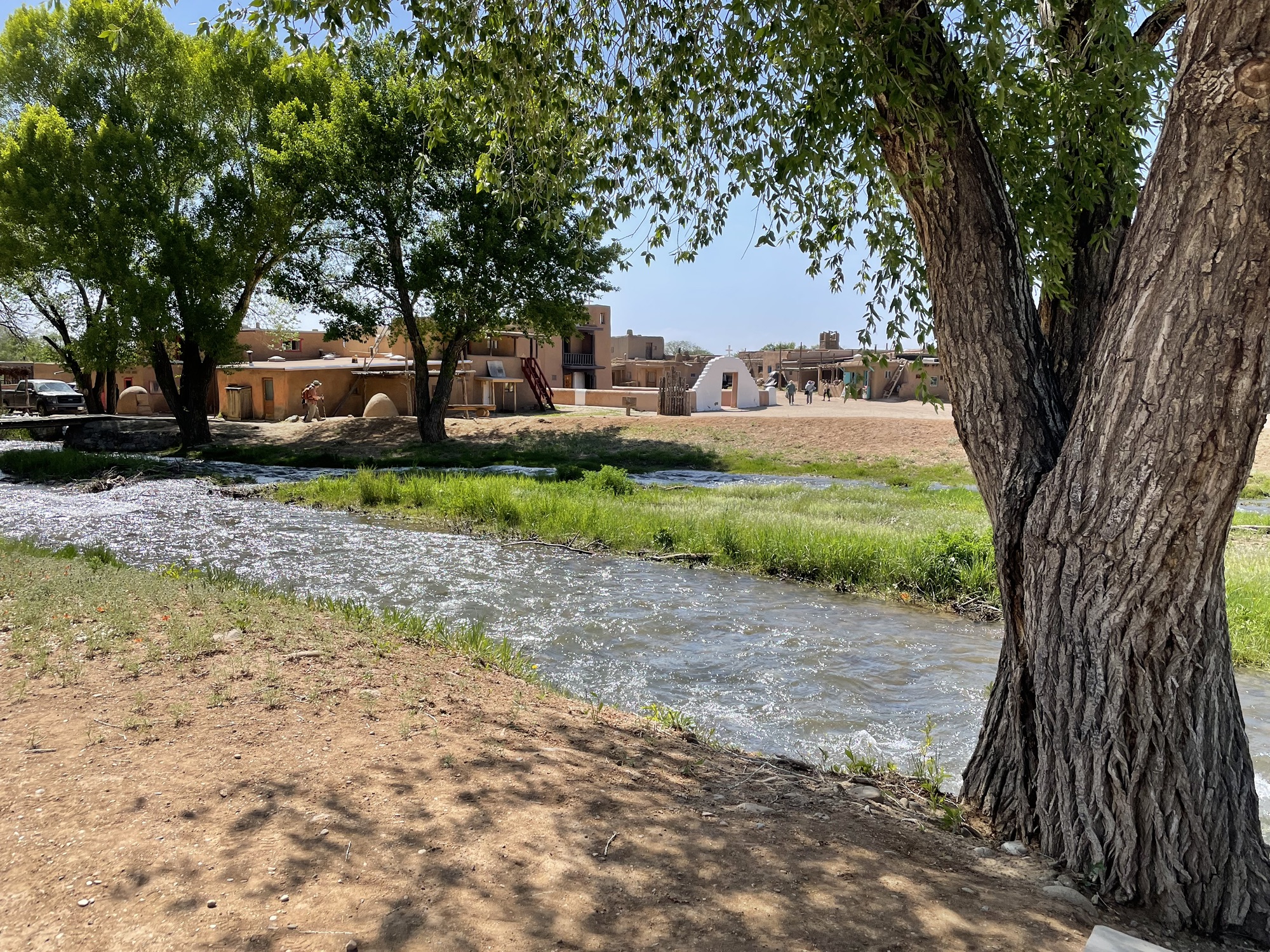
My first thought was ‘perfect setting. What an ideal spot to put a town, where a creek runs through it. With all the snow melt, the water was really running through it.  While most people took photo after photo of the North Pueblo and the South Pueblo, I took photo after photo of the water.  “el agua es vido.”  Water is life.

A young college student provided context for us.  Her family is a member of Taos Pueblo, and they still have a home the Pueblo, even though they do not live at the Pueblo full time.  Only 10-15 families actually live there throughout the year, with no running water, but the creek, and no electricity. These are part of the requirements of a World Heritage Site: no changes.

Our tour started in the Chapel.  We were not allowed to take photos inside.  But there were three things that I was surprised by.  First, it wasn’t a statue of Jesus above the alter, instead it was a statue of Mary.  Second, the decorations surrounding the niche holding her statue was a mural of vegetables, large green leaves. It was very peaceful.  Finally, there was a decorated coffin in the room.  Our guide told us 95 percent of the members of the Taos Pueblo were Catholic, the other five percent practiced the indigenous religions.  The coffin was to remind them that they were forced to convert and that many died.

In my mind this makes no sense, why practice a religion that you were forced into to following, while being such a painful past you keep a coffin in your church.  I even asked.  Her response was noncommittal, but in Taos Pueblo I have the feeling from the décor of the church that their Catholic practice is not exactly what they do in Rome.

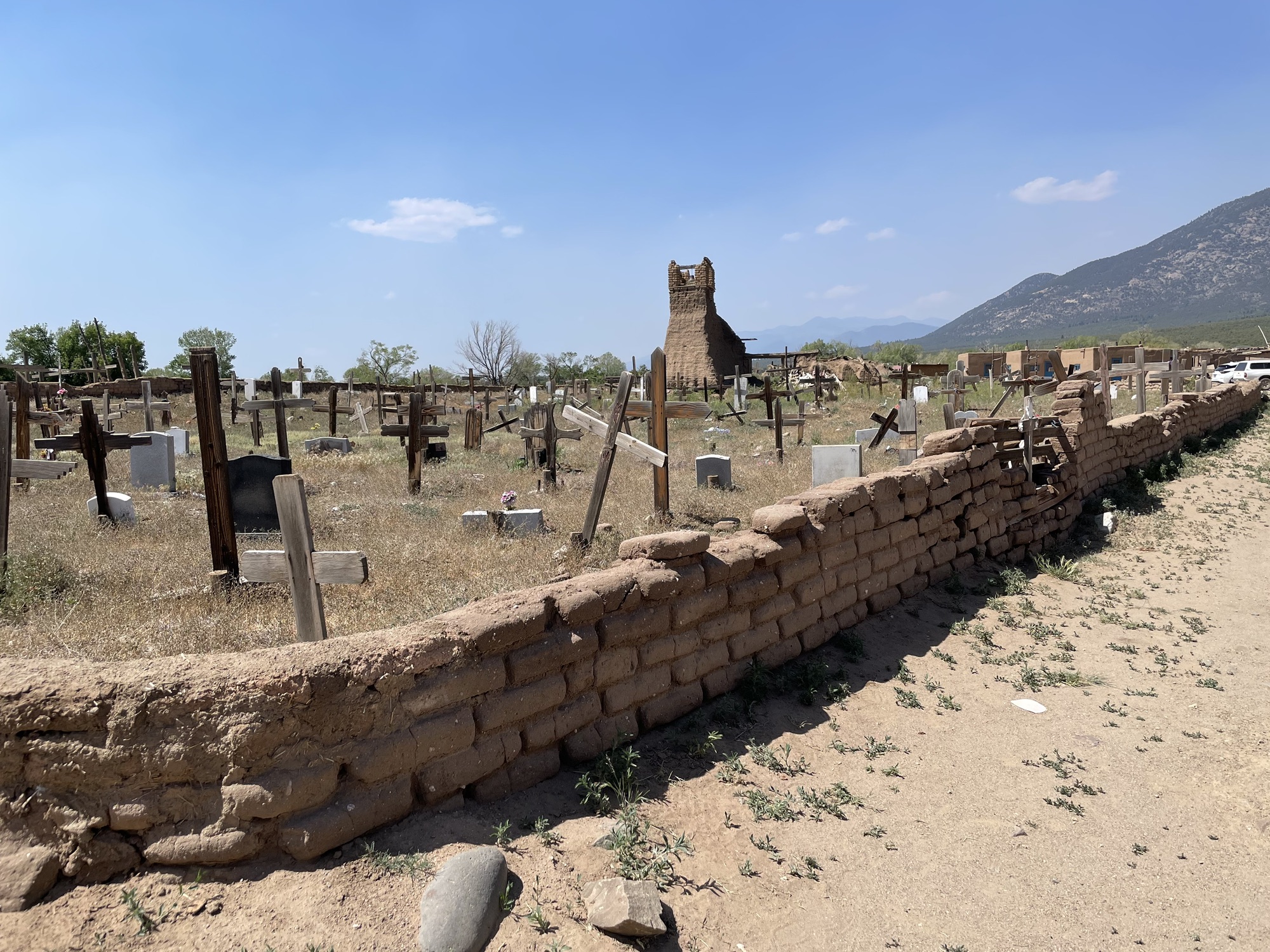
We learned the history about what happened in 1847, when women and children were gathered in the San Geronimo Church for protection from the US Army.  It did not protect them. The Army destroyed the church and killed about 150 people.  Not a good way to start off a relationship between the Taos people and the US government.  But we know that the US government and people were often cruel to the indigenous peoples of the USA.

Taos Pueblo should be seen to understand the relationship of the indigenous people with the Spanish of the early 1600s to the United States in the 1800s to the present.

For those interested in shopping, many of the homes are now storefronts for both food and art. But for me the highlight was just seeing Taos Puebl0 as it would have looked in the 1600 when the Spanish arrived and later in 1800s when the United States took over the New Mexico territory.

Home

Other blogs about New Mexico: https://zicharonot.com/2024/06/09/santa-fes-multitude-of-museums/

Learning about the Crypto-Jews/Conversos in Santa Fe

28 May

As the descendent of a Jewish family that was forced to leave Spain in 1492 or convert, I have always been interested in learning more about the Crypto-Jews/ Conversos of New Mexico.  It was in the 1980’s when the information about this still hidden group first started to be revealed. It started when a Jewish man named Stanley Hordes because New Mexico’s State Historians, and people started coming to him to tell him their stories.  To me it was absolutely amazing that 500 years after the Inquisition in Spain, that descendants were still hiding and still keeping this secret!

I had wanted to attend the Roads Scholar program: “New Mexico’s Conversos and Crypto-Jews in Santa Fe” since 2019.  Covid interrupted my plans. But finally we were able to attend. My family were also once impacted by the Inquisition and Spain’s quest to either convert or eliminate all Jews.  My family chose to move to Portugal and then to Holland.  Our story is written in an earlier blog. (See below.)

We had lectures from the authors of the top two books.

Our first speaker was Professor Ron Duncan Hart, who gave us an overview of the history of the Jews journey to New Mexico. He wrote, “Crypto-Jews, The Long Journey.” Jews were in Spain were given a choice, convert or leave.  Many stayed, they could not afford to go or they thought it would not last long and they would just hide their Jewishness, some decided they really would become Catholic.  But all were doubted because they were not “pure of blood, “meaning they were not just Spanish, they were tainted by either having Jewish or Moslem descent. Those converted in name only and still practiced their religion in secret, known as Crypto-Jews…hidden Jews. Those who were forcibly converted and known as anusim also secretly practiced Judaism.

In fact, so many of the Portuguese who came over to Mexico in the 1600s were of Crypto-Jewish ancestry, that calling someone Portuguese was just another way to say he/she was Jewish. Since my family went from Spain to Portugal, I began to wonder if some of my family made this arduous journey to escape the Inquisition. To be allowed to go to the New World, you had to show that you were purely Spanish, not tainted with Jewish or Muslim blood.  Horrifying!  People actually had their genealogy redone to eliminate their Jewish past to fit the needed requirement.

The Crypto-Jews of today still live in the mountains in northern New Mexico.  They still keep their secret.  In fact, one of our speakers, when asked how many crypto Jews there actually was, basically said, “We do not know. They keep hidden.  They do not talk about it.  They know who the other families in their community are like them. But it is not discussed”

We heard from two women who have reclaimed their Jewish identity.  They were each the child in the home who a parent said “Somos Jodios,” “We are Jews.”  Maria Apodaca told us how difficult it was to come out of hiding and join a congregation and have a ceremony of return.  How family members were not always happy about what they had done.  Many feel, with the way the world is now, it is better to stay hidden!

Isabelle Medina Sandoval wrote a novel based on her family’s history: “Guardians of Hidden Traditions.”  She can trace her ancestry back to Portugal and was able to claim Portuguese citizenship based on her family history.  But she also said that coming out of hiding is a difficult process.  A poet, she has written poems about the Crypt-Jewish experience.

From these two women we learned some of the cultural/religious/cuisine that continues from their Jewish ancestry, like lighting candles on Friday night, covering mirrors when someone dies, making a fried treat at the winter holidays, cleaning the house on Friday.  It is amazing to me that these traditions continue.

Schelly Talalay Dardashti, spoke about: “The New World: Jewish Ehtnicity, DNA& Genetics.“ Schelly is the founder of Tracing the Tribe – Jewish Genealogy on FB. She explained the difference in the different DNA tests and how some do not look for Sephardic DNA, only Ashkanazi.  We were told that between 20-40 percent of people in New Mexico had some Jewish ancestors.  That there are genetic links between those living in northern New Mexico and isolated areas in Central/South America.  People who were also trying to hide away from the Inquisition.  And the final link, a rather sad one, the fact that the BRCA1 mutation that causes brest cancer in Jewish women, is also found in the Hispanic population in Mexico and New Mexico and came from those original converso/crypto Jewish arrivals from Spain in the early 1500s.   Wow.

We attended a performance of “Parted Waters,” a play written by Robert F. Benjamin about the Crypto Jewish community. It tells the story of three generations of a crypto Jewish family.  The grandfather, a crypto Jew; his son, who knows the background, but identifies with his life as a Catholic and does not want to talk about it; and his son, who has never been told about his ancestry.  When the grandson makes a racist comment to a Jewish woman, the truth comes out along with the ramifications.  It pulled together all that we had learned over the week.

Our last lecturer, Chris Herbst spoke about Outliers/Ousiders and Religion.”  He provided us some history about the area of northern New Mexico and more explanations about the genetic composition of the populations today in Spain and in New Mexico.  He said about 1/3 of the population of Spain today has either Jewish or Moorish ancestry.

Throughout all of our talks we were referred back to the book written by Stanley Hordes, who wrote an indepth book about the Crypto Jews called, “To the End of the Earth.”  The Spanish/Portuguese Crypto-Jews traveled to the End of the Earth, the mountains of New Mexico above Santa Fe, to escape the Inquisition.  It is like reading a college dissertation, but it was fantastic in the depth of the research.

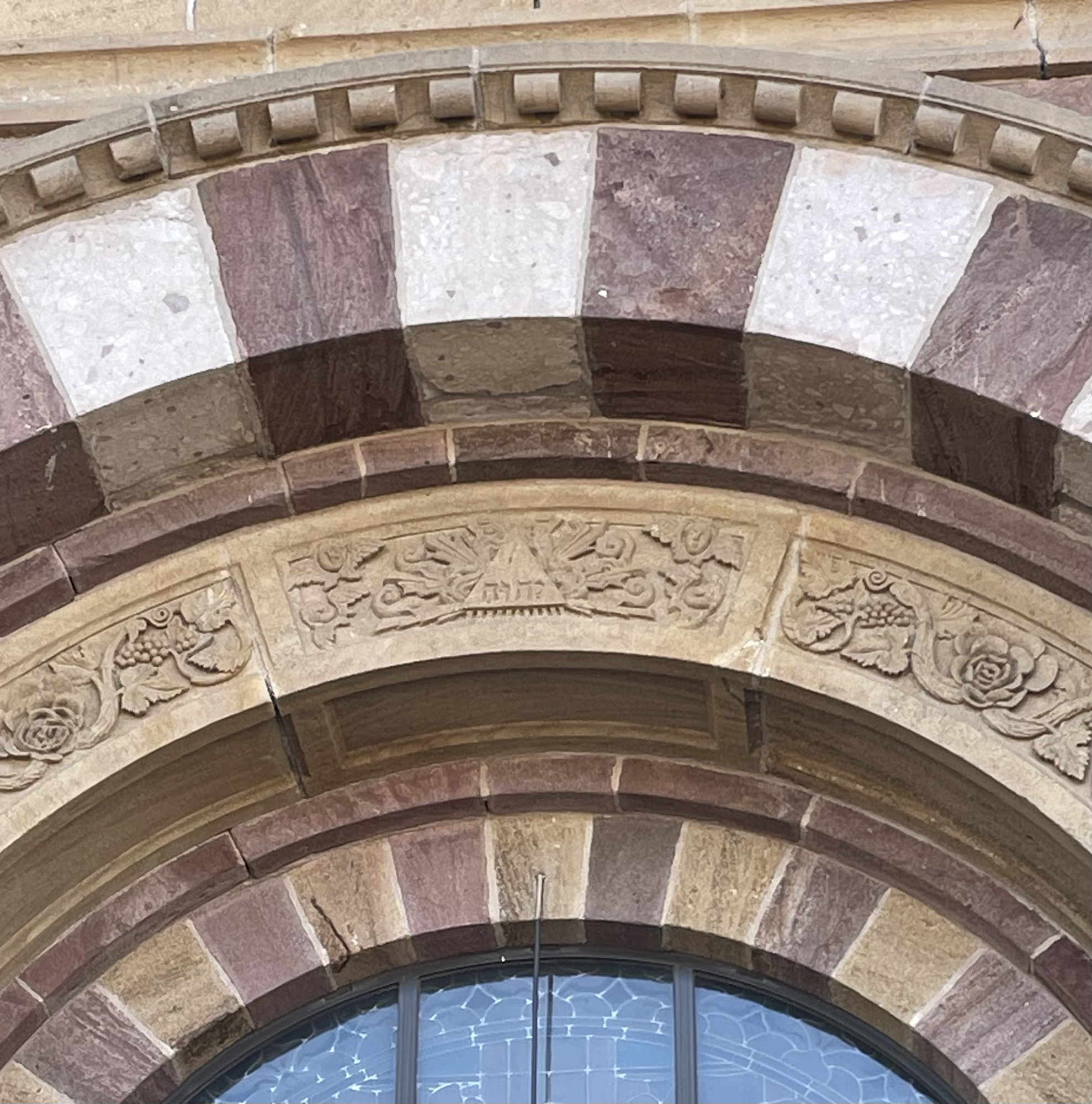
The Hebrew is in the triangle.

We did not spend all of our time learning, we also had time on our own to visit museums and explore Santa Fe.  We went to the  main cathedral of Santa Fe, where over the mantal of the front door, is an inscription in Hebrew and a Jewish Star on an internal wall. 

As part of our Roads Scholar program we also ate at many different restaurants with the most delicious food, toured historic Santa Fe, with our wonderful leader, Vennetta, and went to Taos and the World Heritage Site of the Taos Pueblo.

This was just a wonderful learning experience, where we were able to learn, experience, make new friends and enjoy the true wonders of Santa Fe, New Mexico. If you have any interest in learning more about the Crypto-Jewsof New Mexico, Mexico and Spain, I highly recommend this Roads Scholar program.

I will write about the other places we visited in future blogs.

The Magic City of San Sebastian and a Bit of Puerta Vallarta

16 May

Our cruise ship spent two days docked in Puerta Vallarta, which gave us a chance to do something special.  For me that was to visit the Magic City of San Sebastian Del Oeste about 40 miles up in the mountains.  San Sabastian was the highlight of the places we visited. A small community of 600 people, it was once a thriving town close to a silver mine of close to 20,000!.  It was basically cut off from Puerta Vallarta until a winding road and two major bridges were built about 20 years ago.  Now it is about a 90-minute drive in vans up and up and round and round the winding roads.  But it is well worth the moments of motion sickness.

Our tour guide told us that in Mexico, San Sebastian is known as a “Magic City.”  It actually has been nominated to be a UNESCO world heritage site.  Personally, I love visiting world heritage sites, they take you back into time.  San Sebastian is a perfect example since its original roads/sidewalks and buildings have been maintained and all new buildings keep the character of the old colonial style.

It was founded in the early 1600s for its silver mining and was the home of three Spanish families who made a decision to only marry among themselves to keep their Spanish blood pure.  Definitely a genetically bad idea.  Over time, and the Mexican revolution, the old ways ended and now the families are fulling integrated into the community.

We visited the small museum, Casa Museo Dona Conchita Encarnacion. This tiny building, which was once the home of Dona Conchita and her ancestors, serves as a museum about the town and these Spanish families and their interconnection.  Lupita, the woman who told us about the museum is a descendant, of the Dona Conchita. 

Because it was a silver producing city, the town had some unusual security. The church, Iglesia de San Sebastian, is built like a fortress and the doors could only be opened from the inside.  There was an underground tunnel from the homes of one of the Spanish families directly to the church.  It is quite lovely once you get past the windowless façade.  There are windows, but they are placed high so people cannot break in. But inside they provide wonderful lighting.

The original steep cobble stone streets are difficult to walk on and I think to drive. No busses took us there, only vans. And once I saw the streets, I understood.  The Center of town has a lovely little plaza and shops. While there we walked to a restaurant that served us the absolutely best food we had in all of Mexico.  They serve a specially prepared beef that really is so tender and delicately seasoned.  I still savor the joy of eating there.

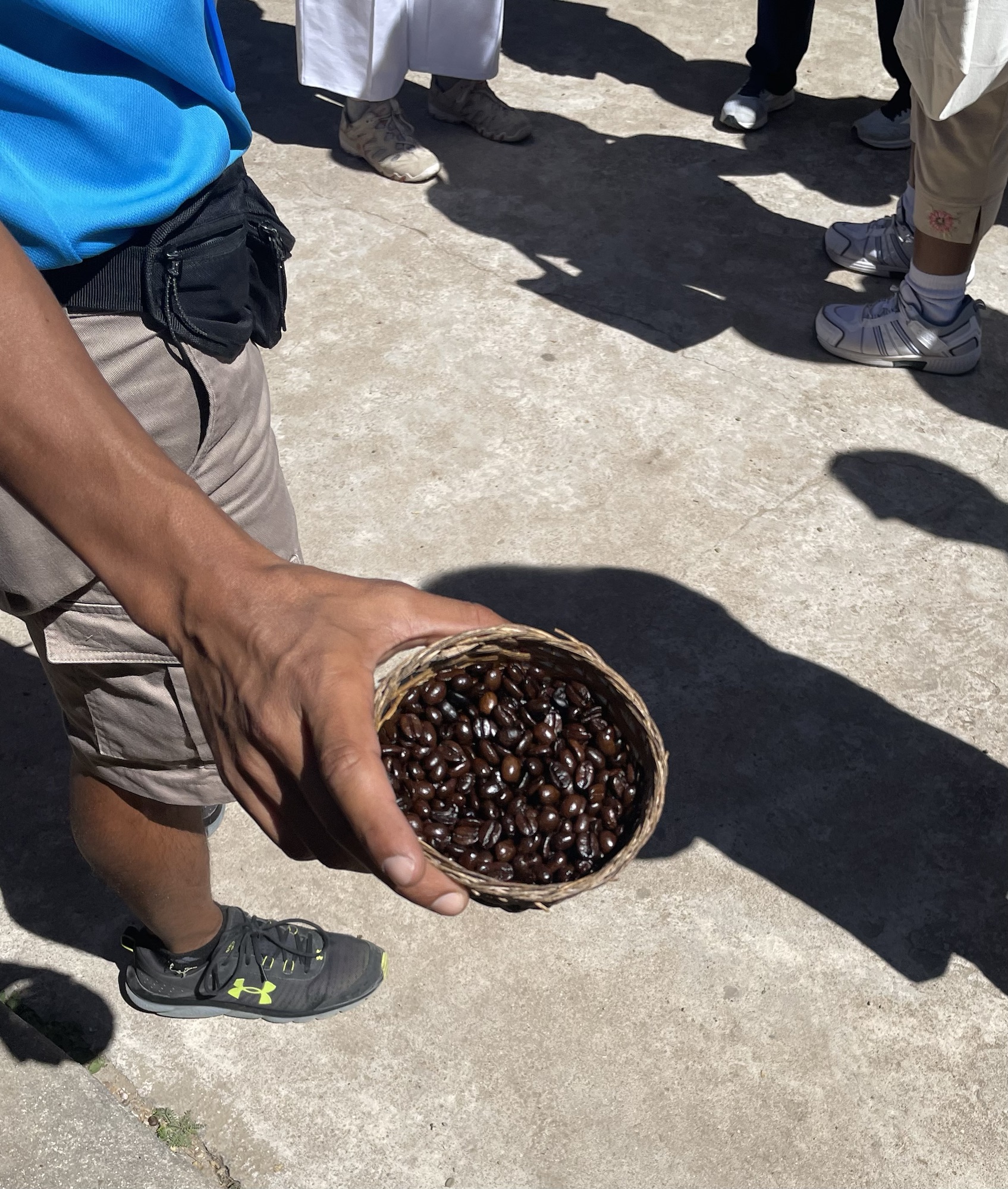
When we first entered the town we stopped at an organic coffee plantation, Café De Altura LaQuinta.  What an interesting place. The coffee bushes are grown among fruit trees, where the fruit just falls to the grown to provide nutrients for the coffee beans. Having all those tall trees provided the wonderful shade that the coffee needed to grow in the wonderful mountain coolness.

On the way there and back we stopped at a small tequilla factory.  Although we did not get anything there, we were able to overlook one of the two massive bridges that were built to connect San Sabastian to Puerta Vallarta.

Since we did spend a day in Puerta Vallarta, I feel a need to tell about the two places we visited there that I did appreciate. To be honest, I did not enjoy the tour we took of Puerta Vallarta.  I heard that others would have fit my interests more.  But I did enjoy our stop at the beach and at Tile Park, El Parque de los Azulejos. 

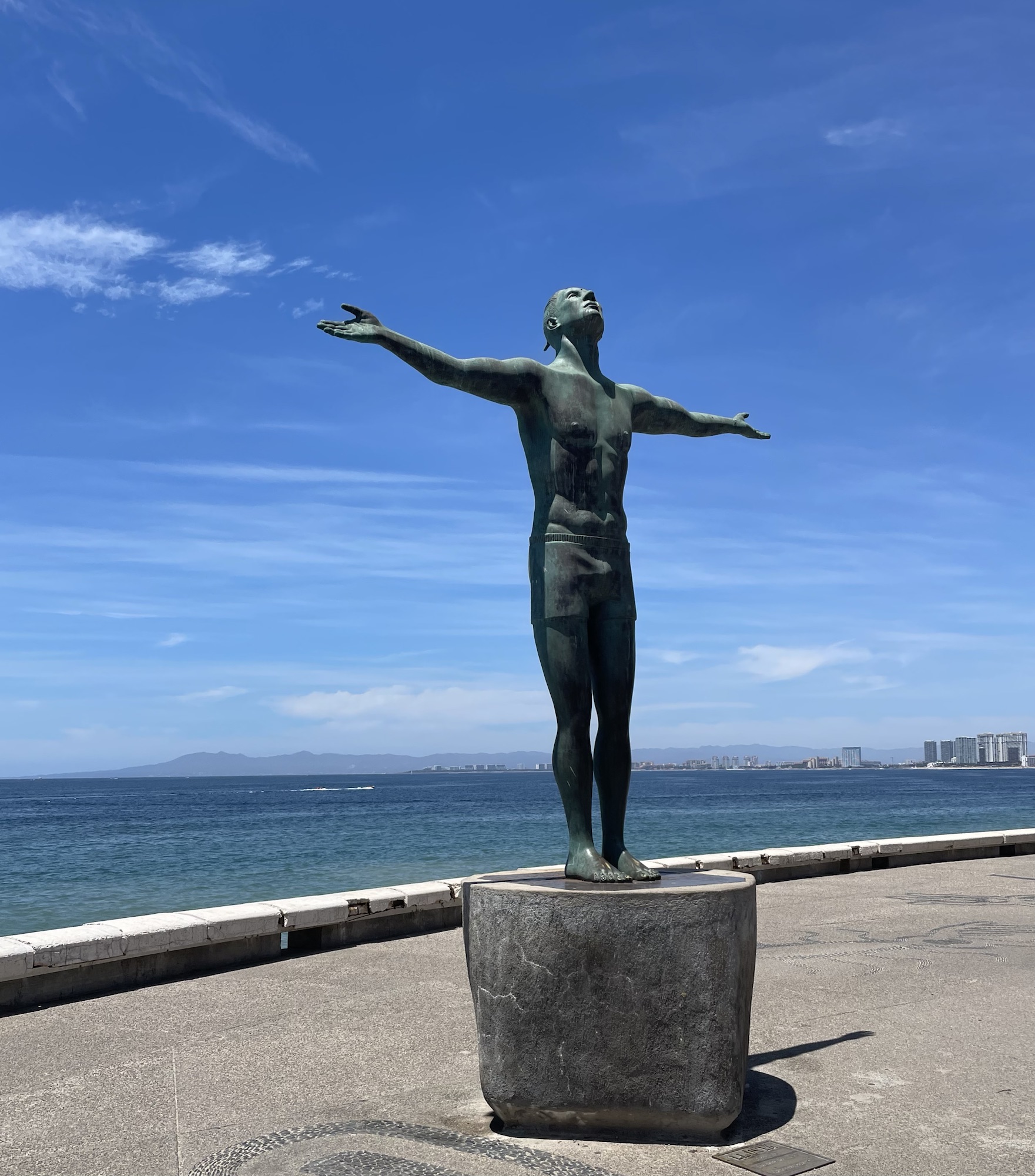
The promenade along the beach in Puerta Vallarta was lovely. With its many statues and views.  We enjoyed taking photos and seeing everyone walking.  It was Easter week so all the children were out of school and families were enjoying the lovely day. I do enjoy some. people watching, and this was a great place to do it.

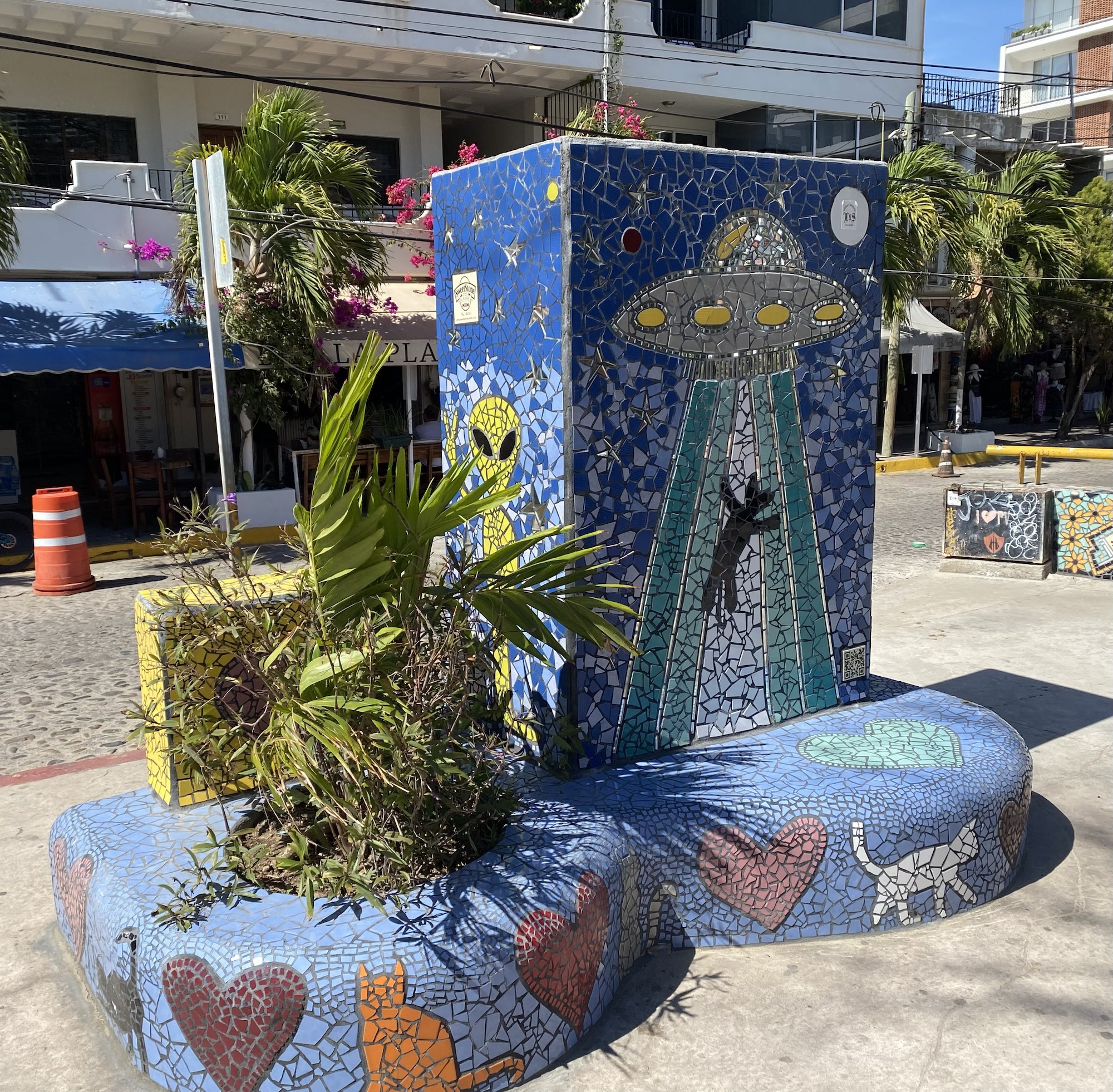
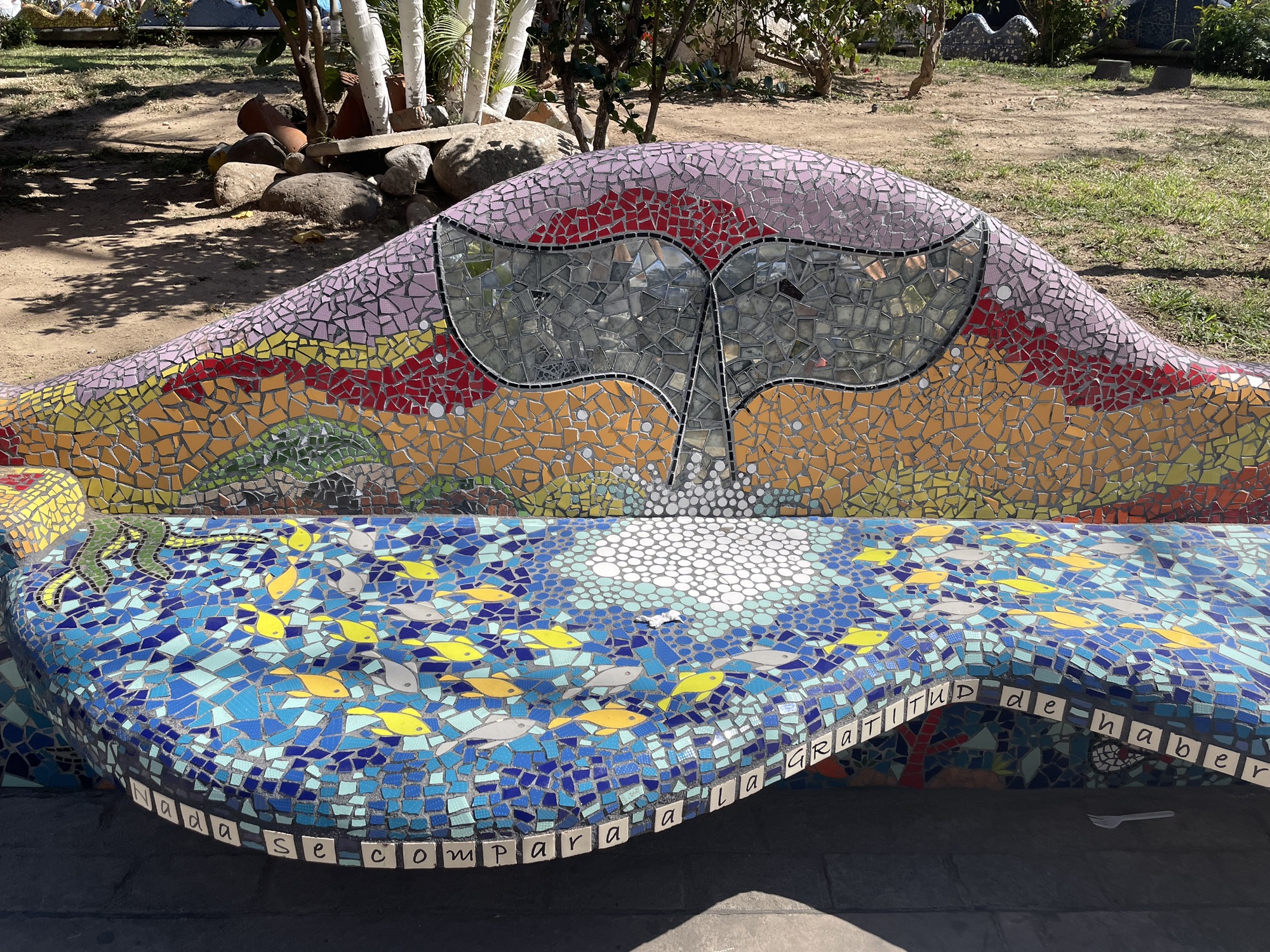
We also enjoyed seeing El Parque de los Azulejos (Tile Park), which  made me think of a miniature Parque Quell in Barcelona, the lovely park designed by Gaudi. The tile benches and other mosaic inlaid objects are fun to walk through discover all the different designs. Each one is sponsored by a donor and their names are displayed on little plaques. The designs are not set on a specific theme, just want the donor wants. We were able to see one from the University of Kansas and one from the University of Michigan among the many beach and sport themes.

There is a lovely gazebo as well as a stage and seating, so I know that concerts are held at Tile Park.  It is worth visiting.  We also took photos sitting on the benches that we liked!

I did enjoy spending time at the port in Puerta Vallarta.  I can see why tourist enjoy visiting.  But to me it was a bit too touristy.  However, the Magic City of San Sabastian made it my favorite stop.

https://www.tileparkpv.com/

Five Highlights Of Our Mexico Cruise

13 May

For 14 days in April we cruised down the coast of Mexico and into the Sea of Cortez on the Holland America Zaandam. We had a fantastic time. Here are five of my six favorite places that we visited. One place needs its own special blog.

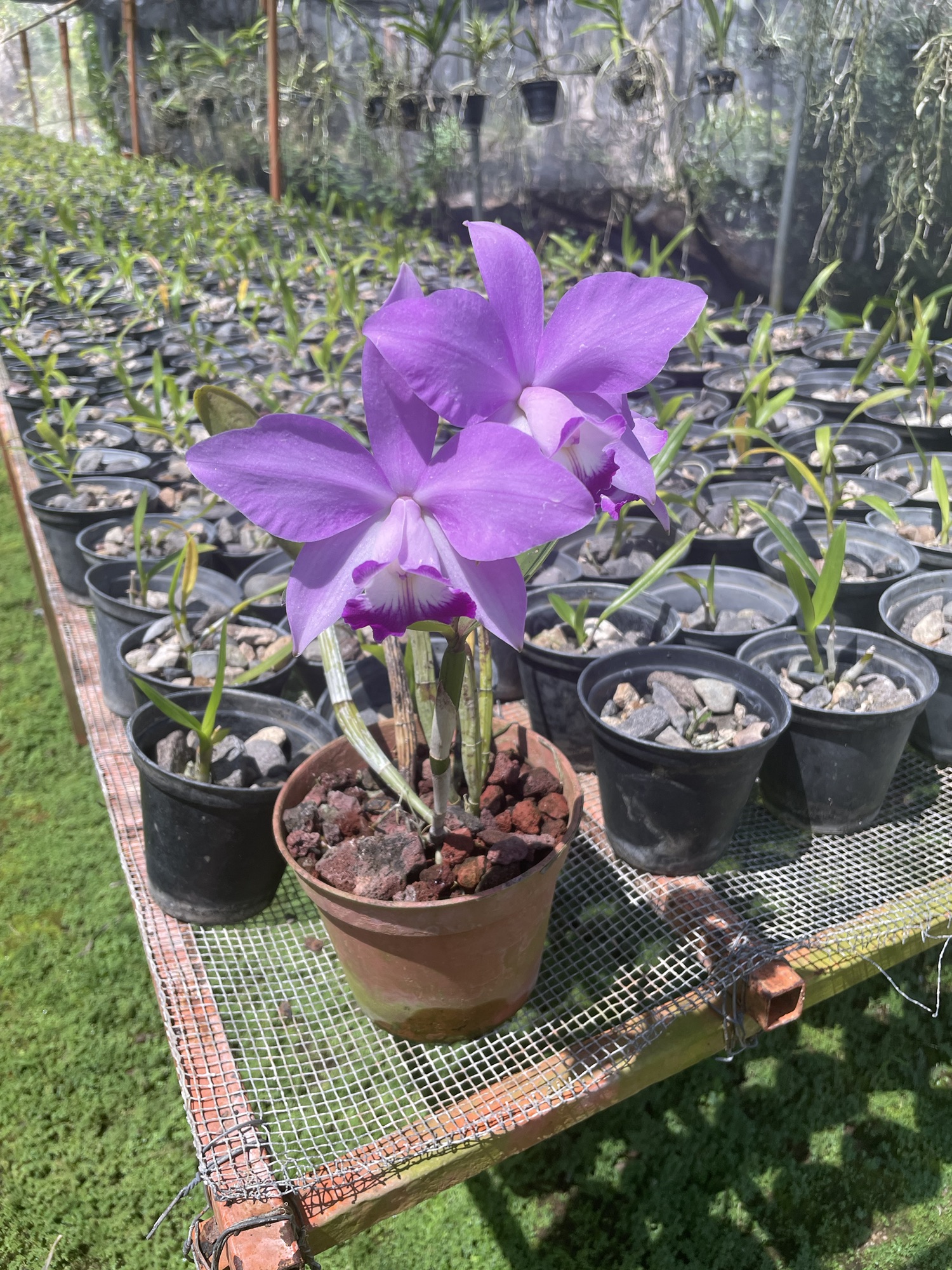
Orchidarium in Manzanillo, Colima.

Our visit to the Orchidarium was great.  We got to see orchids in many different stages of growth, but most important, the owner gave us a great deal of information about growing orchids. For years I have been trying to grow Orchids. I have failed every time.  The longest I have kept my orchids alive is two years.  Now I know why. 

First: Orchids like fresh air and shade.  I had my orchids near a closed window on the south side of my house.  The sun was too harsh on the leaves.  Not having an open window made it sad.  Orchids live on air.    My next orchids will live in an area that only has morning sun and is near a window that opens.

Second:  Orchids do not like a lot of water!  You do not need to water them every week.  You only water them when the roots are bone dry.  Also they must be in a pot with many holes so that the water drains out.

Finally repotting an orchid puts it into decline.  Only repot an orchid after the flowers fall off.  Then do not be surprised if it doesn’t grow for a year.  I did wait to repot mine after the flowers fell.  But I thought it had died too soon.

Zihuatanejo/Guerrero:

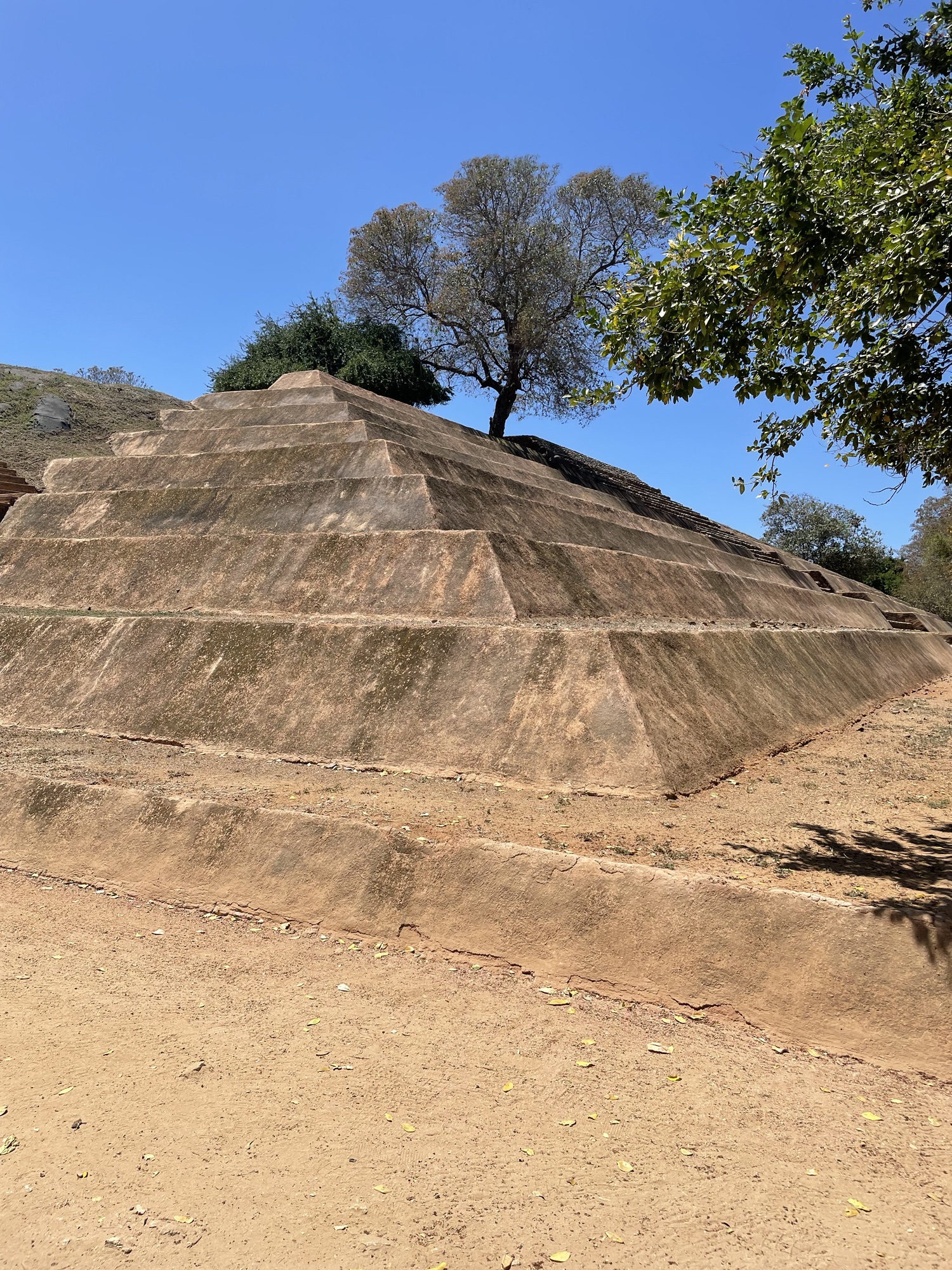
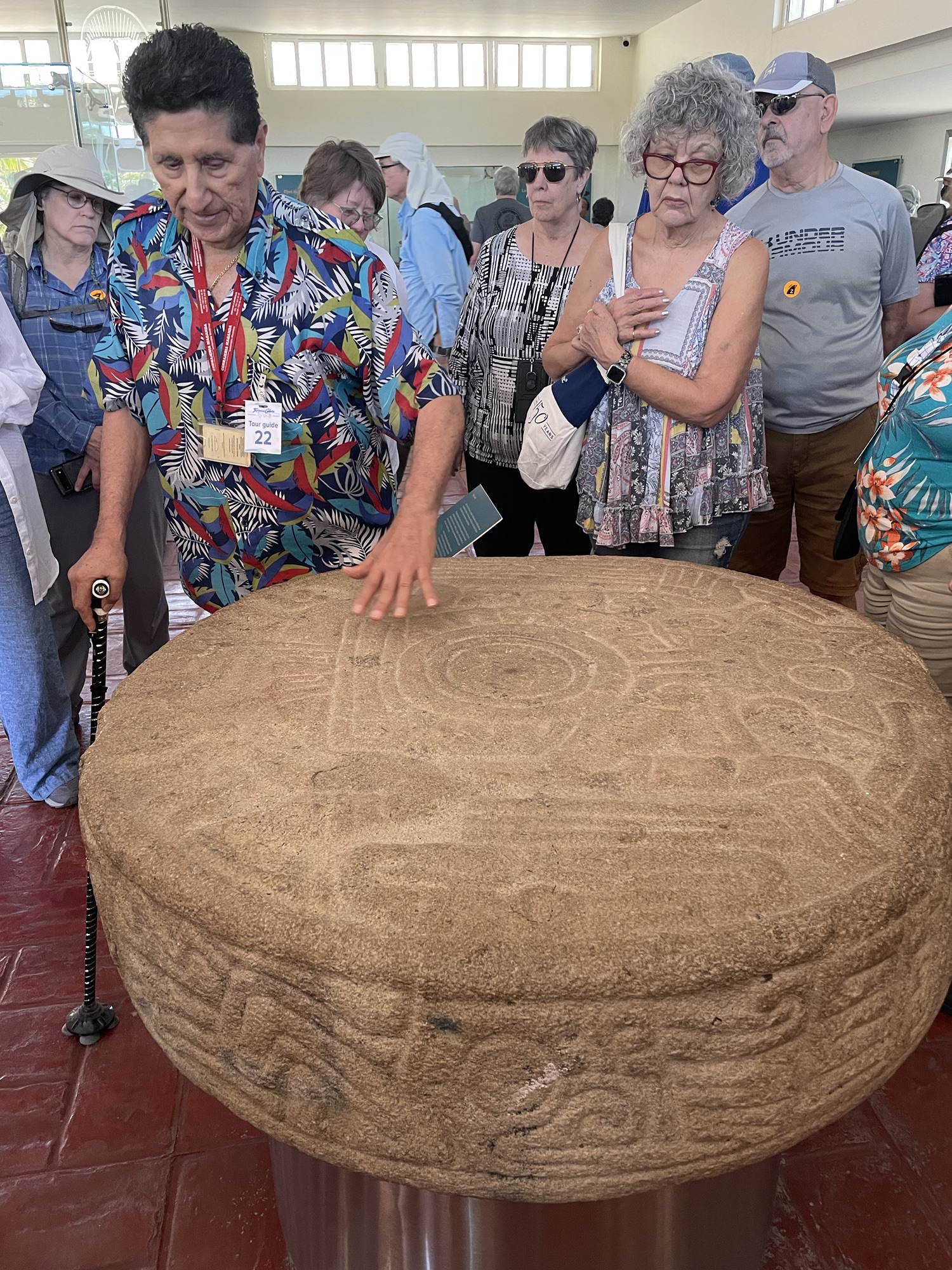
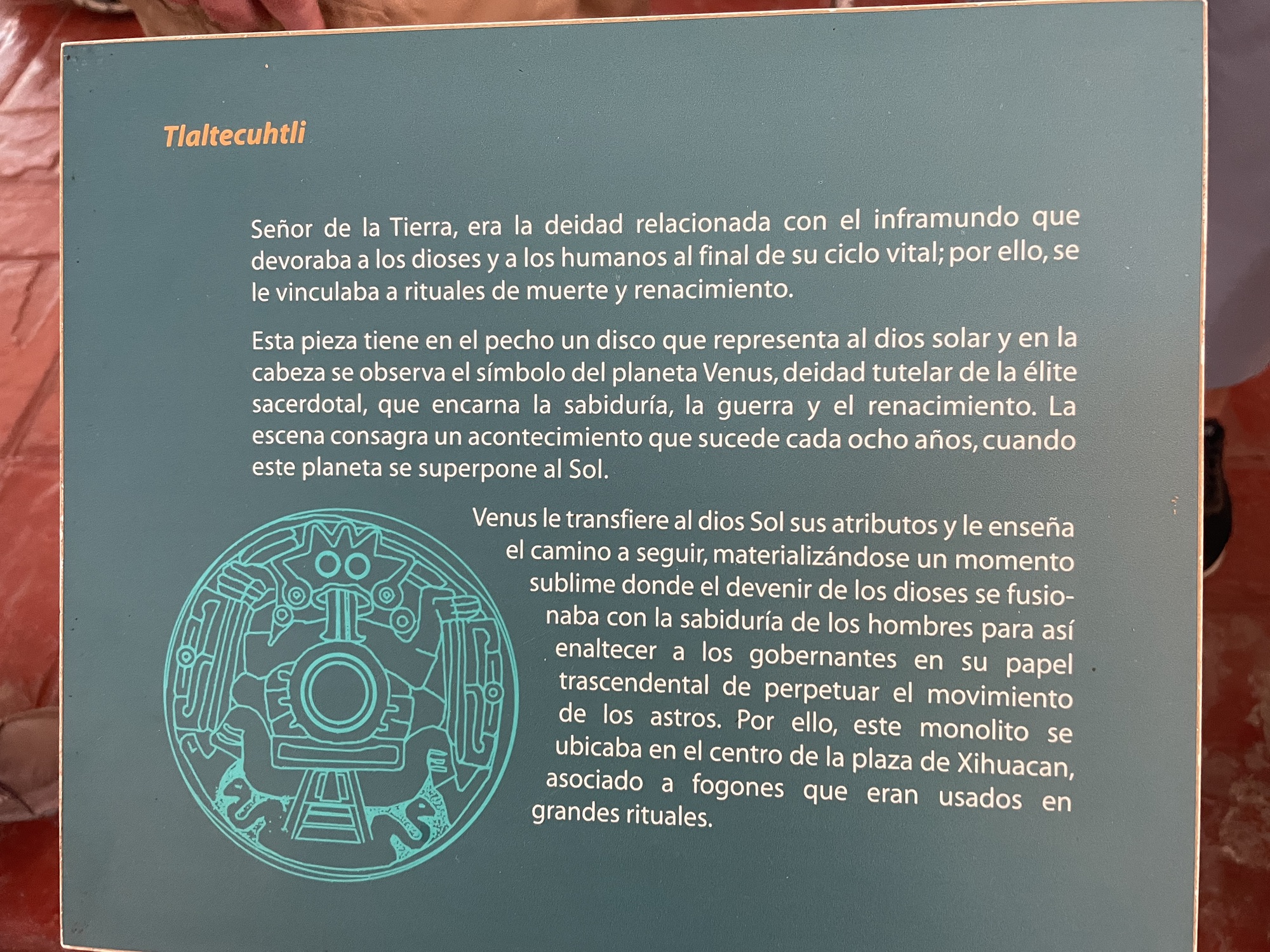
We went to the Xihuacan archelogical site in Gerrero near Zihuatanejo.  I will say that our tour guide for this trip was very proud and inspired to tell us all about the museum and the two area we were able to see, including the very large Mesoamerican ball court. In the museum was the sacrifice circular stone that represents the goddess of the earth. I did not climb up the steps of this pyramid because on our last trip, I fell a bit coming down.  I vowed not to climb any steps without handrails again.  I just watched my husband climb up and enjoyed seeing his photos.

I love learning about the early civilizations, and I have written about our visits to other Mayan, Aztec and Mesoamerican sites in other blogs. The amazing aspect about this site is that most of it is still buried under vegetation. Just a small area has been reclaimed. But I found out from our tour guide that there are so many of these sites, they just cannot afford to uncover all of them! (See blog below.)

Oaxaca and Zapotec Textiles

Oaxaca is known for its wonderful textiles and embroidery.  This is the stop I was waiting for because I love textiles. My Dad owned an embroidery shop when I was little and worked in the textile industry for years.  I am a crafter who focuses crochet now, but I did embroidery, crewel and sewing for many years.

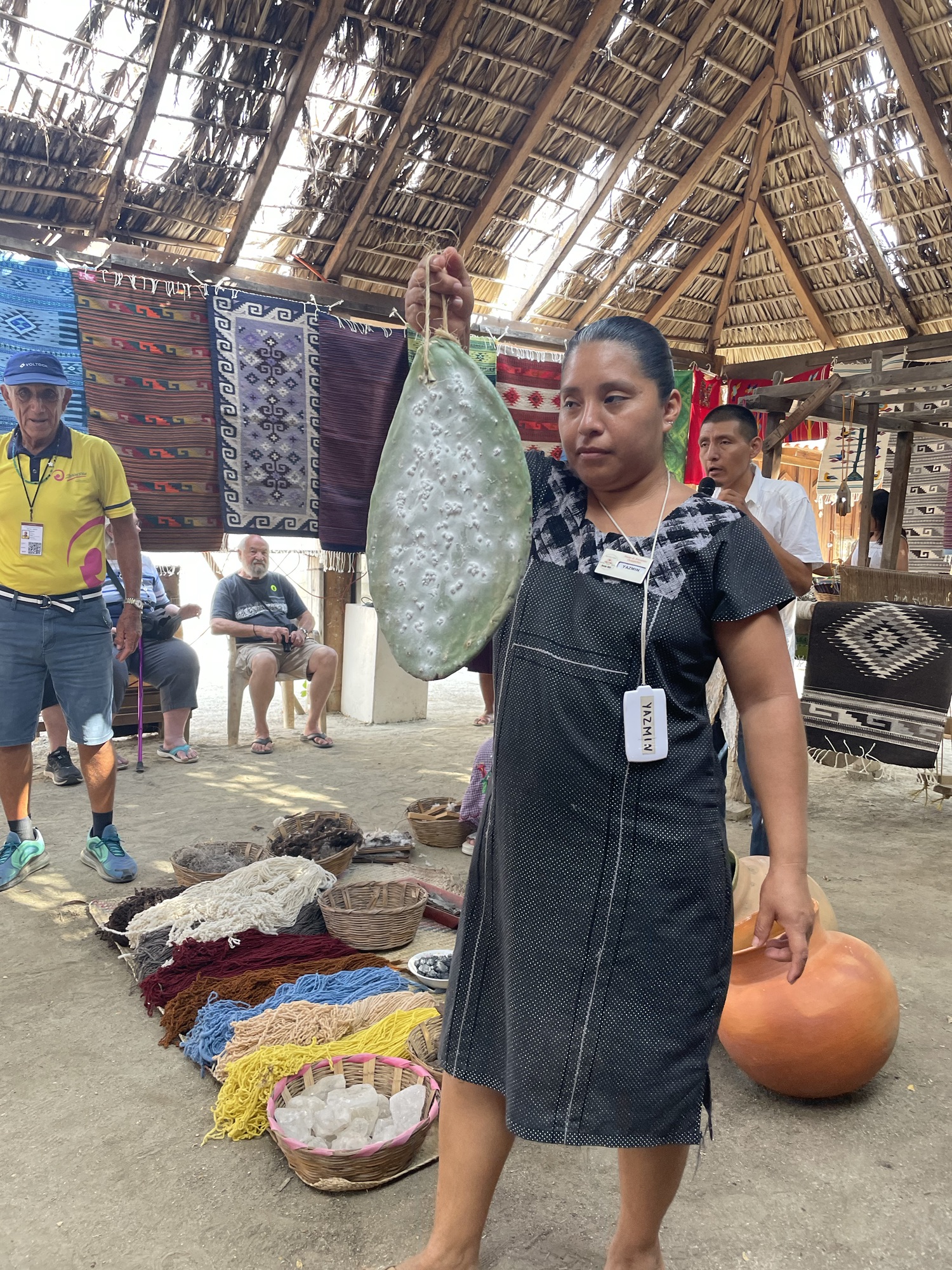
We had a wonderful time visiting with a family from the Zapotec tribe that weaves using wool and cotton that they produce, using dyes that they make from the cochineal bugs. We saw these bugs on the leaves of the cactus. We saw how the colors change by adding natural substances like lemon juice or baking soda.  We watched the weaving and we saw the undyed and dyed yarns.  The weavings were stunning, and I had to get myself one of the woven cotton shawls.

La Paz

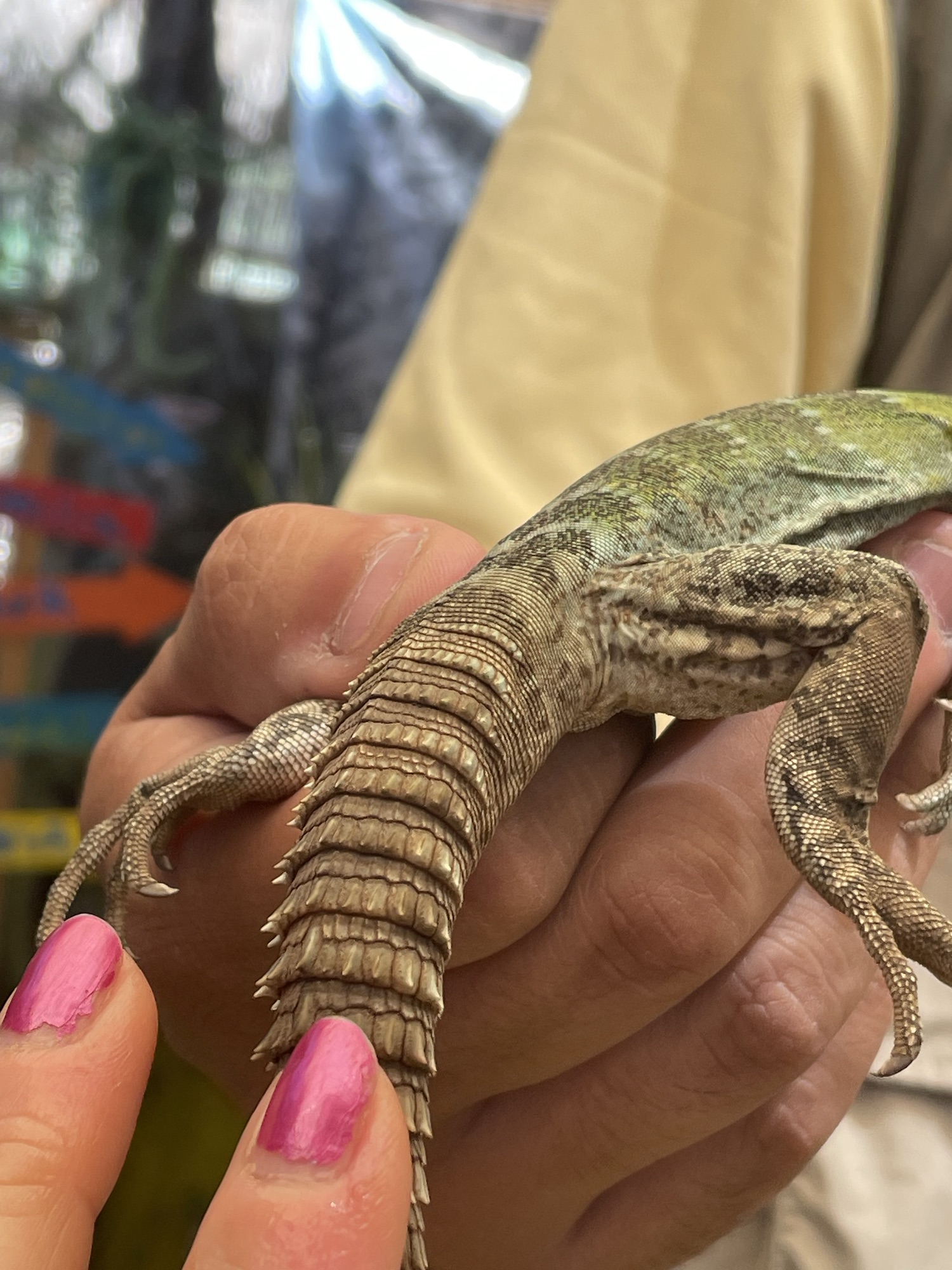
El Serperntario Reptile and Wildlife Rehabilitation Center.  Marcos, our guide was fantastic for many reasons, but the most important is that he loves the Serpentario. He is a volunteer there besides being a tour guide. His love showed throughout our private presentation.  The Serperntario was founded to rescue and rehab reptiles and snakes and to take those reptiles and creatures that are not indigenous to the area out of the community so that they do not kill the local species.   I got to pet the tail of an spiney tailed iguana!

To be honest we went to see this because when our son was young we house his fire bellied newt, two geckos and a ribbon snake. So as a mom I had experiences with lizards and snakes. Also, as a young girl I loved salamanders!  Although I do not especially love reptiles now, I am interested in their survival.

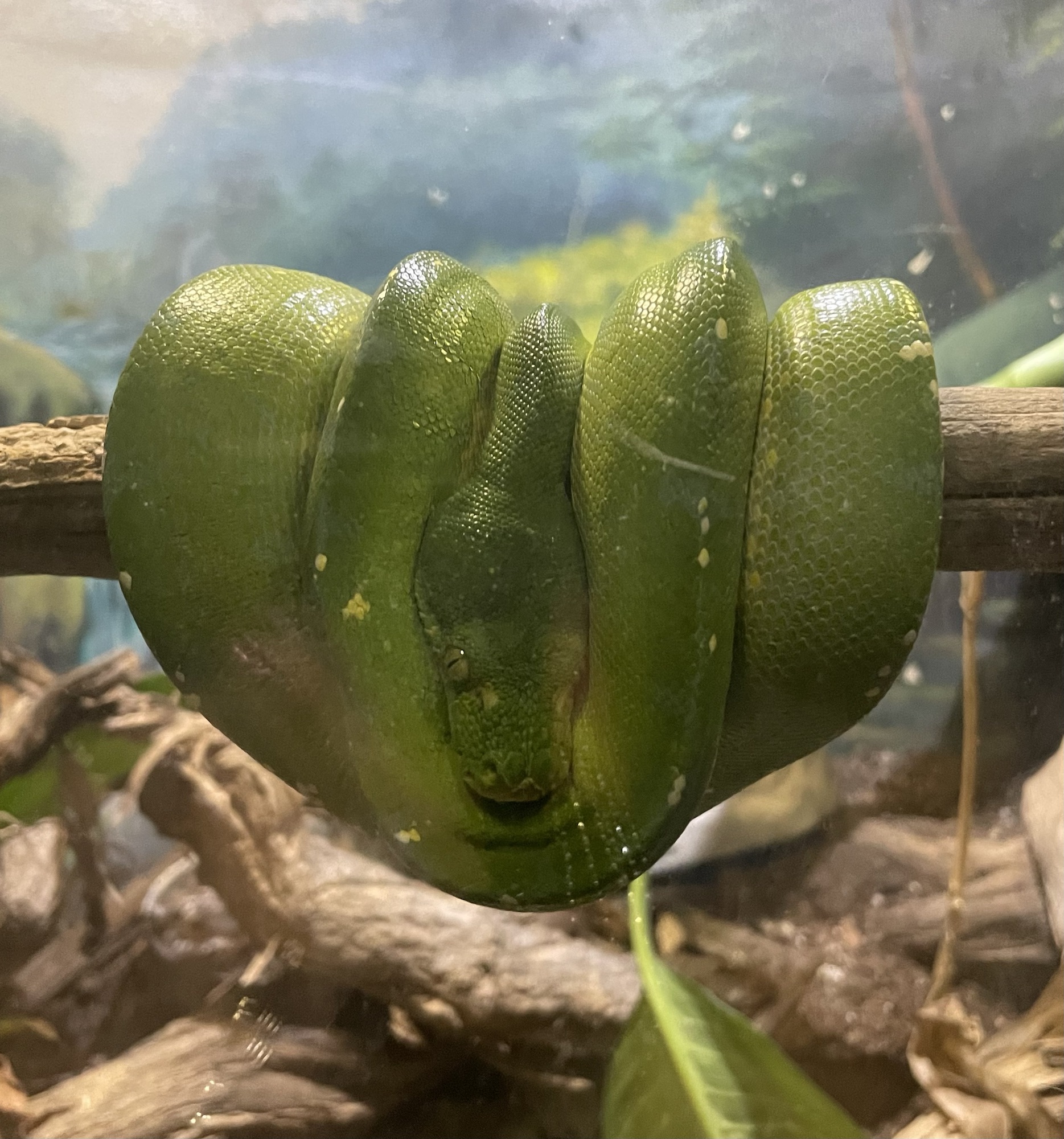
There are giant turtles, snakes of all sizes, multitudes of iguanas and many other unusual creatures living safely behind the walls of the Serpentario.  The gift store has some cute items.  But I focused on getting a t-shirt for my adult child.  It was a necessary purchase!  And all proceeds help to fund this not-for-profit center.

Cabo San Luca/Blown Glass Factory:

I have spent a week in Cabo San Luca. So when we were there on the cruise I wanted to do some touring. I am so glad we did. We had the chance to visit the Blown Glass Factory. What a delightful and beautiful spot! Besides helping the environment by using recycled glass to make their lovely objects, the building itself is a glass gem! Just walking though and looking at the ceiling, the glass art and the objects for sale is a joy. We got to see two artisans make a whale, and we learned how the glass factory came to be. We are going back to Cabo in January. I plan to visit again and this time buy something to take home!!

https://en.wikipedia.org/wiki/Xihuacan

https://en.wikipedia.org/wiki/Textiles_of_Oaxaca

My Mind Said, “just Do Something”

7 May

My mind said ‘just do something to help. It will make you feel hopeful and emotionally better.’  So when we got the invitation to celebrate our friend’s 60th birthday by volunteering at Heart to Heart International packing Personal Hygiene Kits, I knew I found the something to do!

Heart to Heart is a Lenexa, Kansas,  is a non-profit founded by a medical doctor in 1992 to provide medical supply airlifts and medical personnel to countries throughout the world facing disaster. It has sent help to over 100 countries, including Haiti, Vietnam, Liberia, Russia, India and more.  In the USA it helps during hurricane and other disaster relief, supplying medical teams and supplies. 

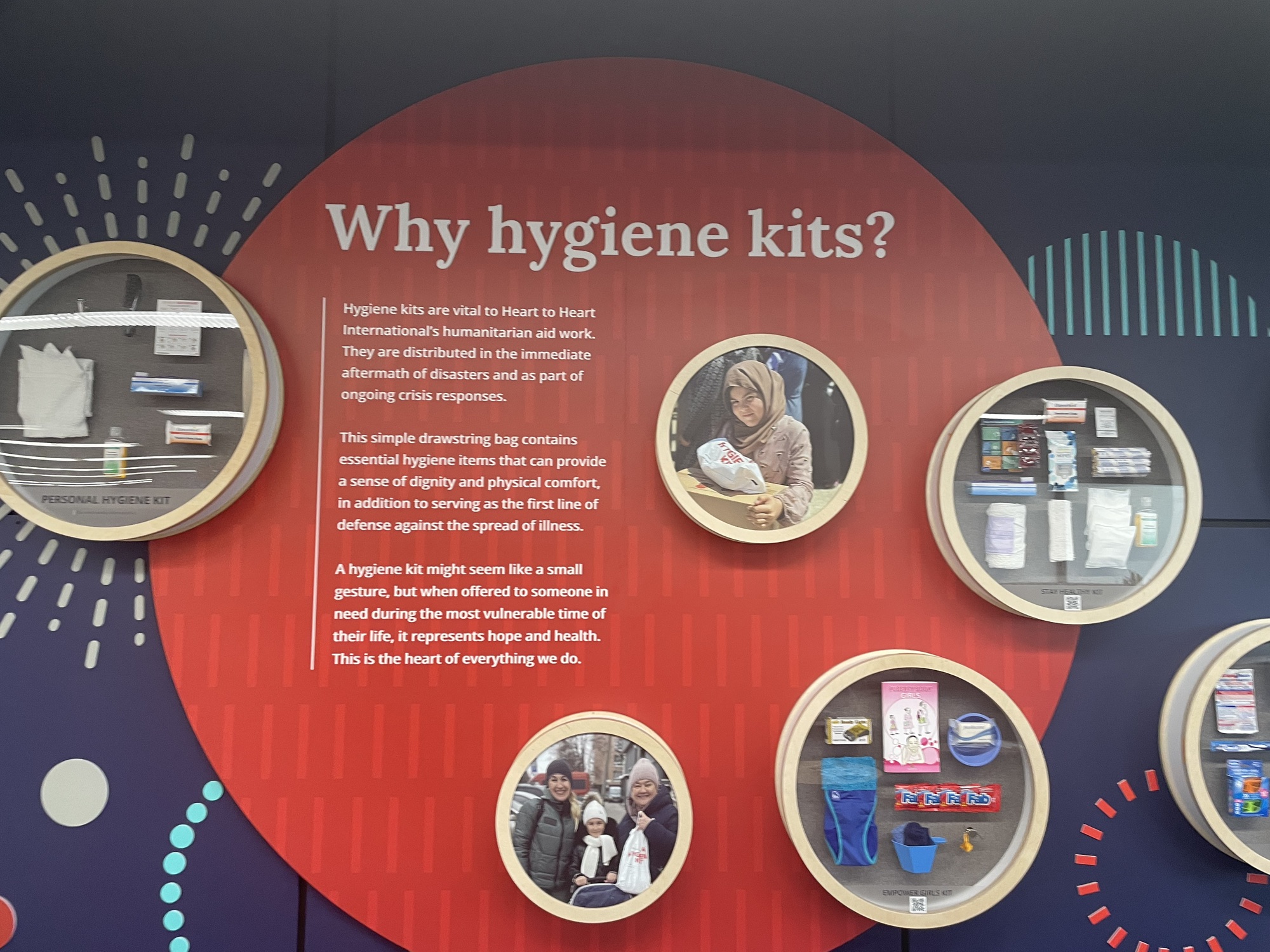
Heart to Heart personnel realized that during a disaster people needed personal hygiene supplies. The Personal Hygiene Kits (PHK) were developed, providing toothpaste. toothbrush, soap, shampoo and other items.  Millions have been distributed globally.

I have known about Heart to Heart for years, but I have never participated in their volunteer activities, nor had I been to the main headquarters in Lenexa.  That changed this past weekend.

Besides wanting to support our friend for his birthday, I must also say that I was drawn to this opportunity because Heart to Heart has been helping  victims on both sides of the Gaza conflict by providing hygiene bags and medical aid to Israelis who have been displaced, as well as providing supplies to the victims of the war Hamas started in Gaza. 

Not all charities have been even handed in their help, ignoring the suffering of Israelis.  Supporting Heart to Heart makes sense.  Everyone who faces a crisis throughout the world needs support.  Heart to Heart’s mission does not discriminate.

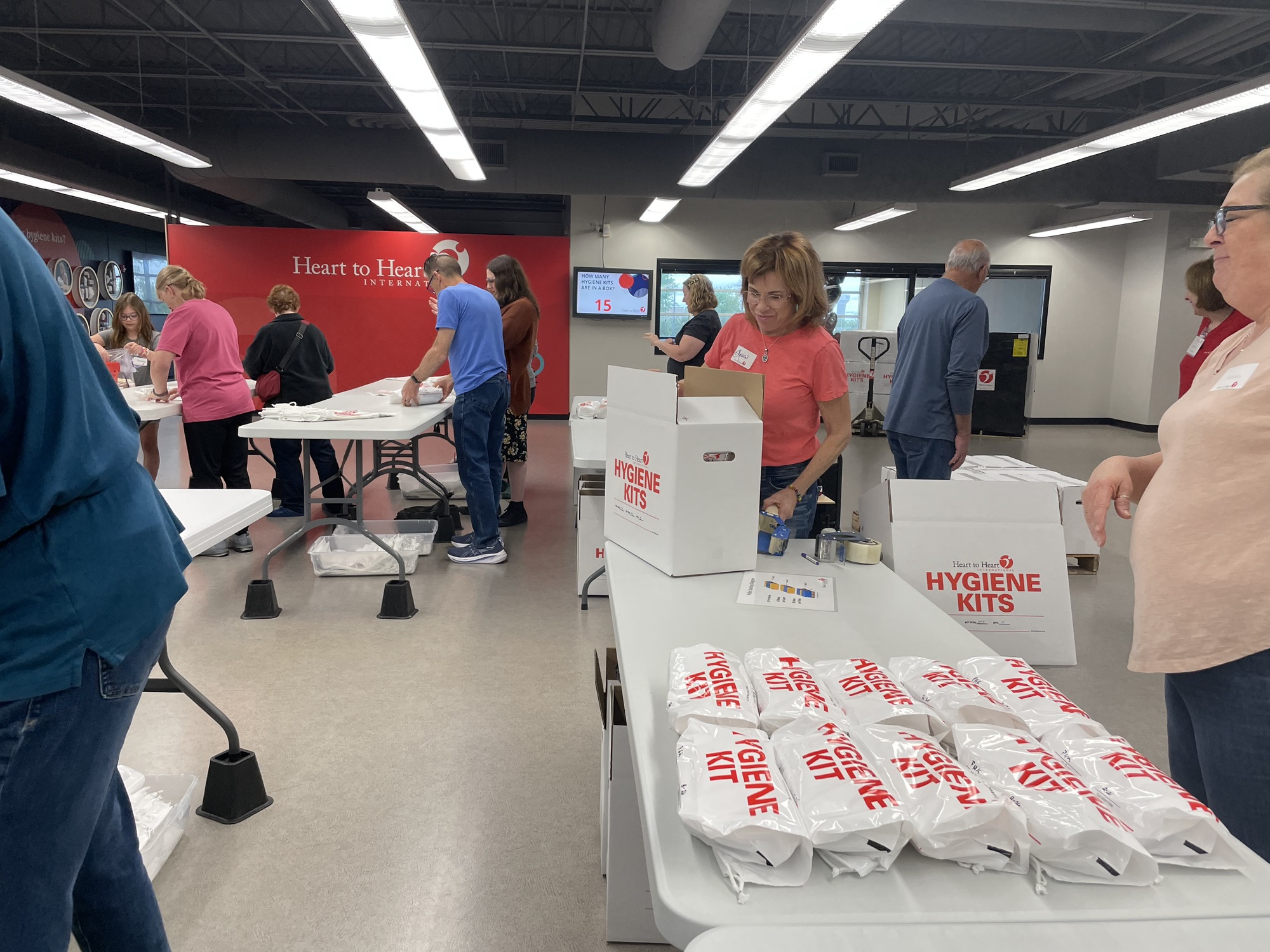
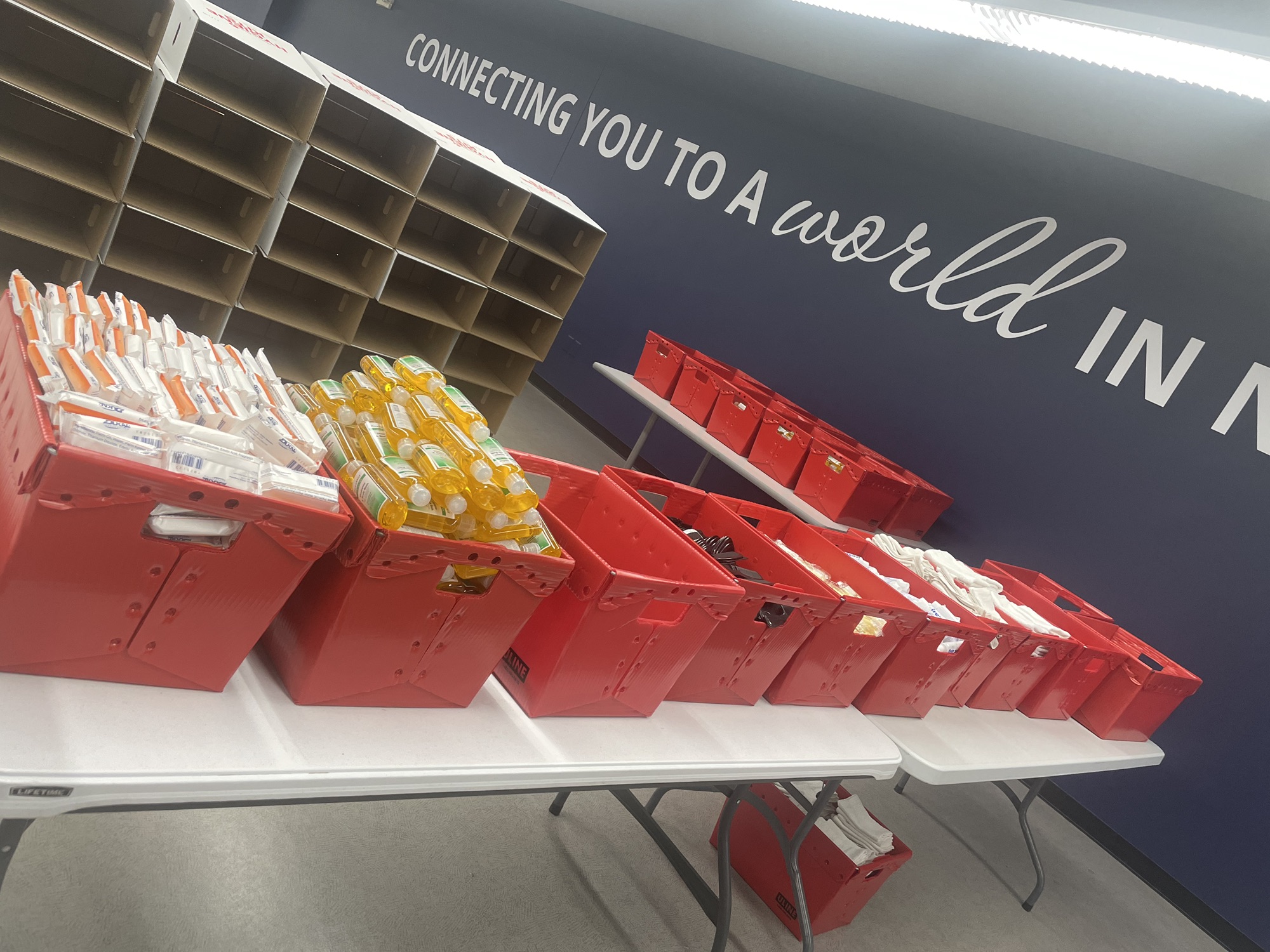
Our two-hour stint was delightful.  At first, we were assigned jobs to get the supplies ready.  I wrote information on to the PHK bags, while my husband had the opportunity to fold towels.  This gave him much joy, because he has been saying for years that when he retires as a doctor (with over 40 years of practice), he wants to fold towels at the gym.  I told him that he now has job experience to put on his application: one hour of towel folding at Heart to Heart.

We then joined the other 22 volunteers to start packing the hygiene kits.  Our job was to put the packed items into a larger draw-string bag for distribution. Our partners then put these in groups of 15 into a packing box to be shipped where needed.

While we packed there was lively music played to keep us moving. At times I could not help but dance as we packed or waited for more supplies.  All the time we were chatting with the other volunteers around us and enjoying the upbeat atmosphere. 

When we completed our two-hours shift, we gathered together for a group photo with the birthday boy and his wife.  The Heart tto Heart staff told us that we had packed 1250 Personal Hygiene Kits. Somewhere in the world, someone in need will get a towel my husband folded and a bag with my handwriting when they are most in need, as well as one that we packed.  That thought makes me feel better!

My mind was right, going to celebrate this birthday by volunteering at Heart to Heart International did help me.  I want to get a group together to do it again!

How A Mother Suffers

1 May

“How a mother suffers!” My mother would moan every so often when one of us got sick, or misbehaved, or had an accident.  Sometimes she would say it in jest when we were all teasing her.

How a mother suffers.  These are words that take on so many more nuances when your child lives in a war zone.  Or when your child is called up to serve in the military. Or when your child is hurting.  My mother-in-law would say, “You are only as happy as your most unhappy child.”  That is also true.

In the past two years I have gone from the highs of motherhood to the lows.  And as a mother I am suffering a bit.  I say a bit because I know there are parents who are suffering way more than I am.  There are mothers whose children are forced to fight for their country against terrorists.  There are mothers of children who are taken hostage and have not seen them for six months.  There are mothers of children in Gaza who have perished as Israel fights for its existence and Hamas refuses all negotiations, using the people of Gaza and the hostages as shields.  Forcing many more mothers to suffer.

My suffering is minor compared to theirs.  But it still resonates in my heart.  When I get off an airplane and turn my phone on to a multitude of messages, including one from my daughter saying, “We are fine. We are in our safe room (bomb shelter).”  When I see the news that Iran is bombarding Israel with 340 missiles, drones and bombs.  When I feel that rise of panic and bile in my throat because I honestly do not know if she is safe.

Too many times in the last 12 years I have woken up to the same message. “We are fine, we are in our safe room.”

Hamas has been targeting Israel with bombs all these years.  Every year, every month, 100s and 1000s of rockets. Because their aim is the total destruction of the state of Israel and the death of all Jews.  All Jews.   And when Hamas is not bombing from the south and west, then Hezbollah bombs from the north. And their rockets are move sophisticated.

Now I see college campuses with ignorant students calling out “We are Hamas. Free Palestine. All Zionists should die.”  Without ever mentioning the fact that Hamas started this war. That Hamas raped, murdered and brutalized 1000s of people. That Hamas took hostages. That Hamas send over 20,000 bombs into Israel. That Hamas does not really care about their own people feeling that they should be martyrs to the cause. Hamas leaders have actually said this! Definitely not mothers.

This mother, who has a master’s degree in journalism, suffers when she sees that the media does not report equally on what Israel has suffered giving more coverage to Gaza.  That the media uses information provided by Hamas to report on what is happening.  That they believe the lies of Hamas, which we have seen over and over again. And when found in a lie, then puts the truth buried on back pages and not the front pages where they put the lies. When they report what Hamas says and not what Israel says.  I find this type of media coverage despicable. And I wonder what happened in the world that the news is so biased. What happened to reporting equally on both sides and not putting personal opinion or bias in the reports.  There are members of the news media who turn my stomach, I can’t imagine why they are allowed on the air.  The BBC is one of these media outlets who actually fired some of their so-called reporters because of their biases.

I think of October 7 and the mothers that I know who really suffered.  I think of my daughter’s friend whose cousin was murdered at the Nova festival.  Three girls went together and only one survived.  The one who survived only did so because she hid under the bodies of the DEAD.  The last time Jewish people had to do that was in the Shoah.

How a mother suffers!  She suffers through the suffering of her children.  She suffers through the suffering of the mothers she knows.  She suffers from the callousness of others who say thoughtless words.

This mother is angry that any mother has to suffer.  But is also angry at the mothers who did not teach their college-age children about right and wrong.  Did not teach them that terrorist groups are not the heroes, they are the villains.  A sovereign country has a right to exist. And through all the suffering initiated by Hamas, we will survive. 

A mother suffers.   A mother is only as happy as her most unhappy child.  Many times a mother suffers in silence, not wanting their children to know how much they hurt and worry about them.  But this mother is strong, supportive and will survive and can speak out for what is right. 

 I say Israel has a right to exist.  Hamas is a terrorist group whose goal is destruction. No mother should have to suffer because Hamas/Hezbullah/Iran started a war. Anti Semitism is alive on college campuses and in the news media.  We all have to speak out. Enough is enough.

As Umbraphiles, we Loved The 2024 Eclipse!

29 Apr

We are eclipse chasers or umbraphiles. The first time I heard that word was from a fellow eclipse chaser with whom we have seen three eclipses. I was shocked that there was a special word to describe this passion.   But, eclipse chasing is a topic in Wikipedia, which does an excellent job describing those who travel to see eclipses.

“Eclipse chasing is the pursuit of observing solar eclipses when they occur around the Earth[1] Solar eclipses must occur at least twice and as often as five times a year across the Earth. Total eclipses may occur multiple times every few years.[2]

A person who chases eclipses is known as a umbraphile, meaning shadow lover.[3] Umbraphiles often travel for eclipses and use various tools to help view the Sun including solar viewers also known as eclipse glasses, as well as telescopes.[4][5]   “    Eclipse chasing/Wikipedia.  See link below.

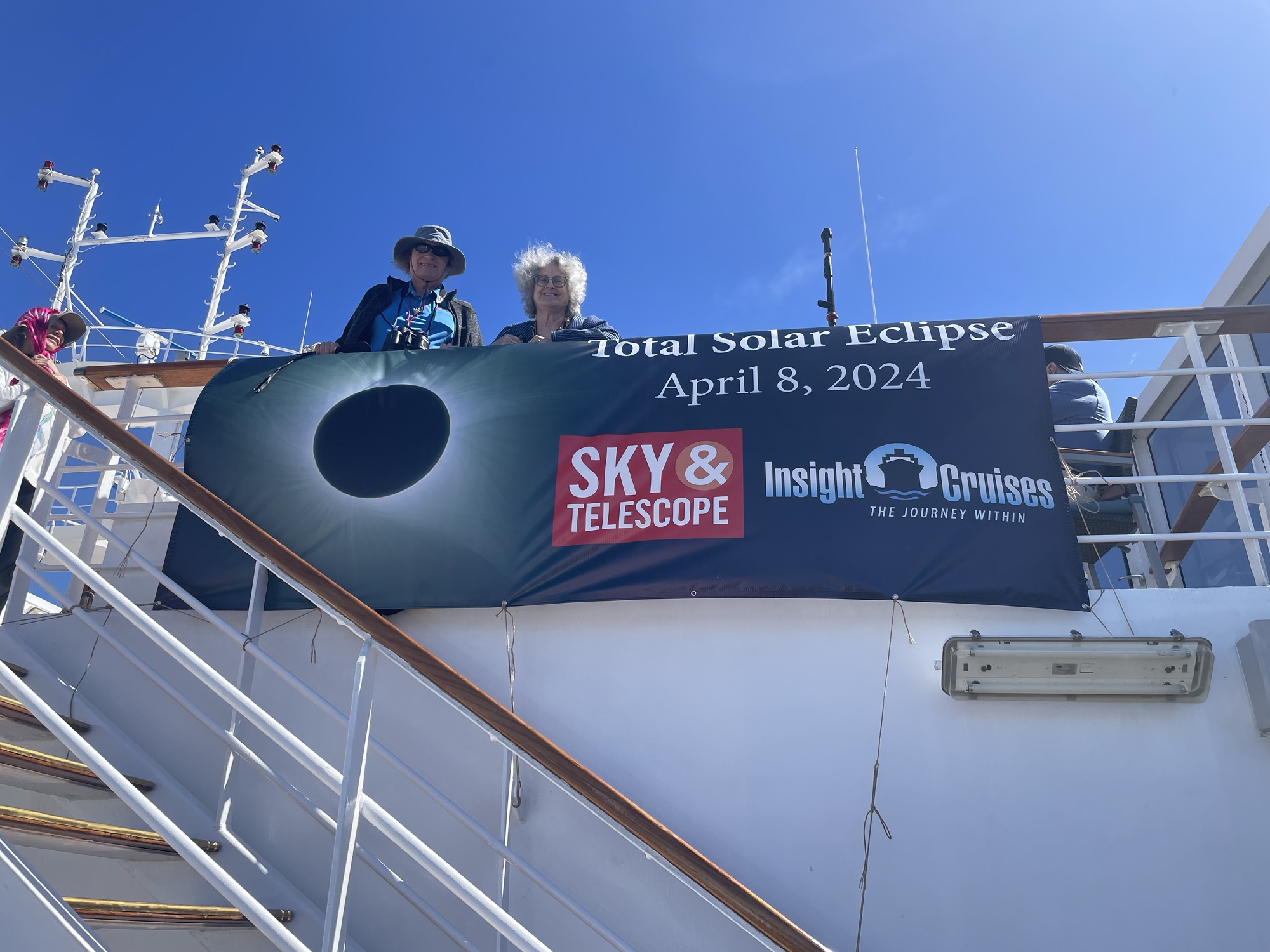
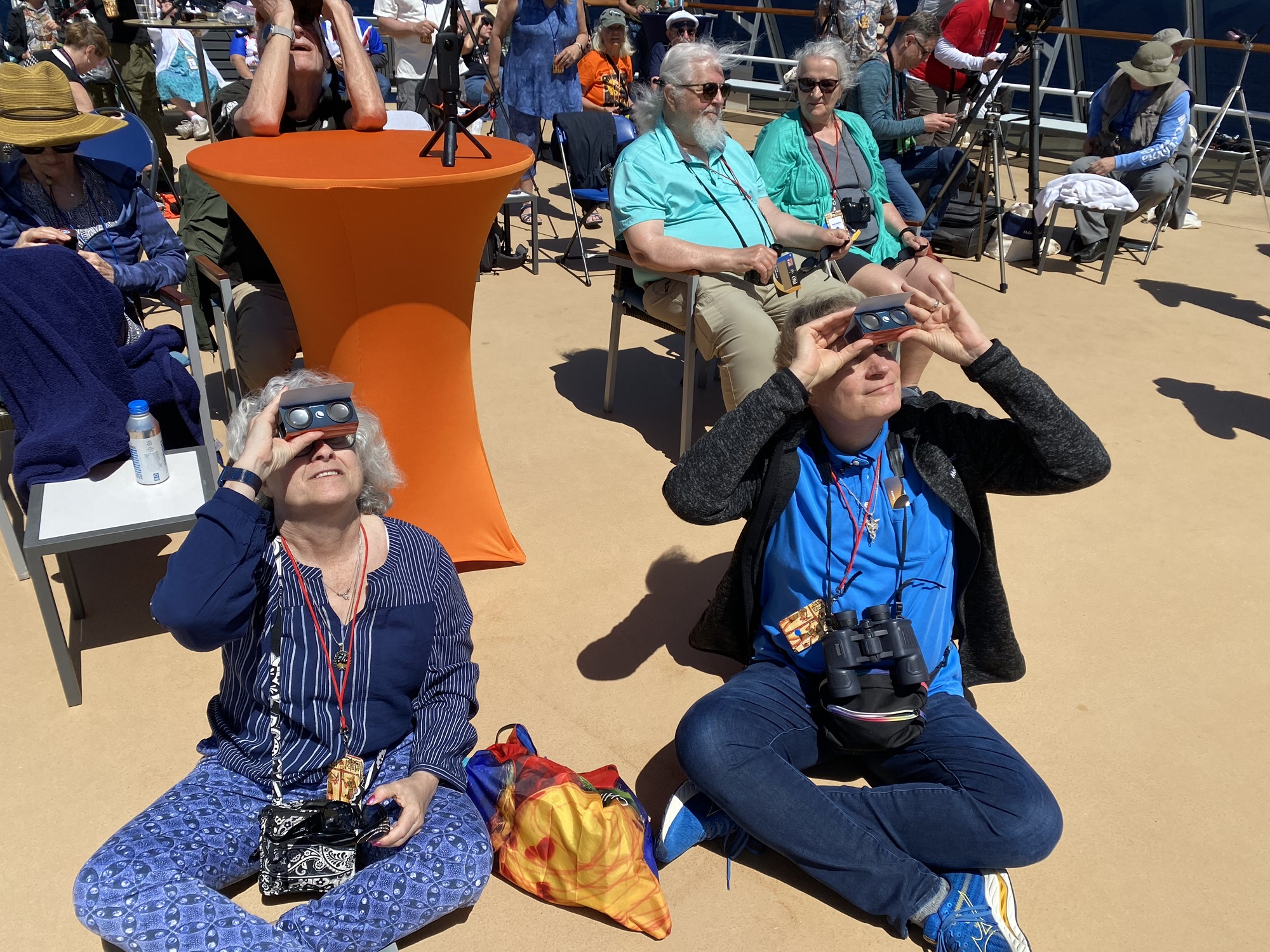
In Early April I saw my sixth total eclipse along with 1700 people on the cruise ship, Zaandam, 100 miles off the coast of Mexico as part of a Sky and Telescope/Insight Cruises group. When I was a teenager in New Jersey, I saw my first eclipse.  With my husband, in our eclipse chasing, we have been off the coast of Aruba in 1998; in Austria/Hungary in 1999; off the coast of Greece in 2005; in Jackson Hole, Wyoming, in 2017; and now in the Pacific Ocean. 

Once you see a total eclipse of the sun, it envelops you with its majesty and awe.  You easily understand why primitive people were petrified when then sunlight disappeared and darkness and chill covered the Earth.  Even today, with all the information about eclipses, you can hear it in the voices of the people who know exactly what is happening, but still are overcome.  Especially those who are seeing their first eclipse.  Many often say. “This is my first one, but it will not be my last!”  And if they have the means, I know it is true.

The Captain of the cruise ship was one of these first timers.  He did everything he could to get us on the path of totality aware from clouds. This meant traveling 100 miles off the coast of Mexico and centered on the eclipse path!  He was as caught in the excitement as everyone else, passengers and crew, spending time with the passengers.  “ Many asked, who is driving the boat.” And “Are all the crew members getting to see it?”  Arrangements were made so that everyone who wanted to could take a quick peek outside.

On this cruise, there were 250 in our group under the auspices of Sky and Telescope/Insight Cruises, and 100s of others who came with other astronomic groups to see the eclipse. There was even a group of Trekkies who came in association with our group. 

Astronomers, both professional and amateur, astronauts, physicists, college professors, scientists, and many ordinary people like me, who just love the thrill of seeing the sun go black and the corona become visible. 

To feel the cool breezes as the sunshine diminishes.

To see the heightened shadows and the ripples in the ground.

To see the darkness overhead, while all around in the horizon, there is light.

My husband says this is where the word AWE came from. The awe of the total eclipse of the sun.

We umbraphiles own welders glasses, obsidian, special viewing glasses, binoculars, telescopes and other special materials to make our viewing the best it can be.  We, personally, do not bring telescopes. But those who do bring them are often eager to share their equipment for others to get a peek. But we do bring binoculars which were great to see the sun at totality and also to see the two NASA jets high in the sky chasing the eclipse!

The art of making pinholes that allow miniature partial eclipse to slip through brings joy to some.  People have colanders or straw hats so they can see dozens of partial eclipses showing on the ground of on white paper. Some make pinhole designs to capture a unique view of the eclipse.

It is true that before, during and after the eclipse, there are people humming the melody or singing out loud the words to “I’m Being Followed by a Moon Shadow” by Cat Stevens. I am one of the hummers.  Actually, we are following the moon shadow.

On our trip were many who had seen over 10 – 12 eclipses.  They go to every one possible.  My husband and I have missed some we wish we could have seen. But we make an effort to see as many as we can. We have spent close to 25 minutes in the darkness of the moon’s shadow in totality. And yes we already have plans to see one off the coast of Spain in 2026!  If you get the chance, chase at least one eclipse.  You will not regret it!

https://en.wikipedia.org/wiki/Eclipse_chasing

My Genealogy Research Makes a Difference To A Distant Cousin

23 Apr

When I started my genealogy research, I did my research and wrote my blogs just for my siblings and immediate family.  Over time, I included my cousins on my blog posts.  And then it just snowballed.  I realized that by posting them on Facebook, specifically on Tracing the Tribe group, I might connect with other more distant relatives.  And it happened.  I have had people help me with my research who are not related. I am in touch with distant cousins including Evan, who has been an immense help in making connections.  I have met some of these cousins in person.  And my understanding of my family increases with each new contact.

This blog is different.  In this instance, I discovered that the information I had from speaking with my grandmother years ago helped solve the family mystery of a women who is actually my third cousin, our grandmother’s were first cousins.

It started with an email from Evan. (He really does a great job keeping in touch with all the cousins) He connected me with a distant cousin named Sherry, the granddaughter of a woman named Esther who was born about 1897/1898.  He said she was part of my branch of the family and thought I could help.  I could.

A number of years ago, I wrote a blog about my grandmother entitled “Too Many Esthers” (see blog below) and “Updated Esther “(see blog below).  My Grandma Esther was one of 5 or 6 first cousins all named for their maternal grandmother, all named Esther, all born around the same time. All were given nicknames.  My grandmother was known as Curly Esther.

Sherry wrote back to Evan and me: (She has given me permission to write this blog, I have edited her emails for privacy and brevity.).  “Thank you for contacting me!  I had trouble with my grandmother, and who her parents truly were.  There were so many unanswered questions and there are no living family members in my close family that know anything more than I do.  I got pretty frustrated and sort of put it on the back burner.  I would be really interested in what you found out!”

I immediately responded: “It’s nice to be reconnected. I am the granddaughter of another Esther born in 1898.  I have been researching the family for years. In late 1970s I sat down with my Grandma and got the names of all of her mother’s siblings. The children of Elka/Esther Lew and Victor/Avigdor Wolf. Here are two of my blogs that will lead back to some of my research and introduce you to the family. The attached photo is our great great grandparents Esther and Victor Wolf(f).

Actually, I knew immediately who her grandmother had to be, which is why I sent her the blogs about the Esthers.  There was one cousin known as Meshugannah Esther.  Her mother Chamka came to the USA pregnant with three children.  Her husband had passed away before she came.  After their daughter, Esther, was born and weaned, she was given to a different sister, Sarah, who could not have children, to raise as her own.  To make things more confusing, Chamka was known as Anna in the USA, but her Hebrew name was Nechama.  Her family called her only Chamka/Chamky.

I must say I was truly happy to receive a reply from Sherry.  Her response filled me with joy to know that my research and pictures helped her.  Here is an edited version of her response.

“Wow!  I am so overwhelmed and thrilled with this connection.  I was getting so frustrated with trying to figure out my grandmother’s story and had no one to ask.  

I did hear that “grandma didn’t find out until the day she was engaged that her aunt was her mother and her mother was her aunt”.  So I knew that there was information that I was missing in order to fill in the blanks.  

“Meshuganah Esther moved in with my family when I was 10 years old. We lived next door to Aunt Lenore and her family.  Grandma was married 5 times!  She felt she needed to do that in order for her to care for her children. My grandmother passed in June of 1993.

“Ellen, you spoke of the cousins’ club meetings.  I remember them although I think I spent most of the time hiding behind my mother’s skirt…

“I actually gasped out loud when I opened the picture of Esther and Victor Wolf.  I have that picture and I had no idea who they were.

Thank you, dear cousins.  This is a gift.”

My initial response to this was just as excited. I was elated that I could help.

“I am so glad that you were able to make connections about the family through my blogs. I am so glad that you have that photo as well, and now know who it is.  It is amazing to have photos of great grandparents, but great great grandparents is really special. 

“Did you see the picture of Chamka and Lenore?  I am not sure which blog it is in.

I can understand a bit why she wasn’t told which sister was her mother.  But I am sure it was a big shock at the time. It was one of those open secrets that everyone knows but does not discuss.”

Since she did not have nor seen the photo of her great grandmother Chamka with her granddaughter Lenore, I sent her the photo and the information that was written on the back. “Tante Chamky and Lenore. Lenore was Meshuggana Esther’s daughter. Esther was raised by Tante Sarah, but was really Chamky’s daughter.”

I am currently looking for the photo so I can send her it for her family records.

Thanks to Tracing the Tribe, over the years, I have connected with a number of cousins.  But this connection honestly made me immensely happy.  

 Finding Answers About My Paternal Great Grandmother

17 Apr

In Ashkenazi Jewish custom we name our children for those beloved family members who have passed away. I was always told that I was named after three of my great grandmothers:

Chava was for my maternal grandfather’s mother, Chava, who was murdered in the Shoah.

Sara was for my maternal grandmother’s mother Sara/Sura, who died in the 1920s in Poland, and for my paternal grandfather’s mother as her name was Sarah as well.

I knew about my two maternal great grandmothers, because there were family stories about them.  But I knew nothing about my paternal great grandmother even though she  lived in the United States and is buried in New York.  I have recently realized there is more to the story about her and my name. 

I have been searching for information about my paternal great grandmother  for years.  The first real clue was when we first saw a photo of her about five years ago.  We did not even know we had one!  But my first cousin was searching through her family’s old photos and discovered one of her with my uncle.  (See blog below.)

More information followed when my distant cousin, Evan, who is a great researcher, found my grandparent’s marriage license.  They were married in January of 1923.  It contained my great grandmother’s maiden name which we never knew: Ritt.

Evan also found a puzzle piece for me when he found her death certificate, which was packed with information. The final link was when Beth David Cemetery in Elmont, New York, where she was buried on January 29, 1938, sent me a photo of her matzevah (tombstone).

I now can tell my family more about my mysterious great grandmother, who I now know is named Chaya Sarah, so close to my own name of Chava Sara, that I think I was bound to have this name.

My great grandmother did not have an easy life.  She gave birth to 11 children. Eight survived to adulthood.  She lost her oldest daughter, Celia, to swine flu when she was in her 20s.  Her oldest son, Samuel, was mentally ill and spent most of his adult life institutionalized.  She and her husband, Abraham, were divorced in the 1930s.  A very unusual occurrence for a Jewish woman, well for any woman, in that time period.

My Great Grandma Sarah died on January 28, 1938, from cancer of the panaceas at Jewish Hospital of Brooklyn, when she was 68 years old.  My grandfather, then the oldest living child signed the death certificate and made the arrangements.

I have three thoughts about this information.  First, the line through my grandfather is cancer free.  But I have since learned that the line through his youngest sibling, Jacob, was not as kind. We all thought Jacob had disappeared after he moved to England when my dad was a child. But in fact he died when he was in his fifties from cancer, as did his son Rufus.  The cancer gene followed them. (See blog below.)

Second, I think I know why I was named for her.  She died in late January.  Years later, I was born in late January.  It made sense.  Finally, I am currently close to her age when she died.  And that touches me that I found out now.

I know that she was born about 1870, in France.  That she and her parents lived in France surprised me. But her father and mother, Hirsh and Flora Ritt, were from Poland.  So I think they were in transit from Poland to the USA when she was born.  I have no proof, but it seems right.  I also know that her father died before 1892 because my grandfather was named for him. Zvi Hirsh.  I now know that she was about 22 when she had her third child, and her other children were toddlers when my grandfather was born.

She died when my Dad was just 9 years old.  He really did not have many memories of her or information.  But now we know her name and also the names of my great great grandparents: Chaya Sarah Ritt, the daughter of Hirsh Zvi and Flora Ritt.  We now can add their memories to our family.

I want to thank the personnel of Beth David Cemetery. I now have photos of the graves of four of my great grandparents.

Olathe, Kansas, Field Trip for our Anniversary

24 Mar

As I have written before, I love museums.  So for the last few years, my husband and I have discovered new places on field trips close to home to visit. The last two years, we have spent our anniversary day seeking new places to see. (See blogs below.). This year I focused on two sites in Olathe, Kansas.

First stop, Museum of Deaf History, Arts and Culture, A Deafhood Institute. I became intrigued by the site and the museum when I served on jury duty at the courthouse in Olathe.  Each morning and afternoon I would drive passed the Kansas School For the Deaf. and think that we should visit it. There is a personal connection as my husband is a member of the hearing impaired community and has needed hearing aids for the past six years  My interest piqued when the school I worked at added sign language to the curriculum and I met two people who taught there.

The school was established in 1861 as the Kansas Deaf-Mute Institute.  Its’ name changed over the years, using words we no longer use to describe it.  It received its’ current name in the early 1900s. The school serves Kansas children starting at age 3 and continuing through age 21. Its mission is: “To ensure that all students we serve achieve their full potential in a language-rich environment.”

The Museum of Deaf History, Arts & Culture was founded in 1988, with the museum building opening across the street from the school’s campus in 2001 and getting its name officially in 2017.

I was intrigued to see the changes in how the deaf community has been treated over the years and the rise of abundant social, cultural and educational opportunities.  Learning how sign language came to the United States through a French educator and how that changed the lives of many deaf people to me was important to know.

 For me the most interesting was watching a 17-minute documentary about the deaf community of Martha’s Vineyard.  This island had a larger than normal population of deaf people.  A large percentage of the population of the island used sign language and spoken English to communicate. Offically called Martha’s Vineyard Sign Language (MVSL), it was used until the 1950s. With the development of American Sign Language, this local sign language slowly disappeared. However, some of the signs in American Sign Language come from MVLS. 

Also known as the William J. Marra Musuem, the museum is opened Wednesday through Sunday from 10:00 am to 4:00 pm.  It is free, but there is a donation box at the entrance.

About a mile from this museum was our next stop, The Mahaffie StageCoach & Farm Historic Site.  I had been there almost 40 years ago when I worked for the local Girl Scout Council for a large scout event.  I remember it as a small site with the main limestone house that was built by the Mahaffie family on land that bordered the Santa Fe Trail and ended being used as resting stop for travelers both on wagon trains or stagecoach. 

The house was built in 1865 by Beatty and Lucinda Mahaffie as a home for their family of eight children, it is one of the last remaining stagecoach stops left! Their farm was one of the most successful farms in the area.  And even though the trains brought the end of the wagon trains, this farm survived!

Now operated by the City of Olathe Parks and Recreation Department, it is a much larger restored site than I remembered.  There is now a large Agricultural Heritage Barn and the Heritage Center to explore that has exhibits and information about the family and life in the 1800s.

When we went on a Friday afternoon, the main house was closed. However, we were able to explore the Heritage Center and walk around the grounds of the farm and the buildings.   During this time of year, the house is only open on Saturdays. But between Memorial Day and Labor Day it is open from Wednesday through Sunday and has living history activities, which are also available on weekends in April, May, September and October. Cost is $3.00 a person.

https://www.ksdeaf.org

https://www.museumofdeaf.org

https://en.wikipedia.org/wiki/Martha%27s_Vineyard_Sign_Language#:~:text=Martha’s%20Vineyard%20Sign%20Language%20(MVSL,to%20participation%20in%20public%20life.

https://www.mahaffie.org

https://wordpress.com/posts/zicharonot.com?s=Anniversary