Archive | Yiddish RSS feed for this section

Our Shul in the Catskills

18 Jun
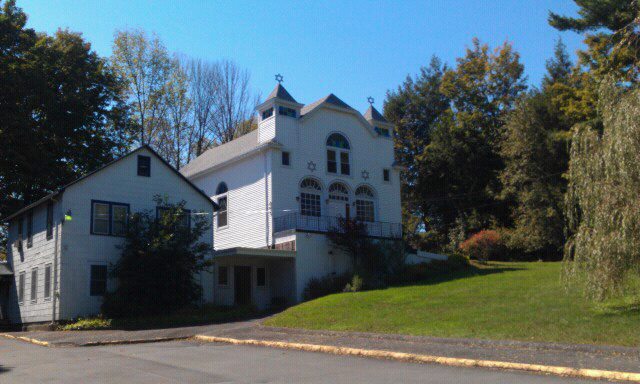
Temple in Kauneonga Lake. Temple in Kauneonga Lake.

(I wrote this a number of years ago. The Congregation is now 100 years old!)

Congregation Temple Beth El in Kauneonga Lake celebrated its 90 anniversary last summer. I only found out because my daughter asked me a question about the shul in the Catskills — the shul that three generations of her family had all attended.

To be honest, I was not sure that it even still held services. I live in Kansas now, and only go up to the Lake once each summer. Even less than I used to. When my parents were alive I would spend 7 to 10 days at our home in Kauneonga Lake with my parents and one or both of my children. But since they passed, at most I have spent a weekend.

So I checked. I went on line, and there it was a website for the congregation! I sent a donation in honor of the anniversary and in memory of my parents. And then I joined the congregation.

It brings back so many memories. The shul was founded in 1923. I think I started going there in the early 1960s. Maybe before. But my memories before then are not very accurate.

We spent every Rosh Hashannah at the shul on the hill in the Catskills. It was an orthodox congregation when I grew up. The women and girls sat upstairs in the balcony, while the men and boys sat downstairs. I actually liked sitting upstairs. We could look down on everyone and see what was going on, while we could be a little less formal.

But my Grandma Thelma and her good friend, Clara Wagner, rebelled one year. They said enough was enough. They did not want to climb the stairs anymore. So the congregation made a mehitzah for the downstairs and made the last three rows of seating for women. Grandma and Clara much happier, and keeping them happy was important. They were both very strong willed women!

I think they would be thrilled to know that there will be a woman rabbi there leading services this summer. Obviously men and women are sitting together and the mehitzah is down.

The shul was where we celebrated special events as well. My parents wedding anniversary was in June. One year, in honor of their anniversary, we held a special kiddish luncheon. My Grandpa Nat, a retired baker, baked plum cake after plum cake. Every oven was filled. Luckily he had saved many of his cooking trays.

The day of the kiddish was special. We were all there, family and congregation members. My Grandma asked Grandpa to sing in Yiddish for us. Grandpa had the best voice. His first song did not make my Mother happy. He sang, “Was is Geven ist Geven it Nitch Du.” My Mom said, “Daddy, why that song?” ‘What was, was and never will be again,’ is not what my Mom wanted to hear on her anniversary. (I think he was reliving her wedding, which occurred when my Dad was in the army on his way to Korea. It was a difficult time for the family, I have been told.)

My Grandpa laughed and then sang Tumbelalika and Schtetla Belz among other songs. There was some singing along, but mainly Grandpa singing to all of us.

We also celebrated my Grandma’s birthday there once or twice. Her birthday was in July. So perhaps her 70 or 75th birthdays were celebrated in the shul.

Grandpa was a cohen. He did not want to go to shul every week, but if no other cohen was available he went. In his younger days he would walk the mile or so to shul. But as he drifted near his 80s and older, he began to drive. He would park at Newman’s or across from Sylvia’s store and then walk the rest of the way. He just could not bring himself to drive all the way to shul on Shabbat.

I remember that a rabbi was hired that was a bit too orthodox for the shul. He put strings up around the syngagoue. As we walked to the shul, my Grandpa stopped and stood so still. “Vas Machts?” He turned to my Grandma. “I haven’t seen that since the shtetl!” He said. (Yes, he said it in Yiddish, but I don’t know how to write the entire sentence.)

I wanted to know what it was; it was an iruv. It makes a wall around the area of the synagogue or community so that people can carry things. You are not supposed to carry on Shabbat, but with an iruv up you can.

My grandparents had many friends at the shul. Among their closests friends were Abe and Clara Wagner. I can still see Abe, a plumber, down in a hole at my grandparents’ bungalow colony asking for some tool.   And my Grandpa laughing hysterically at the sight of the little red haired, highly freckled plumber in a hole.   Abe was so mad, “Stop laughing and hand me the tool.” But they both had a good laugh.

I remember going to their home many times with my Grandma and sitting and talking with Clara.

When Clara passed away, my grandmother was inconsolable for quite awhile. But when Abe remarried, she was welcoming to his new wife.

It was Abe who was there for my Grandpa when my Grandma passed away. We got the phone call from the hospital early on an August morning. My Grandpa refused to go to the hospital. He said, “She is gone, why do I need to go there.” They were worried about him at the hospital as he was in his 80s. So my Mom called Abe.

I can see it as yesterday. Abe spoke to my grandfather briefly, then he pointed at me. “Ellen, you come with me,” he said.

We went to the hospital, and while I signed my grandmother’s name over and over again on documents, Abe said. “Stay with them, I will be back.” At the time the emotion of signing Grandma’s name was all I thought of, nothing else.

We left when he returned. He had a big plastic bag of Grandma’s stuff. As we passed a dumpster, Abe told me throw it all out. “Your Grandpa doesn’t need any of that stuff,” he said.

I then turned to him and said, “Abe, I never saw Grandma.”
“Don’t worry, I took care of it,” He said.

And he did.

Grandma was buried in New Jersey, in our family plot. We, my parents, Grandpa and I, drove back to the Catskills from the cemetery. Grandpa sang, Johnny Mercer’s song, “Autumn Leaves” all the way back. “We promised each other that whoever remained would sing this song,” my Grandpa said. I still cannot bear to hear that song.

When we got to the house, all was ready. There was water by the door. There was a spread of eggs and other dairy items on the table. I am not sure if it was relatives or the Jewish community who prepared everything. But I know that many members of Congregation Temple Beth El came to sit shiva with my Grandpa. They were there for him for the many years he remained living at Kauneonga Lake.

My grandparents and parents always supported Congregation Temple Beth El. And as a community the people of the shul comforted my family.

I am so glad that services are still held at the shul on the hill, and that I have renewed my membership to support it and keep it alive.

http://congregationtemplebethel.org/

http://artists.letssingit.com/johnny-mercer-lyrics-autumn-leaves-wgtz6xc

As Spain Welcomes Back Jews Expelled in the 1400’s, I Share my Spanish Roots

9 Jun

“Grandpa’s family was originally from Spain,” my Grandma Thelma would begin her story with these words. “They left Spain because they did not want to convert. They were court Jews and could have stayed. But their Judaism was more important.”

I thought this was a ‘bubba meiser,’ just a myth and a bedtime story. And for many years, I did not believe the Spanish expulsion of Jews had anything to do with me. I thought it was enough that our family had been decimated by the Shoah. But it seems my grandmother was telling me the truth, and my family is both a survivor of the Spanish and German attempts to destroy the Jewish people.
Grandpa Nat portrait

My Grandpa Nat’s last name was Amsterdam. This is a somewhat unusual Jewish name. And, it seems, actually anyone named Amsterdam is related to me. The family started in Spain as wealthy Jewish merchants and financiers. Supposedly three brothers moved to Amsterdam in the early 1500s. And then a group of them moved to Denbitz and Mielec in Galicia, where they were given the last name Amsterdam.

I started to investigate the Spanish connection when I was in college. And then I got help from an unexpected source. The other story my grandmother told me had to do with the comedian Morey Amsterdam. I was told he was my grandfather’s cousin. He had to be, his name was Amsterdam. I was not sure how to contact him. But he actually contacted me. Morey’s son-in-law met my cousin, Gary, who was an Amsterdam. Since I had the family history, I was then put in touch with Morey Amsterdam. He was on a mission to find all the Amsterdams. He wanted learn all he could about our family. I am not sure he met all of us before his death. But he was relentless. He would send me information about other Amsterdams when he met them. He would give them my contact information as well. People called and contacted me from up and down the East coast telling me that Morey Amsterdam told them to call me. May his name be for a blessing.

In any case, he confirmed the story about our Spanish roots, and then told me more. But it was not Morey who really filled in the missing information. It was another cousin named Bob. His parents and my grandparents were first cousins who all came to the USA in the early 1900s. They stayed in touch in the USA. We have photos of them at family events. My grandparents attended Bob’s wedding.

Bob was a generation older than I, and as an engineer was meticulous about his research. He also got in touch with me through my cousin. That Amsterdam last name stands out. Bob was kind enough to send me his information. And I sent him mine. Since his last name is not Amsterdam, he did not have some of the contacts and information I had received. We filled in each others missing pieces.

The following is what we know and what we think. I have to thank him for all the help he gave me in investigating the family.

Our family has taken on other last names as well. Faya was the original name used in Spain. There are family members who have this name as part of their Hebrew name. This spelling was used up until about 1800. After 1800 the spelling became more Eastern European: Feuer. Other names in the family include Brenner and Asher. All have to do with fire, because they were Cohanim.   The families often intermarried. My grandfather had both a Feuer and an Amsterdam parent. They were first cousins. I have met others, including Bob, who also have parents from both lines. This is a tradition from the days that they were crypto Jews in Spain.

I actually can trace my grandfather’s family back to about 1795 with direct names. My Grandpa Nat’s parents were first cousins, Chava and Gimple. Chava’s parents were Hershel and Frieda; Gimple’s parents were Tzipporah (?) (Hershel’s sister) and Nissin (also a cousin of some sort). Siblings Hershel and Tziporrah parents were Tova and Nissin Amsterdam, and Nissan’s parents were Chava and Morris Amsterdam (My fourth great grandparents!) These names show up constantly in the family and continue today. I am a Chava, named for my great grandmother; my son is Nissan named for my grandfather, so the names continue.

There are many, many men named Nathan (Nissan) in the family. My Grandpa was given this name because he was born between Purim and Passover on the first day of Nissan, but also because it was an important family name.

After the expulsion, some of the family stayed in Spain and converted and became Catholic on the outside. However in their home they were still following the traditions of Judaism.  Through research by a cousin, we believe the family lived in Segovia, a city with a large Jewish population.

However a branch of the family left, we think they all moved to Portugal. We believed they lived in a port city called Oporto before they went to Amsterdam. But some stayed after the Portugal expulsion. The Spanish Inquisition impacted my family in other ways. One family member, Aaron Cohen Faya, was burned at the stake in Lisbon in May 1618. A poet, his secular name was Antonio d’Aguiar. We think d’Aguiar or Aguiar was the name of the entire crypto-Jewish branch of our family.

I have much more information about my Spanish roots. I could tell you about our coat of arms.   I could tell you about meanings of names and how names concerning birds, hawks and eagles are important in our family history.

But I think that as Spain welcomes back the Jewish families they sent forth during the great expulsion, it causes me to think of how it impacted my family. How my family had its own additional diaspora that caused them to travel from Spain to Portugal, to Amsterdam, then to Galicia.   I think about how some survived these moves, left Europe and moved to the United States or to Israel. But others stayed behind and perished in the Shoah. (See my blog, “Speaking Yiddish Always Brings Me Holocaust Memories.”)

My Spanish roots are noted. But more important, I look at what I can do because of my desire to learn about my Spanish ancestry. I found out so much about my family. Most Jewish families cannot tell you the names of ancestors back to the late 1700s. I can. Most cannot tell you that they are related to everyone with a similar last name. I can.

My daughter was at a party. I saw on Facebook that one young man had the last name Amsterdamer. I said, “He is your cousin.” She laughed. “Ask him,” I said. “Mom, I can’t do that. I hardly know him.”

But the next time she saw him she said, “My grandmother’s last name was Amsterdam.” He replied, “Then we are cousins.”

I am proud to have the Amsterdam/Faya/Feuer ancestry.

Grandma Thelma Knows What She Knows

29 May

We always wondered how old my Grandma Thelma was when she celebrated her birthday. She insisted that she was born in 1906 and arrived in the United States when she was 16. This is a debate that went on for years, as her passport had her as two years older.

Her explanation was that she was so desperate to get out of Poland, she made herself two years older to get out. In fact when she finally got her passport and papers in Poland, the official said to her, something like, “I hope you have a safe trip and return safely.” When she got to the door, she turned around and said, “I will never come back here, never.” And then ran for home. Her happiest day was the day she arrived into the New York City harbor.

I have her passenger records from Ellis Island. She arrived as Tauba (Tova), from Boleslawiec, Poland, on November 7, 1922. An 18 year-old, single female, she traveled by herself on the Gothland from Antwerp, Belgium.

Grandma reinvented herself to Thelma. She stopped using the name Tova except in synagogue.

She lived with relatives, her Aunt Gussie, her father’s sister, had agreed to sponsor Grandma. Aunt Gussie had four children, three boys and a girl. But the stories Grandma told always revolved around the cousin who was her age, Katie, who was treated as a queen. While my Grandma said she was treated as the “deinst,” the maid. She had to work all day, go to the school at night, and then when she was in the apartment clean and work for her board.

When Katie would have her friends over, they would tease my grandmother because she was a “greener.” My grandmother also had to ‘serve’ them, and was not allowed to really just sit and visit. It made my Grandma mad, as many of Katie’s friends were also once “greeners.” It also made her mad to be treated like that when she was family. However, she and Katie did become friends, because despite everything, they liked each other.

It was a difficult life made more difficult because her Aunt Gussie wanted her to marry an old widowed man with children. And Grandma did not want to marry him. She had met my grandfather, Nathan (Nissin) who was a baker and either four or six years older than her (depending on the birth year accepted). My sister and I think one reason Grandma and Katie became firm friends is that she helped my Grandma in her romance with Grandpa.

This became a battle with Aunt Gussie. My grandmother took matters into her own hands by writing her father, Avraham Shlomo, in Poland.   She told him about her love for Nathan and the pressure from Aunt Gussie to marry the other man. My great grandfather did what any good Jewish father would do for his daughter, he investigated Grandpa’s family; found out they were a good family of Cohen descent, and approved the marriage. When the letter arrived from Poland, my grandmother got her way, and married my grandfather.


Grandma Thelma and Grandpa Nat in their wedding finery. Grandma Thelma and Grandpa Nat in their wedding finery.

Grandma always kept in touch with Katie. Throughout their lives, they did not see each other, but they wrote many letters. We remember whenever a Katie letter arrived in the Catskills, Grandma sat down and read it. They were always in Yiddish. And then Grandma wrote her a many-paged response. Although Grandma loved her cousin, Katie, she never forgave Aunt Gussie for the harsh treatment. It was difficult because she was also always grateful that her aunt had sponsored her to come to the United States and gave her a place to live, however begrudgingly.

In the meantime, my Grandpa and his Uncle Yidel (Julius) had a bakery. Their business grew. At some point they decided to separate. Uncle Yidel stayed in New York, while Grandma and Grandpa moved to New Jersey and opened their own bakery.

My Grandma was a shrewd businesswoman. She enabled the business to survive through the 1929 stock market crash. She had two children to support, but during the Great Depression she gave out food on credit to those who needed it.   She invested in the Stock Market, but at the same time she had money spread out in lots of different banks. I remember going bank hopping with her in both New Jersey and New York City. She would bring all her bank passbooks at the end of each month, to have the interest entered.

My Grandma is 36 or 38 in this photo. My Grandma is 36 or 38 in this photo.

Over the years, my grandparents became financially and personally successful. They had the bakery and the building it was in; they owned a small bungalow colony in the Catskills, as well as a winter home about half mile from the bungalows. They had investments. They had two children and five grandchildren. All was happy and well.

The memories of Katie A and her parents, as well as their treatment of Grandma, had stayed within my Grandma’s memories and were not really discussed until one day in the Catskills. A day I will always remember, because it shows you how small the world can be, and how connections make changes.

Both my Dad’s parents and their siblings were born in the United States. His mom, my Grandma Esther, was one of five siblings, including her brother Sam. Uncle Sam was a little different from everyone else. He worked for the New York City Port Authority, and he was divorced and remarried. I loved my great Uncle Sam. He had a great sense of humor and was wonderful with us children. His second wife, Sylvia, had a little yappy dog, who scared us all. She carried that dog everywhere. Aunt Sylvia was always perfectly dressed, blonde hair in a French twist. She expected elegance wherever she went, thus she did not like to come to the Catskills because she felt it was too middle class.

Her feelings might have changed the day they decided to finally take a ride up to the Catskills and see everyone. My father’s parents and sister and her family stayed at the bungalow colony owned by my maternal grandparents. So first Uncle Sam went there to see his sister and visit. Later in the day, he and Aunt Sylvia drove up to the ‘big’ house where my maternal grandparents lived, and where we had our bungalow.

Of course there were introductions all around so that Grandma Thelma and Grandpa Nat could meet Uncle Sam’s wife Aunt Sylvia.

When my Grandma met Aunt Sylvia, she said, “I know you.”

“No,” Sylvia replied. “I never met you before.”

I started walking with Grandma back to the house. “I know her,” she said again. My Mom heard. “Mom,” she said. “She probably just reminds you of someone.”

I thought it was over. No big deal. But a short time later, Grandma came back to our bungalow, where we were sitting outside. She walked up to Aunt Sylvia and said, “Sadie, you are Sadie. You were a friend of my cousin, Katie. I remember you.”

Aunt Sylvia…now Sadie, looked at my Grandma and said, “Tova, is that you!?”

And it was. They hugged. They kissed. They spoke in Yiddish for hours.

When Uncle Sam and Aunt Sylvia left, my Grandma Thelma had a new ‘best’ friend. They had so many memories to share.

And then my Grandma turned to my Mom and said, “I told you I knew her.” We should have known that Grandma Thelma knows what she knows.

This incident impacted my Grandma Esther as well, once she heard what had happened. From then on, whenever her sister-in-law made her crazy, she would say, “Sylvia…she is so hoity toity, but she is really just Sadie from Brooklyn.”

Thanks to my sister for remembering with me.

How My Grandparents Impacted My Life

15 May


Summer of 1979 in the Catskills.  Eight months before my wedding.

Summer of 1979 in the Catskills. Eight months before my wedding.

I am so fortunate to have had all four of my grandparents walk down the aisle at my wedding! Two of them were alive when my daughter was born, and knew her. And one of my grandparents survived and knew my son as well. They had a major impact on my life, especially since I spent every summer in the Catskills with all four of my grandparents near by.

My Grandpa Harry, born in 1888 or 1889, was my oldest grandparent. He did not have the easiest childhood. The oldest of five children, he spent two years as a teen searching for his father who abandoned the family. He found him in Seattle, Washington, quite far from his family in New York City. Grandpa returned home, became a tailor and supported his family. All of his siblings graduated college, a feat for women of the time. And Grandpa supported them. The saddest part is that after they were college educated, they treated Grandpa as if he was not quite good enough for them.

I took sewing classes beginning when I was 14, and Grandpa and I started to really talk! He was proud of the things I made and would check the seams and my work. Grandpa taught me how to match plaids, not an easy thing to do. But from him I learned that to make something well, you need to take the time and effort to make it nice. To this day, I cannot buy clothing where the plaids or lines do not match up.

My favorite memory of Grandpa Harry was his guarding the sweet table every holiday. My Grandma Esther was a great cook and baker. Each holiday had amazing treats set aside on special table. Grandpa would sit at the end. I think he counted how much each of the nine grandchildren ate. If we came back too often, he would intone: “The Trolley car stops, too!” From this I learned moderation. You need to take a break.

(From my cousins I learned that there were extra treats hidden in the back bedroom.)

Grandma Esther was also born in the New York City area, but in 1898. She was also one of five children, and was surrounded by cousins. I have written about her teaching me to crochet and knit (See “Grandma Esther’s Afghans Wrap Me in Love” and “Knitting and Crocheting Brings Love and Memories.”) But she taught me many other important concepts as well.

When I was old enough to date, Grandma Esther sat me down to discuss choosing the perfect spouse. She had already dealt with my Grandpa Harry’s family for years, so it was not surprising when she said, “When you get married, you marry the family as well. So be careful. Check out his family before you say yes. Find someone whose family is like your family.” And I did. Almost 35 years later, I can say, Thank you!

The most important help my Grandma gave me was teaching me how to nurse my daughter. Grandma flew out to Kansas when she was 88 years old to meet my daughter. (My sister and her husband flew with her.) When she saw my feeble attempts at nursing, 28 years ago, she was shocked.

First she said, “Only poor people nurse. Your cousins’ wives did not do this.” My response was, “Grandma, they say this is much better for the baby. I want to do it.” Her second response, “Well if you are going to do it, do it right.”

And she showed me how to do it the right way. It made such a big difference. I then taught all my friends the tricks my Grandma showed me. Our mothers had not nursed. So we needed someone who actually had done it to point out the way.

The last advice she gave me was in naming babies. She was one of five cousins named Esther. And she hated that each of them had nicknames. She was Curly Esther because of her hair. But there also was Topsy Esther and Meshuganah Esther as well. I never heard the other nicknames. So she made sure her children’s English names were different from their cousins, even though their Hebrew names were the same.

My Grandpa Nat (Nissan) was born in Europe in 1900. He spent two years traveling to get to the Golden Medina, the USA. He arrived in 1920. Grandpa was a baker (See “Bakery Aromas Bring Back Delicious Memories.”) But most important is that he had a great work ethic, as well as a great sense of humor.

Every spring we had to help get his bungalow colony ready for another season. He would say to my siblings and I, as he handed us paint scrappers, “If you don’t work, you don’t eat.” Which is true. As an adult you have to have a job to get food. He was proud of our college educations. Having grown up in Europe and seen the treatment of Jews there, he said, “They can take everything away from you, but they can never take away your education.”

One of his fun, and my favorite saying of his, “It is as easy to follow a heavy cart, as it is to follow a empty one.” I am sure it is a translation from Yiddish. But it was his marriage advise meaning, try to find someone who has a little more assets. It will help in the long run. But all time favorite saying was “Every Pot has a Lid.” This might have been my Grandma Thelma who said this. But the main point is that everyone has someone.

Grandpa Nat loved us. His entire family, parents, siblings, nieces and nephews, many aunts, uncles and cousins had perished in the Shoah. (“Speaking Yiddish Always Brings Me Holocaust Memories.”) But he never lost a sense of humor, and he always showed us love.

But the most important person to him was my Grandma Thelma (Tova). She was born in Poland in 1906. Grandma was strong willed and determined; she came to the USA when she was 16, worked all day and then went to night school to learn English. She read, wrote and spoke three languages. And she was afraid of Nothing.

Grandma Thelma sang Yiddish songs to me to put me to sleep. “Ofyn Pripetchik “ was my favorite. Grandpa sang to us as well. Their singing of the Yiddish songs was so heartfelt. Grandpa’s version of “Rozhinkies mit Mandlen,” “Was itz Geven Ist Geven,” “Tum Balalayke,” “Eli Eli” and “Schtela Beltz “ still echo in my mind. He had a beautiful voice. My siblings and I often sang along with him.

Advice from Grandma Thelma was never ending. She and I battled for power constantly. She called me the Machshefah, the witch.   But from her I learned to be strong. I learned never to give up. I learned to trust myself.

When I was at college, she would send me letters with a bit of ‘gelt’ (money) so I could buy stamps and write back. Wherever I lived, not matter what I did or where I wanted to go, she was my ally. We could fight, but she backed me up always. When I needed to stand up to my parents, to be who I wanted to be, Grandma was standing behind me.

Her shopping advise was intense,  “When you buy jewelry, always buy real. When you buy gold, always buy solid, never buy hollow.” Grandma taught me how to sew jewelry into clothing, because you never know. She kept silver coins in every purse. And money buried in the basement. Her experiences growing up in Europe scarred her, but she was defiant and not scared. Luckily I never had to use this final advice.

I am who I am because of my grandparents. I think of them often with love.

Speaking Yiddish Always Brings Me Holocaust Memories

28 Apr

My maternal grandparents were from Poland and Galicia. They came to the United States in the 1920s. Met and married when Grandma was 19, Grandpa was 29. At home they spoke to each other only in Yiddish, although both learned to speak excellent English. And Grandma was a ferocious reader in several languages.

When I stayed with them, they spoke Yiddish to me as well. As a young child I could respond and easily speak to them. But that ended when my parents realized that my siblings and I spoke and understood Yiddish. They had been using it as a secret language to discuss finances and personal matters. So the order went out…stop speaking Yiddish to the children. My Mother, in later years, would tell me that she regretted making that demand.

But Yiddish connected me to my grandparents. And I studied German in high school and Hebrew in college. Then I spent a year in Israel at Hebrew University. While there I spent so much time with my great uncle and great aunts, who spoke Yiddish at home. So my Yiddish slowly improved, and I became more fluent.

The kneeling sailor is speaking to my Mom;behind her my Uncle; behind him my Grandma.

The kneeling sailor is speaking to my Mom;behind her my Uncle; behind him my Grandma.

My Grandma’s family was lucky. She went to Europe in 1931 with my Mom and Uncle and stayed for six months. When she returned to the US in 1932, she told my grandfather that they had to get everyone out. And she started the process. She was able to get visas for her father and sister. They made my great aunt younger than her real age, so she could come in on her father’s passport. Her brothers and their wives were not as fortunate. But they did survive the war.

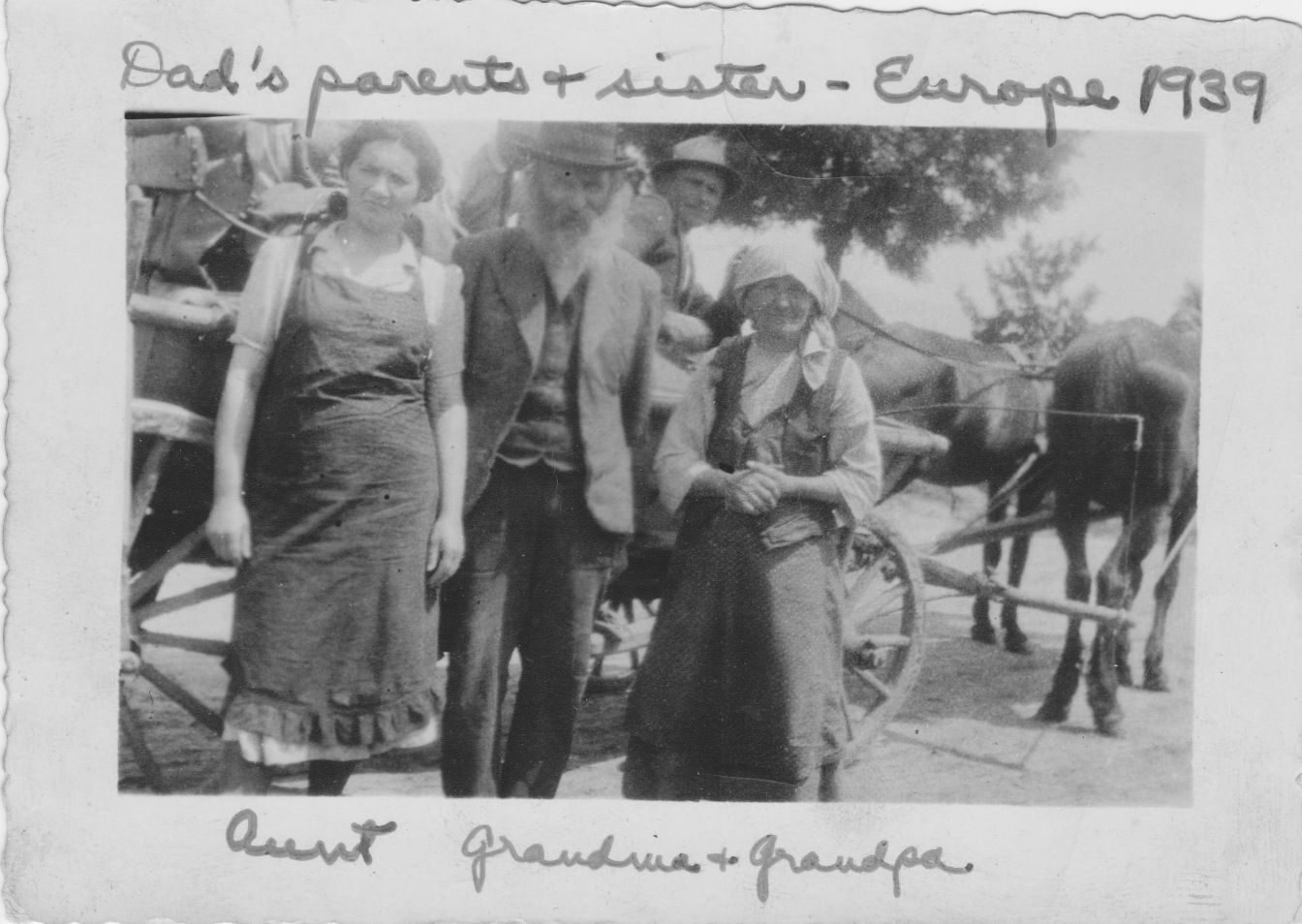
My great aunt Tova, my great Grandparents Gimple and Chava. The man driving is an Uncle. And the horses and cart they bought with the money my grandparents sent. They all perished.

My great aunt Tova, my great Grandparents Gimple and Chava. The man driving is an Uncle. And the horses and cart they bought with the money my grandparents sent. They all perished.

My Grandpa’s family was not fortunate at all. They all perished. My grandparents did send his parents money and visa to come to the US. But they could not believe what would happen. They took the money and bought a horse and cart. They did not want to leave their other children and grandchildren. And my grandparents could not get everyone visas.

My mother used to tell me that every morning after work, when he found out that his entire family was murdered, my grandfather would sit in the kitchen and cry. He was a baker…up all night. But before he went to sleep for the day, he cried for all he lost.

In the meantime, my grandparents thrived in the US. They had two children, five grandchildren; two businesses, both a bakery in New Jersey and a bungalow colony in the Catskills.

Grandma wrote to her brother in Israel often. When I went as a college sophomore, I spent a year of college at Hebrew University. I had a cousin who was my age, and my great uncle and aunts (one uncle had died in the 1950s.) I met a few other relatives who had survived the Shoah. But no one ever spoke to me about it. I was young. But my Hebrew and Yiddish were improving rapidly.

Then when I was a junior in college, I took my Grandma to Israel with me during winter break. She had not seen her brother in 42 years. We spent a month together. A month I will never, ever forget.

The phone calls at the hotel would be in Hebrew. Someone would call and speak to me. “I understand the Tova S. is here,” they would say. “Yes,” I would respond. They would then ask genealogy. Who were her parents? Where did she live? When all the right answers were given, I would hear. Yes. She is my mother’s or father’s or someone’s cousin. And they would set up an appointment to meet with us: to see my Grandma.

And the holocaust became real to me. Each person in Yiddish told my Grandma their story of how they survived the Shoah. And who had died during that horrible time. If I did not understand a word, Grandma would translate. Sometimes they would tell me the word in Hebrew. Day after day, week after week, I heard so many stories.

But then came the worst of all. Rafael came. I knew him and his wife and daughter. His mother and my great grandfather were siblings. Rafael and his wife had never spoken to me about their experiences. But when Rafael saw my Grandma, it was an outburst of pain and crying from both of them. Rafael was my Grandma’s first cousin. His sister, Tova Malcha, had been my Grandma’s best friend. And Tova Malcha had not survived. When Rafael and Grandma met their memories overflowed. Not only on death, but on the lives they had left behind.

At that moment, at that time, my Yiddish was at its best. I understood all.

After Rafael left, I asked Grandma why no one had ever told me these stories? Why I had not met all these people who kept showing up? Why Uncle had only introduced me to a few of the relatives when I spent my year there?

There was no answer.

When we returned to the US, my Grandpa was so happy to see Grandma. “Never leave me again,” he said. He did not come with us, because he refused to ever leave the United States.

She never left him again, till she died.

And I never speak Yiddish or hear Yiddish without the images and sounds of that month in Israel and the Shoah ever present in my mind.