Archive | Memories RSS feed for this section

My Time As A Candy Striper

16 Apr

My 45 year old Candy Striper cap.

I still have the red and white searsucker cap that I wore as a Candy Striper at Hudson County Hospital, New Jersey, in the 1970s. I am proud of the time I volunteered to cheer up patients and help the nurses.

Our job then was pretty easy to do, we did whatever the nurses asked us based on the rules issued by the office of volunteers. For me it was important to help others, and visit the sick.

Several days a week, after I finished my classes at North Bergen High School, I would go home and change into my white and red pinafore and take the bus along Park Avenue to the hospital.  Once there I would check in to the volunteer office and get my day’s assignment. I usually worked for two hours. That was perfect as my Dad would pick me up on his way home from work.

My favorite assignment was to go and visit with the children who were in the hospital.  I knew how to create creatures from paper having learned the art of origami when I was 10.  I often brought some square origami paper with me.  When I ran out the nurses would find colored paper for me to use with the children. It was two hours of fun for all of us!

I tried to visit every room with children. In those days visiting hours were restricted. Parents could only be with their children for several hours a day.   I knew from my own stay in the hospital how sad and lonely it can be.

Making origami figures


It made me happy to bring a bit of joy to a younger child and leave behind a little gift of a bird or box or frog.

But I did not always get assigned to the children’s ward. To be honest I did not like having to help in the adult rooms.  You never knew what you would see, especially on Mondays.  Often on Mondays, the results of a weekend of carousing were evident in hospital beds filled with adults who had been in car accidents.  I really did not like to see people in traction and stitched up.  I would get a little sick to my stomach when ever I entered a room. But since, in those days I wanted to be a nurse, I did whatever I was asked. So into a room I would go carrying the sheets or other items as requested.

My time as a Candy Striper lasted not quite two years. It was on a Monday…accident day… that it ended.  I remember entering a room,  then waking up in the volunteer office and seeing my Dad talking to the director.  It was my last day.

I did not do anything wrong. Just walked into a room, as I was told to, and ended up being there just as a man died.  I passed out. I am not proud of that, nor of the fact that I did not go back. But the sight of blood and death did not make a positive impression. I realized then I would never be a nurse.

It made it difficult, years later, when I married a medical student.  While others would visit their spouses when they were on call, I did my best to avoid the hospital. For me heading over to the hospital for a chat was just not my idea of fun.

As the years pass, I learned to let go of my discomfort in hospitals.  I no longer get a sick feeling in my stomach when I enter a hospital. I am aware of the good aspects along with with difficult ones.

Overall I have good memories of my time volunteering as a Candy Striper at Hudson County Hospital. I believe that the time I spent with the children and helping others were the part of my upbringing that enhanced my belief in the importance of volunteering. My time as a Candy Striper made a positive impact on my life.

Matzah Brie 

15 Apr

Why do I only make matzah brie during Passover?  I truly love it. I heat up my frying pan and make it at least twice each year. And I always make enough to last two days. But once the holiday is over, my desire for matzah brie disappears. 

I have learned over the years that not everyone makes matzah brie the same way.  Nor do they call it the same thing. I say matzah brie, others say matzah briet or matzah brun. There might be even more names. 

My husband’s cousin would break a piece of matzah in half and soak both halves in a egg mixture before deep frying them. It was delicious, but not my style at all.

 I wonder if the area of Europe a family came from or perhaps where in the USA they settled impacts how the matzah brie is made? 

Making matzah brie is something I learned as a child. In my family we make the same batter we do for French toast. Eggs and vanilla mixed together.  Then we run the matzah under water, breaking it down to smallervand smaller pieces till we crumble the matzah into the batter.  The number of matzah we use is determined by the number of eggs we use; about two pieces of matzah for every egg. 


I then take the mixture and place it into a frying pan that I have place a small amount of oil and have  preheated. I smooth out the top of the mixture and make sure I fill the entire pan. Then it cooks. I like mine golden brown. I use a spatula to divide it in half to easily turn it. Then cook the other side.  The smell is enticing. 


Finally I cut it to smaller pieces and I am ready to eat. In my house there is just one way to it eat, with sugar sprinkled over the top. I know some use syrup, but I am a sugar purest. 

Another delicious Passover memory.  But I know when the holiday passes, I will once again crave my Sunday morning challah French toast. All thoughts of matzah brie wil be gone till next spring! 

Hope everyone is having a zissel Pesach! 

Missing Mom’s Passover Recipes

13 Mar

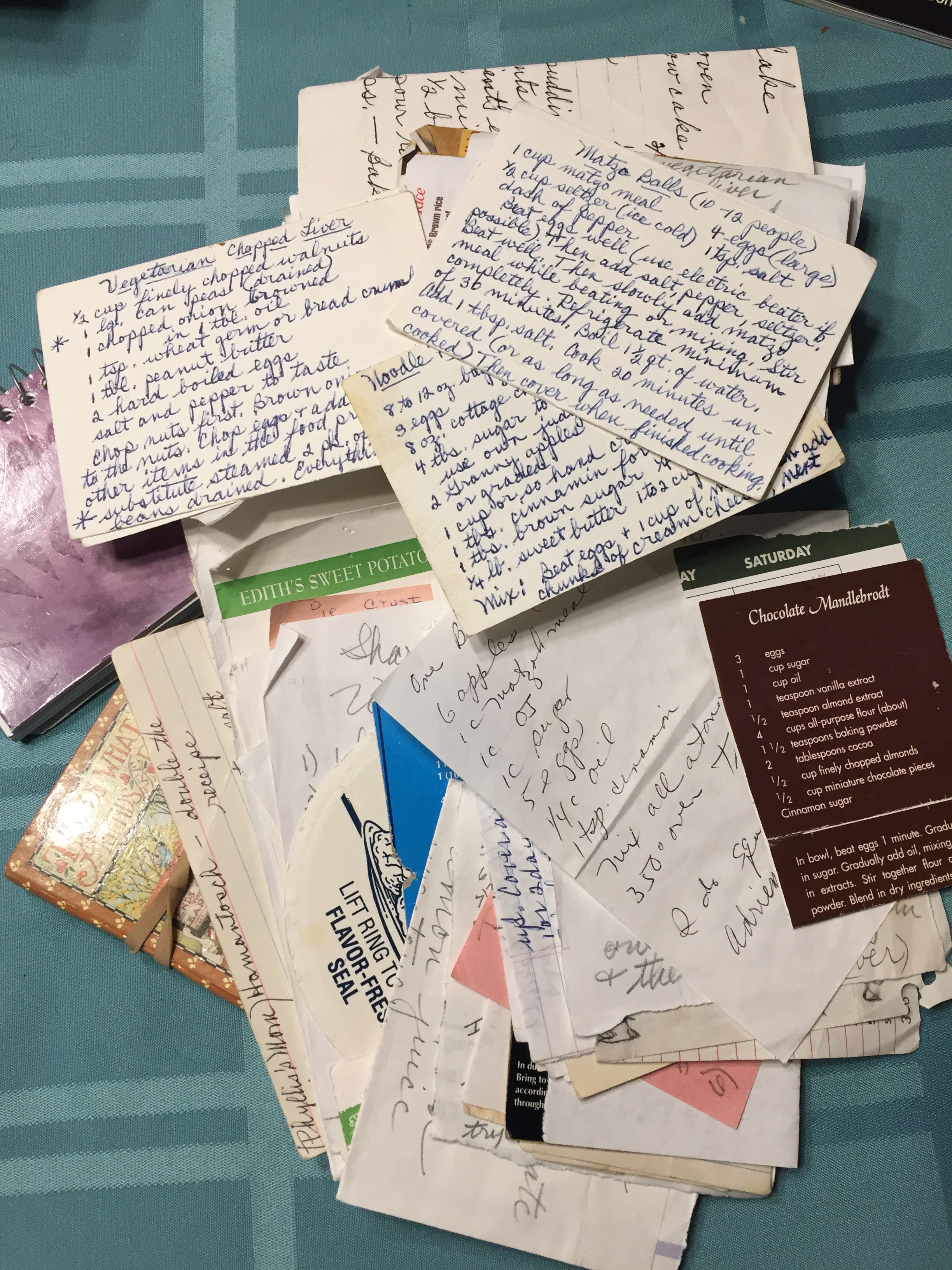
The recipes filled a bag.

There were many little issues that appeared during the year that my parents died. Little things that you do not realize will cause distress. But for my sister and me, one of these issues was my Mom’s recipes. They were gone. We searched the house and could not find them. Most recipes we knew because we continued to make them.

But a few seemed lost forever, these included her Passover recipes. Since we used them only once a year, they were not etched into our memories. And so we had to use recipes from books or from others, or just not make that item. Without her recipes, we felt a bit lost.

My parents would come to me each year for the second night of Pesach.   They did the first Seder in New Jersey with my siblings and their families. Mom would cook her share of the meal, and leave all the leftovers for my brother and sister’s families. Because the next morning, bright and early, my parents would fly out to stay with me for second Seder and the rest of the holiday.

My children went to the Jewish Day School, so they were off that week. It was a perfect time for my parents to have grandparent adventures with the children.

Mom would arrive and join me in cooking. We always spent the first seder with other families at friends. But I alternated second night seder with another friend, and so often it would be at my house. Eventually, second night became my domain.

Whatever the case, there were certain foods I did not make until Mom got here. She knew exactly what to do, even though she might have had the recipes written down. After making seders for so many years, she knew her recipes. Whereas, my sister and I depended on her memory to help us.

So I should have known what happened to the recipes. But it never occurred to me.

About a year or so after both my parents passed away, they did so quickly and within nine months of each other, I finally cleaned out the bedroom in my house where they always stayed. We had already cleaned out their condo apartment in New Jersey; had told the managers of the apartment they rented in Florida to take what they wanted and donate the rest, and we had mostly cleaned out the house in the Catskill. So now it was time for me to do the final cleaning and pack up and donate what they had left behind in my house.

They had their own space, and I had avoided going into it, but my son wanted to move into this larger room, with its own separated entrance.

I finally opened the closet and packed my dad’s jeans and shirts and jackets. I started cleaning out the drawers. Putting tops and items into bags to donate.

There in the bottom drawer, covered by tops, was a small, stuffed plastic bag filled with papers. Recipes. Lots and lots of recipes. She was in the process of rewriting in her beautiful teacher’s handwriting. Passover was back: Vegetarian Chopped Liver, Matzah balls for 10-12 people, Farfel pudding from Sylvia, Baked Gifilte Fish from Lola, Potato Kugel, Stuffed cabbage.

Mixed in were many other recipes, including Hamantasch from Phyllis and my Uncle Stanley’s cookie recipe, which she called Cookies by Stanley. (He was baker and passed away in January 2017, a week before his 90th birthday, on my Mother’s sixth Yahrzeit.)

I would like to say I used these recipes. But I did not.  I put them in my room, in a box, waiting to be used.  I did not share them.  I did not look at them.  I just could not.  Now, I know I need to scan the recipes and send them to my brother and sister. I know that. But for four years they have sat in their bag while I have looked at it as a locked time chest, unable to really sort through the notes left by my Mom.

I decided this year was the time. I was ready.   We are done missing my Mom’s recipes.

Why The Same Old, Same Old Feels Good Now

14 Feb

When I was young, I never understood why my grandmother ate almost the exact same breakfast every morning: Cottage cheese, a piece of toast, fruit, water for her pills and coffee. “Isn’t that boring?” I asked. For me breakfast needed to be an exciting start to the day, especially in the summers.

But now I understand. Each morning I start the day with basically the same breakfast … everyday.  I like it.  Why change?  Occasionally I switch it up, usually when I am traveling.  But when home it is the same old, same old. It feels comfortable. Why change? I have become my grandma.

But I find my need for consistency goes beyond breakfast.  I like to shop in the same stores. I know which clothes lines and which shoes fit me well. Why should I venture to another store when I know I can always find clothes and shoes that fit at Chicos and Clarks?   Yes I sometimes go into another store and find something, but usually it takes more time to figure out where the items I might like are located. But I do go to discount stores that I enjoy like DSW, where I can find my favorite shoes at a less expensive price. 

I am even happy with my usual grocery shopping selection. Friends have tried to get me to go to two newer, more hip, places to do my grocery shopping. But I have my big three depending on what I need. I used to start with Costco for some items, but with no children at home I do not often need bulk food. Instead I buy smaller quantities at a local grocer/supermarket.  Occasionally, I do venture to the newer stores, but I feel a bit out of alignment when I shop there. I have to search the aisles for what I need. 

I often dash over to a nearby Target for sundries. Two years ago they totally remodeled the one I shop at.  The changes were nice, but the disruption made me realize I was getting set in my ways. I like the same old, same old. Although I now love the changes, I feel a sense of loss.  Now I have to readjust my habits to find the items I need. However, I will admit when my favorite brunch place renovated, it became much improved! 

But lately I find that I just like being at home. Especially when I am home.

My husband and I travel … a lot.  We are fortunate that our son lives close. He  moves back to our house to care for our cats when we travel.  But with being on so many trips, the joy of just being at home sometimes is the best.on one hand I know I am getting set in my ways. However,  it just makes the same old, same old feel good. 

Speak Out In Times of Great Moral Crisis

29 Jan

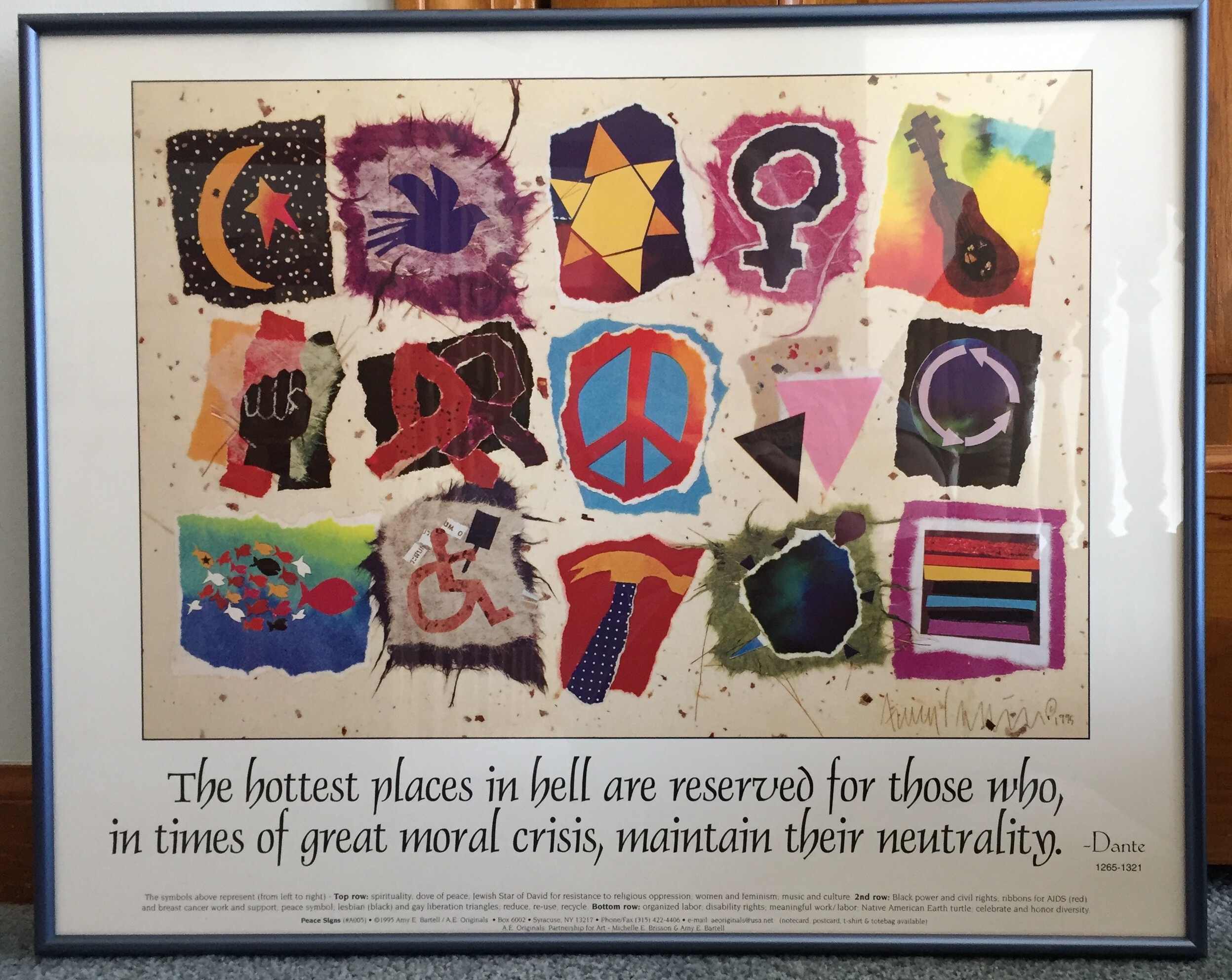
“The hottest places in hell are reserved for those who, in times of great moral crisis, maintain their neutrality.” Dante


In March 2002, my husband and I took our two children to Washington, DC, for spring break. We decided that in order to show no fear in face of terrorism we would go to our nation’s capitol and visit all of the museums and sites.

The White House was still closed to the public. There were snipers on the roof. And new obstacles to block terrorist attacks were being put into place.

But we went to museums, to the Library of Congress, to the Ford Theater, to George Washington’s Home at Mount Vernon. We showed our children that these places will stand. And no matter what happens, we as citizens of the United States had freedoms.

My son was 11 and my daughter was 15. My husband had already been to the Holocaust Museum. We decided that I would take our daughter there, while my husband took our son back to the hotel. A good decision at the time, as it is a difficult museum to see.

My daughter and I walked the halls of the museum. We watched movies and videos. We listened to testimony. We looked at memorabilia. Then we went to the Hall of Remembrance. I wanted to light a candle in memory of my family who perished in the Shoah. For my great grandmother, Chava, for whom I am named; her husband, Gimple, and their children, in laws, grandchildren, sisters, brothers, nieces and nephews who had all perished in the fires of hatred.

But there were no candles left. And I cried. My daughter searched throughout the room for one last candle for me to light.   And then she sat with me as I cried.   I cried for all those who perished without a name. I cried for all those families who had no one left to cry for them.

When I left I purchased a poster, this poster that I show on this blog. This poster, which I framed and hung in my home office; its words call out to me even louder now.   We cannot remain silent in times of great moral crisis.   We cannot be silent like those who said they were only following orders.

We in the United States are now in a great moral crisis. There is no legality in singling out one religion over others. Timothy McVeigh was not a Moslem, he killed 168 people in Oklahoma City. He was a white Christian.   Should we ban all white Christians?

I am so shocked by what is occurring. Those in Congress who say they have values and care about family and country. You are living in a lie. Your alternative truths are lies.

For those of us of faith, we know what the Torah, the Bible says.  It says: “When a foreigner resides among you in your land, do not mistreat them.  The foreigner residing among you must be treated as your native born.  Love them as yourself, for you were foreigners in Egypt.  (Leviticus 19:33-34).  We were strangers in a strange land.  And most of those who live in the United States now were also strangers in a strange land, the descendants of immigrants and refugees.

Anyone who really cares about our country and our people, you must not be silent. We must speak out in times of great moral crisis!  Call your Legislators and Senators; speak out.  Vote!  Support the ACLU! Do not remain silent.  If we do,  then we are condoning those who are the enemy of what the United States stands for: liberty and justice for all.

Brothers and Sisters Must Stick Together

19 Jan

“Brothers and sisters must stick together,” my parents would continually make this statement to my brother, sister and me throughout our childhood.  If we had a disagreement, they would intone this mantra. It was used in many ways.

If a friend of my brother’s bugged me, he would stop it. But then he would bug me.  Brothers protect sisters from others, but that does not mean he could not tease me. His interpretation of this saying.

Over the years my sibling and I have come together many times to help each other.  And this sentiment fills my mind and my soul. We will always stick together.  We repeated it many times when our parents passed away within nine months of each other.

As we cleaned and divided their homes, my brother would say, “Nothing is worth fighting over.”  And we knew that “Brothers and Sisters must stick together.”  It helped to hear these words from my parents. It was an emotional time, and sometimes we needed this reminder.

But I have to say my parents and their siblings took this to the zenith degree.  My Dad and his sister passed away within days of each other. It shocked us, as we sat shiva for both.   My Dad called my Aunt almost every day after my Mom passed, but even before they spoke often. And each winter spent months together in Florida. At the time I remember thinking that they could not survive without each other as they were so close. So although I was shocked when it happened,  I was not really surprised.  Brothers and sisters must stick together.

But this week it really amazed me.  To be honest my Mom and her brother had a separation.  They did not speak to each other the last years of my mother’s life. This broke her heart. Although she often spoke of her brother, Mom passed away before the rift was ended. Her mantra of “Brothers and Sisters must stick together,” did not help in this instance.  But my cousin, who I always kept close with, came to see her. And that help to ease her.

In the past six years the family has healed.  My siblings and I have visited with my Uncle. We see our cousins.  We help in times of need.  Brothers and sisters sticking together. The family has reunited.

Yesterday my Uncle passed away.  He had been ill for a while, but this week he went into hospice. I spoke to my cousins multiple times during the week.  And texted in between.  I love her and I knew this was so difficult.  And then he slowly slipped away, just days before his 90th birthday. When I got the call I was not surprised. But a few minutes later it hit me, this day was my Mom’s yahrzeit, the religious anniversary of her death.

I texted my cousin: her response was perfect, “Maybe now they will make peace.”

But to me it was a sign. To my siblings I texted, “Brothers and sisters must stick together.”

Memories of the Multi-Colored, Rainbow Fence

19 Jan

My son and I recently completed a project in my home. We stripped wallpaper off the walls of a bathroom and covered the vacant walls with a lovely sea foam-colored paint. I loved working on this project with my son over his winter break!

While we were painting, I kept flashing back to my Grandpa Nat, for whom my son is named. Grandpa would have loved that my son was taking on a painting project and successfully meeting my expectations.   It was my grandfather who taught me the skill of scrapping and painting and keeping a home in shape.

As the owner of a small Catskill’s bungalow colony in Kauneonga Lake, Grandpa did much of the maintenance on his own, with help from my Dad and us, his grandchildren.   The difficult plumbing and electrical work was done by professionals, the painting was a chore we could all do. And we did.

“IF you don’t Work, you don’t Eat,” Grandpa would intone. Of course we always ate, but he wanted us to know that it was important to have a good work ethic. In the real world, not working meant no money.

In the spring, that work ethic was obvious. We would go up to the Catskills before the season began for my Dad to help Grandpa get the bungalows ready. My brother and I were scrappers and painters. They would put us along the bottom of the bungalows that needed to be painted, where we scrapped off the peeling paint.

When that chore was completed to Grandpa’s satisfaction, my brother and I would be allowed to paint the bottom.   I actually loved it! It was my favorite chore, even though all the buildings were painted white. (I think my sister was too young to be part of the paint squad!)

img_4330

We still have the furniture.  It is well over 65 years old, and needs painting!

When the bungalows were done, we had to paint the wooden lawn furniture.  Grandpa went for the greens, blues and gray tones.  Scrapping those chairs and painting the wooden slats and metal legs was backbreaking work.  We got to do it because we were lower to the ground!  But I still remember how tired I would be when we completed this chore.

Now I have to tell you that my Grandpa was colorblind. ALL colors looked the same for him. Whereas, my Grandma loved colors. So in a way what happened one spring is partly my grandmother’s fault.

Every other spring, my grandfather would paint the wooden fence that surrounded the colony. Our colony was located across from the lake along the side of West Shore Road.   During the week, the road was quiet with virtually no cars. But on the weekend, the road was zipping with cars.   The fence kept all the children safe.

I do not know why, but one spring Grandpa painted the fence when we were not there.   And instead of getting new paint cans, he decided to use all the old paint that was in storage: exterior and interior paint. Why waste it? He did not mix the cans together. That might have been better, as everything would have been grey.   However, that is not what he did!

Instead as he finished one can of paint, he opened another and continued painting where he left off, over and over again. It was rainbow like in its many colors, but not in any rainbow order. When we drove up to the Catskills and arrived at the colony, we were amazed to see, what I thought was lovely, a multi-colored fence surrounding the property. I cannot remember all the colors that covered the wood. But it was noticeable. My parents were stunned. And then they laughed.

My grandfather had no idea what the fuss was about. When they told him, he just roared in laughter.

I think it stayed that way for two years, even though some of the tenants complained. Although my mother and grandmother were not fans of the multicolored fence, I was. It made me happy. We were the only bungalow colony with such a joyful fence. When he repainted it, he used just one color, grey.   After that he often mixed all the paints together when we worked in the spring creating different tones of grey!

So as my son painted the walls in my bathroom, a joyful sea foam blue, I continually flashed back to the joyful multicolored, rainbow fence that surrounded our bungalows.

Kuk Eyn:  Give a Look

26 Dec

“Kuk eyn!” My grandma would say when she wanted my Mom to look at something quickly, usually when we were out of the house in public place. Kuk eyn, two Yiddish words that mean look, eye.  But when Grandma said it, it meant, “Look now, give a look!”

“Kuk eyn!” my grandparents said as thousands of young people walked past our summer home on the way to Woodstock. “Look at them, what are they doing?” Is what they added to their two word exclamation. Everyone was looking at the mass of people walking by.

Kuk eyn, when we were shopping and someone was acting or dressed unusually. Kuk eyn in synagogue if someone dressed inappropriately. Kuk eyn whenever something out of the ordinary happen.

These two words were a signal, a notification. Sometimes they meant, “Watch out! Something is happening!” Whenever I heard Grandma or my Mom said these words, I always looked up with interest. I knew something was up. They were a secret code to pay attention.  “Kuk eyn” in a whisper, “be careful, watch out.”

Kuk eyn.  Give a look.  After grandma died, my Mom continued to use the expression with my sister and me. It was almost always said quietly. Not to draw attention, but to point something out. A whisper in my ear.

My mother has passed away, but I still say it to my sister and daughter. The first time I saw someone with brightly colored hair, when I took my daughter to college to begin her freshman year, I said it to my daughter. The girl with bright pink hair became one of her best friends. It is so common to see pink and purple and peach and blue hair now, I do not even react with a “Kuk eyn.”

Sometimes a “Kuk eyn” is coupled with a nod of the head in the direction to look. A sweep of the eyes to the side was another indication. It was our way to communicate without drawing attention.

Occasionally the words were said in an joyful voice to point out something we really liked. A sort of, “Wow! Look at that!”

Like most of the phrases I know in Yiddish, these two words, said with different inflections, have so many meanings.

There have been times I have been out with friends who do not know Yiddish, when I so wish I could say, “Kuk eyn.”

New York City Excitement With My Grandma

29 Nov

Whenever I watch the Macy’s Thanksgiving Day Parade, known in my mind as the Macy’s Day Parade, I always think of my Grandma Esther. The first time I went to Radio City Music Hall was with my siblings and my Grandma to see “That Darn Cat” and the Rockettes for the annual Christmas extravaganza. It did not matter that we were Jewish. What was important was seeing the show.

I remember that the line went around the block, but we had tickets. On the main floor! I still remember the first time I saw the Grand Staircase. I remember the thrill of sitting in those seats. I have never forgotten the movie that starred Hayley Mills, or the moment the Rockettes came on to the stage.

The parade brings back this wonderful memory, as well as others that Grandma arranged. I remember the year she arranged for us to watch the parade from her office. Grandma was the executive secretary for a shoe company that had their office opposite Macy’s! Yes right opposite the main store. One year we had the opportunity to watch the parade and all the shows from the company’s warm office and excellent viewing site. I still get chills thinking about how excited I was to be there. This was so much nicer than standing outside in the cold.

Grandma, worked until she was 77, treated me to special dates in the city . They must have been birthday celebrations. I loved going to Horn and Hardart. The Automat’s vast choices of cakes and foods were amazing. Grandma would let me get her food and my food. It was fun opening the doors and removing exactly what we wanted. Such joy!

My favorite date, to be honest, was to Schraftt’s Ice Cream Palour on Fifth Avenue. I remember wearing my dirndl dress and white gloves…to go eat ice cream!!! I had a chocolate sundae, of course. The gloves came off when it was time to eat. I still see the beauty of the restaurant. And I still can remember leaving with Grandma, and skipping as we left. I was so excited.

I know it was in the spring because after ice cream we went to the Barton’s store to purchase lots of candy and treats for Grandma’s annual Passover seder. I see, in my mind’s eye, the boxes of Barton’s Almond Kisses, chocolate covered matzah and other sweets.   I remember that we each had two shopping bags to carry.

Then it was back to her office. I would sit and wait for my Dad to come and get me after work. Grandma would give me some busy work to do while I waiting. And I did get to speak to the president, Mr. Pearlstein. But I knew I had to be quiet while Grandma was working.

It is not surprising that to this day I love watching the Macy’s Parade each Thanksgiving. Even though I now live in the Midwest, on Thanksgiving morning I get a cup of coffee and sit contently for three hours watching as the parade marches on and my memories linger.

A Kansas Wedding With a Catskills Honeymoon

10 Sep


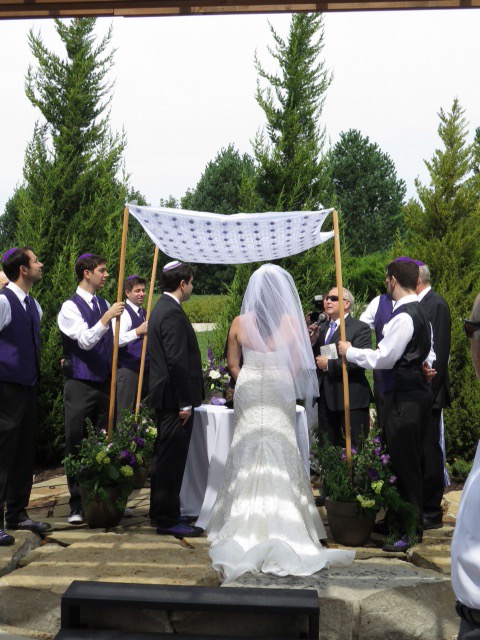
My daughter and her beloved were married last week in a traditional Jewish wedding held outside in a park in Leawood, Kansas.  Gezer Park was established to represent Leawood’s relationship as the sister city to the Gezer region in Israel. 

It was the perfect spot for them to marry as they live in Israel near the Gezer Region. They chose to marry in a quiet area of the park called the Havdalah Garden. 

The small, private ceremony for family and their friends reflected their commitment to focus on their marriage.  And so the park’s limit on guests reflected their desire to keep the ceremony intimate. Later that day there was a larger reception for friends who have had an impact on her life. 

They married under a chuppah that I crocheted for them. Intertwining threads created purple flowers within each white square. Four of the groom’s brothers steadied the poles as the bride and groom stood beneath.  

It was a beautiful day tinged with a bit of sadness. A close friend had lost her battle with cancer and the funeral was the Friday before the wedding.  And then there was the sad fact that they had no grandparents at the wedding. I had all four of my grandparents at my wedding. But I decided the beautiful weather was the gift from all who could not attend. 

From a wedding in Kansas, the couple went on a honeymoon to the Catskills at our home in Kaunenga Lake. They are not the first in our family to honeymoon in the Catskills.  When my parents married in 1951, they spent a weekend at Grossingers before my dad left for an extended tour of duty in the Korean War. 

My grandparents went to have dinner with them each night. My Dad used to say he was the only person he knew who shared his honeymoon with his in laws. They always said that they just wanted to pay for dinner. 

My daughter’s honeymoon is similar, but different. There is no Grossingers. It closed years ago. But we still own our family home. My siblings, who own the home with me, were more than happy to let the couple honeymoon there. 

And my sister is recreating the role of my grandparents. My daughter has never been there without family, and was a bit worried about being there ‘alone.’ She welcomed and actually insisted my sister come as their driver and company. We have been calling her the chaperon. Now to give my sister credit, she offered them a car and keys so they could go by themselves. But they wanted her to come along. We are all getting a good giggle defining her role. 

It is a bit more emotional for me as this weekend is also my father’s birthday weekend. I know that he and my Mom, as well as my grandparents, would be filled with joy knowing that another young couple is enjoying the peace and beauty of our Catskills home. They would kvell knowing that the bridal couple chose to be there for their first trip together as a married couple. 

I know they have walked to the lake and seen the places where my daughter spent many happy moments. They have seen where my grandparents had their bungalow colony. They stopped at the Woodstock site and had ice cream at Candy Cone. They have made new joyful memories. 

It was a beautiful wedding, a lovely reception, a glorious weekend of joy which has led them to a peaceful few days in the Catskills. I hope these moments are reflected in their marriage. Which I hope is filled with love, joy, laughter, glorious moments, peace, contentment and beautiful memories.