Archive | food RSS feed for this section

Oh How I Dream About Ice Cream in the Catskills… In the Summer

7 Oct

Sometimes I dream about ice cream. I know that sounds crazy, but since I became aware that I am lactose intolerant, I stopped eating ice cream about 20 years ago. It has been difficult.

When I dream of ice cream, I am always in the Catskills. It is summertime. I am standing on the side of the road by our dock and the Good Humor man comes by, and I get my favorite treat, a chocolate sundae. I am in ice cream heaven.

For years the same ice cream man came by my grandparents’ bungalow colony. Since it was situated right on West Shore Road, we would run up to the gate when we heard that ding-a-ling bell. There would be the big white Good Humor truck. Sometimes we were at our dock across the street. One of the Moms always had money to treat us. It seemed he came every day at the same time.

One year, when I was about 6, a new ice cream man was on the truck, as our ice cream man retired. But I was not forgotten. He had sent an chocolate sundae just for me. I do have to say, I was adorable with the cutest lisp when I was little. And chocolate sundae sounded like “ouclate undae. “

Ice cream treats were always the best. But it was not just the Good Humor man who made us happy.

When we moved up the hill to the new property my grandparents purchase, it had both a winter home and a bungalow, we were very close to Fink’s Kauneonga Park Bungalow Colony.   There was a small grocery store on the property, and sometimes my Mom would send us there to pick up milk or some other essential. She almost always gave us money for ice cream as well. I loved looking down into the freezer to chose a treat. I liked the cone with vanilla ice cream covered in hard chocolate and nuts.  Oh Yum!

We often got an ice cream treat at the Casino/Clubhouse at the White Lake Home Estates when we went to play bingo. And another favorite ice cream stop was Newman’s. There was an ice cream fountain there, and you could order a sundae, or perhaps a milk shake with two straws, or maybe a banana split, or a malted. Newman’s was extremely yum. The year we came up to the Catskills, and it was closed, we were devastated!

When we got older we often went to Poppy’s in Parksville. That was excitement. Usually a group of us drove there after a movie. The weirdest is that we once ran into our parents there having ice cream. We never saw them there again. I think they started going somewhere else. It was embarrassing to be out with a group in our late teens/early 20s and have our parents there. But I think they were embarrassed as well. They could not let go with their young adult children watching.

Lonely me sitting in the car watching everyone else in line to get Candy Cone!

Lonely me sitting in the car watching everyone else in line to get Candy Cone!

But the best of the best in Kauneonga Lake and White Lake is and was and always will be Candy Cone. Sitting close to the intersection of 17 B and Route 55, near to what was the Ritz Theater and across the street from El Monaco’s, Candy Cone is a Catskills dream come true. To this day, a trip to the Catskills is not complete without a stop at Candy Cone.

On the weekends my Dad would drive us up for a treat. There were so many cars waiting for people to buy soft serve ice cream. Sometimes we would get big containers to take back to the bungalow. But really the best was buying the cone you liked. I always wanted vanilla soft serve with chocolate topping. I loved how it froze and became solid on the ice cream. My Mom’s favorite was chocolate ice cream with sprinkles.   Everyone had a special.

During the week, and before we could drive, we often walked the two or so miles to Candy Cone. I will say my friend and I got in the biggest trouble on the way back from Candy Cone once.

Actually we, “D” and I, had walked around the lake, a seven-mile trek up to Happy Avenue then to 17 B then to 55 and Candy Cone and then back home!  I often made this journey with one or two of my friends. We were tired on our way back, even with the ice cream stop! I think we were about 15/16 years old. So we decided to try to hitch a ride. We stood on the side of the road and put our thumbs out to hitch. A car stopped. It was my Dad. (He was up a day early, having been on a business trip.) As we quietly crawled into the car, my Dad said, “If I ever see the two of your hitching again, I will break your thumbs.”

I honestly do not think he would ever do that, because my Dad yelled, but that usually calmed him down. My friend appreciated that he never said anything to our Moms. “Your Dad was cool,” she recently told me. “We could have been in really big trouble.” Which is true. If our Moms knew that we tried to hitch a ride, we would have been grounded, as we knew that hitching was forbidden.

Candy Cone is such a big part of our lives, that even though I cannot eat it, I still go. There is something special about sitting in the car watching everyone eating an ice cream. It brings back so many memories with our parents. In the back of Candy Cone there is a large deck to sit on. When you walk that is the best place to sit. I have been there many times with friends and cousins.

This past summer my brother, sister, nieces and I were up there. We went one time with my brother. And I thought we were done. But as we left on Sunday afternoon, and we were supposed to be on a rush to get home because my niece had to see someone, we stopped at Candy Cone.

“I hope you don’t mind,” my sister said. “ But I promised.”

And how could I let my sister break a promise to her daughter. So we had to stop. They enjoyed every bit of their cones!

There was something special about eating ice cream in the Catskills. It is no surprise that I still dream about it: that cool enjoyment of a swirl of ice cream in my mouth. Oh, how I dream about ice cream in the summertime!


Sweet Remembrances of Rosh HaShanah in Kauneonga Lake

20 Sep

From the time I was seven or eight we spent every Rosh HaShanah in Kauneonga Lake, Sullivan County, NY. Unlike most people who left their summer bungalows to return to the ‘City’ on Labor Day weekend and did not return until the next summer, we always came back to celebrate the holiday.

My grandparents owned a small bungalow colony in Kauneonga Lake. This meant that after the season ended, the bungalows had to be closed for the winter. Water drained; windows covered; everything locked up. My Mom and Dad would help my grandparents perform many of these chores. And when we got older, my siblings and I would also help out.

Since my grandparents owned a ‘real’ house in Kauneonga Lake, we always had a place to stay. The house was sub-divided into four apartments by the woman who owned it before my grandparents. After they purchased it in 1962, my grandparents returned it into one home, with four bedrooms, and lots of spaces to sleep. There was also an attached apartment that they remodeled.

Over the years the house has seen many additions and upgrades. But the most important part was that it had heat and was livable all year. So for Rosh HaShanah, the five of us always went to stay with my grandparents to celebrate the holiday and the start of a sweet and wonderful year.

Our home was located about a mile and a half from the synagogue, Congregation Temple Beth El. This meant no heels for my Mom or Grandma. It was a long walk in a dress and nice shoes. We had to make our new finery stay in good shape as we walked. Along the way we often met up with others who were going to shul.

When the holidays were close to Labor Day, there were many more who stayed to celebrate. Some even kept their boats on the Lake for the extra weekend. It could be very warm when it was early in September, but sometimes, later in the month, it could be extremely cold on Rosh HaShanah.

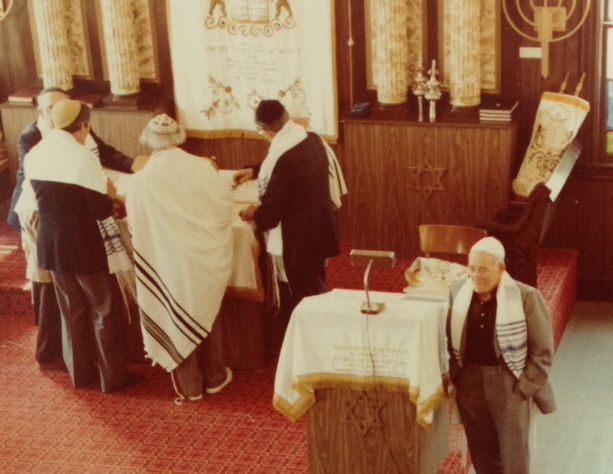
Going to shul was a treat and fun. Everyone knew my grandparents and, of course, us. The shul was full. Men sat downstairs; women sat upstairs in the balcony, except for the few elderly women who sat in the two rows of seats behind the mehitzah on the first floor.  (See blog below for more about Beth El.)

I liked it when I was very young and could sit with my grandfather in the main floor, and he would cover me with his tallit. But eventually, that ended. My Mom, sister and I would climb the narrow staircase, and sit with the other women.

My Cousin took this photo from the women's balcony, at least 26 years ago. My Grandfather is standing on the right, walking away from the bima. My Cousin took this photo from the women’s balcony, at least 26 years ago. My Grandfather is standing on the right, walking away from the bima.

It was different in the balcony. We could see everything that was going on down below. We watched the men with the torah and listened to the chanting. I loved to watch when the Cohanim went forward to do the dukhanen, my grandfather among them. While upstairs, we did pray, but we could also chat and visit. As I got older, I began to resent being upstairs. But it was I tradition I was so used to that I never argued.

We went both days of the holiday and stayed till about 1 pm. Then would come the long walk back to the house after the Kiddish. I could not wait to get home. There was always fresh raisin challah baked by my grandfather. I loved eating the raisin challah for breakfast schmeared with cream cheese. YUM!

For lunch there always was warm soup made by my grandmother. Grandma was not a great cook, but her soup was wonderful: chicken soup, with delicious chicken feet filled with fat immersed in the brew. And if it was mushroom barley soup there were always knee bones to thicken the broth.

Grandma and I were the ones who loved to nibble around these items!

My Grandma made the best homemade egg noodles as well. She would put towels on all the chairs and hang the cooked noodles on them to dry. These were usually for Pesach, but I begged her to make them for Rosh Hashanah as well. I loved making them with her.

When I became a teen, and my friends were up for the holidays, the routine changed.   We often walked to shul together. One stayed at the Indian Lake House for Rosh HaShanah. Her family rented a bungalow from my grandparents, but by the holiday the bungalows were all closed for the season. So her family rented rooms at this bed and breakfast on West Shore Road. The other’s grandmother lived on West Shore Road, and his parents had a home in the White Lake Estates. We would visit on the terrace of the synagogue before services.

After services and after lunch with our families, we would meet. If it was early in September, the one friend always had his family’s boat for us to go out on. We would bring our homework, and take a boat ride to Camp Hi Li’s raft. We would sit on the platform raft doing our homework on the lake. What a great place to study!

As my grandparents aged, they could no longer walk all the way to the synagogue, so my Grandpa would drive most of the way. He would park his car across from Sylvia’s S & G, ‘shlock’ store. I remember saying, “Grandpa, why don’t you just park at the shul? It is just over the hill!”

He looked at my like I was crazy. “You walk to shul on the holidays!” He said. He was from Europe. And traditions were very important. Grandpa was a Cohan. He had rules that he had to follow and obligations that he had to keep.

When I was very young, there was a deli, Elfenbaum’s, almost directly across from the synagogue. We would stock up on special treats there. It closed when I was about 10. I still miss that deli. I remember going there on Sunday mornings with my Dad during the summer and then right before Rosh HaShanah to have delicacies for the holiday.

We usually spent Yom Kippur at our synagogue in New Jersey, unless the holiday was very early in September and on a weekend.   Then we would go back to the Catskills. But Yom Kippur was much more strict. Although, we, the children, were allowed to eat, I always felt the sadness of this holiday more when I was with my grandparents. Of course, when we were older and fasting, that walk back home seem to take forever!

But still I loved going to the shul on the hill. We loved sitting outside on the terrace before services began, or coming outside to take a break when it got too hot upstairs.

I see myself standing in the balcony. And as I am leaving the synagogue, as it empties, I call down to a friend. It is only the two us left. Every one else is out.   Rosh HaShanah is over.   “See you next summer. Next year in Kauneonga Lake.”

Our Shul in the Catskills


Remember The Corner Candy Store; It Was Not Just for Candy

30 Aug

Children of today are missing out on so much fun due to parental fears and lack of neighborhood stores. But one of the most important things they are missing is the corner candy store!

From the time I was 3 until fourth grade, I lived in a three-family home on Third Avenue in North Bergen. It was great living there, but most important the owners of the house also owned the candy store on 85th Street that I passed every day one the way to and from school.

I lived on the second floor.  The owners also owned the corner candy store on 85th Street.

I lived on the second floor. The owners also owned the corner candy store on 85th Street.

Every afternoon I stopped into the store with my treat money. You could get many different penny candies: candy buttons on a paper strip, licorice, sugar water in waxed bottles, candy necklaces and so much more.

These candies bring back so many good and gooey memories. The candy necklaces would get wet and slimy around your neck as you ate off pieces of candy. The button candy on the paper was difficult to eat without eating some of the paper. One of my childhood friends remembers being yelled at by her mom for eating too much paper.   Pixie Stix were a favorite. They were straws filled with flavored sugar. I delighted in eating those!! The little mini bottles of wax with the sugar water came in many colors. I liked to mush the wax into balls after drinking the water. My sister remembers eating the wax and getting into trouble for that action. She also squashed the used bottles into shapes. We had hours of fun with penny candy!

An extra special part of going to that candy store was that the owners knew us so well that often they would give us some extra candy to eat on the way home. Some times they had candy behind the counter for us: items that came in with a broken wrapper or some little flaw. My sister would stand on the step stool, an old wooden milk carton, sometimes to look over the counter to see if anything was there! We would chose our candy and the store owner would put the prices on a brown paper bag and add them up to tell us what we owed.  Then we would put the candy in little brown bags and snack on the rest of the walk home. We usually had enough to eat that we had some left even when we got home.

When I was in third grade, I started going to religious school in the afternoons after finishing Horace Mann. Before going to the synagogue, Temple Beth Abraham, for religious school, we found the candy store a very popular spot. I always would first go to the candy store for a snack and would meet many of my friends in there also getting something to eat. We always needed a snack between school and religious school!

Besides the candy, the most important part of the candy store for me was the comic books. I think every candy store had a comic book section. Each week new comic books would come out, the cost five or ten cents each. And sometimes there was a special one that cost a quarter. I loved getting the comic books. I loved browsing through them. Some of the boys loved to buy the baseball cards as well.

When we moved away from Third Avenue to 78th Street, I was desolate, partly because of the lost of the candy store. But I found out I really had no worries. Even though I did not know the owner at first, I did find another corner candy store to walk pass on my way home from school. It was on either on 77 or 76 and Broadway, if I remember correctly. It also had all the penny candy and the comic books. The only thing missing was the free candy I used to get.

But I did not totally miss out on free candy. My grandparents owned a bakery on Palisades Avenue in West New York. A few doors down from them was a corner candy store. Sometimes when I spent the weekend, my grandma would give me a dime and send me to the candy store….not for food. We had lots of candy and bakery goods at the bakery. But I could go buy a comic book. Yay Grandma! She knew I loved to read them.

There was no candy store within easy walking to our summer home in the Catskills. Oh, wait, I take that back, when I was really little there was a small store that sold candy and ice cream across from the lake on the way to town on the corner of West Shore Road and 55. It closed when I was very young. Now there is a private home where the store used to be.

But we had substitutes. We could walk into the town of Kauneonga Lake, to a small grocery store, Vassmer’s; or to the pharmacy, Newman’s. In one of those stores we could either get candy and comics, or go to the fountain at Newman’s and get ice cream or a soda. It was fun! I remember when I was a teen, I walked into Newman’s one day and there was my brother with his girlfriend having a milk shake…if I remember correctly there was one shake and two straws.

Next to the Ritz Movie Theater in White Lake was a candy store as well. Before we would go into the movie, we would go to the candy store to pick out our treats. How wonderful was that? Very wonderful!

Children today do not have the joy of going into a little corner store by themselves and choosing any little candy or comic. Now you have to drive to the supermarket or a convenience store. The neighborhood candy store seems to be gone forever. And I miss it! Going to a corner candy store every day was a part of the daily routine. And forget penny candy! I do not believe it exists anymore!

I thnk going to the corner candy store also taught us about money. There was only so much you could spend. Would it be a comic book or candy? How much did you need to save from your allowance to get exactly what you wanted? You could plan. The candy store owners knew you! They would hold back your favorite comic, knowing what you wanted to read each week. And if you did not have enough money, they would wait till you came back.

The corner candy store was a gathering place for children and adults. It was a community space, a place for neighbors to visit.  Penny candy and comics gave us so much joy.  I think that is why the corner candy store was so important in my life.

There actually is still a store there: https://www.google.com/maps/place/North+Bergen,+NJ/@40.806574,-74.007579,3a,75y,199.76h,96.03t/data=!3m4!1e1!3m2!1s0C9V1gOMRYvBYne8nYQNwg!2e0!4m2!3m1!1s0x89c25804d4293b57:0x5efe2629bb9f9381

How World War I Saved My Family or My Grandpa Was A Draft Dodger

25 Jun

World War I changed the world! One hundred years ago, Europe became a place of desolation and devastation. Young men from both sides were killed. Millions perished. From all I have read, it was horrible. The use of gases so horrific that laws were later passed banning the use of these and all future chemical weapons. We know that sometimes they are still used. But the world peoples are united against them.

For my family, World War I actually saved my branch of a family. My Grandpa Nat, you see, was a draft dodger.   As he would explain it to me, Jews in Galicia did not really have a chance in the military. They were often put in the worst positions, meant to die. And if they survived, they were conscripted for 25 years. So they never were able to live a Jewish life or return to their families again.

In 1918, when my Grandpa was about 18, his life changed; he received the dreaded notice that he was to report for military duty. It sent his family into action. Nissan, as he was known in Europe, had to be smuggled out of Galicia to save his life.

Thus began my Grandpa’s two-year journey to salvation and survival. He left his home in the middle of the night with just those things he could carry and wear. His intention was to get to British Mandate of Palestine and join the efforts to create a Jewish homeland. But his first goal was to get to his cousins in Belgium.

He wandered through Europe during the battles of 1918 and the aftermath of the war. Slowly making his way to Belgium. He had no real passport. Instead he was using the passport of a dead cousin.

Eventually he made it to Belgium and his cousins. Their reaction to his wish to travel to Palestine was, “Why go to Palestine? It is a desert! Go to the United States, to the Golden Medina. You have an Uncle there. He will help.”

So my Grandpa contacted his Uncle Julius, known as Uncle Yidel to us all, his mother’s brother. Uncle Yidel agreed to sponsor Grandpa to the United States.  But he had one problem, he had been robbed along the way and had to work to earn the money to pay for his trip to the United States.  But finally, after about nine months, the last leg of his journey began. Fortunately for him, his uncle did sponsor him, because when he arrived in the port of New York City, and the immigration site of Ellis Island, he had just a nickel. Without a sponsor he would have been sent back to Europe.

Grandpa often would tell us that we could be whatever we wanted to be. “Look at me,” he would say. “I came to this country with just a nickel in my pocket. And look at what I have.” So we learned early on not to complain to Grandpa and to never give up!

I tried finding my Grandpa’s immigration information from the Ellis Island sites, but could find nothing. My Grandma’s was easy to find. So I often wonder what that passport actually said. And how old he was supposed to be? But in 1920, immigration procedures were not as intense and documentation was not as precise as it is now.

Tanta Molly and Uncle Yidel

Tanta Molly and Uncle Yidel

Uncle Yidel and his wife, Tanta Molly (also known as Malchik)  welcomed Grandpa.

Growing up in Europe, my Grandpa had been a yeshiva brocha, a student of Torah. He had a beautiful singing voice, and perhaps might have been a cantor. But instead, somewhere along the way, he learned to be a baker. When he first came to New York, he worked two jobs. One as a butcher, the other as a baker.  But it is as a baker that he prospered in America. He and Uncle Yidel started a bakery eventually owning a building in New York City. (My Grandma told me that when Grandpa proposed he told her he had a place. She thought he rented an apartment. She did not realize he owned the building!)


Grandpa in his bakery in West New York, New Jersey, 1942.

Grandpa in his bakery in West New York, New Jersey, 1942.

They separated the business after my grandparents married, and Grandpa and Grandma opened a new bakery in Linden, New Jersey.  But in the early 1930s, when my grandmother took their children to Europe for six months, Grandpa sold the bakery in Linden and opened a new bakery in West New York, New Jersey.  He kept this bakery for over 35 years.

Grandpa had many cousins in the United States. His parents were first cousins. So he was double cousins to many of the family. They helped him settle in. But Uncle Yidel was the most important. Uncle Yidel and Tanta Molly were always a part of our lives. They had one son, Ezra.

Whenever we went to see them, we were welcomed in Yiddish. Tanta Molly would come running out to hug us. She would call out our Jewish names: “ Tovaleh, Fagaleh, Chavaleh!” I asked my Mom, “Why does she put an ‘aleh’ on all our names?”

“It means little,” my Mom replied. “Well that did not make sense, Tanta Molly is littler than us!” Was my response. “It means she loves us,” Mom laughed as she said that. Later I found out the ‘aleh’ did mean little, but really was an endearment.

My Grandpa always missed the hills of Galicia. He often told me that he bought his property in the Catskills because it made him think of his home and his childhood. Many years latter when I traveled to that part of Europe, I saw he was right. The rolling, low mountains and hills do look like the Catskills.

My Grandpa forever missed his family. World War I did save him. He came to the United States. But his parents, siblings, and many aunts/ uncles/cousins stayed in Galicia. They all perished in the Shoah.

My Grandpa Nat was a draft dodger, but he never stopped fighting for the right to practice his beliefs and to protect his family in the USA. He loved America. He never traveled outside of the United States. When asked, his reply was always:

“Why would I ever want to leave here? It is the best place in the world.”

Watching Antiques Roadshow Inspired Me to Donate My Great-Grandmother’s Matzah Cover

12 Jun


Matzah cover made by my Great Grandmother Chava.

Matzah cover made by my Great Grandmother Chava.

Watching the Antiques Roadshow, a PBS show, is one of my favorite television experiences.   I started watching it with my parents years ago. Whenever they came to visit, this was one of their favorite shows. They got me hooked on it!

I love learning about different items of furniture, jewelry and knick knacks. It is a history lesson along with seeing the beautiful items. But every once in a while, someone brings in a special ephemeral item: photos, letters, a diary. In my opinion, these items should really be in a museum, some place where researchers and students and others can see the items and learn from them.

It drives me crazy. I even say it out loud. Occasionally we find out that the family did donate the item. Like when a family had the musical notations of the “Star Spangled Banner.” They donated it to a museum, and that made me feel good!

I often wondered: would I be able to do that. Would I be able to donate a family treasure to a museum? The answer is yes.

When my siblings and I were cleaning out our parents’ apartment we found two items that my brother, sister and I all wanted, but knew something special had to be done with them. One was a program from the 1930s for a benefit to help the Jews of Europe, the other was a cookbook in English and Yiddish to help immigrants learn to cook American meals.

My sister contacted the Museum of Jewish Heritage in Battery Park and asked if they would want these documents. The answer was a resounding yes. So we donated them. This way they will survive, and others who might be doing research or want to know about life for immigrant women would have these items. They will be protected. The curator told us that they had only seen one other program like ours, but it was from a Chicago event. Ours was from a New York City event.

The three of us were glad that we made this decision.

I recently made another decision to donate.

I am donating the matzah cover my great-grandmother Chava made in 1901 to the same museum. I have thought about this for several years, and decided it was the best choice for this family heirloom.

The matzah cover is made of beige linen and a teal silk. I think the silk was originally blue. On the matzah cover my great grandmother embroidered the date she made it in Hebrew letters and the words: “Seder shel Pesach” (Seder of Passover) in Hebrew. It has beautiful cut work embroidery made into a Jewish star (Mogan Dovid) with embroidered roses along the edge.

My mother gave it to me about 25 years ago for several reasons: first because I was named for my great grandmother; second, because I also do embroidery; third because my parents would come and spend the second night of Pesach with me; fourth because my daughter is the oldest grandchild. I think they thought I would pass it on to her.

But I will not.

The matzah cover was made in Galicia before the First World War. I think it was made for my grandfather’s first birthday, as he was born in 1900 on the first of Nissan. It came to the USA in 1932. My Grandmother took my mother, then age 2, and her brother, age 5, to Europe for six months. They stayed with my great grandparents. And my great grandmother gave the matzah cover and some other family items to my grandmother to bring back to the United States with her family.

At some point my grandmother gave the matzah cover to my mother. And then it became mine.

I used it every year for Passover. I would cover the matzah on the table before the meal. But as soon as the food and wine came out, I would switch to a matzah cover that I made. I did not want anything to happen to this cover because I was not sure how I could ever clean it without destroying it.

As the years have passed, it has become more and more fragile. I want it to survive. My great grandmother did not survive. She and most of my grandfather’s family perished in the Shoah. This is the only religious item she made that remains.

I also thought about donating my matzah cover because I had a mild infestation of fabric eating bugs. Ugh. They are gone now. And the matzah cover is safe. But part of me was worried. What if they had reached the cover? Perhaps there is something better I can do with this item?

First I asked my daughter how she felt about my donating this item. She thought it was a great idea.

So I contacted the museum and the woman who helped us with the other donations. She asked for photos.

And then she said yes, they would like the matzah cover for their collection. She told me that the matzah covers they had that were that old were all stained and in disrepair, while mine was in wonderful shape. Which is true.

I told her I wanted to use it for one more Passover before I donated it.

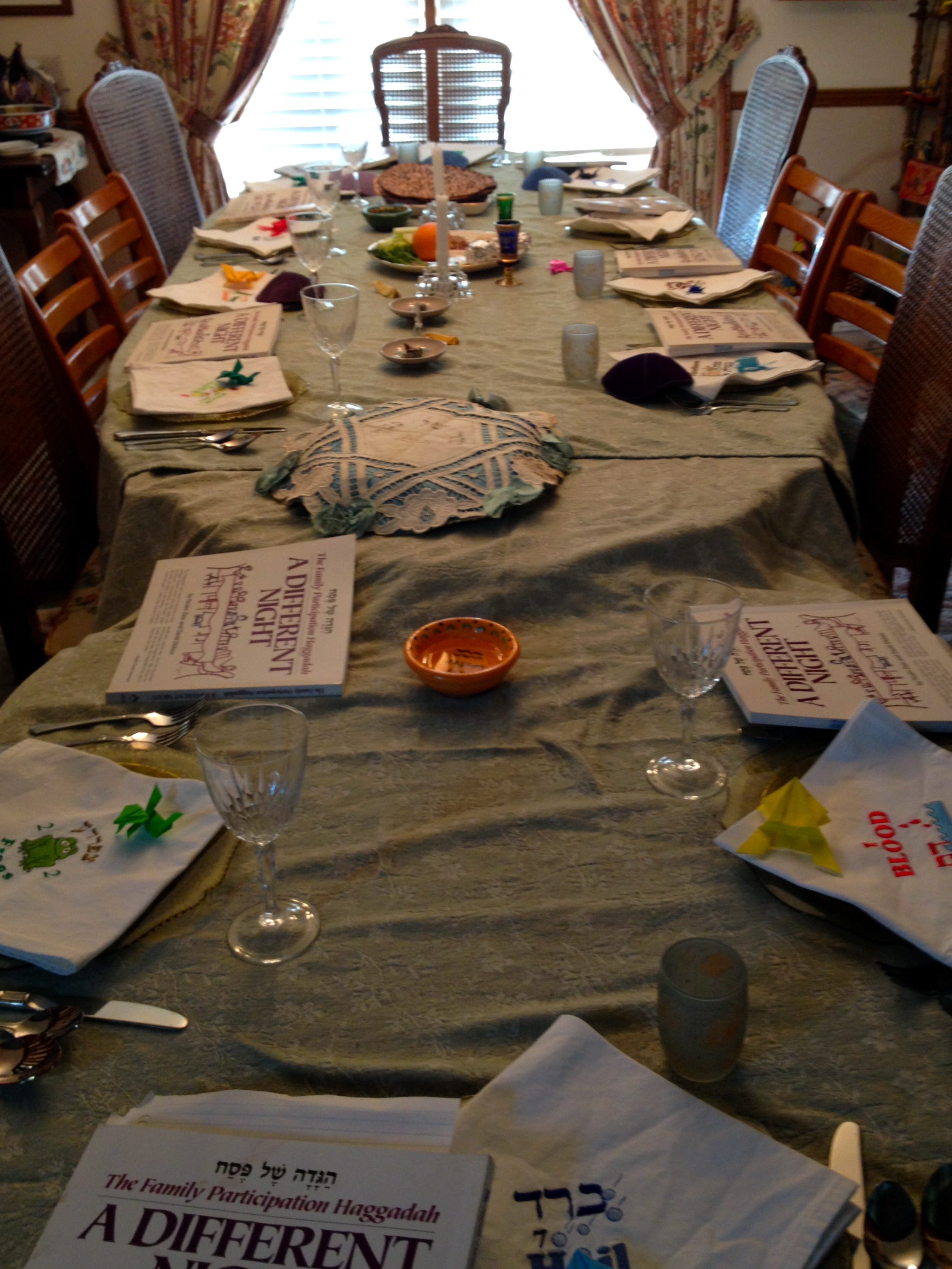
2014 Passover Seder.  Matzah cover in the middle of the table.

2014 Passover Seder. Matzah cover in the middle of the table.

She asked that I take photos of it in use. Which I did and you can see here.

She promised me that anyone in my family would always have the right to come and see it privately when it was not on display, although we would never be able to touch it again. (Probably a good thing as fabric decays.)

In August I will take my matzah cover from Kansas back to New Jersey, and then to its new home at the museum. I hope by sharing it with so many people, it will have continued life, and perhaps help people understand how extraordinary Jewish life was in Europe before the Shoah.

I donated the matzah cover on August 12, 2014.

My Mother’s Sunday Dinner Experiments

7 Apr

My Mother was a lovely wonderful woman, but she was not the best cook. She could make certain meals well and she made them over and over again. Her inability to cook was inherited from her mother. My Grandma T. was a horrible cook. Her hamburgers would sink to the bottom of your stomach and stay there. My Grandpa ate everything with ketchup in an effort to swallow. But she did have a few things that she made very well. And those, like her mushroom barley soup, were wonderful.

However, neither my Mom nor my Grandma were very interested in cooking. There were so many other things to do in life. So we learned to eat whatever was put in front of us, and not complain.

I think my Mom began to feel guilty. It was the 1960s. All moms cooked and stayed home. My Mom went back to work to teach elementary school. I think she felt badly that she was not home immediately after school and not doing what all the other moms did.

No matter the reason, one day my Mom made an announcement. Every Sunday from then on she was going to try a new recipe. A food she had never cooked before, and we were going to try it.

We had sukiyaki one Sunday. My Dad was a veteran of the Korean War and had spent time in Japan. He always spoke about eating sukiyaki. So Mom made it…once.

We had lasagna. It was a really hot day. And the kitchen was like an oven after she made the lasagna. So she decided we would eat it on paper plates, as she did not want to wash dishes afterwards. I will be honest, lasagna is not a food that should be served on paper plates. We ended up having to use three or four each to keep the lasagna from seeping through. Also, the paper kind of oozed into the lasagna.   Not our favorite.

There were a few casseroles she made that we did love. But these were old favorites like hot dog casserole and hamburger casserole. When she made these, we were happy. But these Sunday meals were becoming a blight on our lives.

Then came chicken with brussel sprouts.

Before I get to the meal itself, I will start my saying I had spent the weekend with my grandparents at their apartment and bakery in West New York. They also carried some grocery items. I wanted an O Henry candy bar for a snack. My grandmother said, “No,” because she knew I was going home for dinner. But to ease my sadness, she gave me an entire box of O Henry bars. I think there were 12 or 18 candy bars in the box. My brother might have been there that weekend as well. Because I see the two of us with the O Henry bars.

Back to Sunday dinner: I arrived home in North Bergen in time to set the table and help my Mom get ready for the big reveal. I still remember because on Sundays we ate dinner in the dining room and not in the kitchen. So we had to walk the food carefully from the kitchen to the dining room.

We knew immediately that this was going to be a disaster. The smell was horrendous. And the sauce was this ugly shade of puke green. We all looked at our plates in dread….even my Dad, who usually supported my Mom in her efforts.

My Mom came in, sat down, and said, “Everyone has to take one bite and swallow it.”

So we did. We each cut the smallest piece we possibly could, put it slowly in our mouths between gags, and ate the green chicken with brussel sprouts.

My Mom then stood up, went into the kitchen and returned with the garbage can. We all dumped the food from our plates into the trash. We were very quiet. No one said a word. No smiles of joy, nothing. My Mom had never thrown food away.

Mom then pulled out the box of O Henry bars and gave each of us two. Wow, O Henry bars for dinner! It was wonderful. (By the way, I have never, ever wanted to eat a brussel sprout.)

She turned to my Dad and said, “I am done. No more Sunday dinner experiments.”

We did not cheer, but I know I felt like I should.

You think I would have learned a lesson from my Mom’s experiment and this experience. But I guess until you do something yourself, you never learn. I am also not the most exciting cook. I have several meals that I make really well. And some that I have learned from friends that are easy to cook, and I make those.

But like my Mom, I felt that my children were not getting the experience they needed by tasting different foods. So I too, started Sunday dinner experiments. I actually went to a couple of cooking classes that two friends taught. (I got in trouble for talking, but really I was just trying to figure out what all those cooking terms meant.)

I made new recipes for about two months. Then I stopped. No one wanted to eat the new foods. They wanted the comfortable, family favorites.

My daughter, however, is a good cook. She makes all sorts of soups and interesting foods all the time. I think that came from her paternal great grandmother. My Grandma E served the most delicious meals and desserts.   So I am happy in believing that she will never try the Sunday Dinner Experiments when she starts a family.

My Dad’s Sunday Morning Challah French Toast Feast

3 Apr

My Dad loved to make challah French toast for us on Sunday mornings. He would make a big production of it, even wearing a chef’s hat for this important event. He mixed his secret formula…it wasn’t just a dozen eggs in his batter; heated his cast iron skillets…the best to make French toast; prepared the bread…cutting it into thick slices; and getting the bowl ready to receive the finished toast…it had a lid so that the toast was warm so we could all eat at once.

Making French toast made him happy! It took him to a joyful place!

My parents and Aunt and Uncle after a healthy French toast breakfast.

My parents and Aunt and Uncle after a healthy French toast breakfast.

We would set the table. Putting out all the needed accessories. In our home we put sugar on our French toast, but when others came to visit there was also syrup as well. And there had to be cut up fruit: cantaloupe, berries, watermelon, honey dew. These were important side dishes to have along with the toast.

Once it was ready, we would all sit down to eat together. It still is my most favorite meal. I could eat French toast all day every day.

When we were done, it was time to clean up. Of course my Dad never cleaned up the mess he made. And it was a mess! That was the job of my Mom, my sister and me. But I did not care, I loved this meal so much!!

In the Catskills my father held a Challah French Toast Feast Sunday once every summer. He planned it to be on a weekend when I brought my children to New Jersey and New York for our annual vacation. My cousins, who had summer homes in Kauneonga Lake, were all invited. Sometimes other relatives and friends came up for the weekend. It was my Dad’s French Toast Feast and all were invited.

For weeks he would tell my cousins the exact day and time they were expected to arrive. It was always in the mornings so it did not interfere with time on the lake, because we would all be going to the lake later in the day. In fact part of the breakfast conversation was to plan events for the rest of the day.

DSC03348

My Dad after an exhausting morning of cooking French toast.

My Dad was in his element. He lorded over the stove top. He would buy extra challah each week and put it into the freezer to be ready for this big event. He spent hours slicing bread and preparing his batter, calling my cousins to remind them…over and over. He loved the chaos of all the people talking and sharing and eating.

My cousins would arrive with their children and anyone else staying with them. We would put up extra tables. My Mom would get out a supply of paper plates and plastic utensils. (Don’t worry, we washed the utensils and used them again and again. We were environmentally sound before it was popular.)

We had orange juice, milk and coffee. Sometimes my Dad would call one of my cousins, because he forgot something. They would have to make a grocery run for him. And because he was worried there would not be enough to eat, there was always bagels, lox and cream cheese as a side dish.

It was always a special and crazy breakfast.

One year in particular was wonderful. My Dad’s brother and his wife came up along with two of their daughters and granddaughters. They usually were not in the Catskills…they were Hamptons people. So this was extra special. We took lots of photos. But cooking all that French toast wiped my dad out. He actually fell asleep immediately after eating, with his chef’s hat still on. (To be honest, that was not so unusual, my Dad could sleep anywhere, and often feel asleep when people were over.)

I loved our Sunday morning French toast breakfasts. When I became a Mom, I would make challah French toast on Sundays for my children. And when my husband was out of town, I sometimes made it for us as a special treat for dinner. YUM.

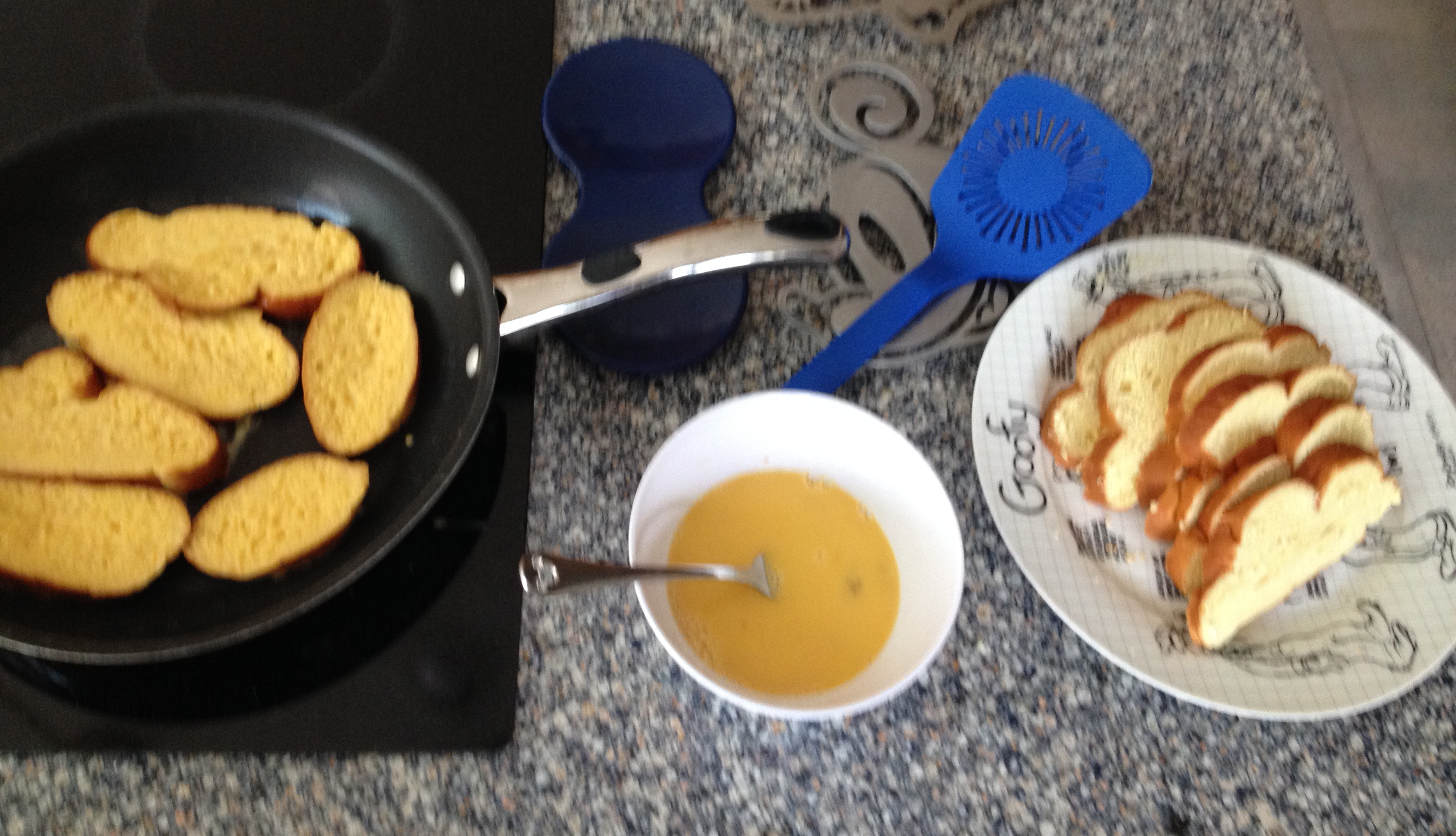
French toast at my home.

French toast at my home.

I still make French toast on many Sunday mornings, even though my children no longer live with us. However, my son still lives close by. I often text him a few days in advance to say: Making French Toast on Sunday? You coming? The response is almost always ”What time?” He always is on time for French toast.

I am happy to say that I have passed the love of challah French Toast onto the next generation.