I wasn’t sure what I would see when we arrived at Taos Pueblo. Our tour for the morning had been cancelled due to a funeral, but fortunately they were able to reschedule for the afternoon.
Before we even arrived at the Taos Pueblo, we had already visited the city of Taos, where we had time to walk around, see some sites and eat lunch. We chose to see the Kit Carson home. The most striking bit of information I found there was that Kit Carson’s first wife was Arapaho, as was his oldest daughter, and he had adopted three other native American children who had been orphaned. These facts made it difficult to reconcile with the same man who was supposedly so cruel to the Navajo people. However, there is some dispute on what he actually did for and against the Navajo nation. But I digress.
Taos the city, has a nice, small dusty plaza (due to construction), but after being in Santa Fe for five days, it paled in comparison. No matter, I was still glad we had a chance to visit it and see the sites. After lunch I was ready for our next adventures. I was not disappointed.
As we drove a bit out of Taos, our tour guide pointed out the flat area we were passing through. It did look perfectly flat, until it wasn’t! As I was sitting near the front, I was among the first to notice a giant rift in the land. A deep canyon, where at the bottom, ran the Rio Grande River. Here it did not look so wide, but as we were 600 feet above it, who knows! As we drove across the bridge, we were amazed that this gorge was here.
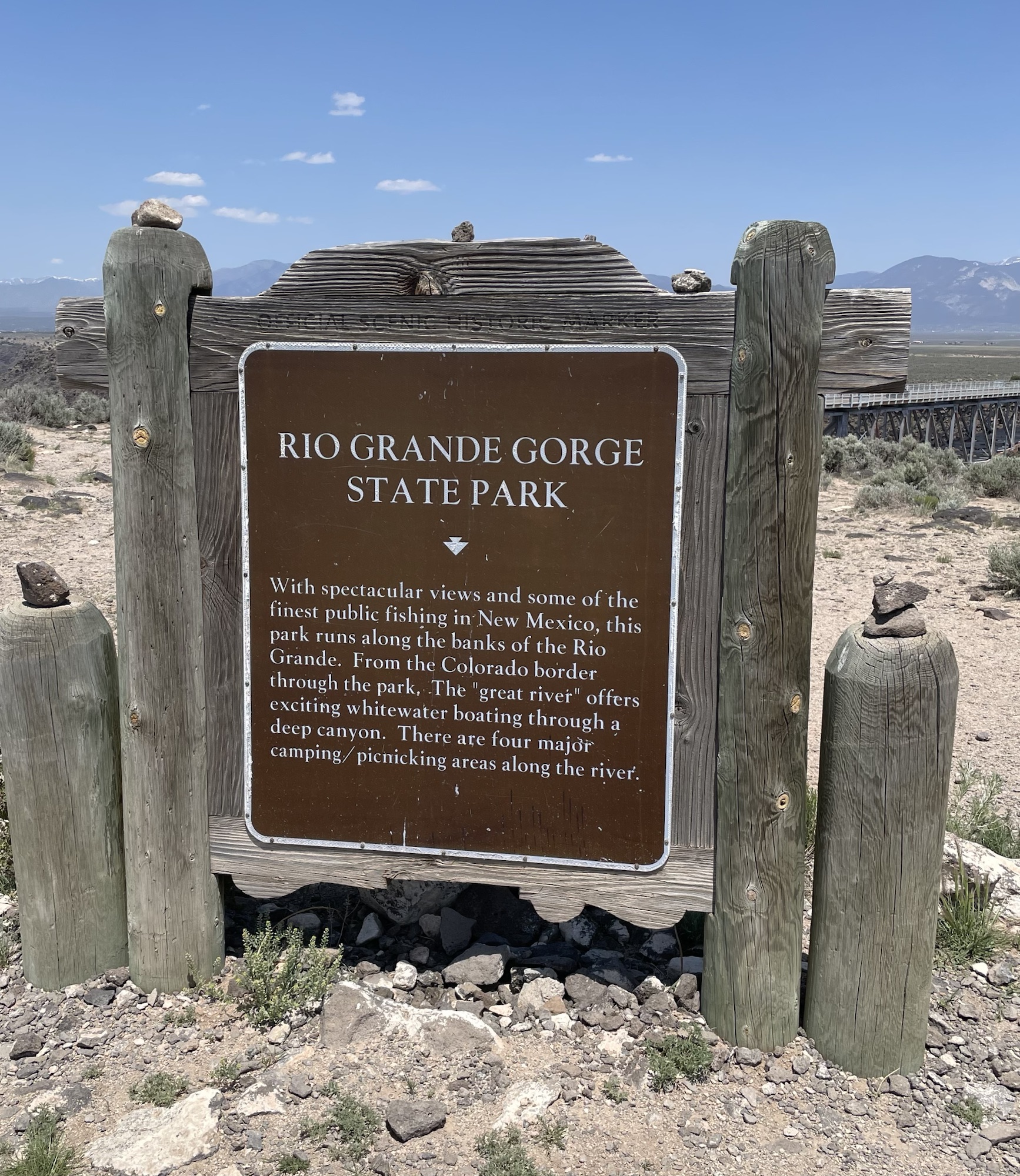
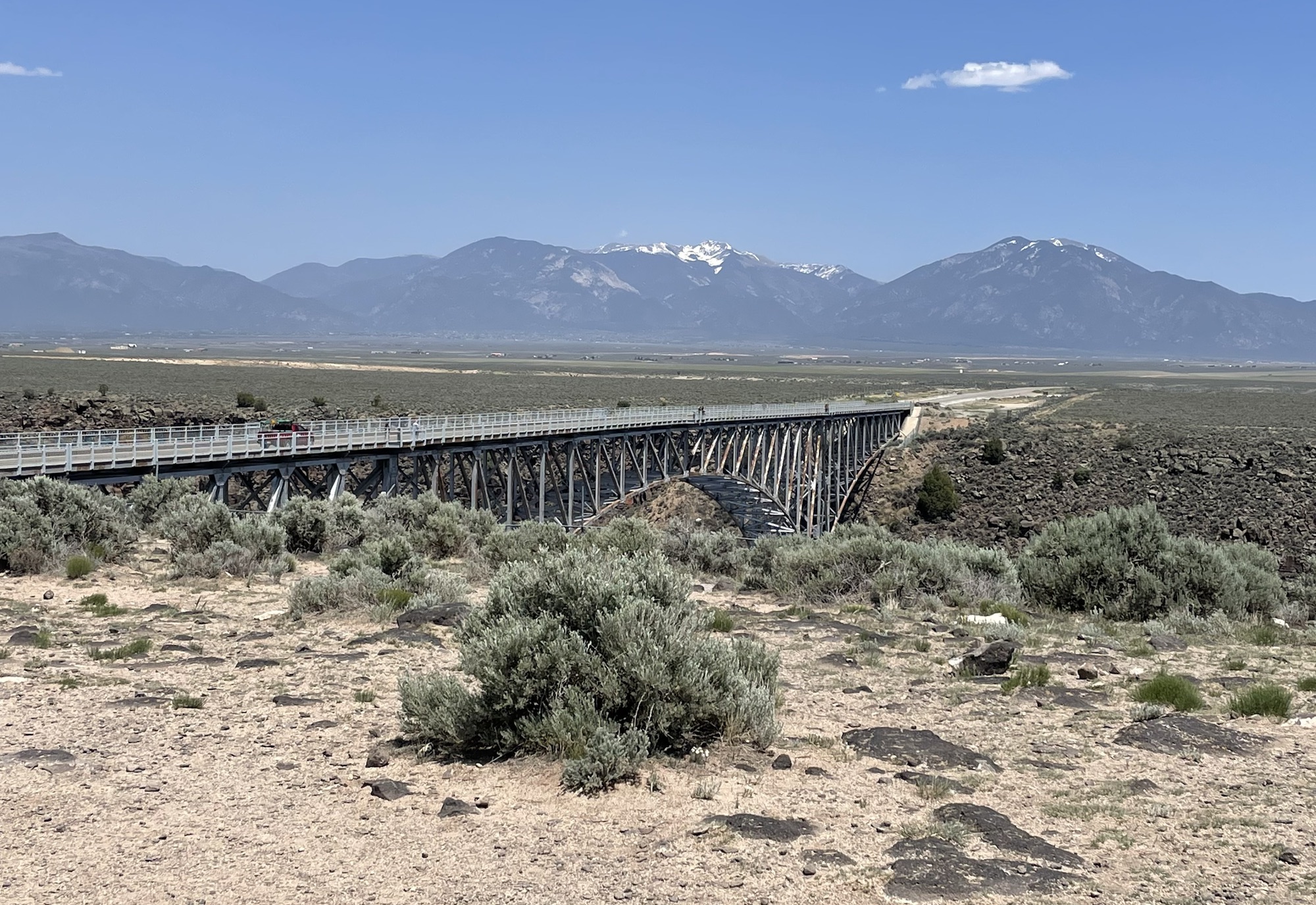

The bus stopped at a overlook area, where others had also come to see the gorge. Some were students drawing pictures of the bridge and gorge. Some were just looking across in amazement. Others were shopping for art sold by native artisans. My husband and I joined the group that traversed over some stones and the barrier to get to the highway and the bridge to view the raging waters from above. Wow! It was well worth going out to see it, even though it was not in our original schedule, making me glad that our trip to Taos Pueblo was changed to the afternoon.
After seeing the depths of the Rio Grande River Gorge, we traveled back towards Taos tothe Taos Pueblo, the home of the Red Willow People. Since there had been a funeral, there were some places that were off limits. But the main areas of this World Heritage Site were open for us to see.

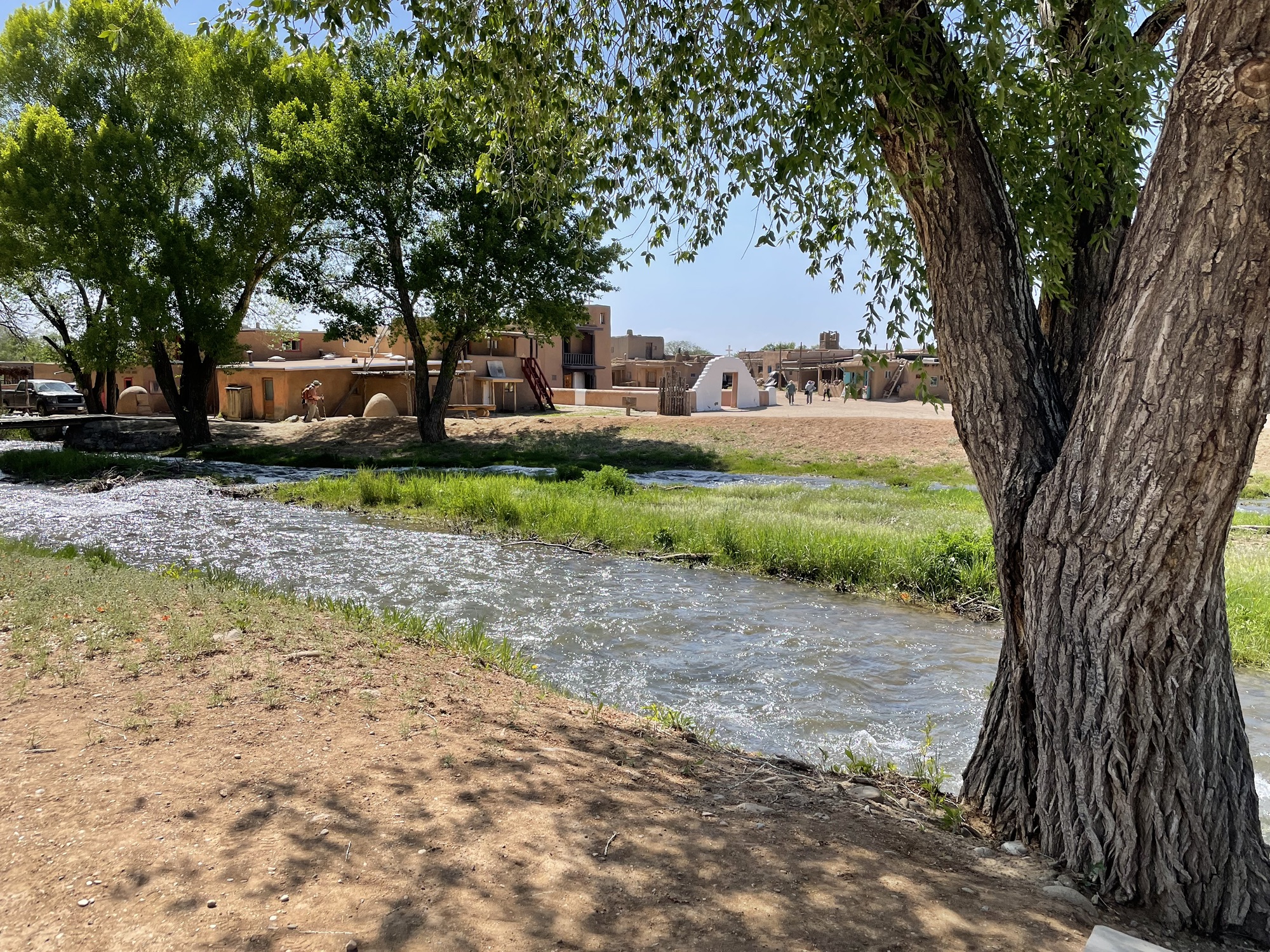


My first thought was ‘perfect setting. What an ideal spot to put a town, where a creek runs through it. With all the snow melt, the water was really running through it. While most people took photo after photo of the North Pueblo and the South Pueblo, I took photo after photo of the water. “el agua es vido.” Water is life.
A young college student provided context for us. Her family is a member of Taos Pueblo, and they still have a home the Pueblo, even though they do not live at the Pueblo full time. Only 10-15 families actually live there throughout the year, with no running water, but the creek, and no electricity. These are part of the requirements of a World Heritage Site: no changes.

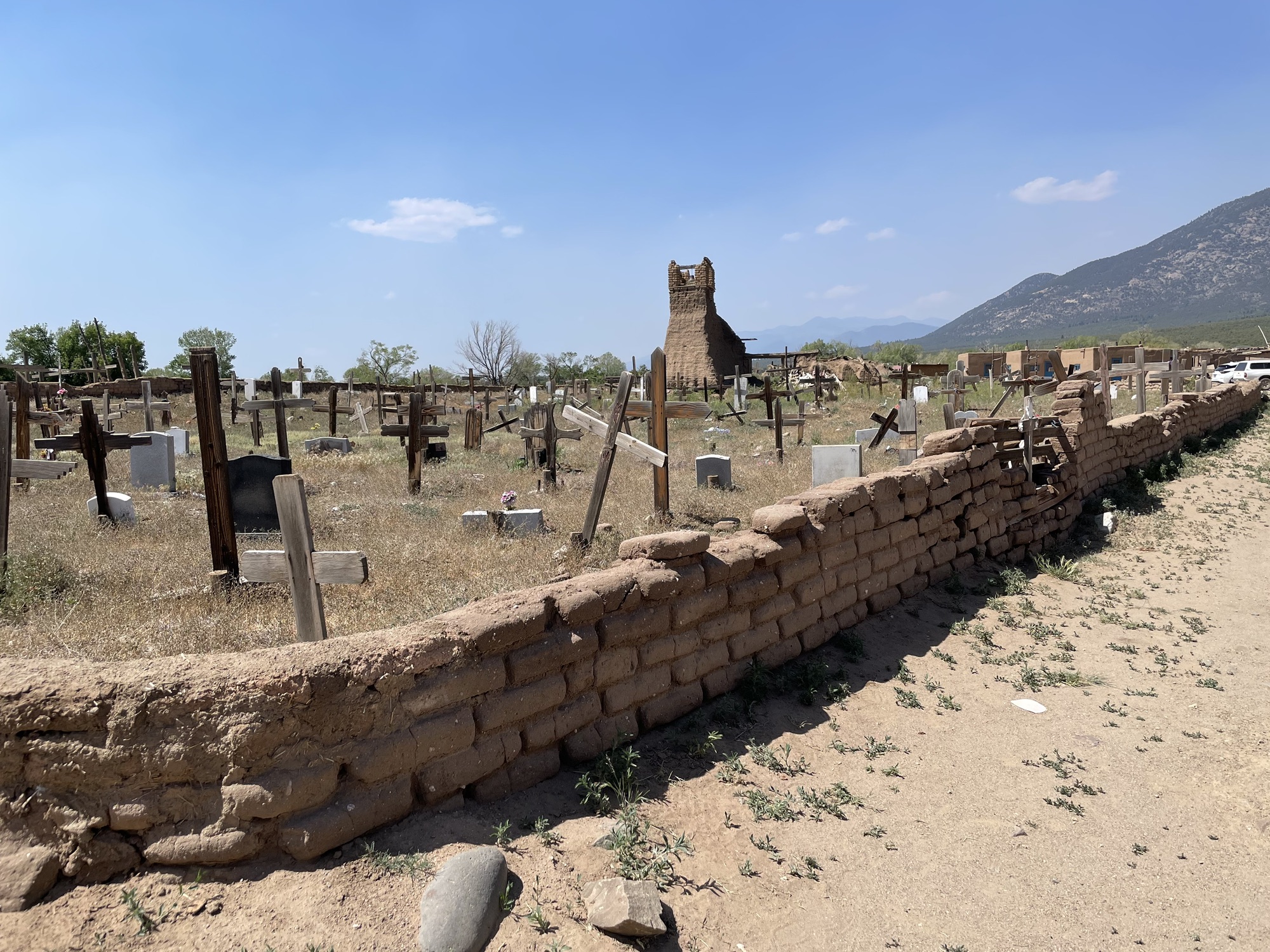


Our tour started in the Chapel. We were not allowed to take photos inside. But there were three things that I was surprised by. First, it wasn’t a statue of Jesus above the alter, instead it was a statue of Mary. Second, the decorations surrounding the niche holding her statue was a mural of vegetables, large green leaves. It was very peaceful. Finally, there was a decorated coffin in the room. Our guide told us 95 percent of the members of the Taos Pueblo were Catholic, the other five percent practiced the indigenous religions. The coffin was to remind them that they were forced to convert and that many died.
In my mind this makes no sense, why practice a religion that you were forced into to following, while being such a painful past you keep a coffin in your church. I even asked. Her response was noncommittal, but in Taos Pueblo I have the feeling from the décor of the church that their Catholic practice is not exactly what they do in Rome.
We learned the history about what happened in 1847, when women and children were gathered in the San Geronimo Church for protection from the US Army. It did not protect them. The Army destroyed the church and killed about 150 people. Not a good way to start off a relationship between the Taos people and the US government. But we know that the US government and people were often cruel to the indigenous peoples of the USA.
Taos Pueblo should be seen to understand the relationship of the indigenous people with the Spanish of the early 1600s to the United States in the 1800s to the present.
For those interested in shopping, many of the homes are now storefronts for both food and art. But for me the highlight was just seeing Taos Puebl0 as it would have looked in the 1600 when the Spanish arrived and later in 1800s when the United States took over the New Mexico territory.
Home
Other blogs about New Mexico: https://zicharonot.com/2024/06/09/santa-fes-multitude-of-museums/
 zicharonot