Tag Archives: grandma

Old Photographs Bring Memories to Life

19 Aug

My siblings and I recently spent a weekend together cleaning the attic, basement and garage of a house in the Catskills that our family has owned for well over 50 years.   And although our parents made an effort to clean out some of our grandparents’ items when they inherited it, it still was quite full.

It has been a process. This was our final weekend of cleaning. My brother with some help from his son and a friend, had already moved out the old metal bungalow furniture and moved in furniture from our parent’s apartment.

We had cleaned out clothing and personal items. We had moved out some items that we wanted in our respective homes. But now it was time to get rid of the stuff that had just collected and decayed over time.

My brother ordered a 20-cubit yard dumpster that he demanded be filled by the end of the weekend. My sister and I thought he was crazy. There was no way we would have that much junk. We were wrong. And it was, amazingly, filled. The house is now in order. Clean, organized and ready for us to use it. We had a feeling of accomplishment by the time we were done.

Two of my nieces were there as well. And the four women, my sister and my nieces and I did the heavy emotional work, we went through thousands upon thousands of photos. We sorted them for each family. We made piles for our cousins. There were some we just discarded and put into the dumpster. And then we put together the ones we all wanted for me to take home and scan into my computer, for I am the family archivist. I will make digital copies and send them out to everyone.

Front Great grandpa USA Visa

The treasures we found included our great grandfather’s passport and 1936 visa to come to the USA from Poland. Our grandparents worked diligently to get the paper work accomplished to bring him and my great aunt to the USA. It saved their lives. My Mom would tell the story of going to Ellis Island with my grandparents to get them when they arrived from Poland.

Years later, when my children were little, we went with my parents to Ellis Island. My Mom asked, “Where are all the cages?” The main room was a large empty space. But on the wall were photos of what the room looked like in the days it was in use. And the metal bars between lines of people could have looked like cages to a child. We think that is what she saw.

In the bags and albums, we found photos of people in Europe from before the Shoah. And wondered how many of them perished? We found photos of our great aunt Tova and our great grandmother Chava. Photos we had never seen before. Our great grandmother is young in this photo. My brother and niece have her mouth. We know they both perished, along with many other family members.

Photos of our parents taken in Hudson County Park, North Bergen, NJ, in the 1960s were also a rare find. They were dressed up, obviously ready to go out somewhere. Mom even had white gloves on… white gloves and a sort of ‘mini’ skirt: an interesting combination; a transition between two generations, two styles of dress. There are no full skirts here.

We found pictures of our aunts and uncles from both sides of our family, grandparents, great aunts and uncles; photos of us and our cousins when we were little. They were wonderful finds. We even found three photos taken during the Woodstock weekend in 1969. We thought all of them had been lost years ago when my Dad tried to mail them to me and the envelope broke while in route.

My nieces loved one photo in particular, of my brother, sister and I when we were in our teens. We hate it. But the girls wanted to keep it as ‘blackmail.’

We found wonderful documents: the list from our parent’s wedding; some of Dad’s school papers, and his army paper, a telegram he sent his parents from the army. One of his school papers said he was in the choir in high school. We all laughed, Dad could not carry a tune!
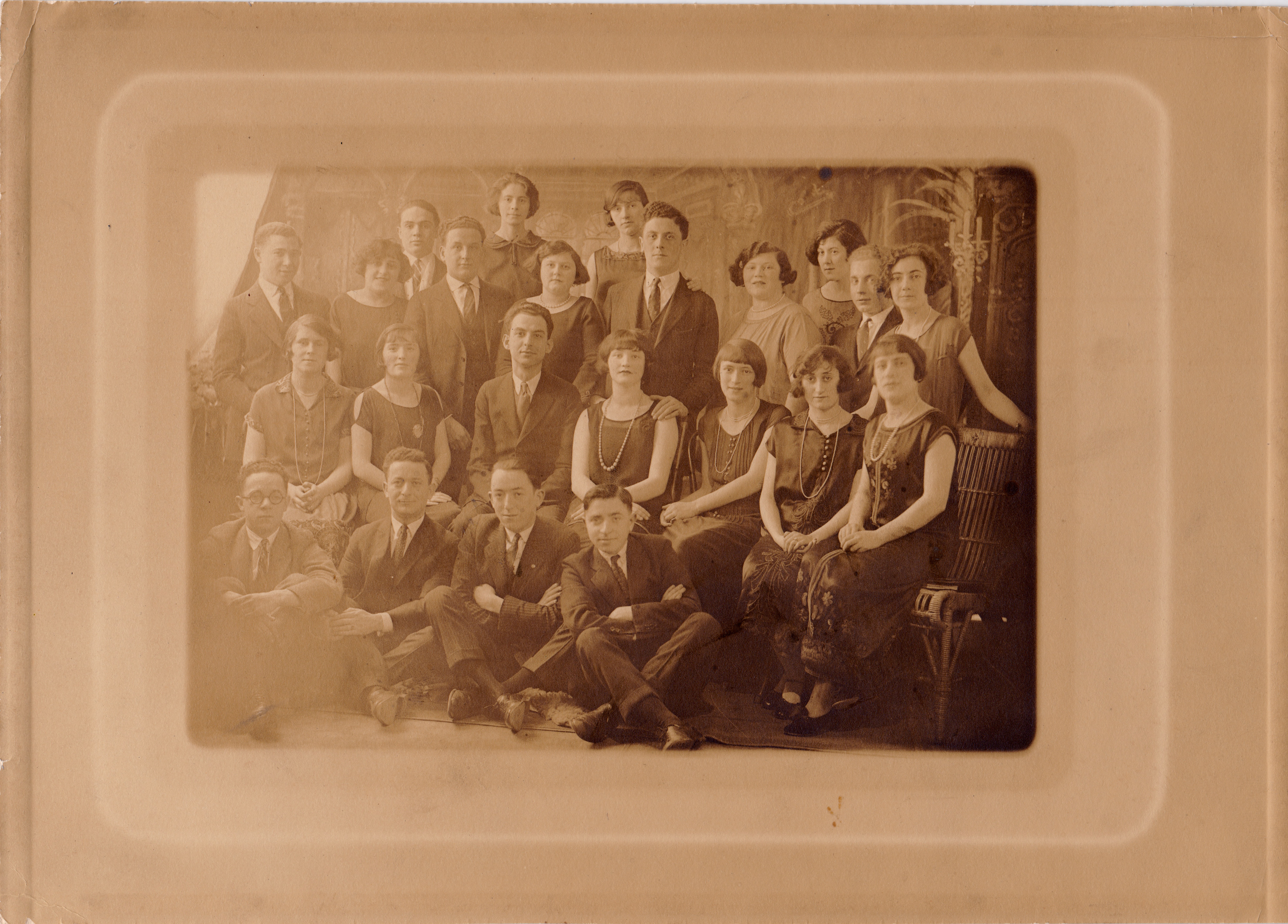
Grandma Thelma graduation from night school she is second in middle row

A favorite was group photo of our Grandma with the other students, when she graduated from night school, after immigrating to the USA in the 1920s.

The attic held a bonanza of information! We actually thought we had found it all because previous cleanings we had found 8mm movies that my brother had turned into DVDs and other photos that I had used to make a book of family history.

But the most amazing find was a photo album of my grandmother from before her marriage. There was one young woman in many of the photos with Grandma. We were sure it was her best friend and cousin, Katie. But there were no names written on any photo. It was so frustrating. But then we found a more recent photo with my grandparents and another couple. In this one the woman was identified. And yes it was Katie. My sister and I were so excited!! When we compared her face to the young women in the photos we knew that we had discovered and identified our lost relative.

There are many photos in the album that were taken in Europe. On the back many are inscribed to my loving cousin, Tova, in Yiddish and in German. I think they are photos given to her before she left Poland for the United States in 1922.

I have that album with me now. I am going to try to match some of the unnamed people with photos that we have where people are identified. I have already found photos of my grandmother’s siblings.

It is a puzzle, and I am determined to make as many matches as possible because these old photographs bring my grandparents’ and parents’ memories back to life.
 

Movie Night in the Catskills Was A Wonderful, Magical Night

24 Jul

It was our Saturday night tradition at the Ritz Theatre in White Lake, NY. In the late afternoon, early evening, we children would go to the early movie with our grandmas: Grandma Esther, Grandma Rose, Grandma Thelma, Mrs. Anoff. They chaperoned about nine or ten children and kept us safe.

Our dads would drop us off at the front of the theater with money for the movie and snacks. We were supposed to be very careful there as it was at the intersection of 17B and 55. So there actually was a bit of traffic.

I think our grandmas would collect all the money and pay. However, when we got a little older, we were allowed to buy our own tickets. If you were under 12 it was one price, over 12 you paid the adult fare. It was always sad when someone had a summer birthday and turned 12. They now had to pay much more!

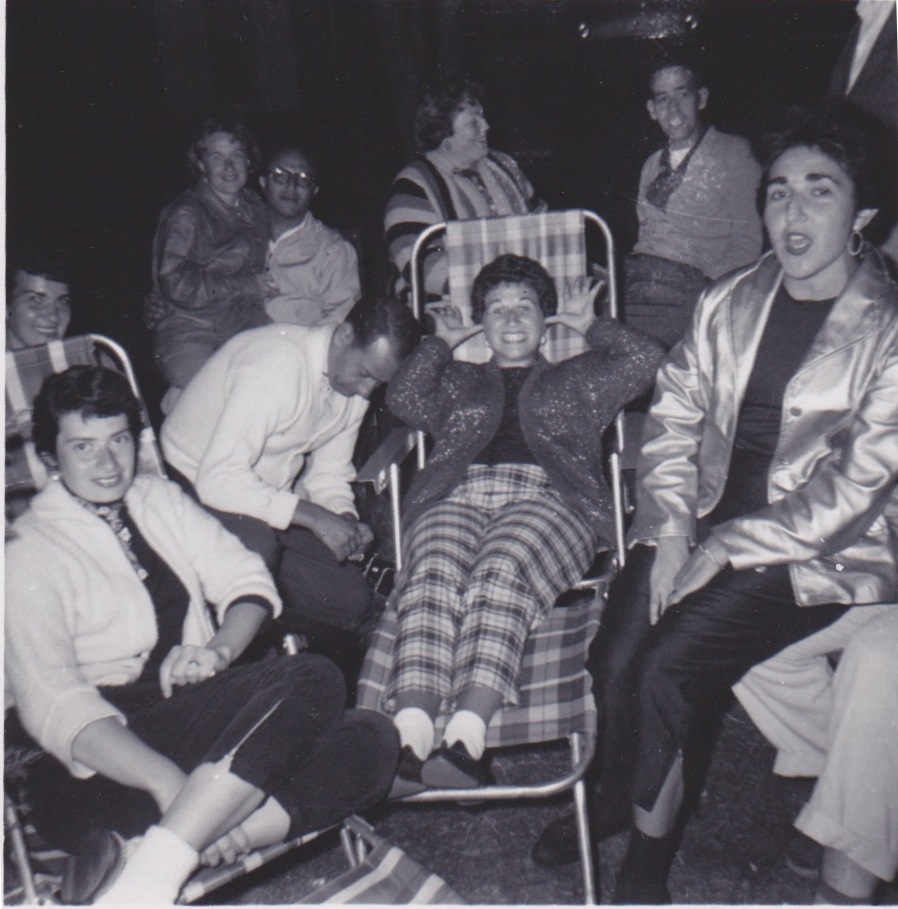
Our parents, in the early 1960s.  Kauneonga Lake, NY.

Some of the parents, in the early 1960s. Kauneonga Lake, NY.

Our fathers, in the meantime, would then go home to get ready for Date Night with our moms. It was their special time together.

We would watch whatever movie was showing that week. The movie I remember the most was “To Cast A Giant Shadow” about the Israeli War of Independence and Colonel David “Mickey” Marcus, the American officer who helped with ending the siege of Jerusalem. It actually had a major impact on my life choices.

For this movie, I sat next to my Grandma Rose.   Grandma Rose, was really my cousins’ grandma, but that did not matter. We shared grandmas in the Catskills. In any case, Grandma Rose lived through the siege of Jerusalem with her husband, Grandpa Asher, and my Uncle Jack.

While we watched the movie, Grandma Rose spoke to me throughout, telling me what happened to her in 1948. She told me what really happened during the siege. What in the movie was true, what was just fiction. She told me about the lack of water and food. She told me about the day they finally left Jerusalem and how difficult that day was for her and Grandpa Asher. How she looked back knowing she might never live in Jerusalem, her Jerusalem again. She never did. They moved to the USA.

I was eleven years old when “To Cast A Giant Shadow” came out in 1966. But this movie and the story of Jerusalem stayed with me my entire life. It was because of this movie and Grandma Rose’ commentary, that I went to Israel eight years later to spend my sophomore year of college at the Hebrew University in Jerusalem. I lived in both the Givat Ram and the HaHasofim campuses.

I was able to go freely between both the old city of Jerusalem and the new city. I saw the places Grandma Rose had told me about, as well as, the places I saw in the movie.

While I was gone, Grandma Rose passed away. My parents did not tell me. They did not want it to be in a letter. In those days we had no cell phones, no computer, no Skype. I found out when I got home. I was heartbroken.  I wanted to tell her all about the Jerusalem, where I lived and how it had returned to one city.   But I never got the chance.

But I always remembered that one movie and Grandma Rose.

Movie night was always an exciting night. Without television, cable, VCRs, DVDs, Netflex, we looked forward to going to the movies one day a week. Even when we got older and did not need our grandmas to go with us, we would still go in a group to the movies. Then we would go to Poppy’s for ice cream after the movie ended. It was always a good time. Even on dates we went as couples with someone else. It seemed odd to go out with just one other person. Sometimes we even ran into our parents at the ice cream parlor. So strange, so different from when we were children.

Because when we were young, our dads would come to pick us up after the movies. When we were settled in back at our bungalows, the parents would go out. They were dressed up, looking fine. Many times they were just going to the movies as well. Sometimes, they went to a show at one of the many hotels or bungalow colonies to see a comedian or musical. It was a wild time in the Catskills.

We always knew when they went to a show because they came home with one of those keychain photo viewers. We loved them. I found some when we cleaned out my parent’s apartment and I brought one back to Kansas with me.

My parents always went out extra special on Fathers’ Day weekend because their wedding anniversary was June 17. They had spent part of their honeymoon at Grossinger’s before heading up to the Finger Lakes and exploring on their own. So a special evening out at Grossinger’s was often their anniversary celebration destination.

Movie nights changed after the Ritz in White Lake closed. We then traveled to Liberty or Monticello to go to the movies. But the magic still remained. Movie night in the Catskills was a wonderful, magical night.

“Abi Geszunt, Zie Geszunt “: As Long As You are Healthy, Be Safe

10 Jul

I have a vested interest in the survival of the state of Israel. Besides being the home to the descendants of my relatives who survived the Shoah, and to family members who made aliyah from the US over the years, it is also the home of my daughter.

For a year in 1974-75, I studied at the Hebrew University in Jerusalem. I met many young men and women who had survived the Yom Kippur War, and were still in shock over what had occurred. Those who had served in the Sinai, I think were forever scarred by the horrors they encountered and the many deaths they saw. We lived on edge that year, never knowing if there would be a flare up.

But that year changed my life. I instilled in my children a love of Israel. I took them to Israel on a family trip. I told them how our family moved there. I wanted them to understand the importance of having a Jewish homeland.

I never hid from the dark side of Israel: the harsh realities that Israelis must face each day. Let terrorists sneak in, or build a wall/fence?   Show weakness, and then more will die. Be strong, because if Israel is not strong, then the country will be destroyed. It is difficult to live with these pressures. But while we must still be strong, we must also be compassionate.

My daughter took my words to her heart.   During the summer of her junior year of college, she studied at Tel Aviv University. Then she went to Israel after finishing college and studied for two master’s degrees there. At Ben Gurion University of the Negev she earned a master’s in Middle Studies, and then went on for a second master’s on the Politics of Conflict.

She spent a year back in the USA, where she interned at Planned Parenthood in Kansas and was a substitute teacher at the Hebrew day school she attended as a child. But then she decided that she had to make aliyah –that living in Israel was the only option for her.

Abi Geszunt. Zie Geszunt. When I went to Israel for my one-year program, my Grandma Esther would send me articles from the newspaper about what was happening in Israel. Her notes said, “You could kill me in other ways.” Grandma Esther was the queen of inducing guilt. But I still went. My Grandpa Nat said, “Abi Geszunt. Zie Geszunt.”

My husband and I went to see our daughter when she was studying for her first master’s degree. We were standing at the Air Force Museum (in the Negev) with a young soldier when several Israeli fighter jets took to the air. The soldier and I looked at each other. And I knew that soon life in Israel would change.

Before I left for the US, I told my daughter, “Be careful. (Abi Geszunt). Something is brewing (Zie Geszunt).”

And a few days later Cast Lead began. I was on the phone with her one day when the sirens went off. “Mom,” she said, “Don’t worry if the phone disconnects. That often happens when a rocket hits.” She had 60 seconds to take cover.

“Where are you? Is your head covered?”

“I am under my desk. Don’t worry, I have my hoodie on.”

I heard the rocket hit. I heard her roommate tell her to stay down, that another one would come. I heard the police loudspeakers telling people to stay inside. And my hair turned whiter. I prayed. Abi Geszunt. Zie Geszunt.

And so when events in Israel flare up, I become somewhat anxious.

The past few weeks have been horrible with the abduction of the three Israeli teenagers. And when they were found buried in a field, I felt the same horror everyone else felt. But my world changed a bit when I found out that a group of Jewish settlers were the possible murderers of an Arab teenager, a revenge event.

In my mind Jews do not participate in senseless hatred. And two wrongs never make a right. Those who killed Mohammad Abu Khedair are just as evil as those who killed Naftali Frankel, Eyal Yifrach and Gilad Shaar, the Israel Jewish teens.

Those who preach hatred against all Arab Moslems are wrong. Target the evil! Hamas is evil in my opinion. The teaching of hatred is wrong in my mind. The constant bombardment of rockets into Israel, into civilian territories, is evil in my mind. But we must remember there are people on both sides who want this seemingly endless cycle to end.

In my heart, I knew the death of the Moslem youth would just put more credence to Hamas for the ever increasing bombardments. I knew there would be an escalation of hostilities. I guess I expected the Hamas response. It was as if they were looking for a reason to escalate the bombardments into Israel, to bait Israel into attacking them.

Now it has happened. Bombs are flying back and forth. People are dying. Young men are being called up for military duty. Smoke rises over the cities and the Gaza. The rockets from Gaza reach further than ever before. Jerusalem and Tel Aviv are in the bull’s eye.

The Middle East is more stressed than it has been in years.   Iraq, Syria, Lebanon, Egypt all in some degree of turmoil; ISIS declaring itself the new caliphate; Iran and it’s nuclear goals… all of these are potential dangers to Israel and the world.

I see what is happening in Israel, and I worry. Not only for my daughter’s physical well being, but also for the mental and moral wellbeing of her and any family she might one day have. However, I had one less fear this week, as my daughter is in the US for our niece’s wedding until the weekend.

I taught my children that racism and baseless hatred was wrong. I have worked for years on interfaith events and building bridges between people of all religions. More than anything else I want an end to this endless cycle of violence.

My daughter returns to Israel this weekend. She returns to the new life she has made for herself. She will leave the safety of Kansas. And I cannot stop her.

All I could do is say, “Abi Geszunt. Zie Geszunt.” As long as you are healthy; be healthy. Of course, what I am really saying is, “Be safe!”

Be Safe everyone!


“Abi Gezunt” song by Molly Picon. http://www.milkenarchive.org/works/lyrics/547

The Beautiful, Yet Horrible Blue Flowered Dress

1 Jun

I close my eyes and I can still see the four dresses next to each other on the bed in my Grandma Esther’s spare bedroom at the apartment in the Bronx. Four identical blue dresses, with Peter Pan collars, bright yellow and red rickrack and springs of tiny flowers printed all over the gingham dress. The dress had a built-in sash and dirndl skirt. Each dress was a slightly different size: one each for my two first cousins, also sisters, as well as one each for my sister and I. I must have been about seven, my sister three, my cousins were about eight and ten.

My grandmother had an urge to buy us matching dresses. I don’t know if it was a special occasion, or she just saw them while coming home from working and decided to get them. I think there is a photograph somewhere of us all wearing the dress at the same time. But I do not know where it is, or if it was really taken. I have searched in my albums looking for some photo of these dresses. But they do not exist. (If a photo did exist, my sister probably destroyed it.)

All I know is that this was a wonderful gift. And we all said, “Thank you!” to Grandma Esther, who was very excited about getting these dresses for us.

The dresses came home.   I wore mine for school, occasionally, after the initial ‘for special occasion only’ wearing. In the early 1960s, girls always wore dresses to school. I had both school clothes and play clothes that I changed into as soon as I got home. So it was fine to have another dress to wear. But really this was to be my dressy dress, for special occasions.

I loved the dress. Blue is my favorite color, and my Mom often dressed me in red or pink because of my black hair. I do not like those colors. So I was happy to finally have a blue dress. I liked the rows of rickrack running along the bottom and bodice. I liked that it had some three-dimensional treatments. I loved the pretty flowers.   I wore it happily. And when I was handed down my oldest cousin’s dress, I was happy to wear that one as well. To me it was just the best blue dress ever!

Notice the generous amounts of rickrack not only on her costume, but also braided to make the headpiece.

Notice the generous amounts of rickrack not only on her costume, but also braided to make the headpiece.

Because of this dress I developed a love of rickrack. I do not remember having it on a dress before this special dress. I fell in love with the feel and texture of rickrack. I also loved to say the word! When I had a daughter, I often made her dresses and costumes with rickrack on them, using all different colors.

As for my cousins, they do not have the same memories of this dress. In fact, they do not remember this dress at all. My sister and I were telling one of our cousins about the dress once, and there was a blank look in her eye.   I think because they only wore the dresses for a short time, and did not have the extra dresses to wear, they did not have as strong an impression.

However, my sister will tell you a different story about the dress. She learned to hate it, even though I think was a pretty dress. But she does have a relatively good reason.

You see, as stated earlier, there were four dresses. She was the youngest. My cousins only wore the dress one year or two. But as each cousin outgrew the dress, it was passed down to the next child. Because one cousin was only nine months older than I was, I did not really get that dress to wear. But my sister did. She wore the same dress for years, as each one was passed down to her.

I should add, that my sister wore the last of the same dress for an extra long time. My Mom saved that dress. She even said to my sister, “That dress still fits you. It has a nice big hem.”

My Mom realized she could buy matching rickrack and lower the hem, then sew the rickrack along the crease where the hem had been.

Because they were dresses for a special occasion, they were not worn out. I think my sister wore some version of that blue dress till she was about 11 or 12…so at least eight long years.

When we talk about the blue dress, my sister gets a sort of pained look on her face and tightens up her body.   It is almost as if she is trying to get the memory of even wearing it out of her mind.

Her daughter did have a similar navy blue dress made by her paternal grandmother. But instead of flowers, it had the alphabet printed on it and apple appliqués. My sister had a difficult time even putting the dress on her daughter. She had a visual and visceral pain seeing her daughter in the dress. After that, her mother-in-law always let my sister help pick the fabric for dresses.

Because of the blue dress, my sister was against matching clothes for our daughters. Whereas some families get matching clothes for family photos, we never did this. We might mention a color theme, but NO matching clothes.

And when I think about it, I cannot remember seeing my sister wear navy blue dresses even today. The impact and memory of the beautiful, yet horrible blue dress lives with her forever.

Grandma Thelma Knows What She Knows

29 May

We always wondered how old my Grandma Thelma was when she celebrated her birthday. She insisted that she was born in 1906 and arrived in the United States when she was 16. This is a debate that went on for years, as her passport had her as two years older.

Her explanation was that she was so desperate to get out of Poland, she made herself two years older to get out. In fact when she finally got her passport and papers in Poland, the official said to her, something like, “I hope you have a safe trip and return safely.” When she got to the door, she turned around and said, “I will never come back here, never.” And then ran for home. Her happiest day was the day she arrived into the New York City harbor.

I have her passenger records from Ellis Island. She arrived as Tauba (Tova), from Boleslawiec, Poland, on November 7, 1922. An 18 year-old, single female, she traveled by herself on the Gothland from Antwerp, Belgium.

Grandma reinvented herself to Thelma. She stopped using the name Tova except in synagogue.

She lived with relatives, her Aunt Gussie, her father’s sister, had agreed to sponsor Grandma. Aunt Gussie had four children, three boys and a girl. But the stories Grandma told always revolved around the cousin who was her age, Katie, who was treated as a queen. While my Grandma said she was treated as the “deinst,” the maid. She had to work all day, go to the school at night, and then when she was in the apartment clean and work for her board.

When Katie would have her friends over, they would tease my grandmother because she was a “greener.” My grandmother also had to ‘serve’ them, and was not allowed to really just sit and visit. It made my Grandma mad, as many of Katie’s friends were also once “greeners.” It also made her mad to be treated like that when she was family. However, she and Katie did become friends, because despite everything, they liked each other.

It was a difficult life made more difficult because her Aunt Gussie wanted her to marry an old widowed man with children. And Grandma did not want to marry him. She had met my grandfather, Nathan (Nissin) who was a baker and either four or six years older than her (depending on the birth year accepted). My sister and I think one reason Grandma and Katie became firm friends is that she helped my Grandma in her romance with Grandpa.

This became a battle with Aunt Gussie. My grandmother took matters into her own hands by writing her father, Avraham Shlomo, in Poland.   She told him about her love for Nathan and the pressure from Aunt Gussie to marry the other man. My great grandfather did what any good Jewish father would do for his daughter, he investigated Grandpa’s family; found out they were a good family of Cohen descent, and approved the marriage. When the letter arrived from Poland, my grandmother got her way, and married my grandfather.


Grandma Thelma and Grandpa Nat in their wedding finery. Grandma Thelma and Grandpa Nat in their wedding finery.

Grandma always kept in touch with Katie. Throughout their lives, they did not see each other, but they wrote many letters. We remember whenever a Katie letter arrived in the Catskills, Grandma sat down and read it. They were always in Yiddish. And then Grandma wrote her a many-paged response. Although Grandma loved her cousin, Katie, she never forgave Aunt Gussie for the harsh treatment. It was difficult because she was also always grateful that her aunt had sponsored her to come to the United States and gave her a place to live, however begrudgingly.

In the meantime, my Grandpa and his Uncle Yidel (Julius) had a bakery. Their business grew. At some point they decided to separate. Uncle Yidel stayed in New York, while Grandma and Grandpa moved to New Jersey and opened their own bakery.

My Grandma was a shrewd businesswoman. She enabled the business to survive through the 1929 stock market crash. She had two children to support, but during the Great Depression she gave out food on credit to those who needed it.   She invested in the Stock Market, but at the same time she had money spread out in lots of different banks. I remember going bank hopping with her in both New Jersey and New York City. She would bring all her bank passbooks at the end of each month, to have the interest entered.

My Grandma is 36 or 38 in this photo. My Grandma is 36 or 38 in this photo.

Over the years, my grandparents became financially and personally successful. They had the bakery and the building it was in; they owned a small bungalow colony in the Catskills, as well as a winter home about half mile from the bungalows. They had investments. They had two children and five grandchildren. All was happy and well.

The memories of Katie A and her parents, as well as their treatment of Grandma, had stayed within my Grandma’s memories and were not really discussed until one day in the Catskills. A day I will always remember, because it shows you how small the world can be, and how connections make changes.

Both my Dad’s parents and their siblings were born in the United States. His mom, my Grandma Esther, was one of five siblings, including her brother Sam. Uncle Sam was a little different from everyone else. He worked for the New York City Port Authority, and he was divorced and remarried. I loved my great Uncle Sam. He had a great sense of humor and was wonderful with us children. His second wife, Sylvia, had a little yappy dog, who scared us all. She carried that dog everywhere. Aunt Sylvia was always perfectly dressed, blonde hair in a French twist. She expected elegance wherever she went, thus she did not like to come to the Catskills because she felt it was too middle class.

Her feelings might have changed the day they decided to finally take a ride up to the Catskills and see everyone. My father’s parents and sister and her family stayed at the bungalow colony owned by my maternal grandparents. So first Uncle Sam went there to see his sister and visit. Later in the day, he and Aunt Sylvia drove up to the ‘big’ house where my maternal grandparents lived, and where we had our bungalow.

Of course there were introductions all around so that Grandma Thelma and Grandpa Nat could meet Uncle Sam’s wife Aunt Sylvia.

When my Grandma met Aunt Sylvia, she said, “I know you.”

“No,” Sylvia replied. “I never met you before.”

I started walking with Grandma back to the house. “I know her,” she said again. My Mom heard. “Mom,” she said. “She probably just reminds you of someone.”

I thought it was over. No big deal. But a short time later, Grandma came back to our bungalow, where we were sitting outside. She walked up to Aunt Sylvia and said, “Sadie, you are Sadie. You were a friend of my cousin, Katie. I remember you.”

Aunt Sylvia…now Sadie, looked at my Grandma and said, “Tova, is that you!?”

And it was. They hugged. They kissed. They spoke in Yiddish for hours.

When Uncle Sam and Aunt Sylvia left, my Grandma Thelma had a new ‘best’ friend. They had so many memories to share.

And then my Grandma turned to my Mom and said, “I told you I knew her.” We should have known that Grandma Thelma knows what she knows.

This incident impacted my Grandma Esther as well, once she heard what had happened. From then on, whenever her sister-in-law made her crazy, she would say, “Sylvia…she is so hoity toity, but she is really just Sadie from Brooklyn.”

Thanks to my sister for remembering with me.

The Great Triangle Shirtwaist Fire Anniversary Brings Memories of Grandma

30 Mar

March 25, 1911. A horrible fire breaks out at the Triangle Shirtwaist Factory.  The exit doors are chained shut.  There is no escape.  Young Jewish and Italian girls jump from the windows: many to their death. But jumping is much better than burning to death in the inferno inside the building. In the end 146 young women and men died.

Across the street a 13 year-old-girl is watching.    She knew many of the young women who worked at the factory.  She knew many who died.  She knew many who jumped.  She never, ever forgot.

I would call it a defining moment in her life. I say this because throughout my life, she always talked about it to my sister and me.  I became obsessed with this fire. I have purchased books about it, watched documentaries, and tried to understand what happened that day.

When my daughter was 13, 88 years later, she had a school history project where she had to interview a family member.  She interviewed my Dad.  And this is one of the stories he told her.

His words, my daughter’s writing:

“A story my mother told that took place in New York City. It is called the Triangle Fire. I will also remember this story to my grave.

There was a blouse factory that burned to the ground. It caused many young Jewish and Italian women who worked there to die.  The reason is, all the doors were nailed shut. The only escape was to jump out the windows, most of the women who tried, died.  Just a handful survived. The incident caused America to change their labor laws. The thing is, my mother lived opposite this building.  She watched the whole scene from her window.”

Two 13 year-old girls, decades apart, great grandmother and great granddaughter, now united with a story, remembering a horrible fire.  My grandmother never mentioned this fire to my daughter.  She was only 6 ½ when my grandmother died.  But to my sister and I, it was a common memory. We often listened to my grandmother relive this day.

It was the heat of the fire; the smell of the fire; the screams of the girls and the people in the street.   They were on the eighth floor.  The ladders did not reach them.  They jumped. They fell.  They died.   (90 years later I thought of this fire as others perished as they jumped from towers to avoid a deadly inferno…choosing to fly into the sky then burn to death.)

It was because of this fire that the women of New York City, and The International Ladies Garment Workers Union became a powerful force in the United States labor scene. The fire and its deadly toll helped this Union, formed years before, into the forefront.

As my sister said, I wish we could talk about my grandmother’s story in the past, because incidents like this fire no longer happen.  But when we hear about incidents in third world countries, like Bangladesh, where women and children perish in factories making the clothing that is imported to the United States, I know we have to continue to remember and to speak out.

I hope that these young women’s lives are never forgotten. It is because of this event, I think I have always volunteered to help women and children throughout the world and  am so active in National Council of Jewish Women.   And I carry my grandmother’s story in my heart and as a strident memory in my soul.


(There were not a residential area across the street.  So we think my grandmother watched from the across the street, not in her apartment as my Dad states.  No matter, it was still an important moment in her life. )

For those who want more information:  The Triangle Shirtwaist Factory Fire, 1911: List of Victims
http://www.authentichistory.com

http://en.wikipedia.org/wiki/Triangle_Shirtwaist_Factory_fire


Grandma Esther’s Afghans Wrap Me in Love

28 Mar

Throughout my home are reminders of my Grandma Esther.   She spent much of her time knitting and crocheting for her three children, nine grandchildren and later 18 great grandchildren.

During the summers she stayed with my Aunt and Uncle in a bungalow in Kauneonga Lake, where my other grandparent’s bungalow colony once stood. Most days, rain or sunshine, Grandma crocheted.

Image

I still have the first afghan that she helped me to make, when she first taught me to crochet. It was the first thing I made after a scarf.  This afghan began life as a poncho. But when I got tired of wearing it, Grandma helped me find matching yarn, and we made it into my first afghan with my Mom’s help when Grandma was not around.  This green, orange, yellow, brown and beige afghan stays in my sewing room/guest room.  It is starting to fray, and the stitches do not look so wonderful. But since it has to be about 47 years old, I would say it is in pretty good shape.

Image,

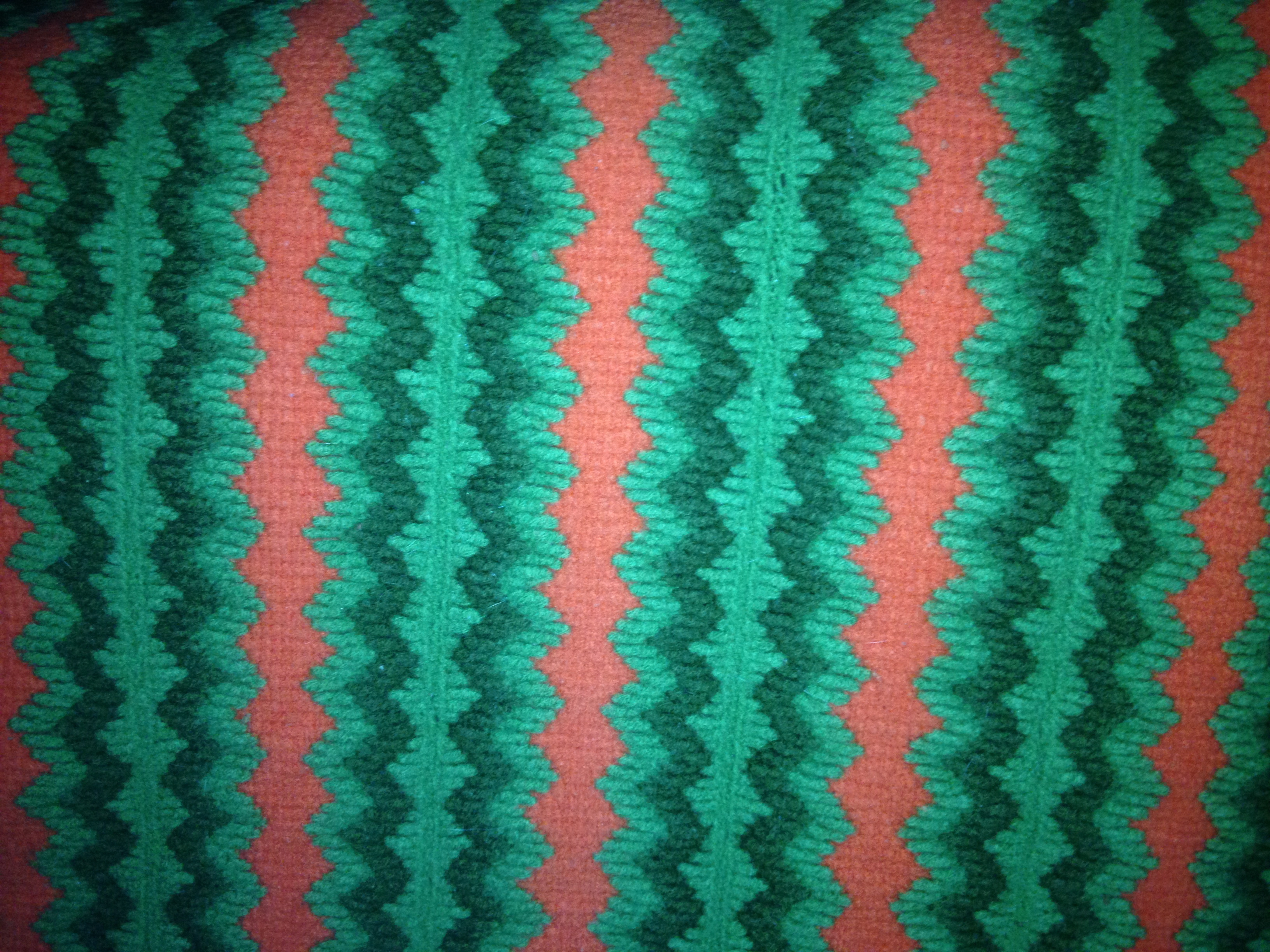
In my bedroom is the afghan she made as one of nine for her grandchildren.  My brother, sister and I each got one when we got married.  Mine is orange and green, because those were once my favorite colors (though not anymore). I keep it in my bedroom on a comfortable reclining chair.  When I am having a bad day or feeling sick, I wrap myself in my Grandmother’s afghan and feel only love and warmth.

My daughter has two afghans made by Grandma.  By this time Grandma only remembered one stitch.  So all the great grandchildren have the same pattern, just different colors.

Image

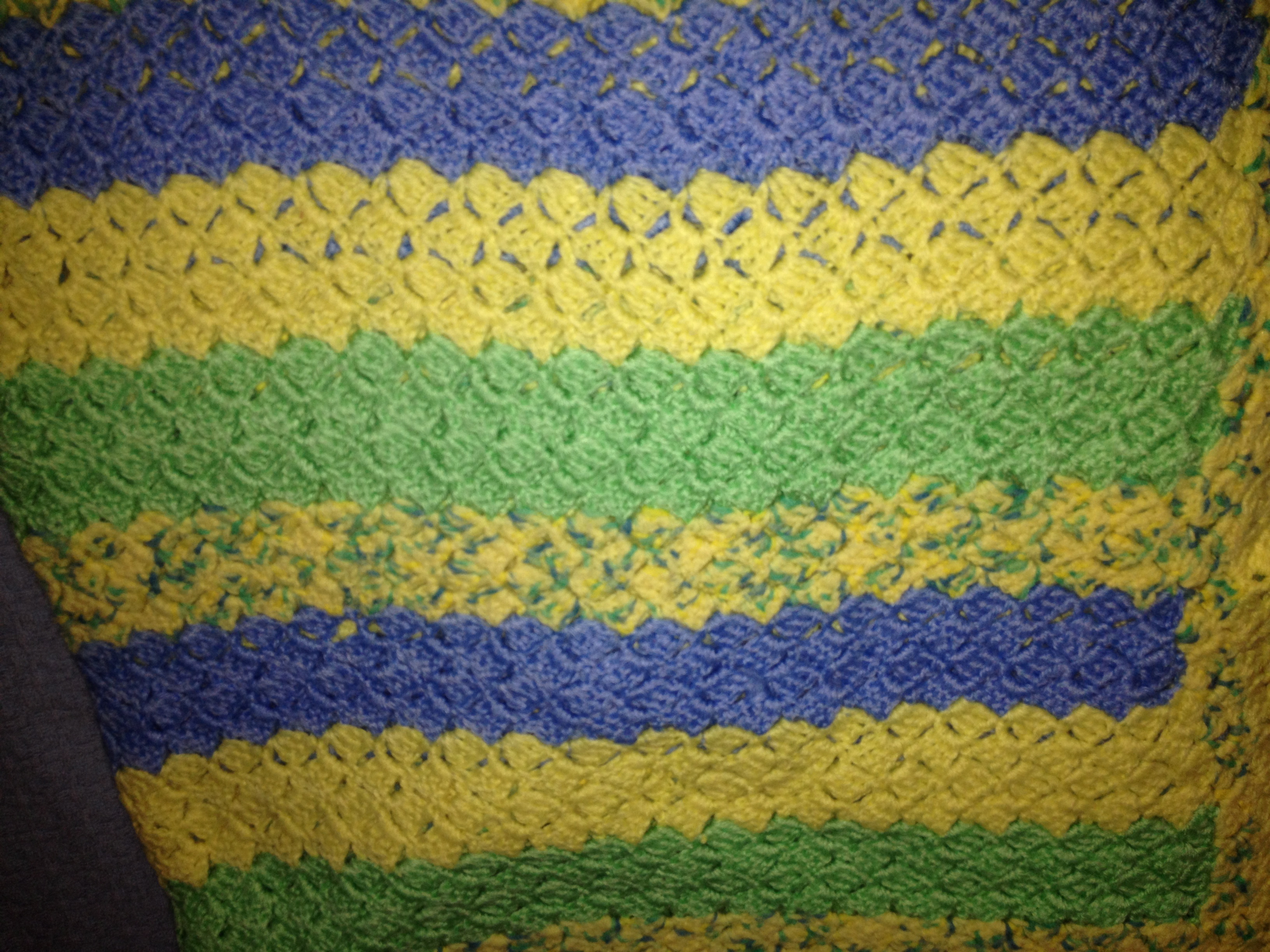
She made one afghan when I was pregnant and presented to me as a baby gift.  The other afghan she made at my daughter’s request, using the colors she wanted…pinks and purple. (My daughter was almost seven when my grandmother passed away.)  But the green, yellow and blue one was made in anticipation of my daughter’s arrival.

Grandma was 88 years young when she flew from New York to Kansas to be here the week after my daughter was born. My sister and her husband flew here with Grandma. Nothing was going to stop her from seeing my daughter. She stayed for a long weekend.  It was a special time.  And these memories are there in the afghan.

Image

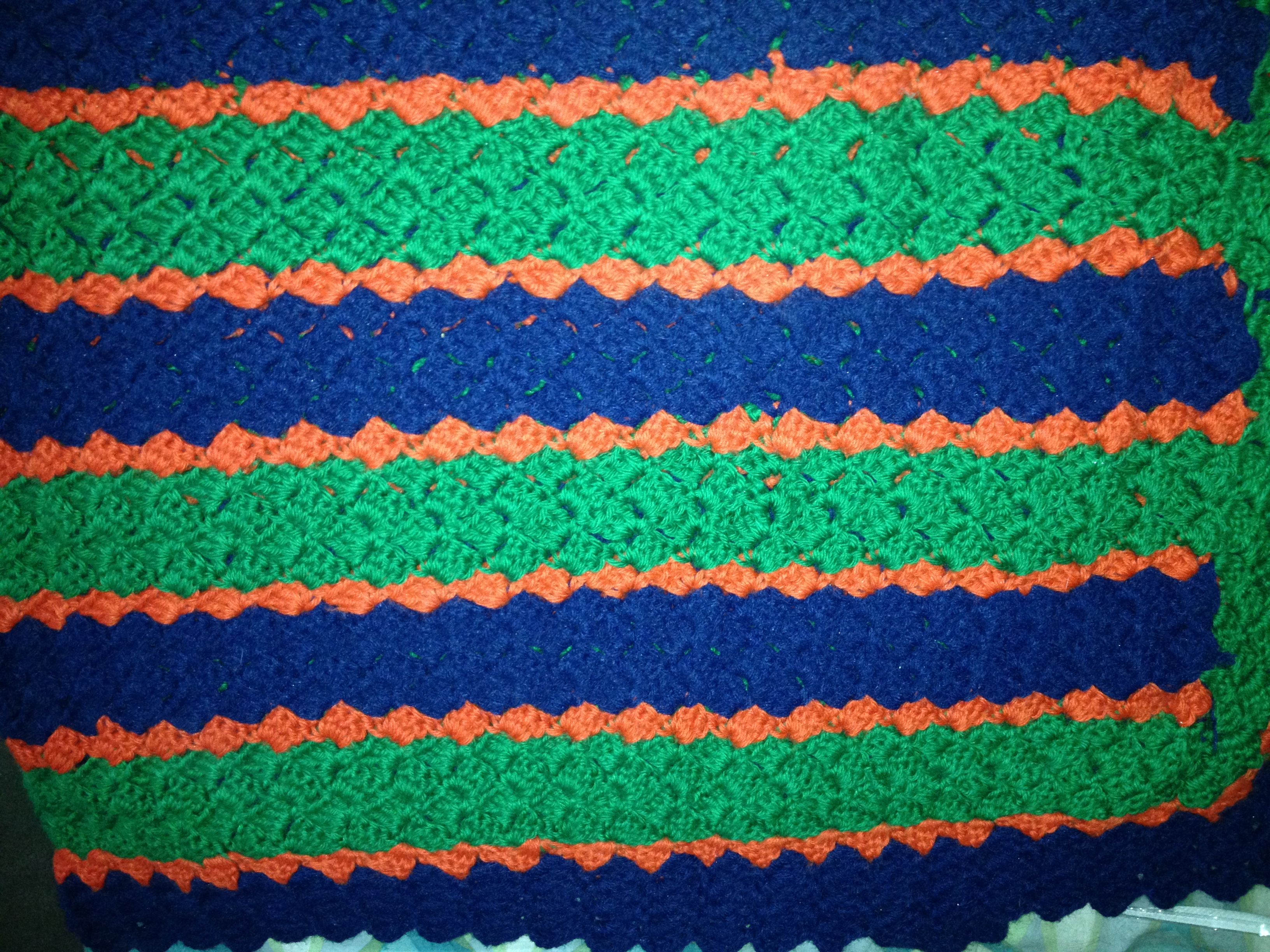
A dark blue, kelly green and orange afghan was made for my son.  By this time Grandma has having trouble.  My son was born when Grandma was 92. Grandma had three great grandchildren born close together that year.  If I remember correctly, my Aunt helped Grandma complete these afghans.   She had several more to make after my son was born.  I think his is one of the last full-size afghan.  She made a matching pillow to go with it as well.

I keep his in a plastic bag in his closet.  When he was little he liked to sleep on the floor of his bedroom in a teepee wrapped in this afghan.  Now it waits for him to once again use it.  There is no room in his little college apartment.

Image

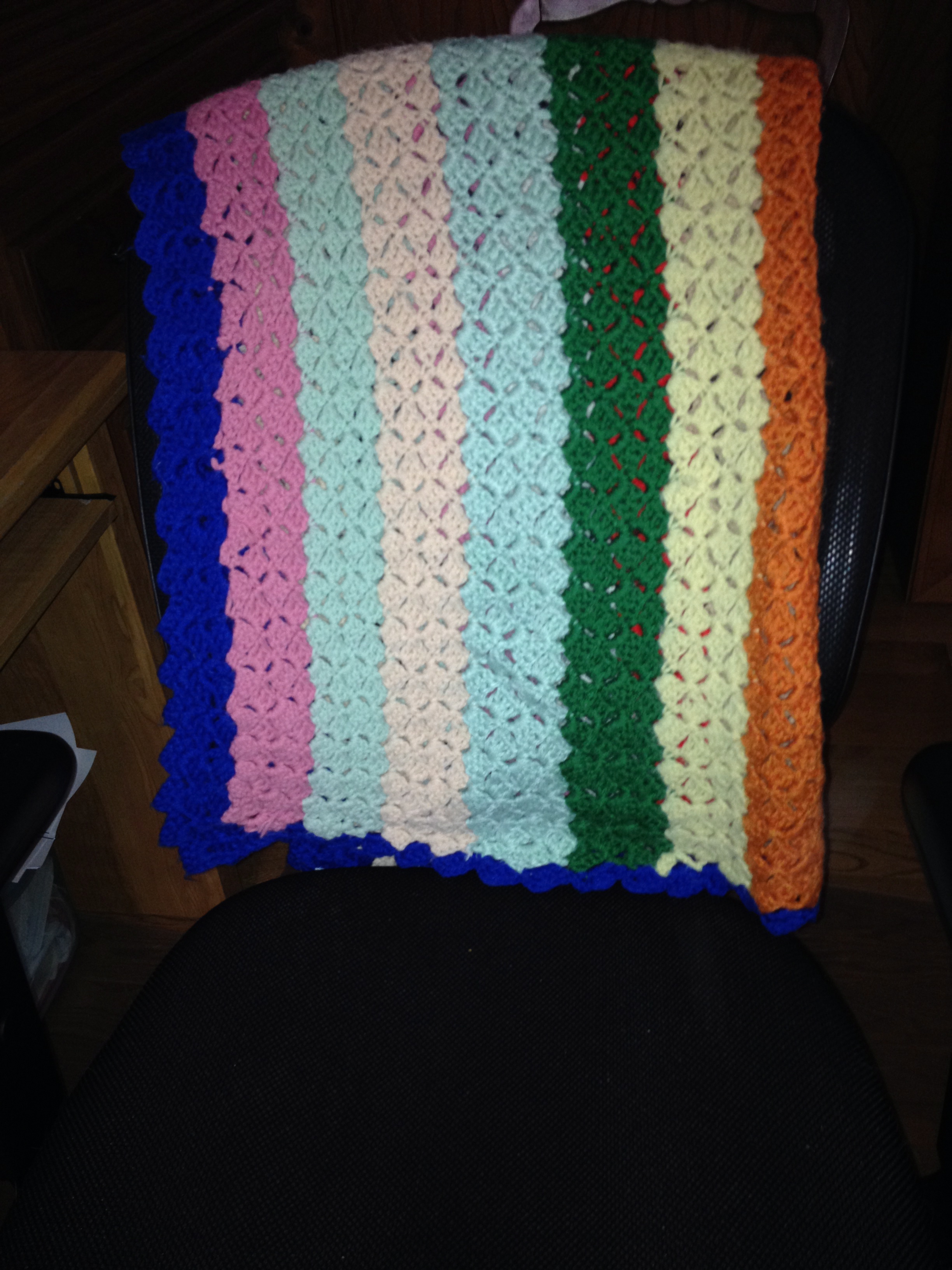
On the back of the chair I work in, is a small lap afghan. This my Grandma made from scraps of yarn leftover from other projects.  She gave it to my parents, who used it for almost 20 years  after she passed away, until they also died. When we cleaned out their home, I took it home with me.

Besides my Grandmother’s afghans, I also have ones that I have made.  A purple one for my daughter when she was born is one of my favorites.

Image

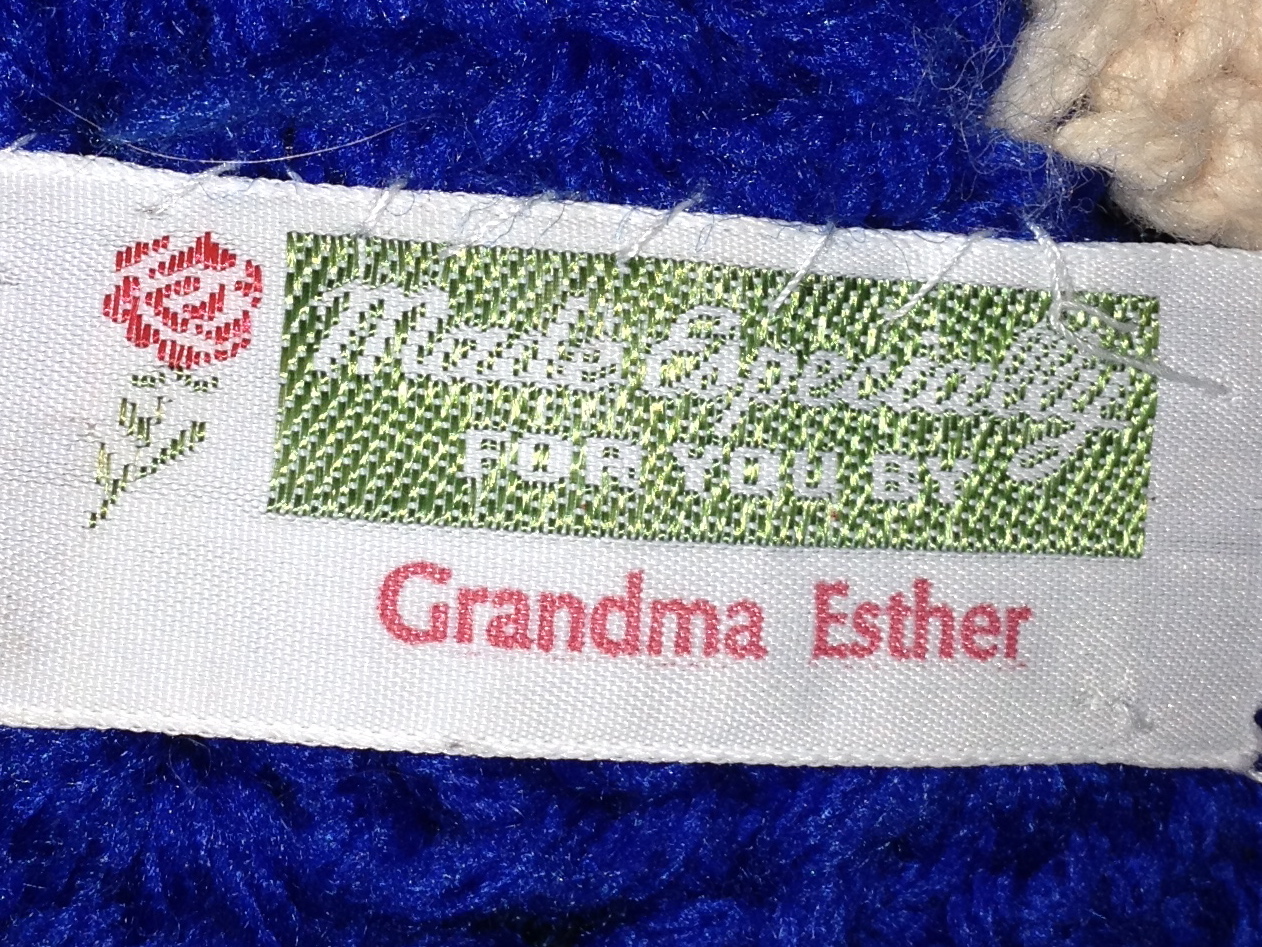
Each afghan holds love in each stitch.  The love I remember when Grandma taught me to crochet and knit.  The love my Grandma put into each afghan she made. And the memories she wanted us to hold with the little label sewn in each one that says “Made especially for you by Grandma Esther.”

A short update/ January 2022:  For the past seven years I have been making baby blankets for all babies born into my family, as well as for all babies whose parent’s invited me to their weddings.  Well over 60 blankets so far.  For my extended family, I make them in honor and memory of Grandma Esther.