Tag Archives: bungalows

How My Grandparents Impacted My Life

15 May


Summer of 1979 in the Catskills.  Eight months before my wedding.

Summer of 1979 in the Catskills. Eight months before my wedding.

I am so fortunate to have had all four of my grandparents walk down the aisle at my wedding! Two of them were alive when my daughter was born, and knew her. And one of my grandparents survived and knew my son as well. They had a major impact on my life, especially since I spent every summer in the Catskills with all four of my grandparents near by.

My Grandpa Harry, born in 1888 or 1889, was my oldest grandparent. He did not have the easiest childhood. The oldest of five children, he spent two years as a teen searching for his father who abandoned the family. He found him in Seattle, Washington, quite far from his family in New York City. Grandpa returned home, became a tailor and supported his family. All of his siblings graduated college, a feat for women of the time. And Grandpa supported them. The saddest part is that after they were college educated, they treated Grandpa as if he was not quite good enough for them.

I took sewing classes beginning when I was 14, and Grandpa and I started to really talk! He was proud of the things I made and would check the seams and my work. Grandpa taught me how to match plaids, not an easy thing to do. But from him I learned that to make something well, you need to take the time and effort to make it nice. To this day, I cannot buy clothing where the plaids or lines do not match up.

My favorite memory of Grandpa Harry was his guarding the sweet table every holiday. My Grandma Esther was a great cook and baker. Each holiday had amazing treats set aside on special table. Grandpa would sit at the end. I think he counted how much each of the nine grandchildren ate. If we came back too often, he would intone: “The Trolley car stops, too!” From this I learned moderation. You need to take a break.

(From my cousins I learned that there were extra treats hidden in the back bedroom.)

Grandma Esther was also born in the New York City area, but in 1898. She was also one of five children, and was surrounded by cousins. I have written about her teaching me to crochet and knit (See “Grandma Esther’s Afghans Wrap Me in Love” and “Knitting and Crocheting Brings Love and Memories.”) But she taught me many other important concepts as well.

When I was old enough to date, Grandma Esther sat me down to discuss choosing the perfect spouse. She had already dealt with my Grandpa Harry’s family for years, so it was not surprising when she said, “When you get married, you marry the family as well. So be careful. Check out his family before you say yes. Find someone whose family is like your family.” And I did. Almost 35 years later, I can say, Thank you!

The most important help my Grandma gave me was teaching me how to nurse my daughter. Grandma flew out to Kansas when she was 88 years old to meet my daughter. (My sister and her husband flew with her.) When she saw my feeble attempts at nursing, 28 years ago, she was shocked.

First she said, “Only poor people nurse. Your cousins’ wives did not do this.” My response was, “Grandma, they say this is much better for the baby. I want to do it.” Her second response, “Well if you are going to do it, do it right.”

And she showed me how to do it the right way. It made such a big difference. I then taught all my friends the tricks my Grandma showed me. Our mothers had not nursed. So we needed someone who actually had done it to point out the way.

The last advice she gave me was in naming babies. She was one of five cousins named Esther. And she hated that each of them had nicknames. She was Curly Esther because of her hair. But there also was Topsy Esther and Meshuganah Esther as well. I never heard the other nicknames. So she made sure her children’s English names were different from their cousins, even though their Hebrew names were the same.

My Grandpa Nat (Nissan) was born in Europe in 1900. He spent two years traveling to get to the Golden Medina, the USA. He arrived in 1920. Grandpa was a baker (See “Bakery Aromas Bring Back Delicious Memories.”) But most important is that he had a great work ethic, as well as a great sense of humor.

Every spring we had to help get his bungalow colony ready for another season. He would say to my siblings and I, as he handed us paint scrappers, “If you don’t work, you don’t eat.” Which is true. As an adult you have to have a job to get food. He was proud of our college educations. Having grown up in Europe and seen the treatment of Jews there, he said, “They can take everything away from you, but they can never take away your education.”

One of his fun, and my favorite saying of his, “It is as easy to follow a heavy cart, as it is to follow a empty one.” I am sure it is a translation from Yiddish. But it was his marriage advise meaning, try to find someone who has a little more assets. It will help in the long run. But all time favorite saying was “Every Pot has a Lid.” This might have been my Grandma Thelma who said this. But the main point is that everyone has someone.

Grandpa Nat loved us. His entire family, parents, siblings, nieces and nephews, many aunts, uncles and cousins had perished in the Shoah. (“Speaking Yiddish Always Brings Me Holocaust Memories.”) But he never lost a sense of humor, and he always showed us love.

But the most important person to him was my Grandma Thelma (Tova). She was born in Poland in 1906. Grandma was strong willed and determined; she came to the USA when she was 16, worked all day and then went to night school to learn English. She read, wrote and spoke three languages. And she was afraid of Nothing.

Grandma Thelma sang Yiddish songs to me to put me to sleep. “Ofyn Pripetchik “ was my favorite. Grandpa sang to us as well. Their singing of the Yiddish songs was so heartfelt. Grandpa’s version of “Rozhinkies mit Mandlen,” “Was itz Geven Ist Geven,” “Tum Balalayke,” “Eli Eli” and “Schtela Beltz “ still echo in my mind. He had a beautiful voice. My siblings and I often sang along with him.

Advice from Grandma Thelma was never ending. She and I battled for power constantly. She called me the Machshefah, the witch.   But from her I learned to be strong. I learned never to give up. I learned to trust myself.

When I was at college, she would send me letters with a bit of ‘gelt’ (money) so I could buy stamps and write back. Wherever I lived, not matter what I did or where I wanted to go, she was my ally. We could fight, but she backed me up always. When I needed to stand up to my parents, to be who I wanted to be, Grandma was standing behind me.

Her shopping advise was intense,  “When you buy jewelry, always buy real. When you buy gold, always buy solid, never buy hollow.” Grandma taught me how to sew jewelry into clothing, because you never know. She kept silver coins in every purse. And money buried in the basement. Her experiences growing up in Europe scarred her, but she was defiant and not scared. Luckily I never had to use this final advice.

I am who I am because of my grandparents. I think of them often with love.

Boating on the Lake Always Brings Joy

6 Apr

Canoes and putt-putt motor boats that went no more than a few miles an hour were the only boats on Kauneonga Lake when I was a child. My friends and I loved to go canoeing. It was such fun. We did not wear life jackets then. We would just get a canoe and paddle. Our favorite spot was to skim over the water and enter the channel so we could canoe on Amber Lake. It was ever so peaceful there.

As times changed, boats got bigger. Sometimes when we canoed, friends would come by and purposely swamp us. There is nothing like sitting is a sinking canoe. We would jump out…abandon ship…then turn the canoe over and lift it over our heads as we headed to shore. I hated being swamped!!! Those boys!

But those boys with motorboats were my friends, and we often went out with them boating around the lake. Canoeing was disappearing. Water skiing was becoming a big deal. And, although I never skied, I was often the spotter, yelling when the skier fell into the water. This time on the late was still wonderful as only a few motorboats were out.

After I moved away from the New York area, my Dad decided that he needed a boat. My Mom was ambivalent on this purchase. But since a friend of theirs, my Dad’s best friend, sold them his old boat and trailer for all of $1.00, my mother could not say no.

It was a putt – putt boat. Yes, it had a motor… small. Yes, it could make it around the lake…. slowly. Yes, my Dad spent hours fixing it.. almost. But he was so happy. He loved to say to his grandchildren, ”Let’s go for a ride in the boat!”

Mom enjoying the breeze on the pontoon boat.

Mom enjoying the breeze on the pontoon boat.

Luckily our waterfront property and dock is and was very close to my cousins, both of whom are engineers, and very loving nephews. They, and later their sons, were my Dad’s support. I think they had special alert when my Dad took his little putt-putt boat out on the lake. Whenever we were out, within 15 minutes, one of my cousins would boat up to us and make sure everything was going well. And then they stayed out on the lake. Why? Because every once in a while, it felt like almost every time, my Dad’s boat would stall in the water.

One of my nieces believes she will carry the emotional scars from a water stranding rescue forever. She was so embarrassed that her cousins had to tow the boat back to the dock. For years later, whenever my Dad would say, “Let’s go for a ride in the boat,” she would try to hide.

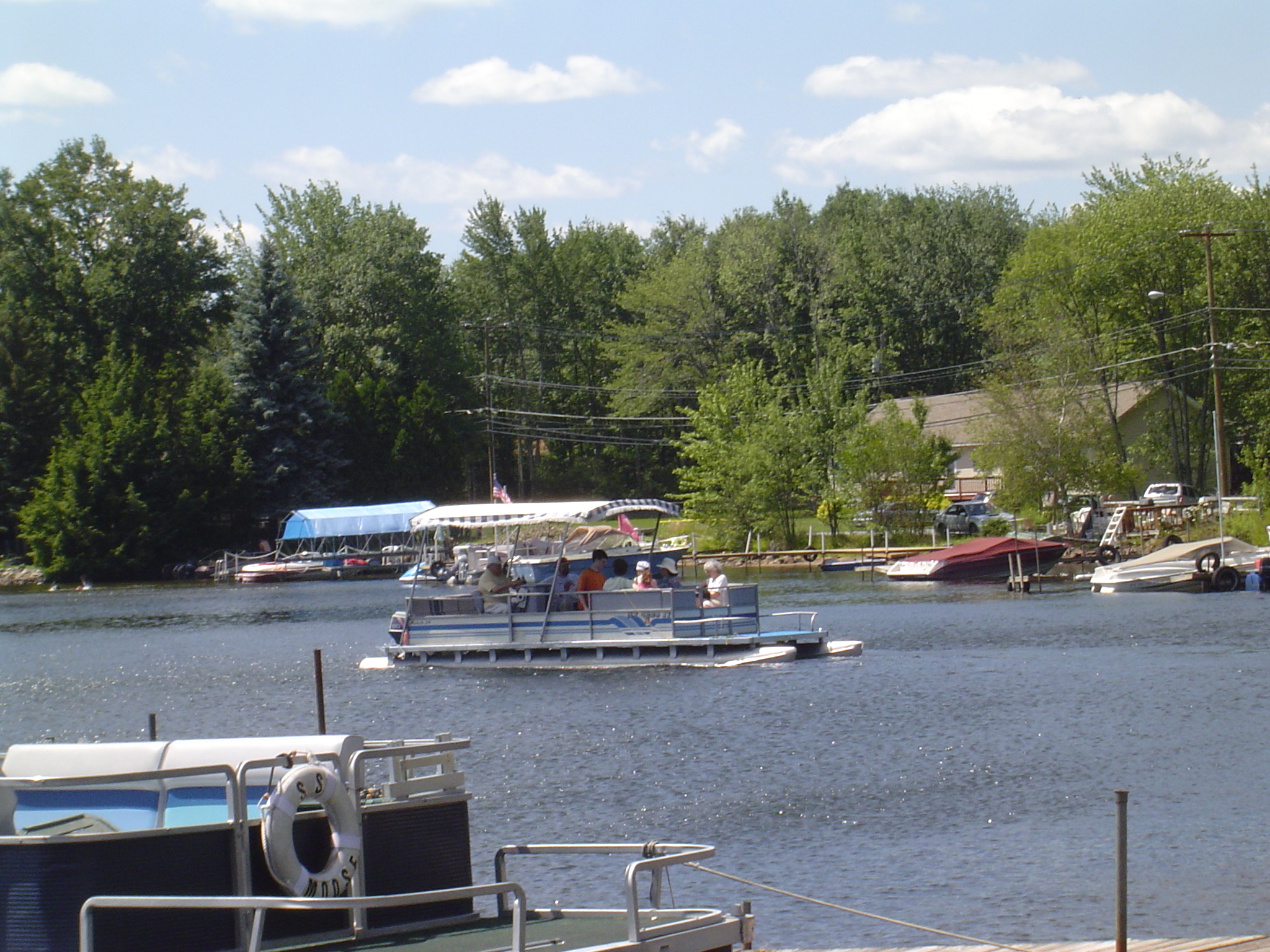
My Dad’s dream boat was a pontoon boat.   And eventually he sold his little putt-putt boat and purchased an older pontoon boat. He worked on that boat for as long as he owned it, replacing so many parts and making it presentable. He just loved it. As did my Mom. They would go out on the Lake and slowly peruse the sites. They would watch the skiers and the tubers and the people on jetskis. They would wave to friends. In their pontoon boat, they would meander around the lake and enjoy the breeze of the lake.

They enjoyed taking their friends, children and grandchildren out. It held many more people than the little boat. And I do not remember it ever needing to be towed back to shore. But my cousins were always there when the motor would not start, or a plug came undone, or my Dad just could not get something to work. Thank goodness for my cousins!

We eventually told Dad that he should only go out on the Lake when my cousins were up. And we think when he was 80 he listened to us.

My Dad driving his pontoon boat on Kauneonga Lake.

My Dad driving his pontoon boat on Kauneonga Lake.

They were blissful days. I still see my parents’ smiles as they roamed Kauneonga and White Lakes in their pontoon boat. I hear the laughter and joy of the grandchildren. I see hats blown off into the water, and the exciting water rescues to get a hat back.

I have such joyful memories.

My Dad sold his boat the summer before my Mom died. It did not matter, he never spent another summer there.

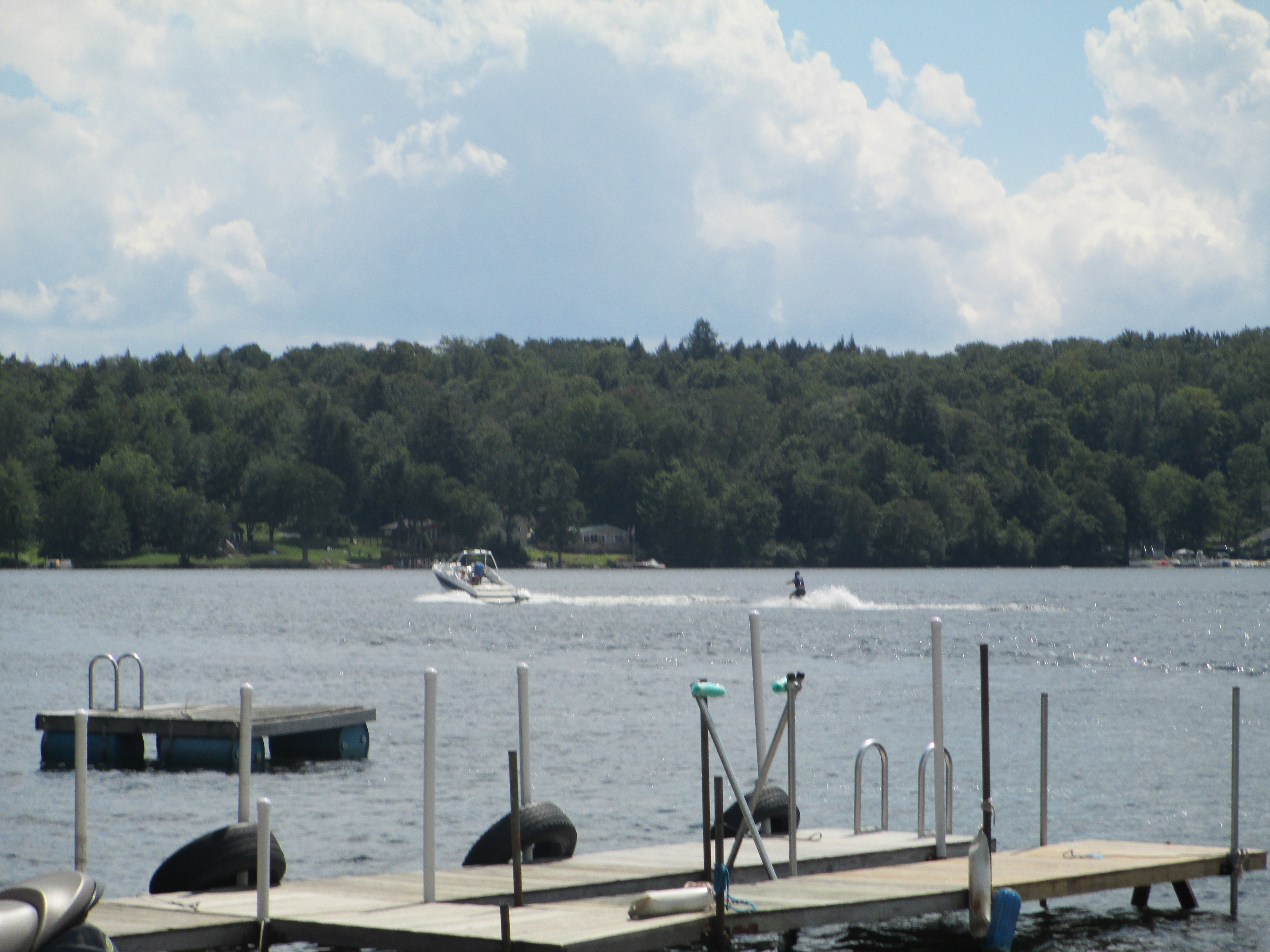
My nephew waterskiing in a boat driven by cousins.  Kauneonga Lake 2013.

My nephew waterskiing in a boat driven by cousins. Kauneonga Lake 2013.

My cousins still have boats and jetskis on the Lake. When I go up I spend my sunny days with them by their beach and docks. We have not put our dock in since my parents passed away. But when I go on the lake with my cousins, part of me is looking for my Dad’s pontoon boat. Another part of me is laughing as we zoom around the lake and talk about all the changes that have occurred in the past year or so.

Most of all, when I am out on the Lake, I think of all of our happy memories. How lucky we were to spend our summers there. And how lucky we are to be able to share that time with our children. Summers at the lake are the best summers.

Grandma Esther’s Afghans Wrap Me in Love

28 Mar

Throughout my home are reminders of my Grandma Esther.   She spent much of her time knitting and crocheting for her three children, nine grandchildren and later 18 great grandchildren.

During the summers she stayed with my Aunt and Uncle in a bungalow in Kauneonga Lake, where my other grandparent’s bungalow colony once stood. Most days, rain or sunshine, Grandma crocheted.

Image

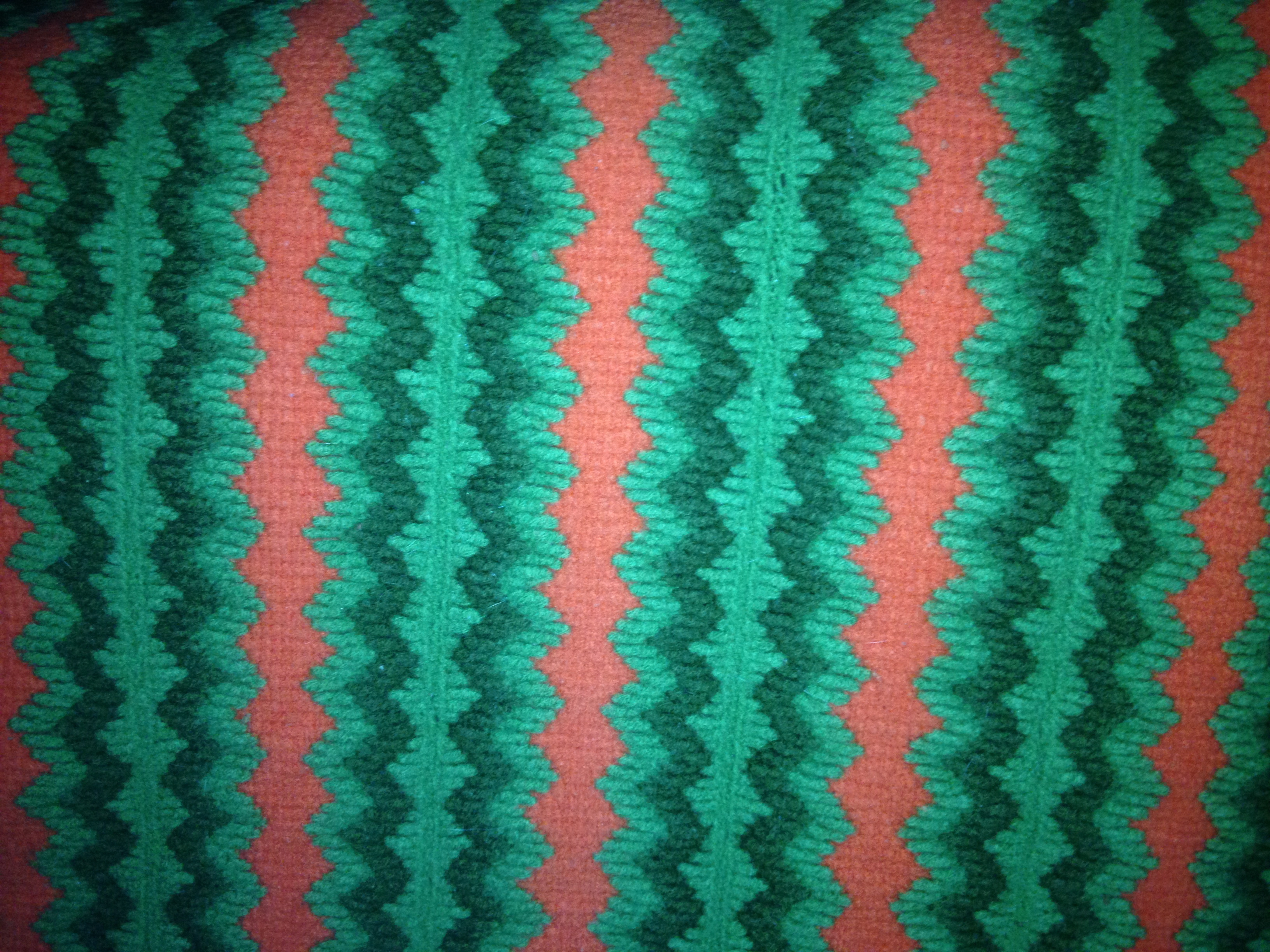
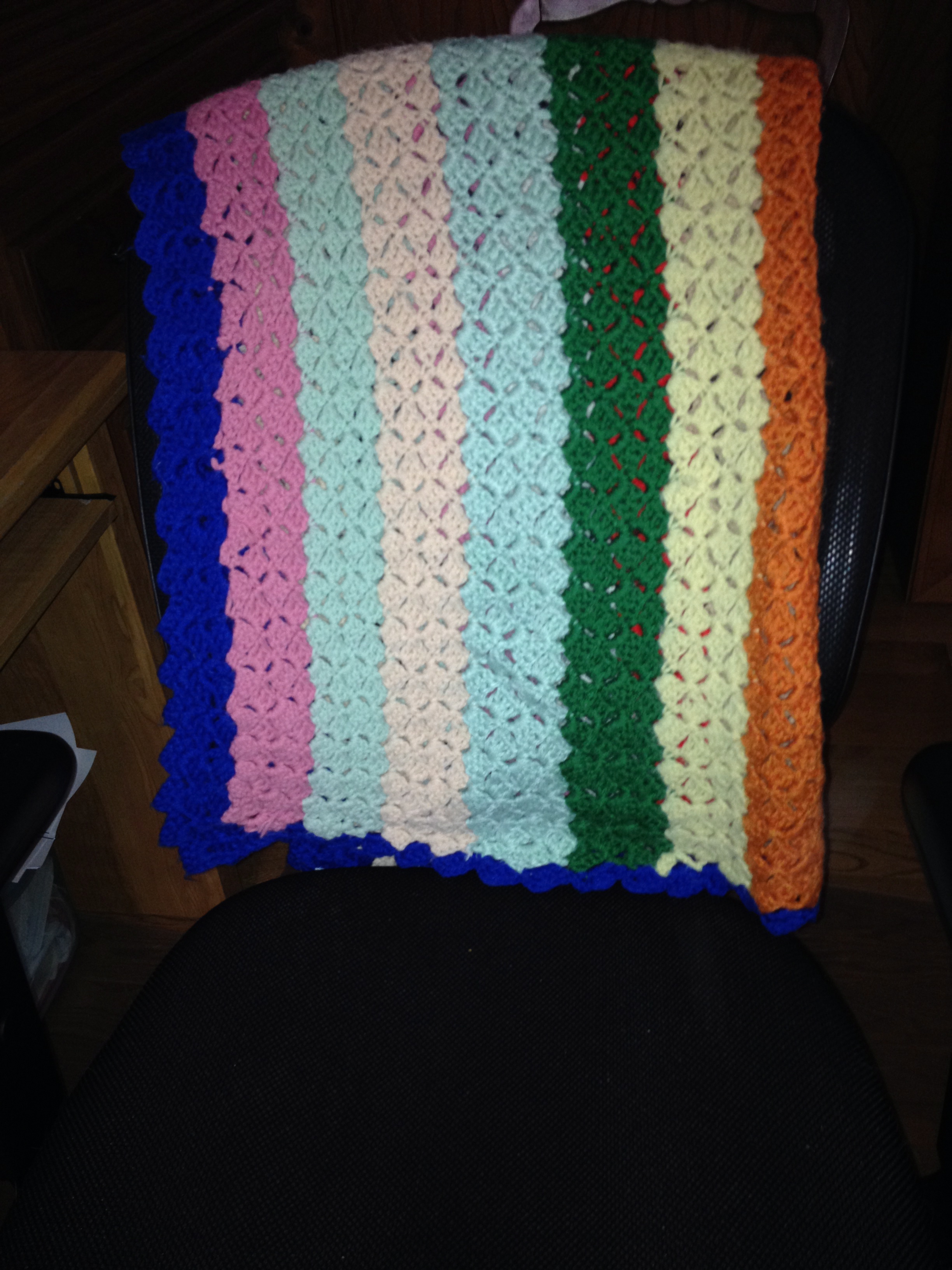
I still have the first afghan that she helped me to make, when she first taught me to crochet. It was the first thing I made after a scarf.  This afghan began life as a poncho. But when I got tired of wearing it, Grandma helped me find matching yarn, and we made it into my first afghan with my Mom’s help when Grandma was not around.  This green, orange, yellow, brown and beige afghan stays in my sewing room/guest room.  It is starting to fray, and the stitches do not look so wonderful. But since it has to be about 47 years old, I would say it is in pretty good shape.

Image,

In my bedroom is the afghan she made as one of nine for her grandchildren.  My brother, sister and I each got one when we got married.  Mine is orange and green, because those were once my favorite colors (though not anymore). I keep it in my bedroom on a comfortable reclining chair.  When I am having a bad day or feeling sick, I wrap myself in my Grandmother’s afghan and feel only love and warmth.

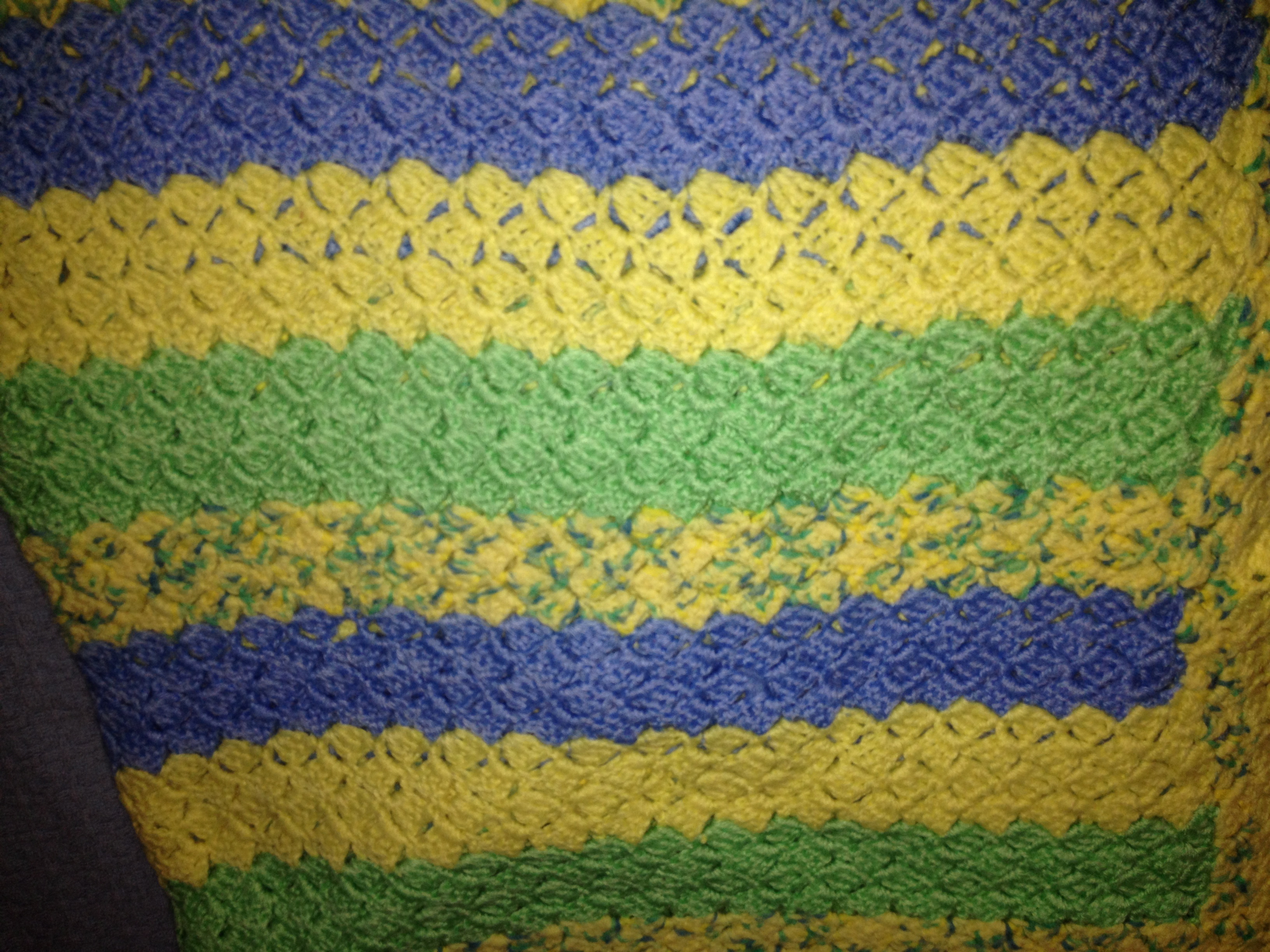
My daughter has two afghans made by Grandma.  By this time Grandma only remembered one stitch.  So all the great grandchildren have the same pattern, just different colors.

Image

She made one afghan when I was pregnant and presented to me as a baby gift.  The other afghan she made at my daughter’s request, using the colors she wanted…pinks and purple. (My daughter was almost seven when my grandmother passed away.)  But the green, yellow and blue one was made in anticipation of my daughter’s arrival.

Grandma was 88 years young when she flew from New York to Kansas to be here the week after my daughter was born. My sister and her husband flew here with Grandma. Nothing was going to stop her from seeing my daughter. She stayed for a long weekend.  It was a special time.  And these memories are there in the afghan.

Image

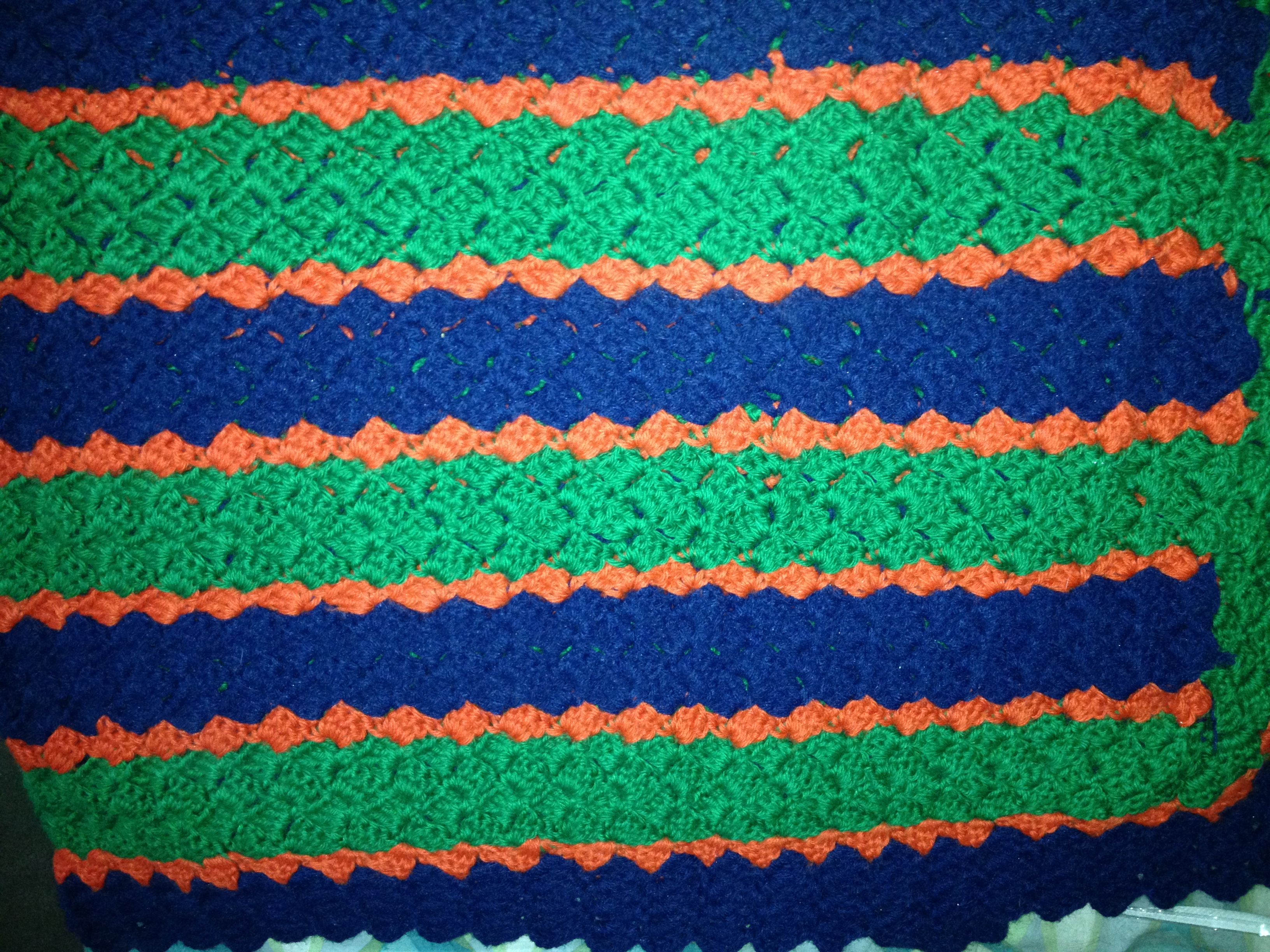
A dark blue, kelly green and orange afghan was made for my son.  By this time Grandma has having trouble.  My son was born when Grandma was 92. Grandma had three great grandchildren born close together that year.  If I remember correctly, my Aunt helped Grandma complete these afghans.   She had several more to make after my son was born.  I think his is one of the last full-size afghan.  She made a matching pillow to go with it as well.

I keep his in a plastic bag in his closet.  When he was little he liked to sleep on the floor of his bedroom in a teepee wrapped in this afghan.  Now it waits for him to once again use it.  There is no room in his little college apartment.

Image

On the back of the chair I work in, is a small lap afghan. This my Grandma made from scraps of yarn leftover from other projects.  She gave it to my parents, who used it for almost 20 years  after she passed away, until they also died. When we cleaned out their home, I took it home with me.

Besides my Grandmother’s afghans, I also have ones that I have made.  A purple one for my daughter when she was born is one of my favorites.

Image

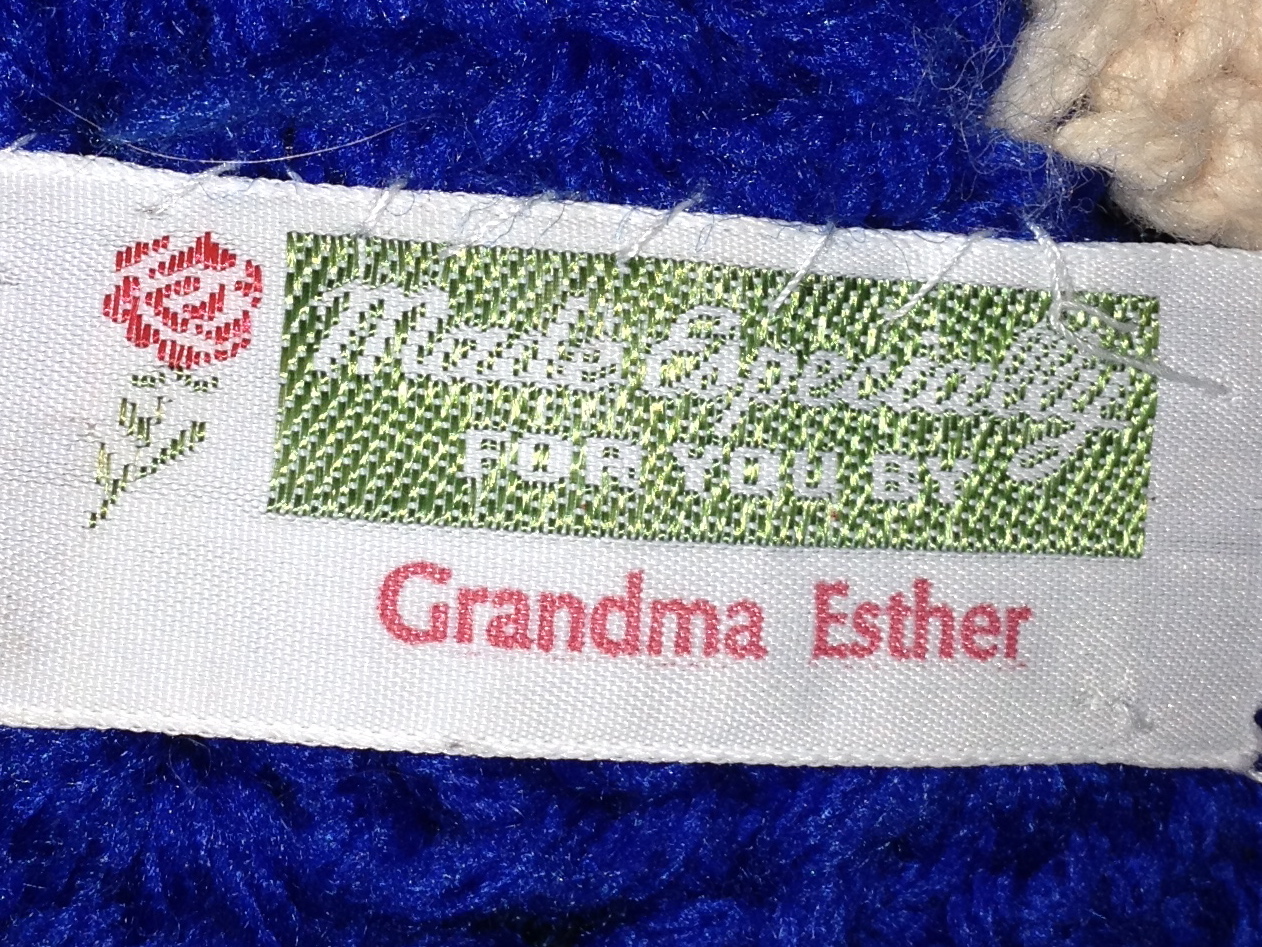
Each afghan holds love in each stitch.  The love I remember when Grandma taught me to crochet and knit.  The love my Grandma put into each afghan she made. And the memories she wanted us to hold with the little label sewn in each one that says “Made especially for you by Grandma Esther.”

A short update/ January 2022:  For the past seven years I have been making baby blankets for all babies born into my family, as well as for all babies whose parent’s invited me to their weddings.  Well over 60 blankets so far.  For my extended family, I make them in honor and memory of Grandma Esther.

The Great Shoe Catastrophe

18 Mar

Spending the summers in the Catskills was so important to my brother, sister and I, that once we became of age to work, we looked for jobs in and around Kauneonga Lake.  We wanted to be able to spend the weeks in the Catskills and not have to join the long line of cars that went to and from the City every Friday and Sunday night/Monday morning.

For two years, when my brother was 16 and 17, his job was at a shoe store in Monticello.   It started as National Shoe Store, but then was changed to the Triangle Shoe Store. He worked five days a week.  Sometimes he worked during the week, but many times on the weekends, because that is when all the tourists were up.  For this job he had to be dressed appropriately.  No jeans and tee-shirts  and sneakers for him, instead he was in nice pants, a collared, button-down shirt and dress shoes.  This attire lead to what I call the GREAT SHOE CATASTROPHE.

It started as an abnormal day to begin with for us.  Not only was my Dad in the City working, but my Mom had left the day before to spend time alone with Dad at our home in North Bergen, New Jersey.  I think they had a meeting and a social event they had to attend.  My Mom decided she would take some items back to our house.

At this point, we were no longer staying on the grounds of my grandparent’s bungalow colony.  Instead we had a bungalow on the same property as their year-round home about 1/2mile from the colony.  Both houses sat on several acres of land.  It was peaceful and beautiful.

Image

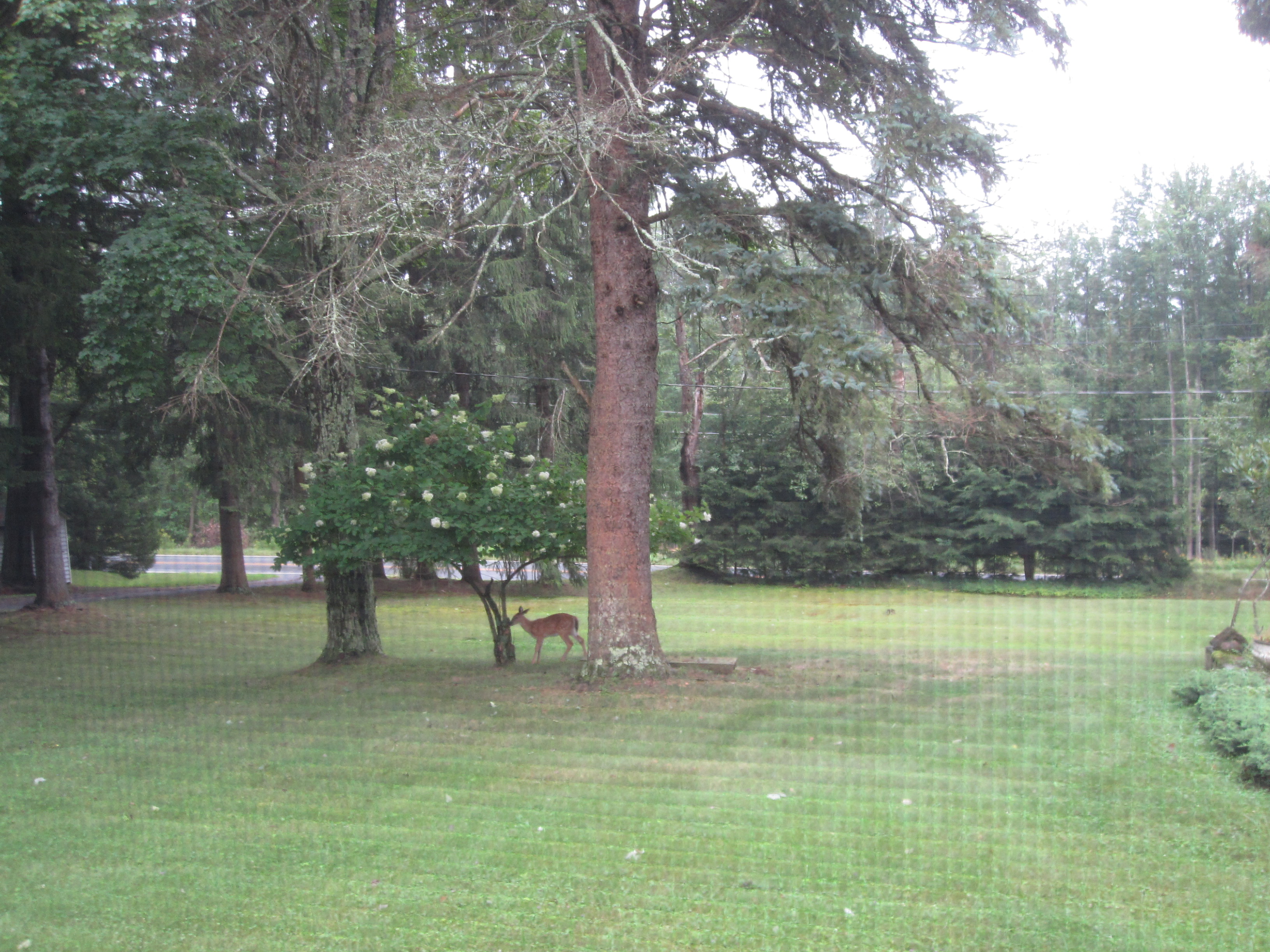
A peaceful Catskills morning on our property.

But not so peaceful on this morning.

My brother was getting ready for work, when he realized he had no shoes.  My Mom had taken his good shoes with her to New Jersey to get the repaired or resoled or something. But she did not only take the damaged shoes, she took both pairs of shoes. All my brother had to wear was a pair of sneakers.

He went bonkers.  He was yelling, he was screaming. “How could she take my shoes! Both pair.!”  I have to be honest, I was laughing.  That is what a younger sister does, when an older brother is annoyed.

But then he lifted up a kitchen chair.  I don’t think he meant to do anything really wrong.  But first the chair hit the ceiling then crashed into the floor.  A t this point, my sister and I decided it was prudent to leave the bungalow and get my grandmother.  Which we did: we ran to get her, screaming all the way.

She quickly went back to the bungalow to see what was happening.  And then came back to the house, laughing.  With a big smile on face, she turned to my grandfather and said, ”Go back there.  Look at yourself.”

We stayed with Grandma, while Grandpa walked back to the bungalow and my crazed brother.  I was not witness to what was said. But it became family lore.

My brother raved and ranted about my Mom taking both pair of shoes and leaving him with only sneakers. And he had to wear nice shoes for work.  And why would she do that to him?  (This was before the age of cell phones, so he could not even call her.)

My grandfather laughed.  “Shmenrick ,”  he said.  “You work in a shoe store.  Buy another pair of shoes.” And he gave my brother money for shoes.

I am laughing as I remember the story.  My brother, for a long time, did not think it was so funny.  But later…the words,  “You work in a shoe store, buy yourself shoes, “ became amusing even to him.

When my Mom returned, she felt terrible.  She realized when she got to Jersey that she had both pairs of his shoes.  She had not meant to do that. But it was done.  However, she was not happy with the hole in the ceiling or the broken chair.

That chair matched her kitchen set.  And there were only four of them.  She wanted it fixed.  So it was put in the corner of the screened-in porch.  We all knew not to sit in it.  Eventually my Dad was going to fix that darn chair.  But he did not get around to it right away.  It sort of just sat there in the corner for most of the summer.

Several weeks later, we had lots of company one weekend.  We were all eating breakfast on the porch.  Along came my cousin to join in for the food and conversation.  But there were no empty chairs at the table. In the corner was a chair that looked fine.  So he went over to sit on it.  (Yes that broken chair.)

We all yelled at the same exact moment,  “NO DON’T SIT THERE!!!!!”

Too late.

He was down and out. The chair splintered into hundreds of pieces beneath him and scattered everywhere.

He had a horrified look on his face.  And said,  “Did I do that?”

None of us could respond because we were laughing … there was nothing else to do. The chair was a goner.  My cousin was fine, just startled.  We tried to explain what happened.

The great shoe catastrophe had taken one more victim.  But the outcome was important: my brother never lost his temper like that again.

We are going to the LAKE!!!

1 Mar

I did not swim in a pool until I was 17.  Up until then I had only ever swam in a lake…one lake in particular: Kauneonga Lake in Sullivan County, NY.  My grandparents owned a small bungalow colony right across the street from the lake on West Shore Road. 

Kauneonga Lake is the northern side of White Lake.  White Lake and Kauneonga Lake once had just a small channel connecting them, but it was widened many years ago.  Amber Lake was off to the side, and could only be accessed on foot or by canoe because the channel was so shallow.

Each spring we would begin to prepare for the first visit to the lake.  Memorial Day weekend the bungalows would open. But the season would really not begin until the end of June, when school ended.  We would go up earlier so my Mom and Dad could help my grandparents prepare for the season.  My siblings and I would be put to work. . My brother and I would be scrapping paint off the bungalows to get ready for a new coat!  My sister was too young for those jobs, so was given a simpler job to do. 

Oh the excitement of knowing that summer was coming!  Once school was out, we would be there for two months of joy.  We would pack up the car, put on our pajamas, and head out for what was then a four-hour ride.  When we woke, we were there in our bungalow at Kauneonga Lake.

There, in the mornings we could watch the mist rise above the lake. In those days it was so cold in the mornings, we slept with our clothes under our pillows to keep them warm.  We would dress in layers under the covers and then get up.  Going to the bathroom in an unheated bungalow, first thing in the morning, was a COLD experience.  But even though the lakes were fed by spring water, in the mornings the water was warmer than the air, and mist would rise so ghostly above the water.

Watching the mist rise over the lake was a normal experience and also a beautiful one.  It was so peaceful.  There were very few motor boats on the lake then, just canoes and rowboats. 

My grandmother, who grew up in Poland, believed that washing your hair in the lake was the best.  So some mornings I would join her to walk over to the dock.  She wore her hair in braids on top of her head. But at the lake, she let it down and then would wash it with Ivory soap. She would wash my hair as well.  Then we would dunk in to the warmth of the lake and quickly wrap ourselves in towels when we came out.

Image

Swimming in Kauneonga Lake 1961.

Every afternoon, when it wasn’t raining or too cold, we would all go to the dock to swim.  Along side the dock were rocks were we could hunt for crayfish.  Some mornings we would fish.  I was an expert in filleting fish, which I did for my brother and I.  Later these skills were important when I worked in a deli and would filet white fish for the customers.  But then it was the joy of fishing and being at the lake.

When we swam, we tried to stay out of the gush. This was the seaweed and the bottom of the lake. The area we swam in was sandy because of all the activity. But on either side it was gushy. The older boys tried to make us have to step there. And in the gush were turtles and fish that would nibble at our feet.

We knew that a warm spot was a bad sign…and we would scream and yell when we walked or swam through one.  Who had peed in the lake?  No one would ever tell.

When I reached my teens, the lake atmosphere had changed. But I still loved it!  Now there were many motor boats and water skiing.  My friends and I would go out on the lake for hours, boating over to the cove where we could swim without our parents watching.

In the early fall, we would come back for weekends.  Even though the colony was closed, we came out to help do the closing of the buildings.  A friend of mine, who had a boat, came up sometimes as well, especially during Rosh Hashannah.  We would ride in his boat over to the beach at Camp Hi Li and sit on its floating dock working on our homework.

My parents had a pontoon boat in their later years.  It was perfect for my Dad to go gently around the lake. My cousins would keep watch over my parents when they went boating. Just as my parents kept an eye on my cousins when they were young.  Generation reversal!

Image

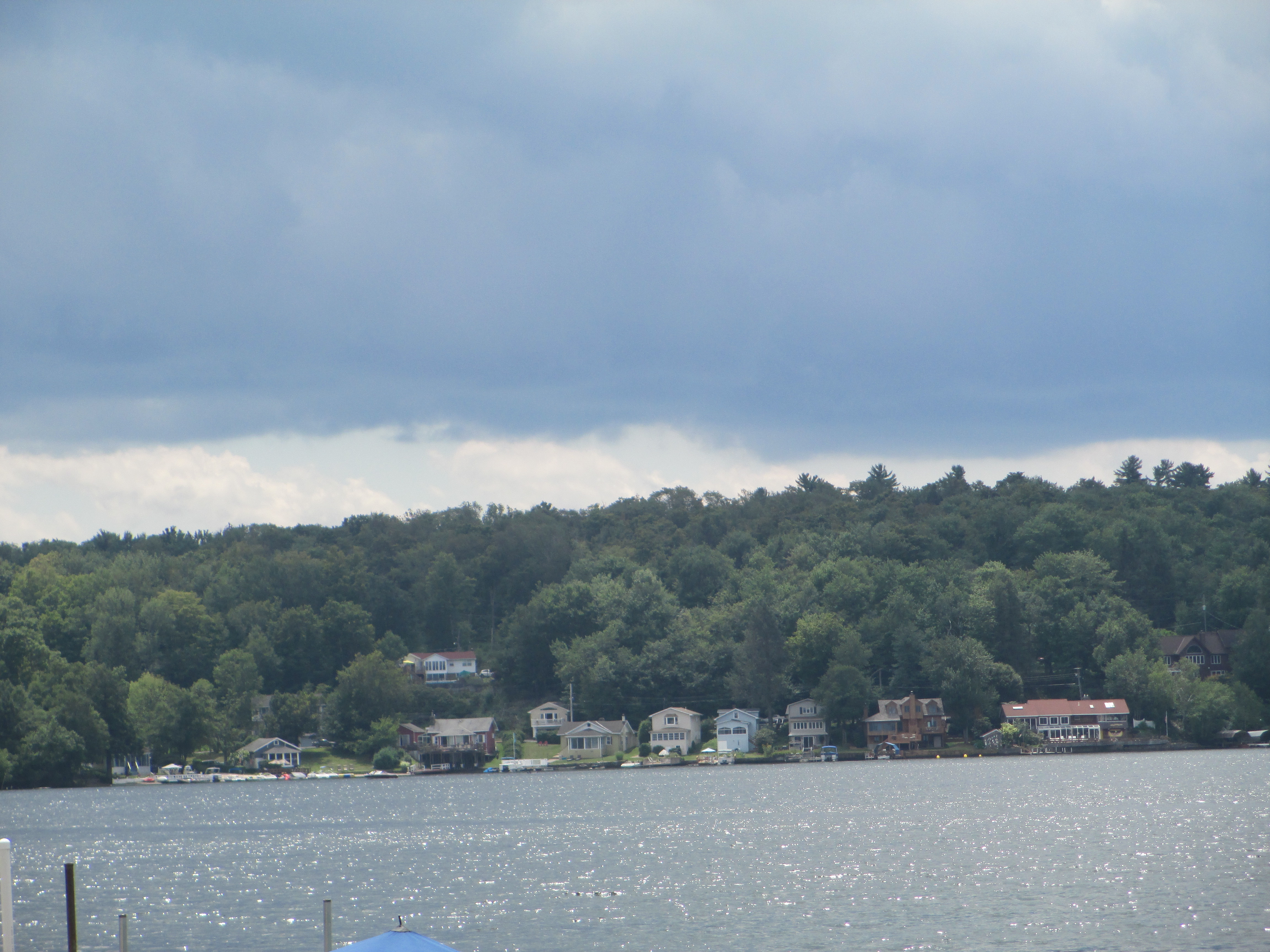
Kauneonga Lake summer 2013.

I still go up to the Lake.  There are so many more boats on it.  I don’t see as many people swimming. Most are boating.  My cousins have a large beach area where we hang out.  The ‘youngsters’ swim and boat and ski and go tubing and other water sports.  We, now the older generation, go out on the boat once in a while for a spin around the lake.  My cousins tell me about all the changes in the past year.

For all of us, there is joy just being by the lake.  Visiting with each other. Continuing the fun we had in the many years we spent growing up together across the street from Kauneonga Lake.

To this day, the words,  “We are going to the Lake,” still bring joy to my soul.

Knitting and Crocheting Brings Love and Memories

13 Feb

I am told that what I do is a dying talent.  When I sit in an airplane or in a waiting room, people walk over to me to see what I am doing.  What am I making?  How did I learn to do that?

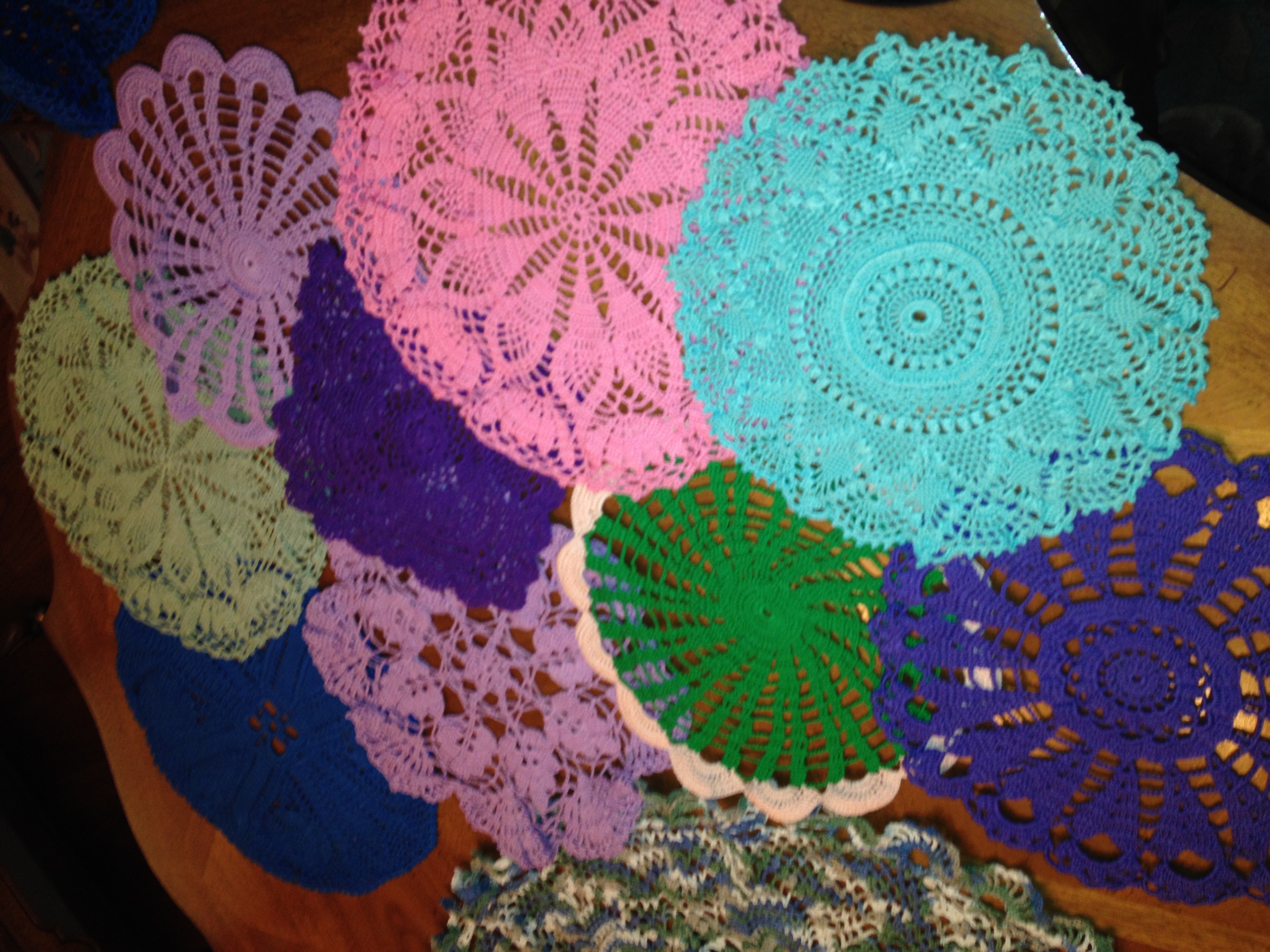
I am crocheting with thread.  I use a tiny hook, with thin brightly colored yarns.  Sometimes I make up my own designs, sometimes I navigate the instructions in a book or magazine.  My favorite is to make doilies, bookmarks and small table clothes.

Image

I started when I was nine year old.  One summer my Grandma Esther decided it was time I learned to knit and crochet.  It became our summer project.  Whenever I was not running with the ‘pack’ of children,  I was sitting with my Grandma and learning a new skill.

My Grandma was always knitting…when she wasn’t playing canasta.  She made sweaters for all of us.  Afghans were important. She made one for each grandchild and great grandchild, when they arrived.  There was a yarn store in Kauneonga Lake where you could buy yarn in bulk.  I think my Grandma, aunt and mother supported that store.

But teaching me was much, much harder than she imagined, because I was left handed, and my Grandma did everything right handed.   Which is why, in the end, I crochet right handed.

I remember sitting on her lap on a wooden chair under a tree at the bungalow colony in Kauneonga Lake.  We started with large needles and thick yarn.  I first learned to make a scarf and a hat.  Knitting and purling; straight needles for the scarf, then a needle in the round for the hat.  I learned increase and decrease, casting on and casting off.

She taught me by holding her hands over my hands.  And soon the knitting was no problem.  I just sat next to her and knitted while we talked.  If I had a problem like dropping a stitch, she was right there to help me. She showed me how to fix it and to keep on going.  The idea was not for her to fix it for me, but for me to learn how to do it for the next time.

Once I finished the hat and scarf, it was time to learn to crochet.  This was oh so much more difficult.  At least when you knit, you use two needles.  So even though I was not right handed, I could still learn to knit the way she did.

But crocheting was different. Grandma tried.  We spent hours and days as she tried to crochet left handed to teach me the techniques of single, double and triple crochets.  She eventually gave up.

“We are going to try something different,” she said, as she put the crochet hook in my right hand.  It was not a problem.  I think as a left-handed person, you learn early on to do things with your right hand.  I had to cut with scissors with my right hand, I threw a ball with my right hand…we only had left handed gloves, so it made sense that I could crochet with my right hand.

The knowledge of knitting and crocheting that I learned that summer has stayed with me my entire life.

When my children were little, I made lots of sweaters, blankets, scarves and hats.  I made gifts for my friends’ children.   A close friend of mine and I knitted all the time, sharing patterns for sweaters we made for our children.  I enjoyed knitting more than crocheting.  It went quicker.

But when my son was four, I broke my right elbow and wrist.  And all knitting had to stop.  I was in the middle of a sweater when it happened.  I tried to go back to knitting after my arm healed, but I could not hold the weight of the sweater with my arm as I knitted.

I stopped all knitting and crocheting for years.  And I missed it.

Then one day while watching my son in his gymnastic class, I noticed a woman using thread yarn to make a bookmark.   I thought. “I think I could do that. “ It did not look heavy at all.  She was nice enough to share her pattern. I went out and bought a fine needle and some yarn.

Image Crocheting at our home in Kauneonga Lake.

I was addicted!!!  I made hundreds of bookmarks.  I used patterns from books. I made my own designs.  I made about five each day.  I crocheted at music lessons, gymnastics, basketball, bar/bat mitzvah lessons, watching television.  Whenever I had down time, I crocheted.

The bookmarks were everywhere.  My children’s school friends each got some. Relatives got them for every birthday and holiday.  I donated them to the school library. I gave them away.  Finally my daughter said in exasperation,  “MOM, CAN’T YOU CROCHET SOMETHING OTHER THAN BOOKMARKS?”

And I said, “Yes, I think I can.”

I started on doilies.  I have made hundreds of doilies of every color, except white….too boring.  For my son’s bar mitzvah I made 65 thread crocheted ‘doilies’ head coverings  for the married women to wear.  It was a great idea.  The men always get something, why don’t the women?  I was going to make them all green, my son’s favorite color. But my Mom insisted I made some quieter colors.   So I made blue and beige as well.  I still see women in my congregation wearing a head covering from the bar mitzvah.

I give them to people who frame them for their daughter’s room.  I give them to friends.  I give them to strangers.  If I have some in my bag and someone admires one, I will give them the finished ones.  It’s not like I do not have at least 30 at home at any time.

I became obsessed with the yarn.  When my daughter lived at home, I would sneak more yarn into my own home, because she could not understand my need for more.   “MOM, I can’t believe you bought more yarn. You haven’t finished the yarn you have,” she would say.  She wanted to do a yarn intervention.

But these were colors I did not have.  I had to buy them.  I have way more yarn then I have time to finish. And the crochet books! They fill a cabinet.  I admit it.

However, when I crochet, I enjoy the feeling of making something.  I love giving them as gifts. I remember the times with my Grandma knitting or crocheting, I have joy from giving them away.

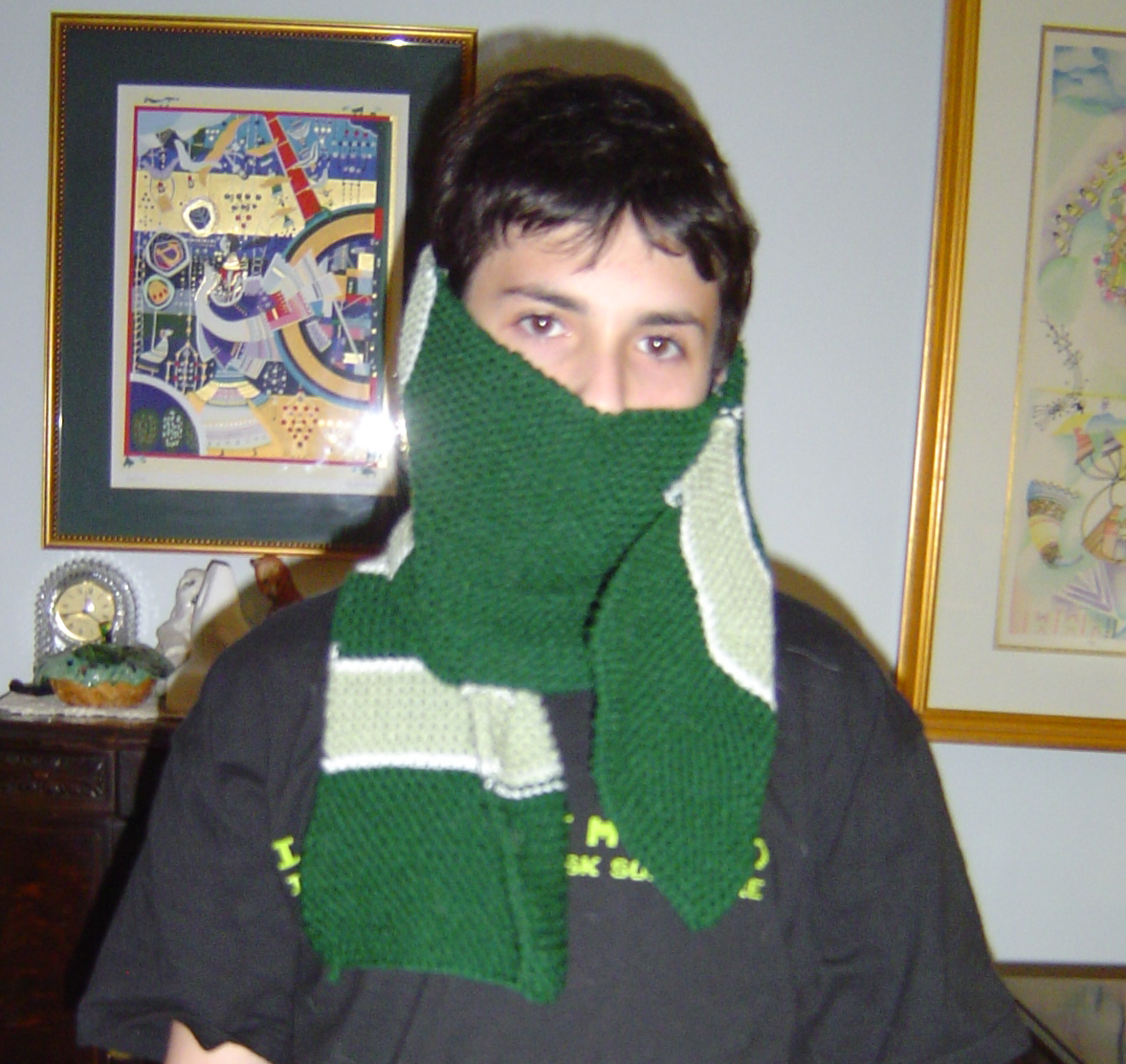
Image My son wearing a scarf that my daughter knit for him.

So, finally, I taught my daughter to knit scarves and hats.  She made some for her grandparents and brother and friends.  And now she loves yarn as well.

From generation to generation, my daughter learned in Kansas,  because my Grandma taught me in the quiet of the Catskills.  And a tiny bit of me is up in the Catskills, sitting on my Grandma’s lap, learning a new skill, while part of me is enjoying watching my daughter follow in a family tradition.

Shopping at Sylvia’s In Kauneonga Lake

8 Feb

Every summer of my childhood and teen years, I spent some time in the S & G Outlet clothing store; or as my grandmother called it, the schmattah store.

Also known as Sylvia’s, this small store was an important part of Kauneonga Lake life.  Located on the hill just as you enter town and overlooking the lake, Sylvia’s carried a bit of all the types of clothing you might need during the summer and beyond.

Image

The town of Kauneonga Lake, looking up the hill to where Sylvia’s store used to stand.

Because it was the only clothing store in town, it had the undivided attention of all the girls and their moms. Sylvia, the owner, was a short, blonde dynamo of a woman.  She could sell anything.  And she did.

My sister, my mom, my grandmother, and I loved going to Sylvia’s.  We bought our bathing suits there each summer. We got jeans and sweaters, socks and underwear, sneakers and flip-flops, shoes and hats.  Everything you needed to survive the summer, you could get there.  It was the time before the big stores like Target and Walmart.  If you outgrew your clothes during the summer, as my brother often did, it was at Sylvia’s that he could get new jeans.

When my friend, Vicki, and I were 13, we were so excited that we were allowed to walk up to Sylvia’s by ourselves.  We both worked as mother’s helpers.  We would save our pay and then shop.  It was great. We felt in control because we shopped by ourselves.  But looking back, I realized our moms had no worries.  Sylvia did not carry anything we could not wear.  Sylvia kept an eye on us and knew both of our moms. And finally if we found something we could not afford, Sylvia would set it aside till our moms could come up to, perhaps, buy it.

We would often buy some of our back-to-school clothes at the store. One year Vicki and I got matching long, mustard gold sweater vests. We thought they were beautiful.  I remember we called each other to plan to wear them to North Bergen High School on the same day, once we were back in school in New Jersey.

The store itself was small. Just one large room with two lines of tables down the middle piled with clothing. A pathway between the tables allowed you to examine all the clothes. Under the tables were stacks of brown shoeboxes filled with sneakers, shoes, and sandals in children and adult sizes.  Extra merchandise was hidden under the tables as well.  Men and boys clothing did not take up as much room as the girls and women clothing. While along the walls were shelving and hanging items.  If you wanted to try something on, you went into the bathroom, which served as the changing room.

Behind the store was a small apartment where Sylvia lived with her son.  It had a little kitchen.  Sometimes when we went there with my grandmother, we had tea in the kitchen.  If the store was not busy, Sylvia and my grandmother would visit and have tea. We were allowed to go into the store and search, while they chatted.

My sister started working for Sylvia when she was 14. Sylvia always loved her.  She, my sister, had the most extensive vocabulary for a small child.  When she opened her mouth, you never knew how she would express something.  I believe Sylvia enjoyed this about my sister.  In any case, as soon as she was old enough to work in a store, she became Sylvia’s helper.

Once my sister started working there, we had an advantage over everyone else. Since she unpacked the boxes and put out the new merchandise, she knew when the best stuff arrived. When she came home from work, she would let us know what had been delivered.  If she really liked something, she would put it on the side.  I remember a pair of shoes, in particular, that my sister felt we both needed.  For that I had to go up and try them on.

When my sister was 14, I was 18.  My full time summers in the Catskills were coming to an end.  By the time I was 21, I was spending my work weeks in the city, and coming up only for the weekends.  I did much of my shopping at B. Altman’s in NYC, or at Little Marcy’s in West New York.

But I still shopped at Sylvia’s.  There was something special about walking up and down those aisles, checking everything out and finding the perfect treasure.

It was a sad day when Sylvia retired and no longer opened her store on the top of the hill overlooking Kauneonga Lake.

The Grandmas’ Forever Canasta Game

25 Jan

Every day, unless it was raining, the grandmas at our bungalow colony at Kauneonga Lake played canasta. They had a special blue, wooden table that was designated for them.  No one else ever sat there.  We knew that at some point during the day, the grandmas would wander over and a game would begin.

It was such a peaceful setting.  Cool breezes, shade from trees, people enjoying the nice weather…and the grandmas and their canasta game.

Grandma Esther, my father’s mother, always played with her sister, my Great- Aunt Minnie, as her partner.  My mother’s mother, Grandma Thelma, partnered with her best friend:  Nana was my friend Vicki’s grandma.  Grandma Rose, my cousins’ grandma, she sat nearby to be part of the conversation.  I do not remember Grandma Rose playing canasta, but she was always there.

The games were intense.  Often my grandmothers would yell at each other or at their partners.  God forbid if the wrong card was thrown, or if a canasta was not made, then the yelling commenced.

“How could you throw that card?  Weren’t you paying attention?” One of them would comment.  Often there would be a sigh of disgust.  I sometimes wondered if my grandmothers would ever speak to each other again!  But after a cooling off period, they always did.  However, I think sometimes Grandma Esther and Aunt Minnie would stay angry a little longer.

There would be silence as the tension in the game increased. But when the game ended, the yelling would start up again.  “How could you do that?” Someone would say.  None of these grandmas liked to lose.  I learned to stay away near the end of a game.

For me there was an extra tension.  When I would walk over to ask a question, I had to be careful to make sure I treated each grandma equally.  If I said good morning first to Grandma Esther, I made sure the next day, I said hello first to Grandma Thelma.  A hug and a kiss were always expected.  They always sat catty corner to each other, so it was a simple matter to hug one and then the other.

“Good morning Grandma. Love you!”  I would say, then turn to the other one. “Good morning Grandma. Love you, too!” Then Aunt Minnie, Nana and Grandma Rose each got their hug and good morning. It was an expected routine.

I learned canasta by sitting between my grandmas and watching them play.  I learned very early in my life not to say anything.  When you are watching two people playing against each other, it is not a good idea to reveal anything about the cards in their hands.  You do it one time and never again! I learned how to keep a ‘poker’ face.  If I had a question about a card thrown, or why something happened, I would tap the grandma and whisper in her ear.  There was definite pressure not to give anything away!

Occasionally one of them would let me hold the cards and play.   My grandma would sit behind me to help with the hand.  That was great fun and made me feel very grown up.  I was playing canasta!  My friend, Vicki, would come and watch sometimes as well.

When it was windy, all the children would start running to find pebbles to place on the cards so they would not blow away during an important game.  There was a gravel road that led to the parking area.  We would run as fast as we could to the road to get the right size pebbles.  Not too big that they covered the numbers, but not too small that they did not hold down the cards!

My grandfather would complain that he had to get more gravel each year to make up for the canasta playing stones.

If it got too windy, we would run over to the game to help gather the cards and bring them inside.  We tried as hard as we could to keep the cards in the right order so the game could continue.

I cannot imagine how many hours they played cards each summer.  And I also cannot imagine a summer without the grandmas playing canasta.  The games seemed to last forever, as do the memories.  In my mind I see them sitting in the sunshine playing canasta forever.

Love of Mah Jong started in the Catskills

14 Jan

One rainy summer day in Kauneonga Lake, my Mom pulled out her mah jong set.  It was the start of my love of the game.  Soon my grandmother came over.  And for hours, my Grandma, Mom, sister and I played maj.  I remember it as if it was yesterday.

I don’t know exactly how old I was, but probably about 12 since my sister had to be old enough to play.

I just know that we sat in the kitchen of the bungalow, with tea and cookies, and played.  In the beginning it was slow, because they were teaching us. But by the afternoon, my sister and I began to play with more assurance, making the games quicker.

That summer we played every time it rained.  I almost looked forward to bad weather.  Almost, because compared to the allure of the lake and outdoor activities, mah jong was second.  But being together with my Mom and Grandma and sister, playing mah jong was just so much fun.

I was excited because my Mom played every week with a group of friends.  Each week they played at a different home.  When they played in our home, even though we were not supposed to disturb them, as I got older, I was allowed to watch for a bit.

Now I understood the game.  Now my Mom, my Grandma, my sister and I had our own activity; something just for us to do when the weather was dreary.

Image

Those memories remain.  And each time I play mah jong, a little bit of me thinks back to those days.  I now use my Grandma’s mah jong set, while my sister has my mother’s set.

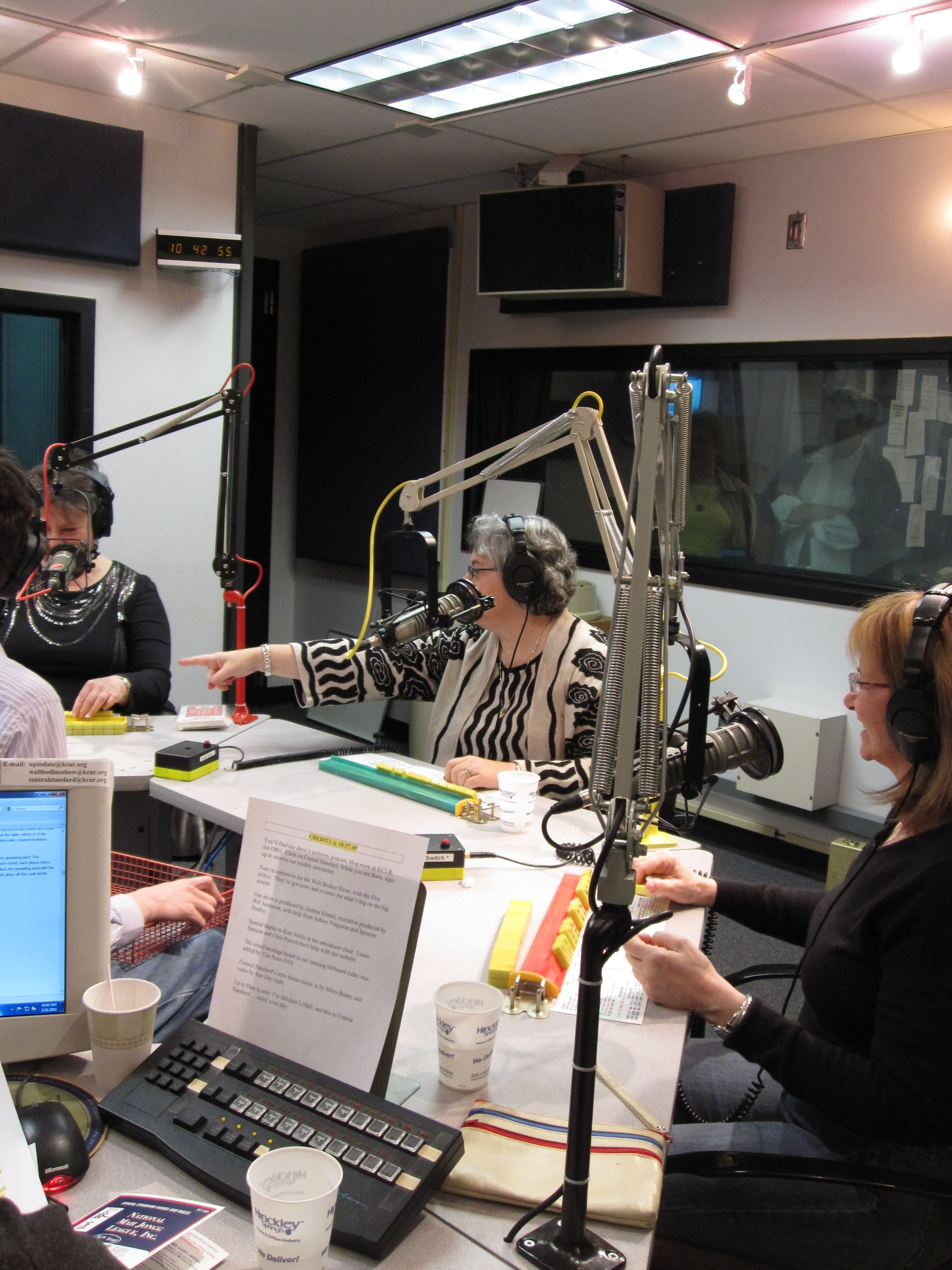
I enjoy mah jong so much I tried to spread the joy by organizing a special mah jong program through a local organization. We brought in the curator of a Mah Jong exhibit at the Battery Park Museum in New York City. As a way to advertise it, we played mah jong on the radio!

Image

People listened to the lecture and slide show, ate Chinese food, played mah jong, and examined sets that others had brought to share.  An important part of this museum exhibit was people playing Mah jong in the Catskills. They even had a photo of people playing in a pool!

I play in two groups.  One group I have been playing with for 13 years.  We started because we live in the same neighborhood and wanted to get out a bit.  We meet once a month to play this game that has been passed down from our mothers.  All of us have sets that belonged to our mothers, grandmothers or aunts.  I actually also have my mother-in-law’s set.

When we started playing our children were in still in elementary, middle and high school.  Now the youngest are still in college. But the older ones are working and living away from home.  We are empty nesters. 

When we come together we share memories.  We have helped each other though emotional upheavals: death of a parent, children moving far away, a spouse’s retirement.  We listen to stories about vacations, jobs, volunteer work.  We have been to each other’s children’s bar/bat mitzvahs, high school graduation parties.  We are waiting for the weddings to begin.

We planned special events. Like the time we all had our mothers in town over Easter, and decided to play.  Moms played at one table, daughters at the other.  Two generations enjoying the same game while laughing, snacking and sharing a memory.  Sometimes we go out for lunch, or celebrate a birthday.

Mah Jong is so much more than a game for me.  I often say it is the game I love to hate and hate to love.  But in reality, it is a game that brings back so many memories.   And teaching it to my daughter meant so much.  When she was in eighth grade I actually volunteered to teach a group at her school for students who wanted to learn.  Once a week the students played for an hour, while I and several other moms taught.  It was wonderful.  In fact my second mah jong group includes another mom who taught with me.

Although my daughter does not play now, I hope that one day she will remember fondly playing with my Mom and me.  And I hope, that just hearing the click of the tiles brings back moments of joy.

In the meantime, I promised one of my cousins that I would teach her to play mah jong.  This summer I hope we will finally have a cousins’ game in the only place possible for us to play: Kauneonga Lake, Bethel Township, Sullivan County, New York.

Blueberries Bring Back Catskills Memories

29 Dec

I love blueberries.

Almost every morning I add them to my breakfast menu.  Some days I have them for a snack in the middle of the day.

When I eat blueberries I feel joy.  When I eat blueberries I travel back in time.  I am no longer sitting in my kitchen in Kansas.  No I am now sitting at a table with my Mom, sister and brother.  It is summer time.  Cool in the mornings, warm in the afternoons…the perfect weather even when it rains!

Blueberries bring me back to the Catskills at Kauneonga Lake, BethEl Township, in Sullivan County, upstate New York in the 1950s and 60s.

Image

My entire childhood, we spent the summers at a small bungalow colony owned by my maternal grandparents.  Situated on West Shore Road, just opposite Kauneonga Lake, the bungalow colony was the home to all four of my grandparents, some aunts and uncles, cousins, other assorted relatives, and close friends.  We spent 10 weeks together every year.  The happiest times were there.

We biked, we swam, we played.  It was in the Catskills that I stayed up late to watch Neil Armstrong walk on the moon.  And it was there that I watched the hundreds of thousands stream into town for the Woodstock concerts.  In the Catskills I spent time at the Firemen’s Festival, shopped at Newmans and Vassmers.   Worked in the town’s bakery.  I lived for the summers.

Image

 We were watched my five grandmas: Grandma Thelma and Grandma Esther, were my true grandparents.  Grandma Rose was my cousins’ other grandma.  Nana, or Mrs Anoff, was my friend’s grandma.  And Aunt Minnie was also Grandma Esther’s sister.  They ruled the roost.  When they wanted something done, it happened.  There were moms, dads, and grandpas as well. But the eyes of the grandmas were always alert.

Sometimes, when we got too bored or in too much trouble, the buckets would come out.

“Go pick some blueberries!”  One of the moms or grandmas would say.

And heaven opened.

Next to my grandparents’ property was a blueberry patch.  As a child I never thought about it.  But this patch was not just a few wild blueberry bushes growing on the side of the woods, no this was over an acre of blueberry bushes.  Someone at some time had to have cultivated it and planted the bushes in the symmetrical lines.  But there it stood…abandoned.   And so each summer it provided us with wonderful free fruit.

We would grab those buckets and run to the patch.  Filling the buckets was so much fun.  Two berries for the bucket, …one berry to eat.

“Look at the size of this berry!!  I am going to eat it!!!”

We would all run over to see the biggest blueberry ever!!!

And watch as it was eaten with glee and joy.   We all wanted to find the biggest berry!

The buckets always got filled. Then we would run back to our bungalows and show off our blueberries to our moms.  The next step was to fill a bowl with salt water and put in the berries.  The bad ones, the ones with worms or the ones not ripe, would float to the top.  These we put back outside for the birds.  The others we washed and ate.  Some got put in the refrigerator for later.

They made the best blueberry pancakes. I can still taste them.

But every once in a while, we were told to bring all the blueberries to Aunt Leona’s bungalow.  And there, my Grandma Esther and my aunt would make blueberry muffins for all!!!  Oh yum!  I can still smell the tantalizing aroma; see them warm from the oven and covered in butter.  It was a special treat.

So today when I go to the grocery store and buy pint after pint of blueberries, no matter the price, I am not buying my favorite fruit. I am buying a moment to revisit a moment of childhood and remember the joy of picking blueberries.

I am buying time with my parents, grandparents and aunts and uncles who have passed.  I am buying memories that I share with my sister, brother, cousins and friends.

I loved the blueberry patch.