So much information has come my way since Izabela S. contacted me. But the first in-depth story I must tell is about Zissel Feuer, my grandfather’s second cousin, who married my grandfather’s first cousin. I have learned so many details about how he survived and what he did immediately after the war, before he made aliyah to Israel.
Before the war Zissel was married to my grandfather’s first cousin, Dvorah/Deborah. Zissel then used the name Sussel or Zygmunt, the Polish version of his name. His life was intertwined with Schulim/Shalom Hollander because they were married to sisters. Shalom’s wife, Cerla, and Devorah were the daughters of Zacharias, my great grandfather, Gimple’s brother. My grandfather told me that Shalom and Zissel were his second cousins from opposite sides of his family. But since his grandparents/or great grandparents were first cousins, there was much intermingling.
Both Zissel and Shalom and their wives lived on a farms in Trzciana close to where my great grandfather had his farm and both Zacharias, the father of their wives and Shalom’s parents had their farms.
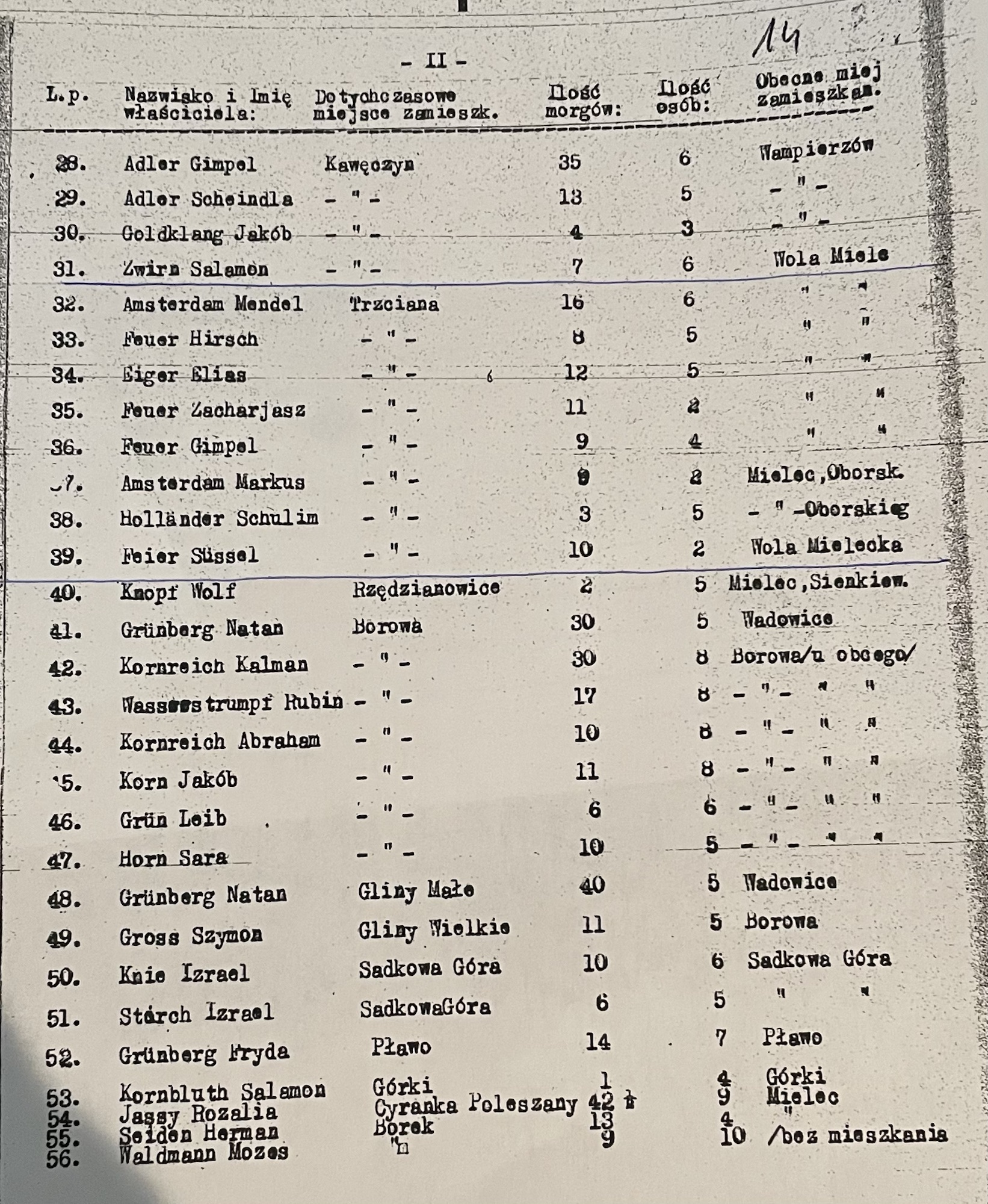
In fact in the document I have, is a list of farms taken from Jewish citizens. The Germans documented everything. Her you can see that seven of my relatives in listed from 32 to 39: Mendel Amsterdam, Hirsch Feuer, Zacharias Feuer (Dvorah and Cerla’s father), Gimple Feuer (my great grandfather), Markus Amsterdam (Shalom’s father), Schulim (Shalom) Hollander, Sussel Feuer. They were all inter-related. My grandfather once told me that this entire plot of land was once owned by his great great grandfather, or even further back. But with each generation the land was split among the sons. There was so much intermarriage as they kept the land within the family.
Zissel was a farmer and a corn merchant. I know that they also had potatoes and other crops on their farms. But it doesn’t matter, they were all forced to turn over their lands to the Germans in 1941.
After they were all forced off their land, Zissel and his wife; Gimple and Chava, my great grandparents; Zacharais, along with other Jewish farmers, were resettled in Wola Mielecka, a nearby village. Shalom and Cerla and his parents were sent to Mielec where they had a home. And then began their efforts to survive. I will let you know in advance, only Shalom, Zissel and one other cousins, the son of Zacharias lived. The rest did not survive.
Much of this information about Zissel comes from the book “Sztetl Mielec. Z Historii mieleckich Zydow” written by Andrzej Krempa that Izabela S. translated for me. (In English, Shtetl Mielec. From The History of the Jews of Mielec.”) Other information came from documents that Izabela has uncovered and translated for me. Part is what Izabela and I have determined through our many email conversations and the research I did and memories I took from my grandfather. I will mix her information with the information I know from my family.
So where was Zissel/Sussel and Dvorah during the war after he was removed from his farm? At first they hid with a man named Stanislaw Wojtusiak in Gliny Male and then with Jozef Padykula in Platkowiec. At some point Zissel’s wife was exposed by a resident of Trzciana, then murdered by the Germans. At this point Zissel had to run. He hid in the Piatkowiec forest near Mielec, near the village of Piatkowiec.
In the meantime, On March 9, 1942 Shalom was sent to a Labor Camp in Mielec. He was then sent to Wieliczka, then to Płaszów. He then became one of the people on Schindler’s List and ended up in Brunnlitz.
My one issue about this, is that Zissel told me he had two children. I do not know where they were or their names. But Izabela told me there is a mass grave near Tarnow where 800 children were murdered and buried. These children came from the Tarnow orphanage and ghetto. Shalom and Cerla’s children, as well as any child Zissel and Dvorah might have had, if they were not taken to a camp with their parents, may be buried here. Or they could have been shot at the Tranow Jewish Cemetery. Or deported. In any case we do not know exactly where the children are buried.
Zissel spent the time from March 9, 1942, the date that the Jews were rounded up for deportation and many murdered, until April 19, 1944, wandering and hiding around the villages near Mielec. For part of this time, he hid in Polaniec (July 25 until October 25, 1942). He left that area after the Jews of Polaniec were deported and returned back to Mielec.
He was able to stay hidden for a while. But starting in April 1943, the Gestapo was looking for him. They knew there was Jewish man hiding in the woods. Honestly, I cannot imagine how he survived for so long, having watched so many of his family die and disappear. But he survived! I know he had to have help, because his freedom was always in doubt. Finally in 1944 he was caught by the Polish Forest Administration and turned over to the Germans. But the slippery and I think smart Zissel, escaped. On his way back from Polaniec he was attacked in the village of Otalezh, which he was stripped and robbed. But he survived.
We know this because he filled out a questionnaire at the Central Committee of Polish Jews after the war. (Izabela says this document is now in the Jewish Historical Institute.)

After the war, he returned to Mielec, where he became the President of the Jewish Religions Congregation in Mielec. He was among the 55-70 Jews who survived. Zissel, Shalom and a woman named Chava Amsterdam are listed. Zissel was now using the name Lieb Sussel Feuer. His post war address was Maly Rynek 1. Shalom also lived at this address for a while after the war.
I think they still had battles for survival after the war. Padykula, who helped Sussel was accused after the war for helping in the capture of Zissel. But Shalom Hollander wrote a letter saying this was not true. That he actually helped not only Zissel, but also Shalom’s son Nissan. (This is interesting because in his Yad V’Shem list, he details the names of his five children who died. There was no Nissan. There is also no Nissan mentioned on the list of survivors who returned to Mielec. So perhaps it was someone he took care of during the war.)
Zissel did leave Mielec for six months. He visited his brother, Arthur, in the United States. I never him. But I did know that Zissel visited my grandparents. He is the one who told my grandfather that everyone died during this visit. I know from Izabela, that Zissel is one of the witnesses for my great grandfather, Gimple’s death. I know how difficult this was for my grandfather. My mother once told me that after baking all night my grandfather would come upstairs to their apartment and sit and cry with his head on his arms on the table. Can you imagine, not only finding out that his parents died, but his siblings, his entire family. Of those that stayed in Austria/Poland, I only know of four close cousins who survived. Shalom, Zissel and one of Zacharias’ sons. ( will write about one of the son’s in my next blog.) Shalom moved to Israel and remarried.
Zissel also went to see another brother in Berlin and then on to Israel. He did not stay in Israel, instead he returned to Poland. I really cannot understand why he would return, unless he had unfinished business. Which, from what Izabela told me next, I think I know what he needed to accomplish.
In 1947 he owned an apartment building at 41 Sandomierska Street, where he lived. As President of the Jewish Congregation, he began the work of fencing in the Jewish Cemetery on Jadernych Street. But the Provincial Office stopped the work. This is the Cemetery that Izabela now cares for with a group of volunteers. A few kilometers from the cemetery, at Swierkowa Street, there is another mass grave, where the Holocaust victims from Mielec are burried. In the area of this mass grave, Shalom put a tombstone in memory of his parents Tovah and Marcus/Markus Amsterdam. (Tovah’s maiden name was Hollander). It is possible that my great grandparents are also buried in this mass grave.
Zissel also gave testimony for the Polish people who helped him, by writing letters to document what they had done. I have photos of two of these letters, where he mentions Polish people who defended and saved other Jewish people. Two of them are Loen Wanatowicz and Stanislaw Rebis.
Zissel also testified against those who did evil, included a war criminal named Jek. He testified that Jek beat Jews and humiliated Jewish women by ordering them to strip naked. In the Tarnow ghetto he also killed at least three Jewish men.
Besides these testimonies, Izabela told me that there are still rumors about Zissel stating that he cheated some of the people of Mielec. How so? There were many homes that were now vacant because almost all of the 5000 Jews of Mielec and the surrounding area were murdered in the Shoah. They basically were available for people to move in to without having to pay anyone. Zissel, as the President of the Jewish Congregation, said that those who survived and returned were descendants of people who owned some of the property. Therefore, the Polish people now living on the property and in the homes had to pay the survivors for the homes and or property.
I told Izabela, since the families were so interrelated it could very well be that they were distant relatives. But even more important. They had NOTHING left. Everyone was dead. Their homes were gone. They had suffered. In my mind Zissel had done honorable work. He found a way for these people to get some money to begin their lives anew. Perhaps some of them were not really related to the property owners. But they did not belong to the people now living in them either.
(On a side note, I once asked my grandfather if he had tried to get compensation from Germany after the war for the death of his parents or his property. He became very angry and asked the following questions. “Would getting the money bring my parents back? Would getting the money bring my brothers back, my sisters? Would it bring any of my family back? I don’t want their blood money?” We never discussed it again.)
When Zissel was done with this work, he left Poland for Israel. He started using the name that I knew for him, Zissel: no longer Lieb or Sussul or Zygmunt. I met him in 1974. He was living in an apartment near the center of Tel Aviv with another Holocaust survivor. He worked in a bakery not far from the Shuk HaCarmel, the Carmel Market.
The last time I saw him was in 1976 with my grandmother. Zissel was not a perfect man. He stole from my grandmother. He was a bit of a goniff. But perhaps that is what kept him alive and allowed him to help others after the war.
May his name be for a blessing. May his memory live on from the blogs I have written.
Previous blogs about Zissel Feuer
Previous blogs about Shalom Hollander
 zicharonot