A Cathedral, A Basilica, A Black Jesus, and Slowly Sinking Buildings

6 Dec

What is a trip to Latin America without going to churches?  You just cannot do it.

In Mexico City there were two church sites we had to visit.  The first was Mexico City Metropolitan Cathedral of the Assumption of the Most Blessed Virgin Mary Into Heaven.  They just call it the Metropolitan Cathedral.  I understand why.

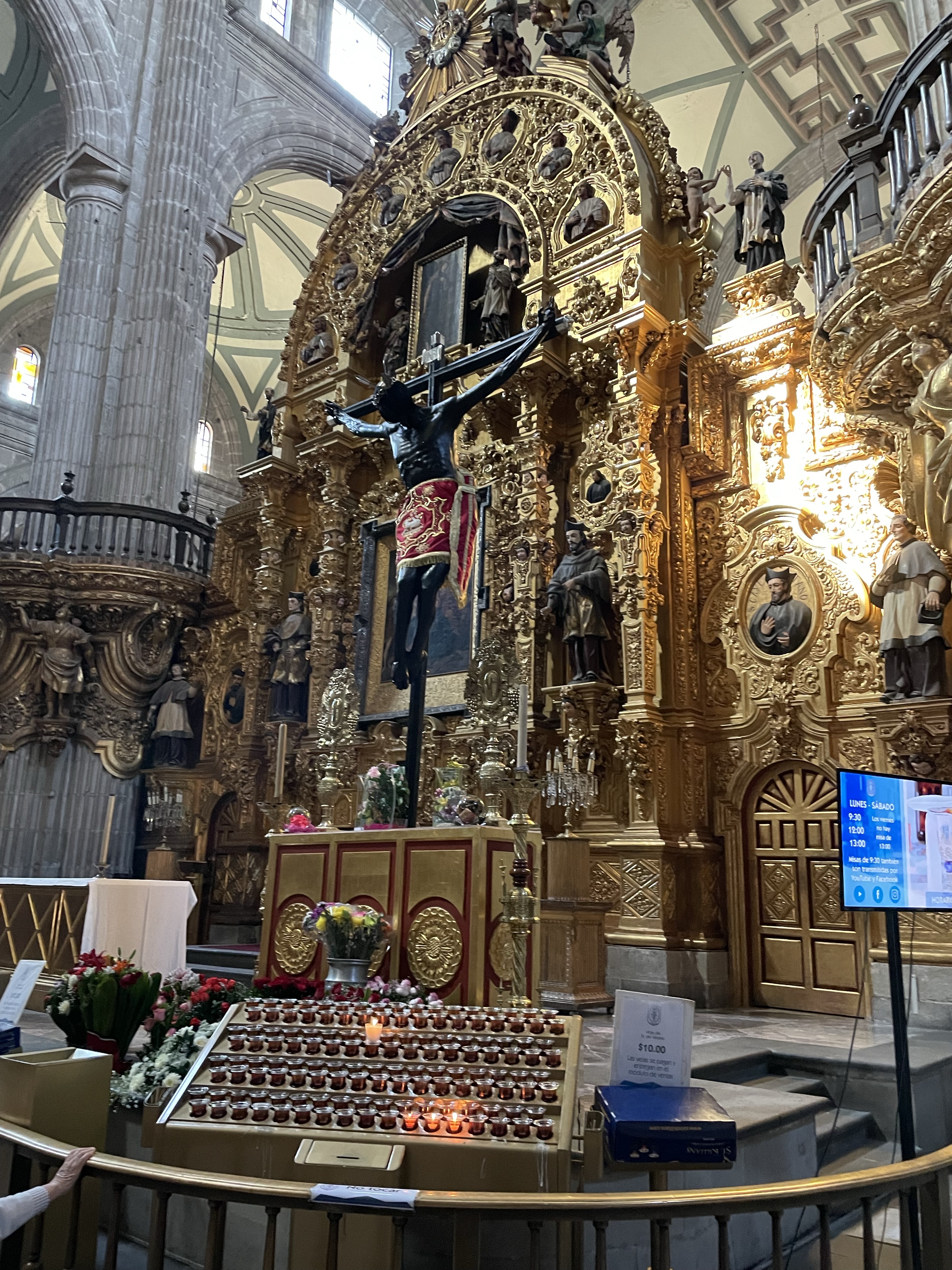
Cristo Negro/The Black Jesus

There were several facts about this Cathedral that make it special.  The first deals with the tradition of Black Jesus/Cristos Negros of the area.  There are several countries that have wooden Jesus sculptures on a cross that have darkened and turned black over the ages.  The one in Mexico City has a story.   Supposedly the bishop always prayed at the crucifix as he entered the cathedral.  There were those who wished him to die.  So they put poison on the feet of the wooden Jesus, knowing that the bishop would kiss the feet when he was done praying.

The bishop did as he always does, and kissed the feet, but he did not die.  Instead, the Jesus sculpture turned black. 

To be honest this is not my first Cristo Negro, or Black Christ/Jesus.  I have been to Portobelo, Panama, and saw the one in the Inglesia de San Felipe. It is special because it was found in the town’s harbor and it wears a robe!   I have also seen the black Madonna in Montserrat, also known as Our Lady of Montserrat. Many go on pilgrimages to see these statues.  For me they have been a happy surprise. (See blogs below.)

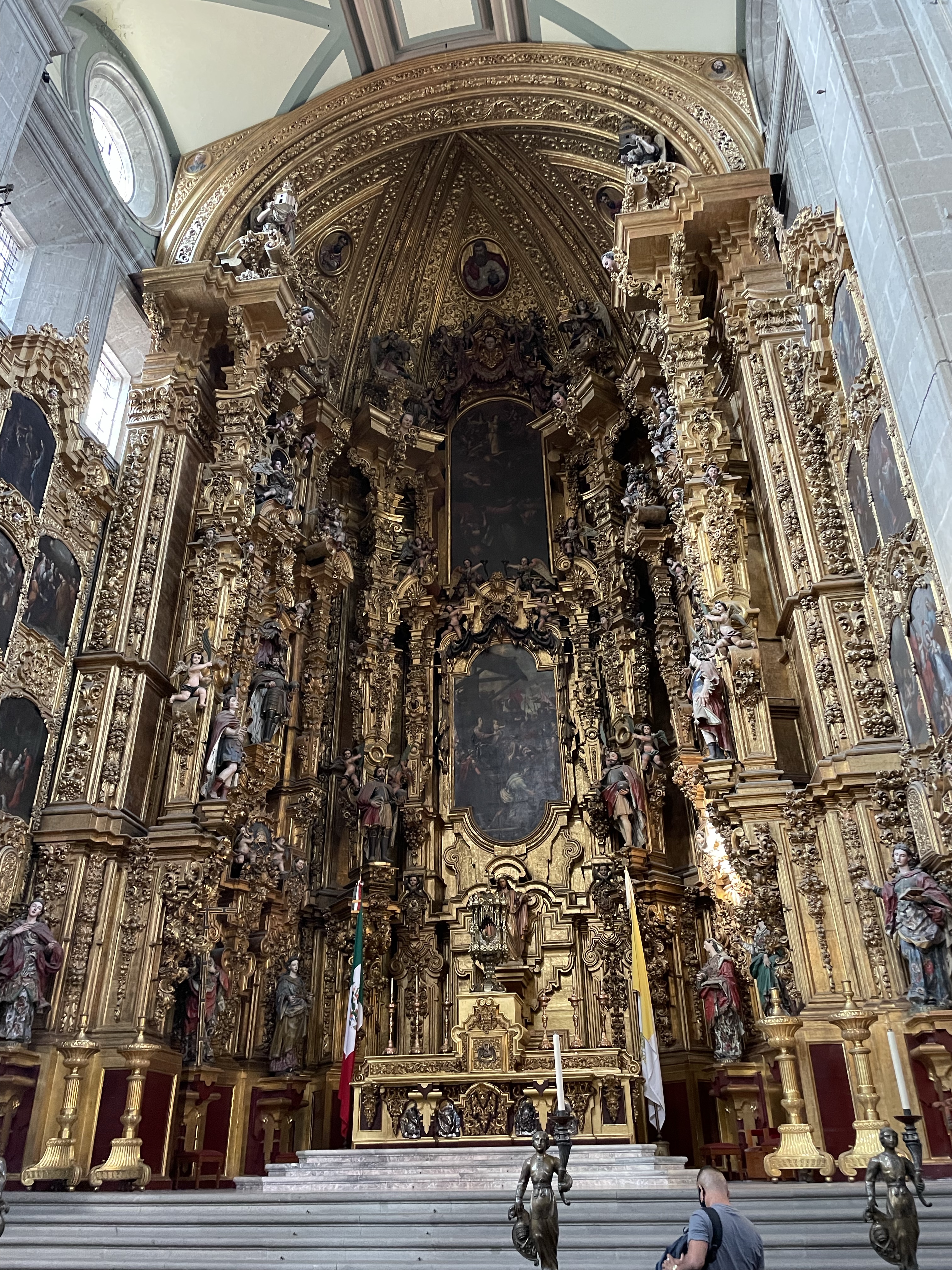
This is not the only special site within the cathedral.  There is also magnificent altar and intricately carved wooden sculpture behind it.  Outside, in front of the cathedral, there is a statue of Pope John Paul with an image of the Lady of Guadalupe carved into his robes.  This foreshadows the second religious site we visited.

Statute of the Pope.

But the most obvious and unusual aspect of the building is that it is sinking.  Completed in the mid 1600s, the cathedral was built on land that was once the bottom of a giant lake.  It was also built in the area where the Aztec’s had their temples. In fact, the stones used in the construction of the church were parts of the dismantled Aztec temple.  The cathedral was built upon the ruins.  One way of saying to the Aztec, we beat you.  But not so great centuries later.  

Around the cathedral you can see the excavations of the Aztec sites. A model of what the plaza area looked like when the Spanish first came is near the excavations.

Part of the excavation of the Aztec ruins.

 Within the church, you can see how they have worked to stabilize it.  Marble stone stairs, now sit on a bed of concrete stairs.  A pendulum hangs from the high ceiling and shows if the building is still standing straight or sinking again.  By the lines on the floor, one can see how tilted it once was, and how close to straight it stands now.

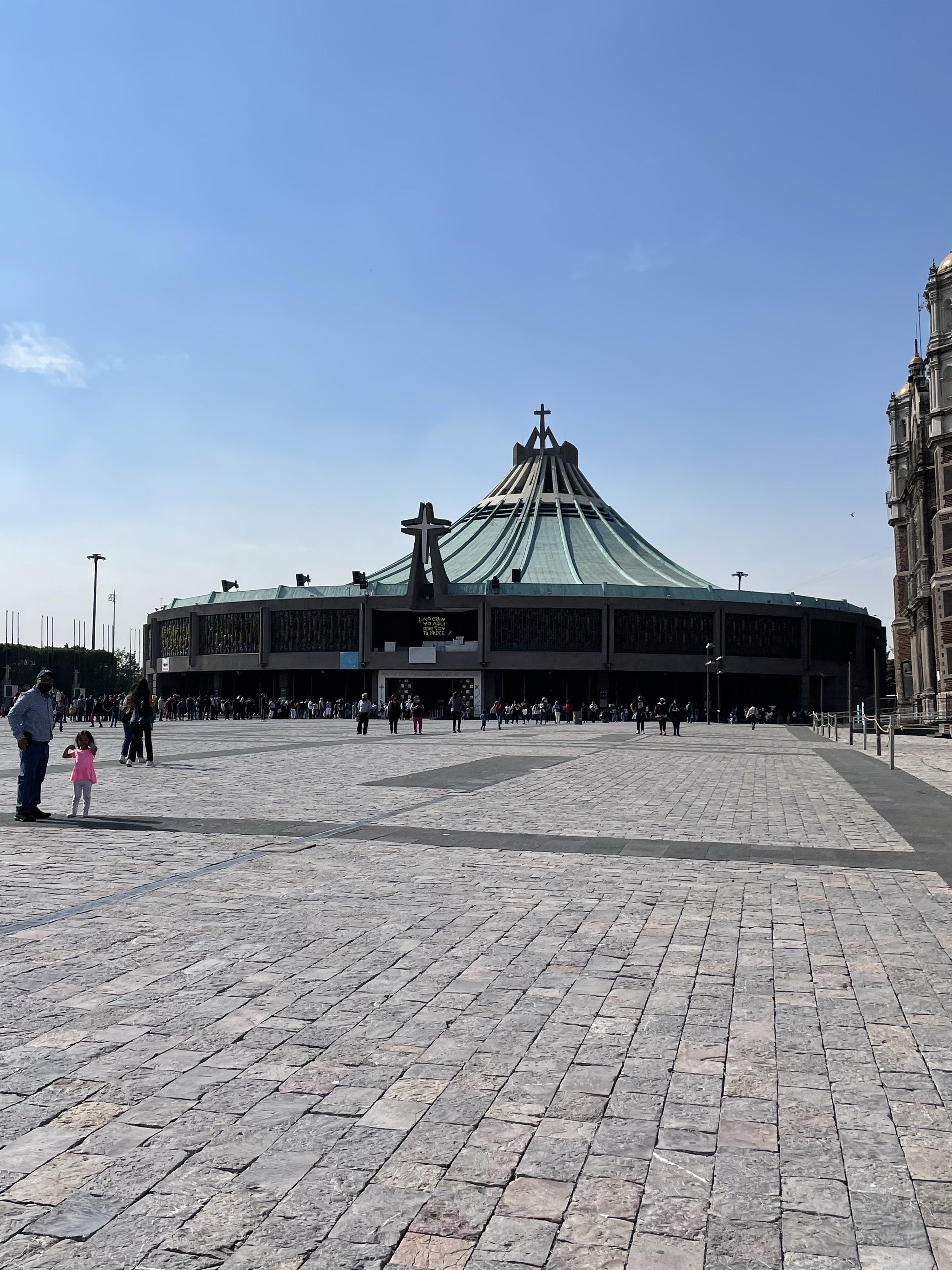
Our second religious site was the Basilica of the Lady of Guadalupe.   This site is also sinking, and many of the buildings, the older basilica, the first church and the convent, were also tilting.  They have been stabilized. But you can see that much work still needs to be done.  The newer, larger, round Basilica built in the 1970s seems fine for now.

The Basilica and all the other buildings on the site, including the original basilica from the early 1700s were constructed to honor Saint Juan Diego and his visions and miracles of the Lady of Guadalupe. Sometime around 1530 a picture of the Lady of Guadalupe/Mary appeared on his cloak, which he said was a signal that the indigenous people should convert to Catholicism.  There have been visitors/pilgrims to this site ever since. And many buildings have been constructed to provide a place for them to pray.

Today the new Basilica houses the image.  Encased in two frames, one silver and one gold, it is mounted on the wall near one entrance of the Basilica. You must get on a short moving walkway to see it, which keeps everyone moving forward and no one can stay in front of it for too long.  The Basilica is constantly being used by the people for Mass.  Each hour a new Mass begins. 

Statue of the Pope along side the old basilica.

There is a large open plaza on one side of the Basilica.  It is here that Pope John Paul came to  dedicate the site. A statue to him stands between the old and new basilicas.  He also came here a second time to canonize Juan Diego.

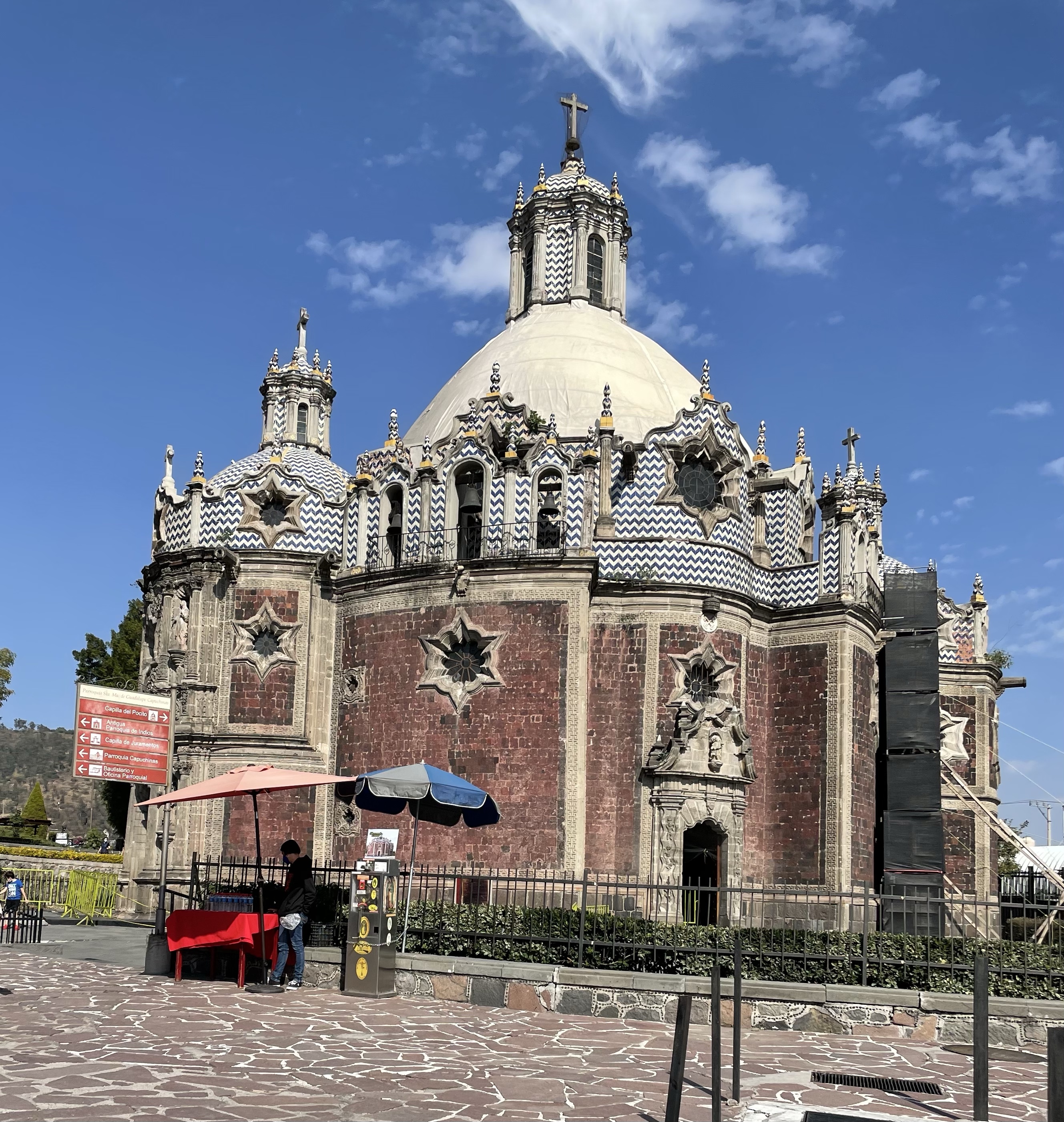
The temple of the well.

We could not enter all the buildings. But I will admit my favorite was the one that covers the well.  It was a lovely little building.  And each of the windows was in the shape of a six-pointed star.  For my Jewish mind it was perfect.  Miriam, the sister of Moses, was known for her affinity for water. When they were in the desert, water followed Miriam.  So to know that here at the site of the visions of the Lady of Guadalupe/Mary/Miriam, there is a well with a temple with six-pointed stars, gave me a little joy.

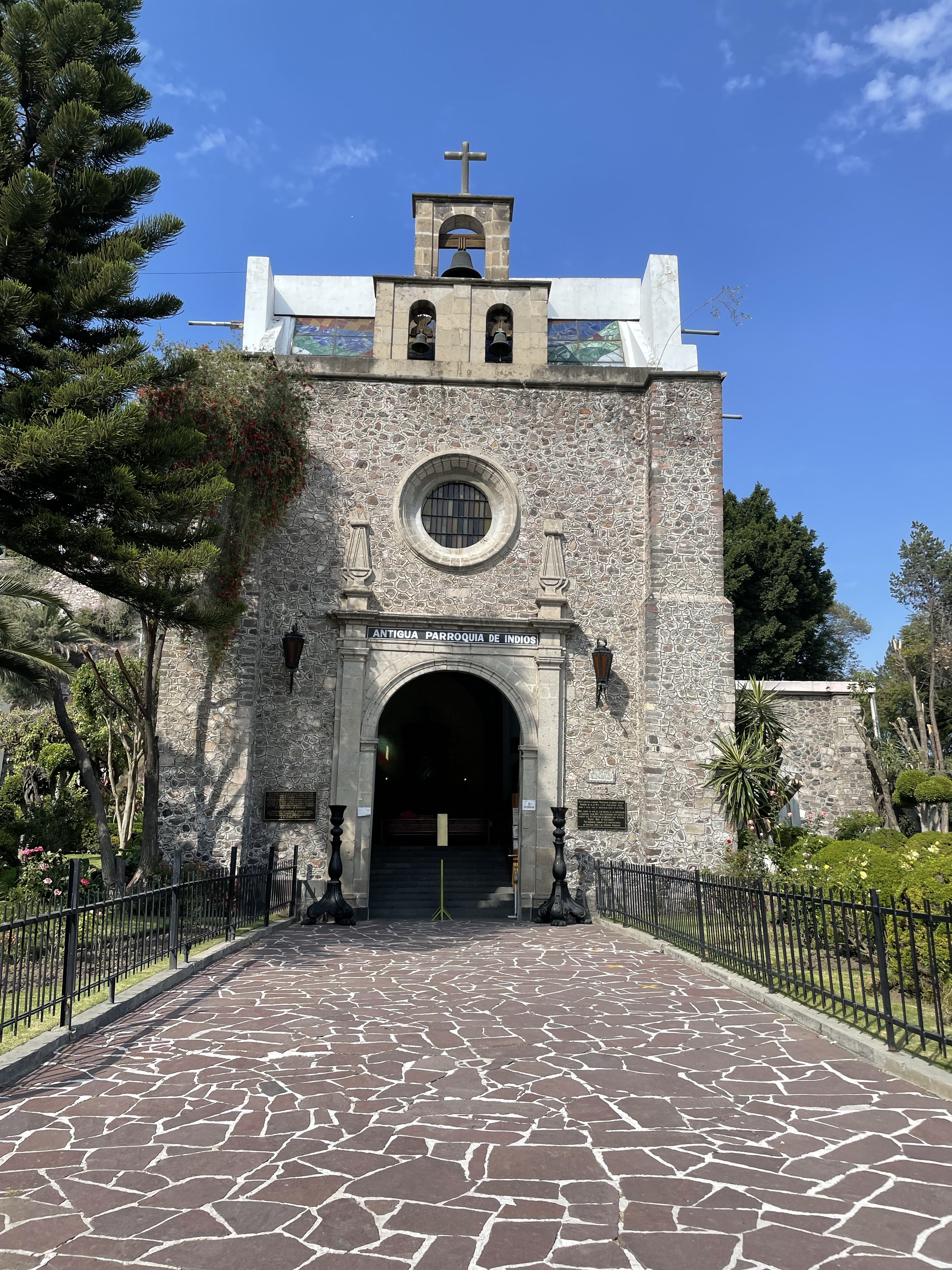
My second favorite building was a small church that is still standing, but only with the help of metal beams.  In front of it was a small water way, with no water right now, except for a bowl of water that a mama cat was enjoying while her kitten struggled to reach it.

It is quite a site, much larger than I anticipated.  To be honest, I did not want to go.  We had spent the morning visiting the Pyramids of the Sun and Moon, and I was both exhausted and not feeling well.  But our guide insisted that we had to see it.  As it was on our way back to the hotel, I figured I would say yes, but could always back out.

That did not happen.  I was hot, tired and feeling ill.  But I got out of the van and walked the many steps to the entrance of the site. And then for over an hour walked the grounds and through the buildings to see all that I could.  I was amazed that I started to feel better as we walked.  It was so interesting that I forgot to think about not feeling well.  So I have to commend our guide who insisted we visit.

Bosque de Chapultepec: Visiting Chapultepec Park

30 Nov

While we were in Mexico City, we stayed at a hotel that was located on Reforma, just a short half mile walk from the wonderous Bosque de Chapultepec.  We visited three important sites within the park, besides passing by many others and seeing all the activities enjoyed by park visitors.

rOur three main stops were: National Museum of Anthropology/Museo Nacional de Antropologia; The Chapultepec Castle: and Jardin Botanico del Bosque de Chapultepec/the botanical gardens.  We passed by the Ghandi Garden, the entrances to other sites like the Zoo and the History Museum; and walked through an open air market, where I purchased a straw hat.  We also ate in one of the restaurants within the park, El Lago Restaurante.

Honestly, we did not do these activities in one day.  The park is enormous with so much to see.  But I thought it is best to put it all together in one blog.

The first place anyone who goes to Mexico City must visit is the National Museum of Anthropology.  Besides its wonderful architecture, the museum galleries are filled with pre-Columbian masterpieces.  We had a tour guide who explained what we were seeing in English, which was extraordinarily helpful as almost all the signage is only in Spanish.

The building itself is built around a central courtyard with a large umbrella like structure providing shade. As you walk through the different galleries, you return to the center courtyard between areas.  I found that refreshing.  A way of clearing my mind before entering another new world.

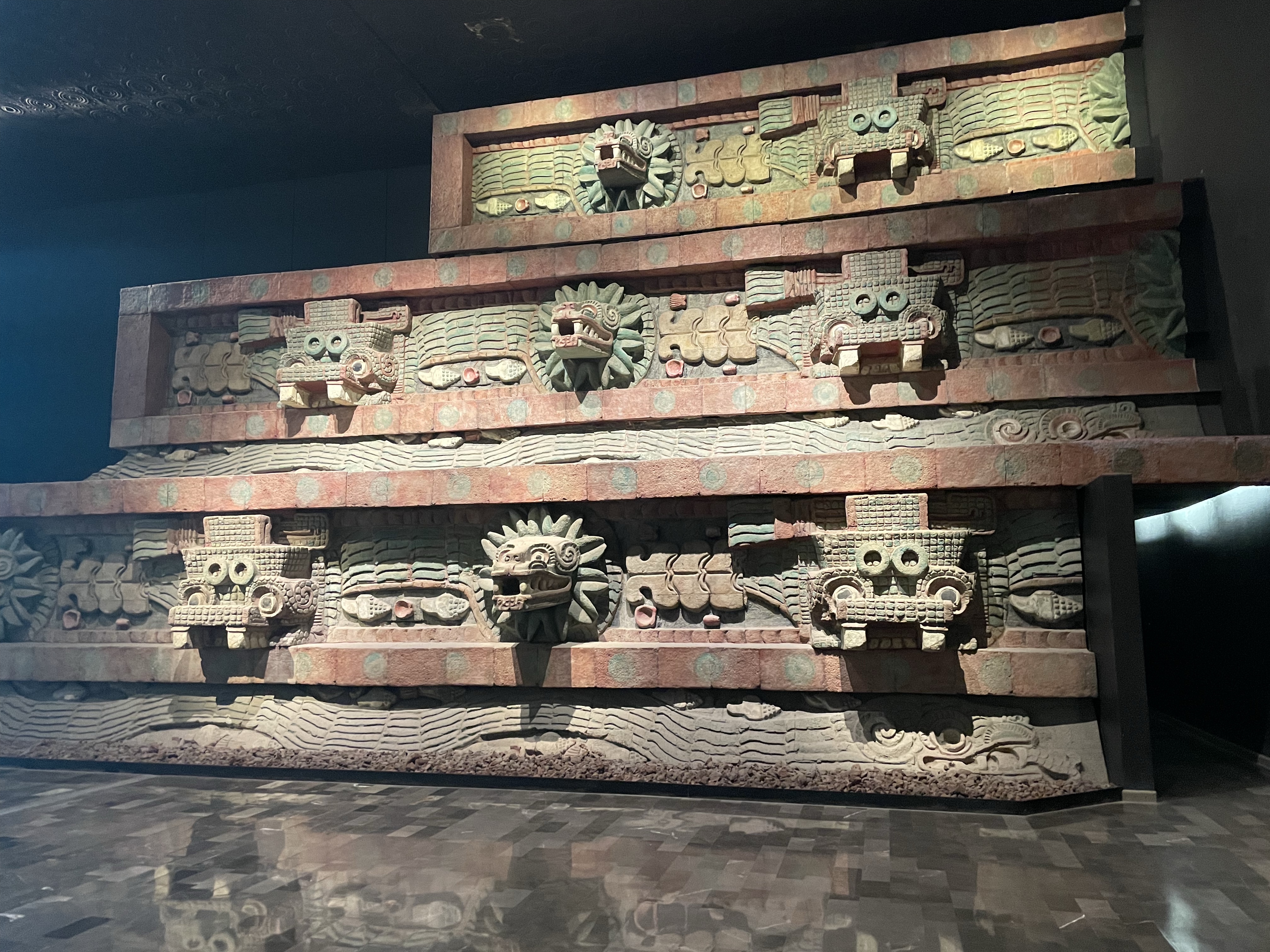
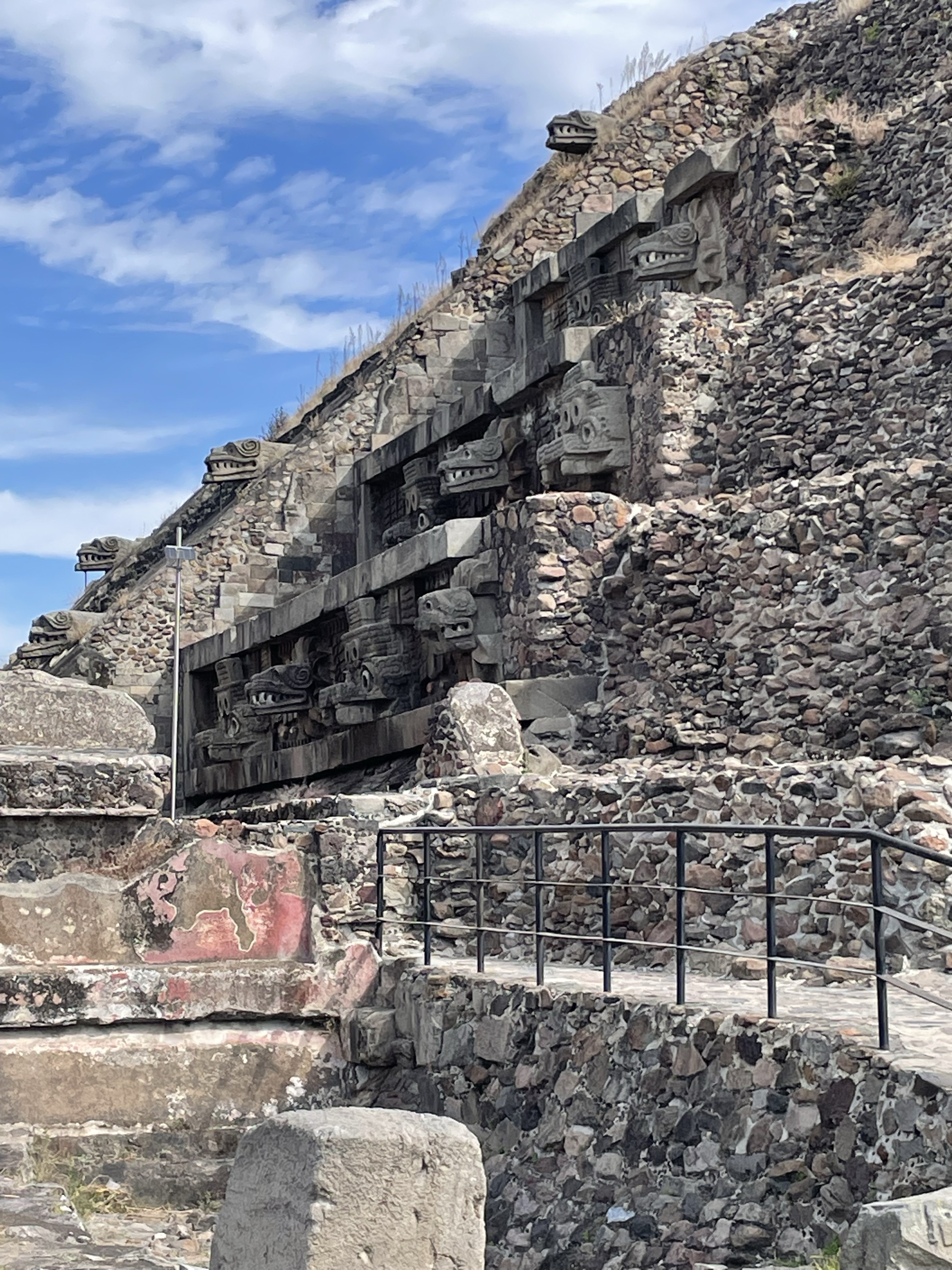
We learned about the Inca, Mayan, Aztec, Olmec  and other peoples who once lived in the various areas of Mexico.  I knew that human sacrifice was a large part of the religions.  Owever, I was shocked at the brutal and almost daily sacrifices.  The artwork of these groups, especially the Aztec, focused on skulls, dismemberment and death.  We learned about the Goddess of Rain and the God of the Sun and the feathered snakes that adorned many of the buildings.  The immense stone carvings were beautiful and many were so intricate, you wonder how they were made centuries ago without modern tools.

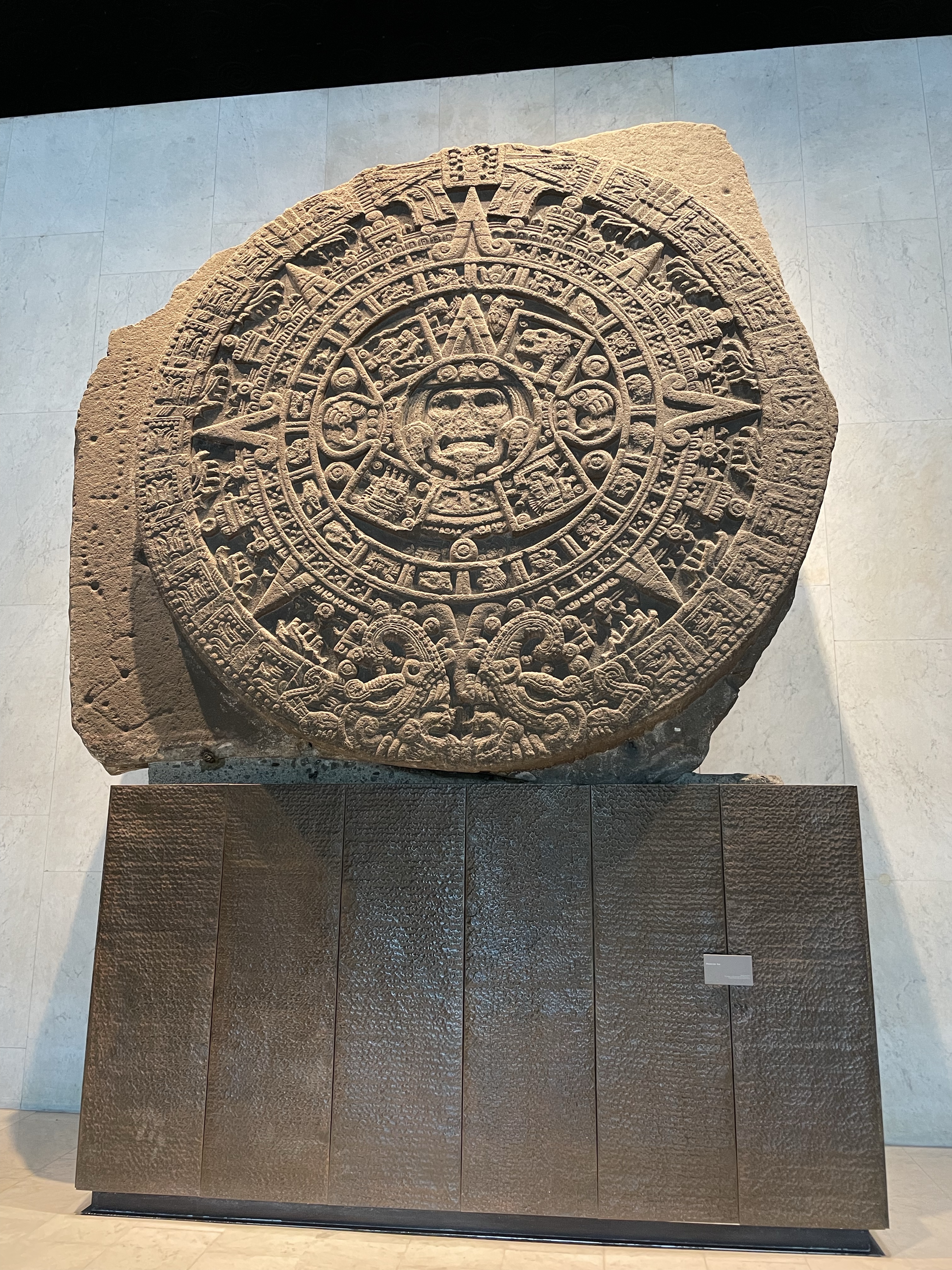
The original Aztec Sunstone is on display, as well as many other majestic and large works of art.  The Statute of Chaichiuhiticue,  and the Olmec stone heads were immense.  Each were carved from one block of stone.  I don’t know how they moved them!

I honestly cannot tell you what was the most interesting thing to see because there were so many!  I did like learning about the game they played with balls that had to go through a stone hoop. However, I was sad to learn that after each game, someone was sacrificed. 

We spent three hours visiting all the rooms of this museum.  I took many photos.  But in the last room, I was exhausted.  I knew I had had enough because I did not take one photo.  I was mentally done.  There is just so much to see.  It is a museum you could visit again and again and still see and learn about things you missed on an earlier visit.

Needless to say, we left the museum exhausted and ready to eat lunch.  We knew we would be back to the park!

We returned the following evening for a dinner at El Lago Restaurant.  It is situated by one of the lakes in the park and is just lovely.  The food is delicious as well.  But the main reason I am mentioning it, is that while we ate, a young man asked his girlfriend to marry him!  It was quite exciting and everyone cheered when she said yes!  It added an extra bit of charm to an already charming trip.

With the park so close to our hotel, we knew that we would be walking back another day.  We chose the morning after we took our Covid tests to make sure we could return to the USA.  Even though we knew we did not feel sick in any way, having to wait several hours for the results would have made me anxious if I just sat around.  We started walking to the park.  Our first planned stop was the botanical gardens.  This one was filled mainly with succulents and orchids, two of my favorite plantsWe walked around the gardens enjoying the quiet.  We ended with walk through the orchid house and enjoying the many succulents planted in cement cinder blocks!  I want to do that in my garden.

Chapultepec Park is considered the lungs of Mexico City.  The acres upon acres of trees supplies the valley with clean air, which is important, because there is pollution in the valley that encompasses Mexico City.

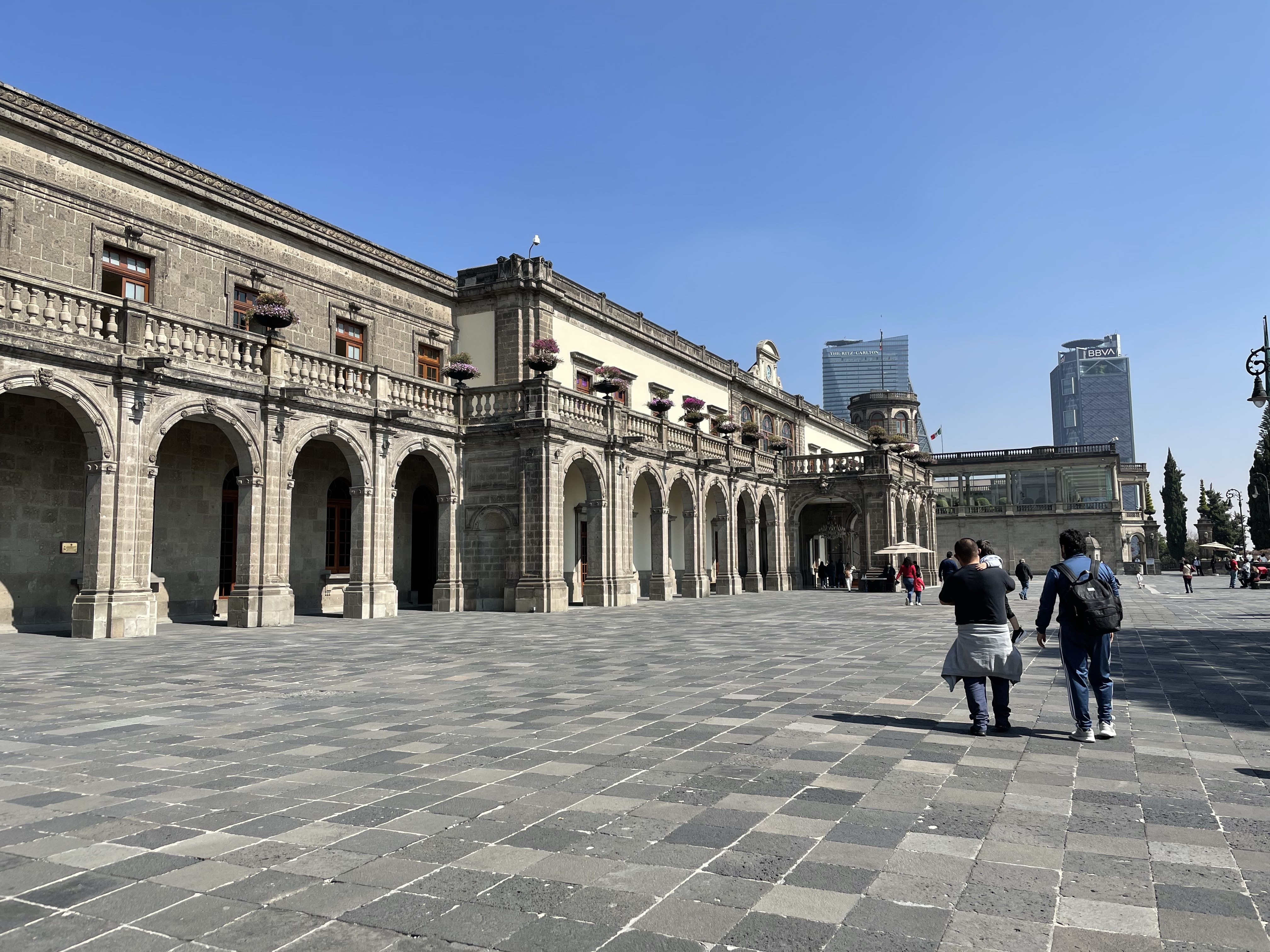
After we left the gardens we continued walking through the park towwards the hill where the Capultepec Castle sits. The first building of the castle began in 1795 as a summer home for the viceroy.  Eventually it was enlarged and became the home of Emperor Maximillian and his family.  Maximilian did not survive for long in Mexico.  He became Emperor in 1864 and was executed in 1867. The unfortunate thing is that Maximillian seemed to care about the people of Mexico.  But it did not save him from execution.  

The Castle then became the home of the President of Mexico and continued as the Presidential residence until 1939.  Now it is a museum. It does cost 85 pesos to enter.  I did not have that much cash, and they do not take credit cards.  However, if you are over 60, which my husband and I definitely are, you can enter for free!  The cashier said,  “Are you over 60?”  I said yes.  She said go in for you it is free.  Thank you Mexico!!  It would have been so sad not to have seen this building and its gardens!

You do have to walk up the hill.  But the slope is easy to climb.  However, I will say with the altitude of 7500 feet in Mexico City, I am glad I waited for the third day to make that climb!  We walked slowly.  You can take a bottle of water to go up the hill.  But once you get to the entrance of the Castle grounds, you cannot bring it in with you.

To describe the building, all you need to do is think about Vienna and St. Petersburg.  Maximillian was a member of the Habsburg family.  So, of course, his home reflected the elegance and grandeur that a member of that family needed/demanded.  It was a bit offsetting to see the grand carved furniture of Europe throughout the areas of the home.  But it was beautiful.  A major difference from a European home, is that each of the rooms could be entered from the interior of the house, but they also had large doors that opened to the outside.  To see the mansion, we walked along the perimeter of the home and looked into the rooms through opened doors.

The view of the park and the city from the top of the mountain is wonderful.  Even better was going all the way to the top and visiting the gardens on the roof and seeing the view from there.

Another added bonus to our visit to the park was finding a parade was in progress on Reforma!  It was Revolution Day in Mexico.  We spent almost an hour watching the music, the floats, the marchers in colorful outfits denoting their province of Mexico, before we discovered the underground walkway that enabled us to return to our hotel.

Visiting Chapultepec Park is a must.  We only saw a few of the many interesting museums and sites to see there.  Honestly, you could spend a week just visiting Chapultepec Park!

https://www.wmf.org/project/chapultepec-park

https://en.wikipedia.org/wiki/Chapultepec

https://en.wikipedia.org/wiki/Chapultepec_Castle

https://en.wikipedia.org/wiki/National_Museum_of_Anthropology_(Mexico)

https://en.wikipedia.org/wiki/Maximilian_I_of_Mexico

The Pyramids of the Sun and the Moon: A journey to Teotihuacan

28 Nov

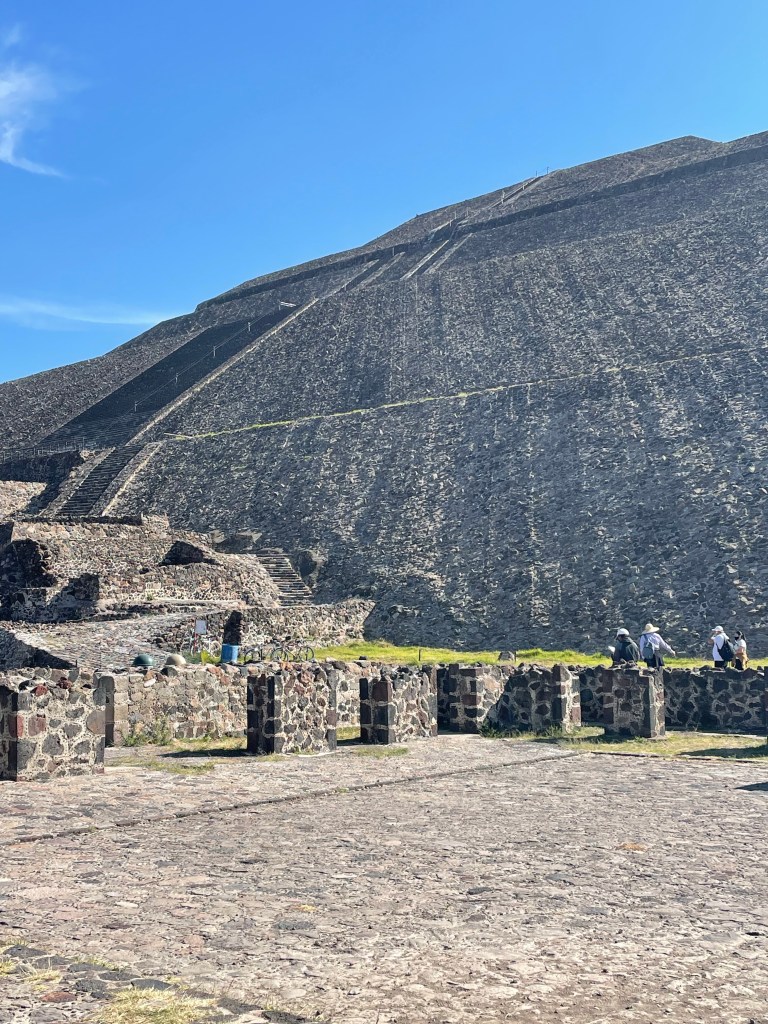
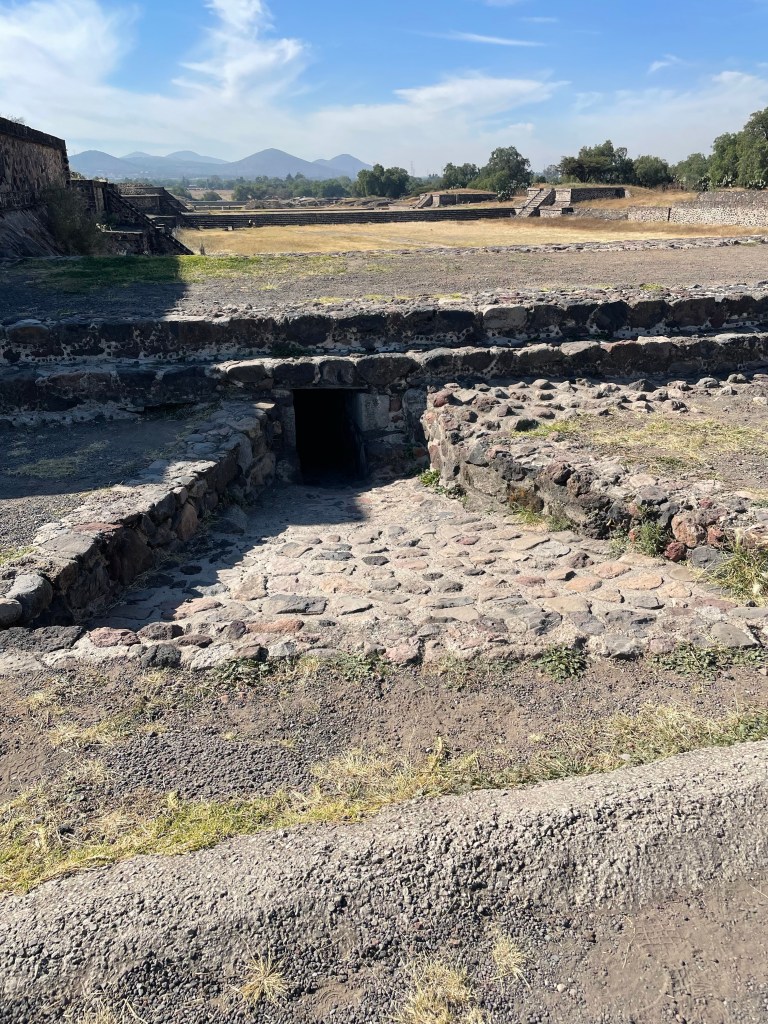
Wow.  My husband and I spent over three hours exploring the Teotihuacan site of the Pyramids of the Sun and the Moon and many, many other buildings, temples, and vast plazas.

It was incredible that such an intricate community was built in the early third century, around 200 AD. 

Nearly 2000 years later, the site is still spectacular.  I can only imagine what it looked like to the eyes of people so many years ago.  The wonder and disbelief to what was built had to be awe inspiring and truly a monument to the gods.

For me it was the completion of another item on my list of places that I needed to see in my life time. And it was well worth the journey from Mexico City to Teotihuacan. My husband and his family went to Mexico City in December 1978. He climbed the Pyramid of the Sun. It was on that trip that he realized he missed me. When we saw each other back at Missou, he proposed. I rally needed to see this site!!

When at first you see the Temple rising from the fields as you drive along the highway, I really could not image the massive height of these temples.  Even up close I was stunned.  And it is not just the temples. It is the entire complex of buildings, homes, and plazas.  Each plaza has its own temples and homes. 

The drainage system to keep the clean water from flooding and the waste water from combining with the fresh water was great.  We could see where the rainwater would travel continually downhill till eventually it reached the river.  Keeping the two waters separated made using the fresh water easy.  However, when they reached the river, they combined.  (The river, unfortunately, is quite polluted and smelly!!)

The welcoming plaza with its temples to other religions was grand.  I could imagine myself walking there and being mesmerized by the central temple to the gods surrounded by the many temples of the visiting travelers. Each plaza is so large.  Closing my eyes, I tried to imagine each one filled with worshippers on holy days.  We learned that they believe the priests would meet together before each mass gathering so that they would preach the same information to all the worshippers.   Good planning.

A pyramid’s original decoration rediscovered.

But really nothing can prepare you for the size of the Pyramid of the Sun reaching up to the sky. And also the Pyramid of the Moon strategically placed in front of a mountain that makes its size seem even more gigantic.  Someone had a great eye for drama.  The Pyramid of the Moon demonstrates that drama.

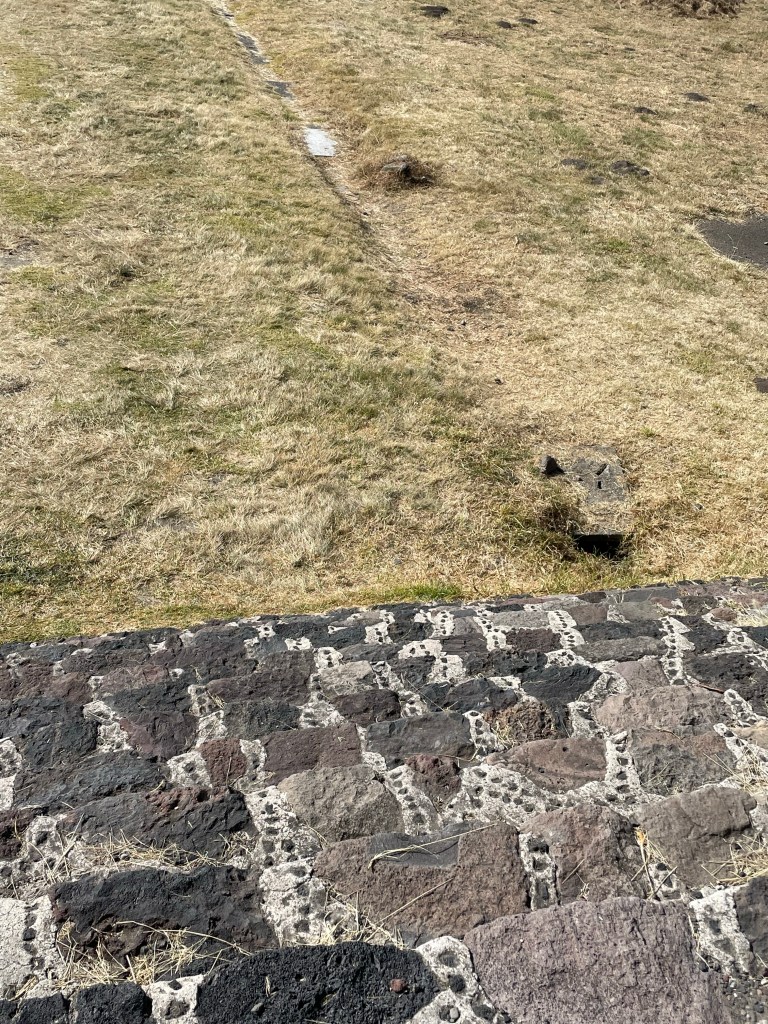
Originally these brick and stone monuments were covered with stucco and painted. There are a few areas where the art and color still remain.  It was interesting to have a local man show us how the colors came from the plants to paint the stucco.  That truly surprised me. But the mural of the puma lets you envision how the entire plateau once looked.

We did not just stay in the large plaza dedicated to the Sun and the Moon. We walked the entire two kilometer site. Climbing up and down the steep stairs to get to yet another plaza.  To be honest it made me think of the song that goes, “the bear went over the mountain to see what he could see. HE saw another mountain.”  For us we climbed over another stairway to see another plaza to see another stairway to walk through to another plaza.  I kept saying to my husband, I think this is the last one.  And it was not.  Till it was.  But honestly, this seemingly endless trek through plazas and up and down steep stair cases was amazing, and worth the trip!

https://en.wikipedia.org/wiki/Pyramid_of_the_Sun

My Grandfather’s Mysterious Family is Slowly Unveiling

3 Nov

I recently wrote a blog about my Grandfather’s sister Celia.  In it I call her my grandfather’s younger sister.  That might or might not be true.  Her date of birth ranges from 1890 to 1895.  She could be a year older or perhaps four years younger.  But then my Grandfather’s birth dates range as well from 1890 to 1892.  Who knows?  What I do know is that keeping records was not that easy in the late 19th and early 20th centuries.

That blog brought a response from Amy, one of my friends, who I met through Tracing the Tribe.  She recommended that I go to Family Search, part of the Mormon genealogy sites to try to find my great aunt Celia’s death certificate. 

Although I have used JewishGen and Ancestory, I never used Family Search on my own before. It was wonderful. Although I already had my Great Aunt’s, death certificate, someone had found it for me, I did not have a photo of her head stone. Family Search had it! Celia’s Hebrew name is Tzipa Gittal. (Thank you to Robin of Tracing the Tribe for figuring out the first name for me.) Like those of many who die young, the stone is in the shape of a tree cut down. There are palm leaves engrave on it along with the words, Beloved Daughter and in big letters SISTER. (I plan to put this photo on the other post as well!)

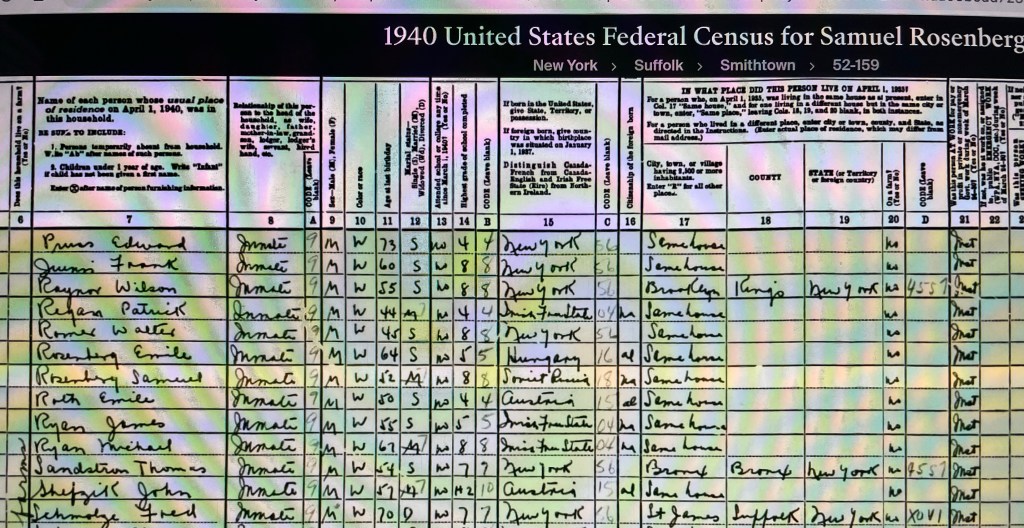
I found my grandfather’s family on the 1910, 1915, 1920 and 1925 Census.  In the 1915 Census, the last name was misspelt as Rosenbery.  In the 1920 Census, I found out that my great grandparents had divorce before then.  I knew that they were divorced, but somehow knowing they divorced before Celia died made me a little sad.   In the 1925 Census only five of her children were still living with Sarah.  Samuel disappeared after the 1915 Census, Celia died before the 1920 one, and my Grandfather married before the 1925 Census.  All four daughters: Bertha, Edith, Hattie and Minnie, who in this Census was renamed Muriel, were stenographers.  Jacob was already a lawyer.  (See blog below.)

Finding success with Celia, I decided to look for more information on my grandfather’s other missing sister, Minnie/Muriel. I found her as well. She also has a number of birth years ranging from 1904 to 1910. On the census from 1910, 1915, 1920 and 1925, it was either 1904 or 1906. But then I found her marriage license, there she is listed as being born in 1910. It makes sense, even with using 1910 as her birth year, she was still two years older than her husband. In reality, she was about 5 or 6 years older.

Muriel got married May 26, 1934, to a man named Harry Moskowitz in Kings, New York.   She and her husband had four children, three boys and one girl.  Since some of them are still alive, I will not name them.  Muriel died in the New York City area in January 1991.  That actually made me sad.  It means that my Grandfather did not live far from his sister, but he had no contact with her.  Why?  I honestly wish I know the answer!

He did have one sister who he did stay in contact with and whom I knew, Aunt Hattie and Uncle Lenny.  I wrote about them in the blog below.  I also found their marriage license. Besides seeing several birth years for her, 1901 to 1903, I found out that her legal name was not Hattie, even though that is what everyone called her.  On. December 16, 1934, Ethel H. Rosenberg marred Levert Greenberg, the son of Joseph and Rebecca (Schneider).  Uncle Lenny served in WW 2.  They never had any children.  But I remember them fondly.  Although over the years, Aunt Hattie made my Dad crazy at times.

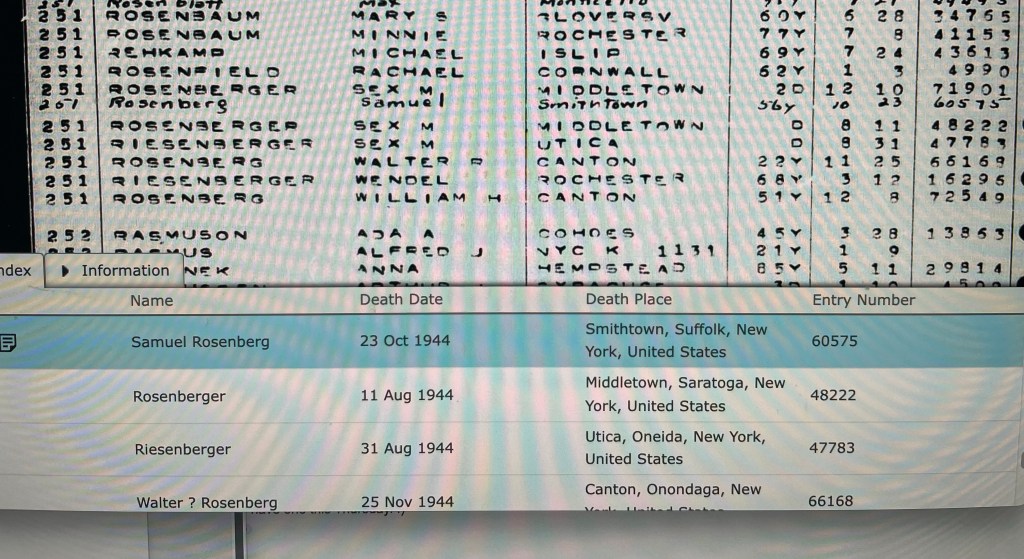
Using Family Search was easy and helpful.  I am glad Amy suggested that I use it.  I do not know why I have never used it before now.  However, I know that I will continue to use it as I double my efforts to find Samuel, as he is the only sibling I have been unable to find.

Did Great Aunt Celia Die From the Spanish Flu?

31 Oct

With the Covid pandemic in its second year, I decided to write about my Grandfather’s younger sister who died over 101 years ago.

As I have written in other blogs, much about my paternal grandfather’s family was a mystery.  My Grandmother told me that my Grandfather was the oldest of 6 children, I now know that his mother actually gave birth to 11 children. I now also know that eight siblings that survived to adulthood and that my Grandfather was the second oldest of these eight.  

I know a bit about his one brother (See blog below) and I actually knew one of his five sisters.  (see blog below.) Three sisters and brother I know their names and perhaps some information, but it nothing definite.  I know Muriel married and had two children.  And I know there were two ‘maiden’ aunts.   I know Samuel supposedly went west in the early 1900’s.  But there was one sister that I had absolutely no information about his younger sister Celia.  I did not even have her name, as Celia died before my grandparents became engaged and married.

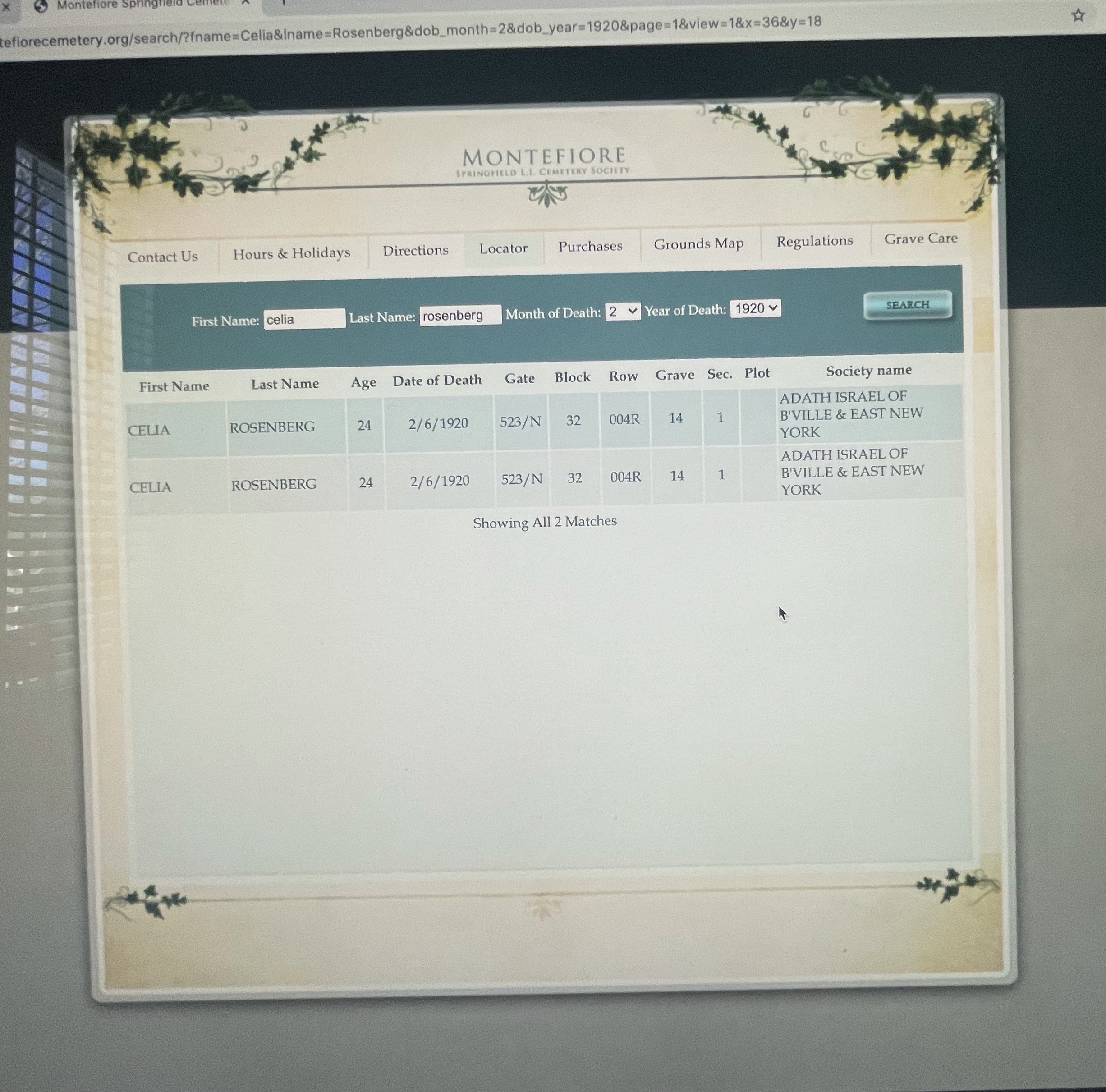
But now I know Celia.  Born on the Fourth of July in 1895, Celia was five years younger than my grandfather.   But whereas my grandfather lived until he was 95, Celia died when she was just 24 years old on February 6, 1920, from pulmonary edema and pneumonia, which was a major cause of death from the Spanish Flu.

According to Wikipedia, the Spanish Flu continued from February 1918 to April of 1920.  And the CDC website that discusses the Spanish flu has this information: 

“The 1918 influenza pandemic was the most severe pandemic in recent history. It was caused by an H1N1 virus with genes of avian origin. Although there is not universal consensus regarding where the virus originated, it spread worldwide during 1918-1919.  In the United States, it was first identified in military personnel in spring 1918.

It is estimated that about 500 million people or one-third of the world’s population became infected with this virus. The number of deaths was estimated to be at least 50 million worldwide with about 675,000 occurring in the United States. Mortality was high in people younger than 5 years old, 20-40 years old, and 65 years and older. The high mortality in healthy people, including those in the 20-40 year age group, was a unique feature of this pandemic.”  (The bold high lights are mine.)

By the winter of 1920, the Spanish flu had begun to ebb.  But people were still dying.  One of the symptoms was lungs filling with fluid, pulmonary edema, which killed them.   Was Celia one of the victims of this pandemic?  I might never know, but with the Covid pandemic on my mind, I cannot help but think it was the Spanish Flu that killed my great aunt Celia.  Sadly, a few months after she died the pandemic was officially over. 

Celia is buried in the old Montefiore Cemetery in New York.  She is in the Adath Israel of B’ville section.  I do not think any other members of our family are buried there, or at least any that I have found so far.   Most are buried in Washington Cemetery.  The fact that she is there alone saddens me.

I have not been able to find a picture of her grave online. But I do have the information needed to find it.  I hope one day that I will.  In the meantime, I wonder if my Great Aunt Celia was one of the millions of people who died during the Spanish Flu.  In my heart the answer is yes.

Update: I now have Celia’s Headstone. See the additional Blog for more information.

https://www.cdc.gov/flu/pandemic-resources/1918-commemoration/1918-pandemic-history.htm

Wonderful Wisconsin Weekend

27 Oct

In May friends of ours drove from Wisconsin to Kansas for a long weekend visit.  While they were here, we promised to return the favor and spend a weekend with them in October.  We try to keep our promises, so we got into our car and drove the 8 hours to see them. A wonderful weekend in Wisconsin ensued.

We packed a lot into our short time there.  First stop was the International Crane Foundation and its Cranes of the World exhibit in Baraboo, Wisconsin.  I had no idea that most types of cranes are found in Asia.  But now I know. We saw 15 varieties of cranes in areas designed to match their natural habitat.  Each setting had a small pond and marsh area. 

The cranes range in size from majestic to small.  A pair of cranes were housed in each site that were accessible on a lovely pathway.  Besides the area devoted to the cranes, there were also walking nature paths through a meadow planted with native plants and grasses that attracts butterflies and birds.

We spent two hours enjoying the nice weather, the lovely cranes and the other sites like the Zen Garden and the Prayer Wheels.  My favorite was the Senbazuru sculpture of 1000 colorful cranes made to look like origami cranes.  I am glad we went when we did, as the Center is open only from May 1 through October 31.  I encourage anyone who can to visit it next year!

After a stop for lunch, we continued our journey of discovery by visiting artists who were part of the Fall Art Tour.  We visited four artists who were located in either Baraboo or Spring Green, Wisconsin.  I wish we could have visited every one of the two dozen artists, but that was impossible.  However, I will say that my friend and I did as much as we could to support the artists we did visit.

We love botanical gardens and try to visit one wherever we go.   Thus, next on our list of places to go was the Olbrich Botanical Gardens in Madison, Wisconsin.  LOVELY.  I was impressed by the Thai Pavilion and garden.  As we walked throughout the gardens, there was beautiful greenery and flowers everywhere and having a river run through it added to the serene scenery and wonderful atmosphere. 

A walk through the giant green house, known as the Bolz Conservatiory, provided us with a view of wonderful tropical plants including a large variety of orchids, and an not-yet blooming corpse plant, was exciting.  When we entered the greenhouse, there were volunteers offering us a free plant, that we could put into a pot to take away.  Of course my friend and I each needed a plant.

When I say large, I mean large.  The Bolz Conservatory is 100 feet by 100 feet by 50 feet high.  Photos do not do it justice.  It holds almost 500 plants!

Another favorite for us when we join our friends is to taste wine. In fact, when they visited us in May we took them to a wine tasting at our arboretum, combining two enjoyable events in one.  They took us to a winery on the same day as the botanical gardens, so that counts!

We went to Drumlin Ridge Winery in Waunakee, Wisconsin.  There each of us could order a flight of 3 or 6 wines to taste along with a small plate of food.  We each chose three wines.  I like whites and rose, so I tasted the Edelweiss 2019, Drumlin Sunset and Marechal Foch Rose.  The Edelwiess was my favorite and second was the Marechal Foch Rose.  We ordered mixed nuts and pizza and a cheese board for them, while I had a soft Bavarian Pretzel.   Yes, I know pretzels really go with beer, but for me a soft pretzel goes with everything.  And I did snack on some nuts….especially the cashews.

Our final stop was the University of Wisconsin Campus for a snack while we sat along the lake front.  It was a quick and exciting three-night visit.  But I think we saw some of the wonderful highlights to be seen in the Madison/Middleton area of Wisconsin during our wonderful Wisconsin weekend.

Saving Cranes and the Places Where Cranes Dance

http://www.olbrich.org/visit/

https://www.drumlinridgewinery.com/

Tsundoku, My New Favorite Word

14 Sep

A teacher at my school sent me an email today using the word tsundoku to describe his reading habits.   It was a Japanese word I did not know nor heard before.  Which for me is unusual as I have had an affinity for Japanese words since my days in graduate school as the roommate to a Japanese exchange student.  (See blogs below.)

Of course, I had to look it up.  According to the Cambridge Dictionary tsundoku is “the practice of buying alot of books and keeping them in a pile because you intend to read them but have not done so yet; also used to refer to the pile itself.”

WOW.  How did the dictionary editors know about my secret?  Wait how do the Japanese know what I am doing?  I thought it was well hidden.  However, although I have those piles, I do eventually get around to reading all of the books piled on shelves and in a queue in my I Pad library.   I promise!!!

I will also admit that after getting onto BookBub, my online Tsundoku has increased.  Many days I just delete the email from BookBub to avoid adding more books to my online tsundoku collection.   I will also admit that sometimes I forget which books I have purchased, till I try to buy them again. Luckily Amazon sends me a note saying, you already own this book.  Thankfully they keep track.  When I cleaned out my house, I found several books I owned in duplicate and triplicate!

I have a book issue.   I thought I had released this when we moved 18 months ago.  I gave away thousands of books.  Not an exaggeration.   I really did.  (See blogs below.) I only moved about 1500 books to the new house.  I ended up purchasing four new bookcases, because the new house does not have built in bookcases.  So I took a deep breathe and told myself that my book buying days needed to end.  I made a promise to myself to go more frequently to the library and to stop buying as many books.  I could do this!!

But you all know, the libraries were closed for a long time.  And my so-called friend told me about BookBub.  She actually sent me an email telling me about it.  Putting in my face. That sometimes you could even get books for FREE!  Yes, you can!  And books for $1.99, $2.99, $4.99, and so on.  And if you like one of the free books, you can be drawn into a series and then need to pay to find out what happened.  Thanks friend!!!  You know who you are.

I do need to go to the library and not to Costco, where, when I am grocery shopping, I need to go past the tables filled with books. I inch around snooping at what is there.  Sometimes, I take a picture of the book.  I don’t buy it then.  I think if I come back next week and it is still there, I will get it.  But sometimes that does not work, I slowly walk around the store and return to the book table.  The book jumps into my cart by itself. I don’t notice till I go to checkout. And there it is still calling my name to join my tsundoku pile.

I have to be honest, now knowing the name of my syndrome, I feel much better.  But most of all, I can relate to the many others who share this same compulsion.  I always knew I was a bibliophile.  My love of books is well known.  For goodness sake, I was an English literature major in college. How much more booky can you be, unless of course a librarian.  I know them as well.  Some of my good friends and even relatives are librarians.  I just realized that they live a life surrounded by tsundoku piles. All those books to read piled up around them, calling them.  How do they get anything done?  I guess I need to ponder that as well.

Tsundoku is definitely my new favorite word.

How a Shoe Store became a Jewlery Store

8 Sep

Growing up in the New York City metro area, one thing I will say, we had connections.  The majority of my extended family lived in New York and New Jersey.  Family get togethers were important.  Besides that, our summers in the Catskills with my cousins made us extremely close.

So of course engagements, weddings, bar and bat mitzvahs and the arrival of babies were always celebrated.   This continues today as well into the next generations.  But when I was a teen and young adult growing up, everyone lived within a short distance of each other.

When we needed new shoes, we did not go to just any shoe store.  No, we drove from North Bergen or West New York, New Jersey, to Yonkers, New York, to get our shoes.  Why?  There were lots of shoe stores near by.  But my Uncle Jack was the manager of a shoe store in Yonkers.  So, of course, that is where we went for our new school shoes each year.   If ever we had a shoe problem, or issue, we knew to stand up and see where our toes ended in relationship to the edge of the shoe.  I have written about my Dad’s fixation on healthy feet. And wearing good shoes was part of this. (See blog below.)

My Uncle Jack had other connections.  One of his best friends, also named Jack, was a jeweler.  I asked my cousin if he was related to them.  But No, Uncle Jack and Jack A. met at the Sephardic synagogue they went to in NYC.   Uncle Jack lived in Israel as a child and teen.  ( I wrote about his mother, my grandma Rose, and her experiences during the siege of Jerusalem in 1948, see the blog below.)  

So why a shoe store and a jeweler and family gatherings all in one story?  Because in 1979 I got engaged to a nice Midwest boy who wanted to buy me a diamond engagement ring. I was shocked.  He wanted to go to a store and buy it retail?  Who heard of such a thing?  Not when my family was involved.

To be honest, I do not remember exactly what happened.  All I know is that we were in town for my brother’s wedding.  It was nine months after we got engaged, but I still did not have my engagement ring.  We were waiting until we went to see my family.  Finally, a meeting was set up.  My husband, then fiancé, thought we were going to go to a wholesale jewelry store in Manhattan.  But that is not what happened.  He was a bit shocked.

My parents drove my husband and I to the shoe store in Yonkers. My then 24-year-old fiancé asked, “We are getting your ring in a shoe store?” I just nodded my head yes. My father said something like, “Don’t worry, it’s fine.”

When we got to the store, my Uncle was waiting for us, and led us to the back of the store.  Mom stayed in front to shop!  Next thing I know is that Dad, my fiancé and I are in the shoe storage racks in the back of the store.  Jay was a bit shy about entering the back stacks, but as we were all going, he went along. It was here that we met with Jack, the jeweler!

When we were situated where no one was coming, way in the back, Jack, the jeweler, opens the shoe box he was carrying.  Inside were five or six diamond rings, all about one karat, all different shape diamonds.  I tried several on and finally decided on the ring I wanted.  A check was written.  We were given an appraisal, but Jack was firm about us getting an appraisal from another jeweler as well.     If there was any problem, we were to let him know.

We left the stacks.  I was now wearing my engagement ring.    Jack the jeweler stayed behind.  My Uncle went in to say goodbye to his friend, who left through the back entrance.  Quite the covert mission.  You did not want anyone to know you were carrying a shoe box filled with diamonds!

I wore my engagement ring for years.  But about five years ago, I had a ring I inherited from my grandmother that I used to make a new ring.   I put my engagement ring away with the idea that one day my son would use it.  That time is now.  He and his girlfriend got engaged.

Beautiful Feet, A Shoe Store and My Dad’s Sage Advice

Movie Night in the Catskills Was A Wonderful, Magical Night

Ralph, Pete and Bambi, Turkeys And A Flock of Birds

29 Aug

My husband loves to feed birds.  We have always had bird feeders and books identifying birds outside our kitchen window so we could not only watch the birds but identify who was visiting our feeders.

When we moved 17 months ago, my husband was extremely concerned that the birds would not find us!  He even put a sign up on our deck beneath the bird feeders telling the birds our new address.  Yes, he is a bit crazy.  But then he is a pediatrician, so he has never grown up.

Happily, the day we moved in, a cardinal perched on his bird feeder.  I was able to say, “Look the cardinal read your sign.  I am sure the other birds would follow.”  Follow they did!   We now have a flock of birds of all sorts lounging near our yard.

Our new, small subdivision backs up to a park and a golf course.  Acres and acres of natural beauty along with several small lakes and a stream.  The animals love it.  And our home has become a gathering place for all sorts of nighttime and daytime visitors.  All due to my husband’s bird feeders.  You see, he does not just buy any old bird food.  No, he buys what I call the Mercedes Benz of bird food, hearts of sunflowers.

We have had turkeys and mourning doves and chipmunks happily munching on the seeds that fall to the ground.   We see chickadees, finches of all colors, Blue Jays, cardinals, woodpeckers, robins, swallows, and a multitude of other birds gathering on the feeders, many times waiting their turn to eat.   We buy bird food in 30-pound bags, several at a time.  And yes, we do have a hummingbird feeder as well, which we recently moved. 

Our garden is surround on two sides by a limestone wall, one side by our house, and the other by a wrought iron fence.  It is lovely and peaceful during the day.  But we have found out that at night, it is a place of high demand and drama.  We recently put in a security camera in the back of the house.  Included in its scope are the birdfeeders. 

We have found it quite exciting to watch and the videos explain much.  We were going through so much bird food, we really could not understand how the birds were eating so much especially at night.  We found out that our bird feeders were being raided by a raccoon, who my husband promptly named Ralph.

Ralph draining the bird feeder!

Ralph would stand on his tippy toes on the fence and reach up to tip the bird feeders right into his mouth and just drain the seed. So first my husband put bricks under the pole to raise the height of the feeders. Ralph won that battle. He climb up the fence, climb up the pole and shimmied down to the feeders. Then another raccoon joined him, I named him Rocky. They did not get along and often had loud fights with growling. I honestly did not like that.

Now the war was really on.  My husband started bringing the bird feeders in at night. Ralph and Rocky showed up, but there was no food. Friends started recommending solutions.  Put a slinky on the pole!  Get a dog!  (Cats don’t work.) Then the best advice came from a friend of mine, who got us into bird feeding and watching years ago. She recommended we get this raccoon baffle thing that is put on the pole. The first night it was on, we just put up two bird feeders to see what would happen.  Ralph could not get the food.

Birds waiting for a morning perch to eat!

With the raccoon baffler in place, we can leave our feeders out at night.

But in the meantime, my husband had been putting humming bird nectar out on a low pole.  And one evening when Ralph moved out of the vision of the camera, we noticed a deer, named Bambi of course.  Bambi had been draining our hummingbird feeder.  So now the humming bird feeder is inside the garden behind the gate, and the hummingbirds are happy. So the deer is back to eating all of our sedum plants! 

Ralph and Rocky can no longer climb the pole, so the birds are happy.  In fact, the raccoons have not even shown up for a week now.  But our yard is not empty.  Now that the raccoons are gone, an opossum, who my husband named Pete, has spent some time walking along our walls at night.   He joins the chipmunks and lizards who already inhabit the hedges.

As for the turkeys, Tom and his three lady friends, they come whenever the mood strikes them. It has been entertaining and fun to watch the wildlife, and I guess feed them. And no animal was injured in our battle to keep the birds happy.

An earlier battle: https://zicharonot.com/2014/05/18/man-versus-squirrel-devastation-disaster-depression-and-destruction-of-dreams/

The Catskills House Delivers A Father’s Day Surprise

21 Jun

I really thought we had found all the treasures there were to be found in our grandparent’s home.  But I guess not.  Our home in the Catskills keeps pushing out surprises.  This time it was my Dad’s high school diploma and his sixth-grade graduation photo. My brother found it on Saturday, June 18. What a great surprise for Father’s Day!

My brother, sister and I share this house which has been in our family since 1962. First belonging to our grandparents, then our parents and now the three of us.  Every once in a while, my brother, who is lead ‘administrator,’ decides we have to clean out some more of the decades of stuff squirreled away in the house.  Several years ago, we all went up and worked on the attic and the garage for several days.  We filled a dumpster and were physically and emotionally exhausted.  (See blogs below.)

Due to the pandemic, my nephew, my brother’s son, has been living in our house.  I guess my brother decided to take advantage of his son’s presence.  It was time, in his mind, to finally tackle the basement.  I was glad I did not have to be part of that cleaning as it is a dusty, damp mess down there. He ordered a ten-cubic-foot dumpster to be delivered to the house.  This past week, the two of them focused on filling it up. And they did!

I must say, my brother is not sentimental and is quite decisive in his cleaning and tossing of what he considers useless items.  I know because the two of us cleaned out our parent’s apartment over eight years ago.  While I had a hard time letting things go, my brother would say, “Do you really need that.  Just put it in the to go pile.”  We had piles for each of us, for trash and for donating.  I will admit that perhaps sometimes when he left the room, I moved things from trash to donate, and perhaps from donate to one of the to keep piles.

So I was really happy that when my brother and nephew did clean the basement, they did a little searching before just throwing.  As it was in a box of old broken picture frames that they found these two treasures.  The high school diploma is not that much of a surprise, as we knew when Dad graduated from DeWitt Clinton high. (See blog below.). But the class photo was the treasure!

The class photo is from PS 70 in the Bronx, June 1940, just over 81 years ago!  Behind the students is an American flag with only 48 stars. Hawaii and Alaska did not become states until 1959. The photo is not in great shape.  It looks like it has moisture damage.  But the part with my Dad is a bit better.

The boys are wearing white shirts and ties. The girls are in dresses with many of them wearing scarf like a tie.  The teacher is a man in a full suit.  Our Dad is the boy in the second row, standing behind a sitting girl at the far right of the photo.  His abundant hair is obvious.

This photo makes me happy.  I love seeing my Dad with his classmates.  I sent it to my Dad’s best friend to see if he was also in the picture. But he was not.  However, it gave me a chance to be updated on what was happening in his life.  My Dad’s friend said: “I think of him almost every day. He was my best friend.”  To be honest I cannot imagine one of the them without the other. They met when they were 12 years old. And were best buddies till my Dad died in 2011.

Since the basement is not yet totally cleaned out, I have hope that a few more treasures might come to light.  In a way I will be sad when all the alcoves and crannies are clean because I know I will not have any more happy surprises. But in the meantime, I am happy for this Father’s Day surprise.