My Personal Coat of Many Colors

29 Mar

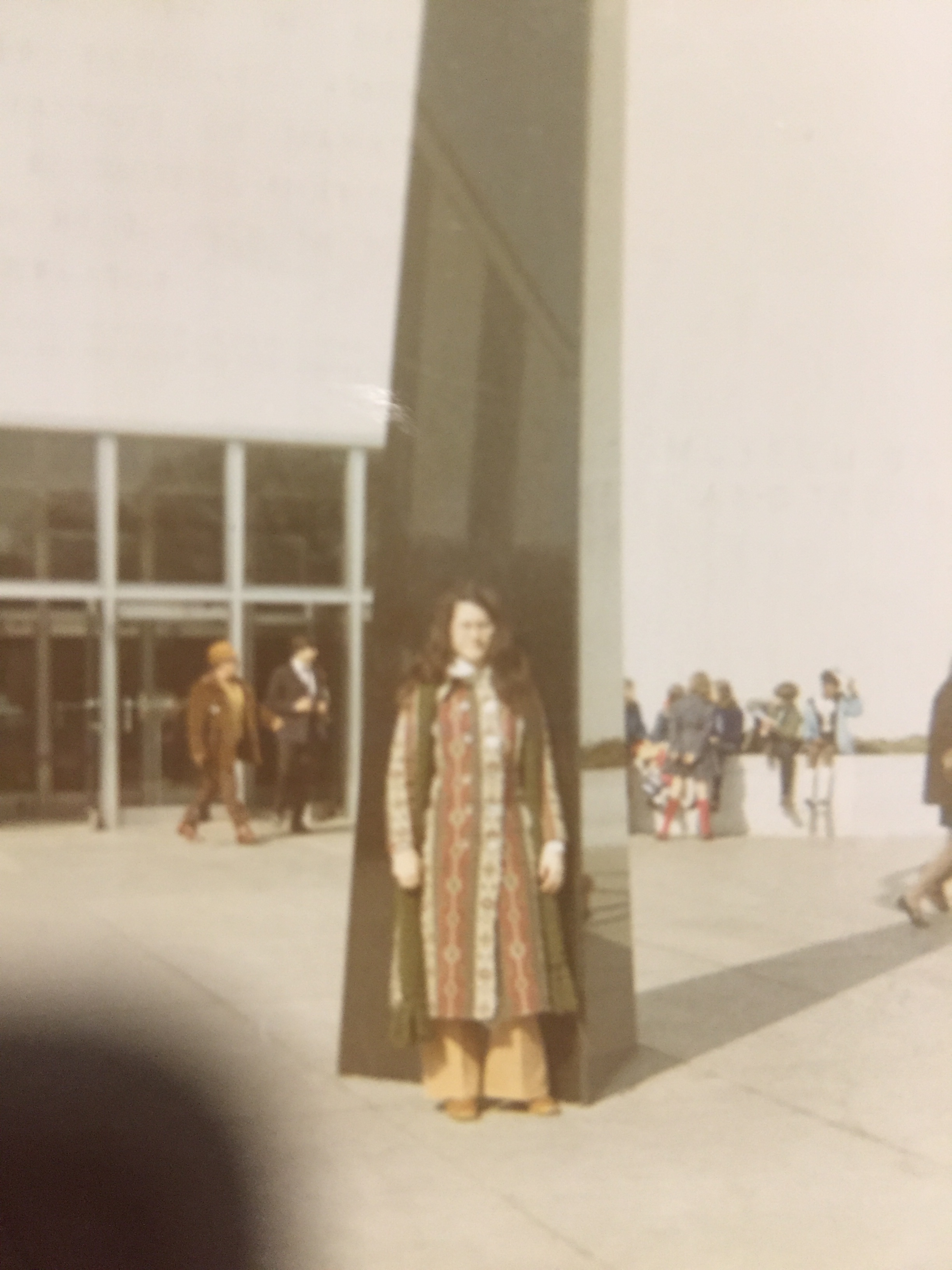
A recent on-line post from a friend reminded me of my favorite coat!  I had a coat when I was a freshman in high school that I just loved.  It was a long, mid-calf, tapestry coat in beige, cream, red and green, with a red satin lining. It was my personal coat of many colors.

My wonderful tapestry, multi-colored coat.

I wore it every day in the late fall till the early spring.  It was warm; it was comfortable; and I loved the feel of it.  I crocheted a green scarf to wear with it.  Over time the scarf got longer and longer.  I could wrap it around my neck, head, and face about three or four times, which kept me so warm.  When I wore that coat, I felt stunning.   I do not know why, I just did.

I have one photo of me wearing that coat.  I remember the moment it was taken.  I was on a high school trip to Washington, DC.   I have tried to remember why I went.  It was not the entire sophomore or junior class, just one teacher’s students.  Was it American history?  I sort of remembering that it was a specialty class.  North Bergen High School for a while offered one semester classes on all sorts of topics.  I took several of those.  My favorite was about Canada.  So perhaps it was one of these classes that sponsored the trip.

What I do remember is that my Dad drove me to the high school so early in the morning, the sun was not yet out.  Then we all got on to the bus for the drive from North Bergen to Washington.  It was the trip of a lifetime.  One I have always remembered.

We toured to the White House; we toured the FBI building; we toured the Capitol; we went to the Supreme Court; we went to the Lincoln Memorial and the Washington Monument, I did not climb up.  We also had a short visit to the Smithsonian, original building.  How we did all of that in one day, I do not know.  But we hustled and we walked fast.

We were allowed to walk around in small groups in some of the sites. I took lots of photos.  I don’t know where most of them are now.  But there is one I have: a photo of me in my lovely tapestry coat standing in front of a black marble monolith.  I do not know where it was taken, except it was on this DC trip.

I tried asking my North Bergen friends about when and why we went.  Only one other friend even remembers going.  No one else does.  I do not know who took this photo.  I wish I did because I would thank her.  My coat is long gone, but this photo gives me joy.

I wore that coat as much as I could for five years. The lining was frayed. The pockets had holes in them.  I kept sewing them back together.  But eventually the fabric was so thin, it could not even be sewn.  I thought about replacing the lining.  I never got the chance to do that. This coat drove my mother crazy.  She was constantly asking me to buy a new coat as the tapestry coat was falling apart.  But I would not.

In the end my mother won this argument.  It was not a fair fight, and I was really annoyed!

My sophomore year of college I spent overseas in Israel.  I did not take the coat with me.  Honestly, I could have used it.  Winters in Jerusalem can be cold, and a bit of snow did fall.  I was gone for 12 months.   When I got home in July, I did not look for my coat.  I had a lot to do.  In this time before social media, I lost a year of local, national and friend news.  I had to reconnect.  It wasn’t until I was getting ready to go to college in late August, that I discovered my coat was missing.

I asked my sister, “Where is my coat?”  She looked at me with a deer in the headlights stare and said something like.  “You better ask Mom about that.” I did. 

That did not end well because while I was in Israel, my Mom got rid of my coat! I will say that my Mom and I had one of our worst fights ever.  The following reconstructed conversation is to my best memory.  I will say the tone of the conversation was loud and screaming on my part.  My Mom was almost laughing the entire time.  She really did hate that coat!!!

“You did not wear it for a year so I thought you did not need it. It was just taking up room.” Her words.

 “I did not wear it because I was in Israel, it would have been difficult to get.” My words.

 “It was falling apart, the lining was shot.” Her words.

“I was going to replace the lining when I got home.” My words.

“You only asked about it now, you did not even notice it was gone.” Her words.

 “It was 80 to 90 degrees, and we were in the Catskills, who thinks of a winter coat then.” My words.

“You always hated my coat,” I finally yelled in frustration.

“It was in horrible shape and you could not wear it another year. There is nothing I can do now.  I will get you a new coat,” my Mom responded.

It was long gone and there was nothing I could do about it. Mom was right.  I went shopping with my Mom to get a new winter coat.  It was an okay coat.  A typical college coat.  Nothing special.  Solid colored with a hood.  I also got new gloves and a new scarf (Yes she got rid of the scarf as well). I was warm for the winter; however, without the sparkle or style I had with my tapestry coat!

I have never found another coat I loved wearing as much as I loved wearing that coat.  I can remember the feel of the coat.  It was not a printed-on tapestry look. It was an actual woven tapestry.  Although many, many years have passed, I have never forgotten my multi-colored, wonderful tapestry coat.  But at least I have this one photo to keep its memory alive.

A Pleasant Evening At Phoenix’s First Synagogue

25 Mar

I try to find something related to my love of Judaism wherever I travel.  This time, I did not have to look, as a group we meet with held its annual dinner at the Cutler Plotkin Jewish Heritage Center in Phoenix.   The Center is housed in what was the first synagogue in Phoenix, which gave me joy.  It mixed my love of history with my search for Jewish sites.

The two buildings have Spanish vibe.  They made me think of the Alamo!  In fact, the buildings were designed in a Spanish mission style when they were built in 1922 for the new Congregation Beth Israel, the first synagogue in Phoenix.  At its start it catered to all Jewish families in the area and did not have a permanent rabbi until the 1930s.

The original synagogue buildings.

The buildings hosted several congregations over the years.  By 1949, the Jewish community had moved out of the Phoenix downtown, and the synagogue was eventually sold to the First Chinese Baptist Church.  They held services there from 1951 until 1981. From 1981to 2002 it was the home of the Iglesia Bautista Central Baptist Church.

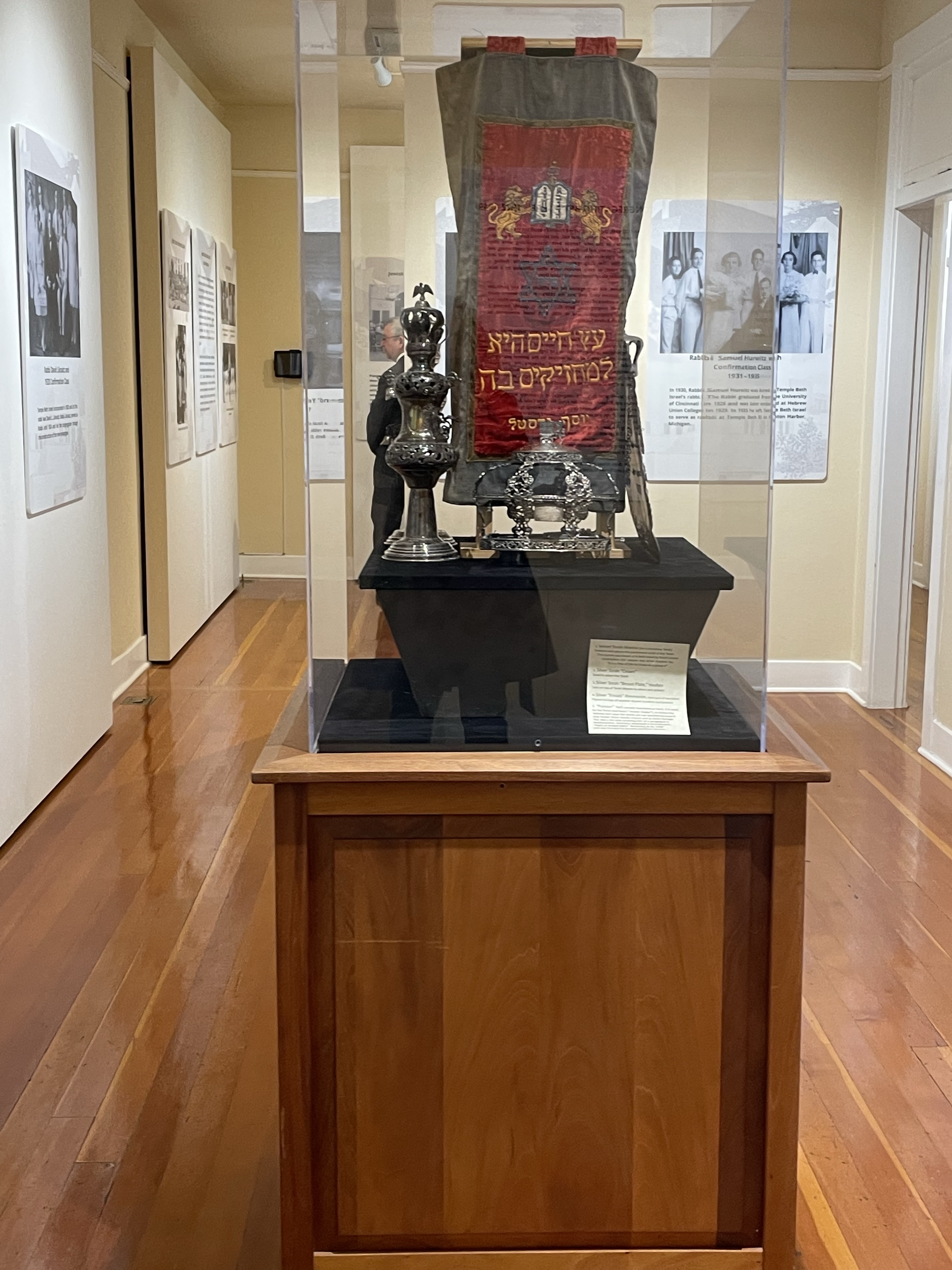
But in 2002, the Jewish community purchased the buildings to become the Arizona Jewish Historical Society’s headquarters.  Restoration of the buildings started in 2008.In the smaller building is a museum dedicated to the history of the Jewish community and the building.   Among the interesting artifacts in the museum is a violin that survived the Shoah. It was buried during the war, and recovered afterwards.  It is on loan thanks to the daughter of the survivor.

The larger building, which once was where services were held, now is a social hall with a stage. When they renovated the building, they found the area on the back wall of the stage where the Torahs were kept in the Aron Kodesh.   The area was covered again, and now the stage is set for community events.  I found it fascinating to find out that when the synagogue was built there were only 120 Jewish people in Phoenix.  There are now over 80,000 and 30 Jewish congregations in the great Phoenix area!

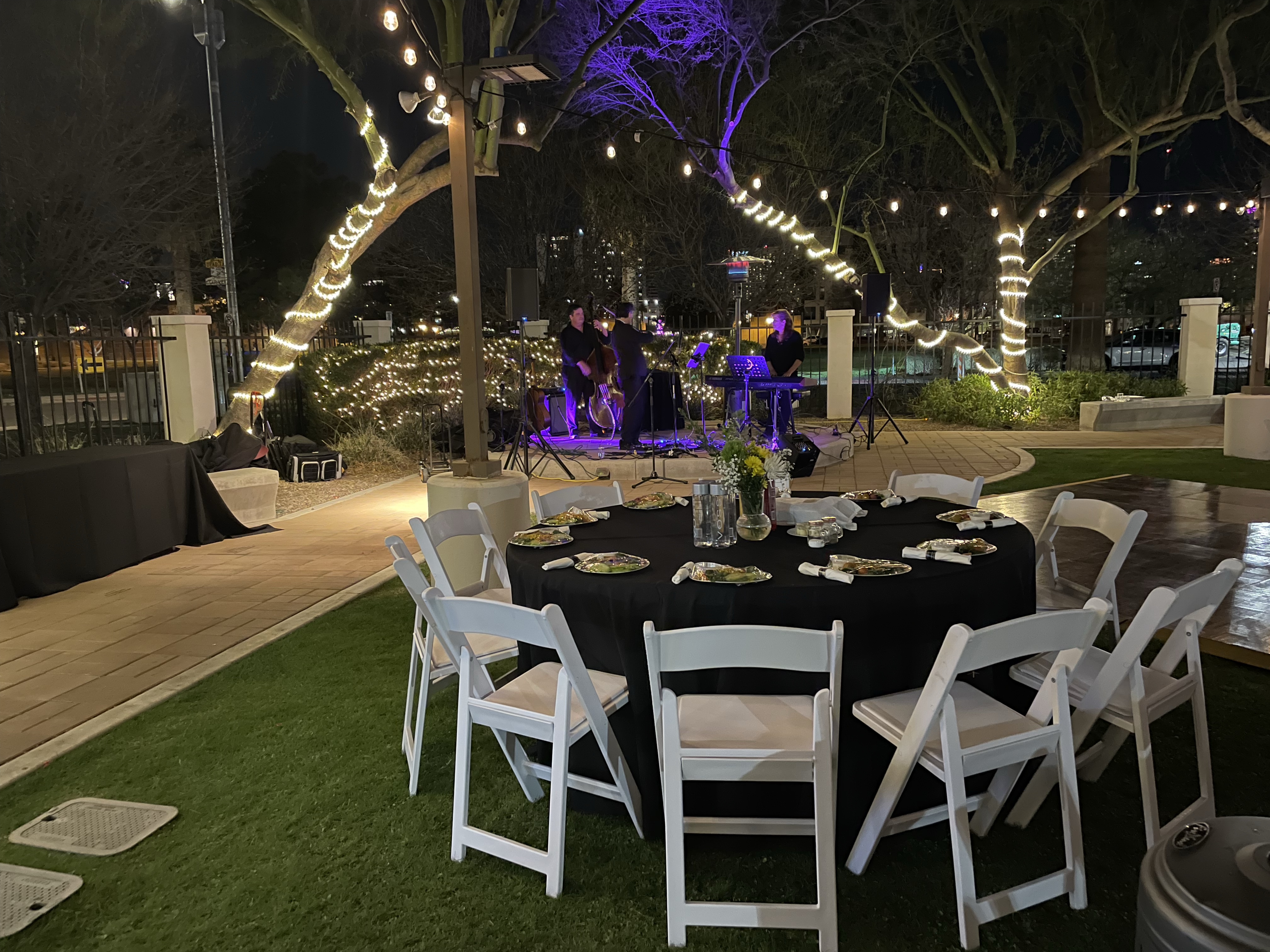
The event venue is open to the community.  Besides the indoor space, there is a lovely garden area where we had our dinner and music.  I had a great time both exploring the history of Phoenix’s Jewish community and enjoying the lovely outdoor space.

This is a quick museum visit, but the Historical Society does have an archive of materials about the Jewish community and holds programs at the site.  They are planning to build a Center for Hope, Humanity and Holocaust Education building on the grounds. If you live in Phoenix, I would advise you to join to get information on upcoming programs! Also the exhibits change and there are online exhibits!

https://www.azjhs.org/

Chihuly Double Dose

19 Mar

I do love Chihuly.  So when we were in Phoenix recently, I was delighted to learn that there was not one, but two, Chilhuly exhibits in town.  Luckily for me, my friends were willing and interested in an adventure,  seeing both exhibits in  one day! 

Friday, February 25, was Chilhuly Day for us in Phoenix. We purchased our tickets in advanced.  The morning was devoted to the “Chihuly In The Desert” at the Desert Botanical Gardens, where the art often imitated the nearby cacti.  The late afternoon was devoted to a tour of Frank Llyod Wright’s Taliesin West and the Chihuly pieces chosen to fit this unique architectural site.

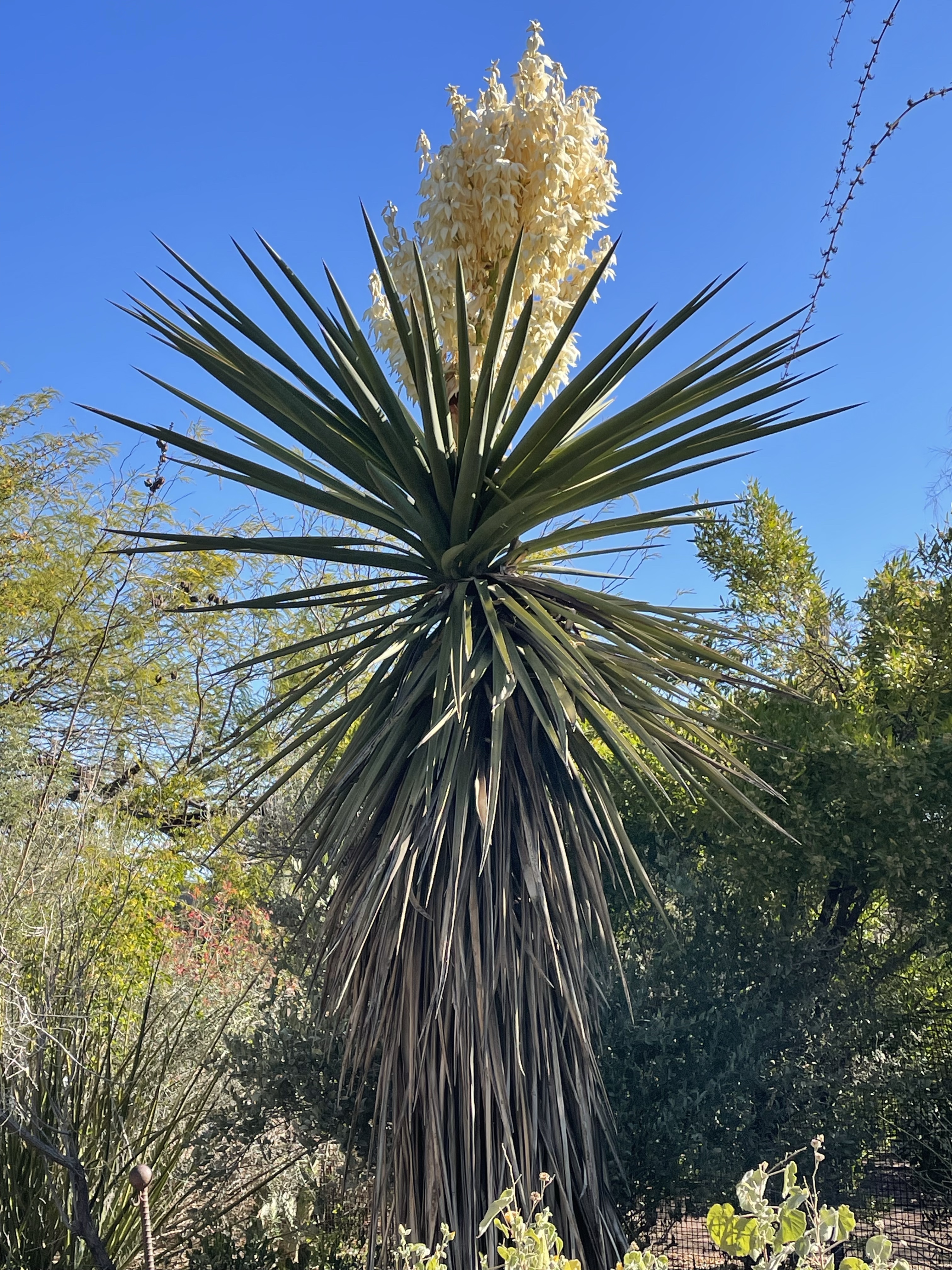
I had been to the Desert Botanical Garden in Phoenix many years ago.  Even then, there were a few Chilhuly pieces at the entrance.  But I had only seen a small part of the gardens. Since I came with a group, we were kept close by on the paths near the front.  This time my friends and I walked the entire grounds!!!  We saw everything that was outside; the Apache household and native crops; the cactus and succulent galleries; the Agave yucca forest and more.  In each area, we looked for and admired the Chilhuly glass that was selected to highlight the natural art.

My favorite natural beauty was the crested cactus.  That was truly something amazing.  As well as the giant cactus that were highlighted by Chilhuly purple reeds.  I also loved this smaller twisted cactus!  Another amazing cactus insight was that birds make nests inside the cactus.  All those holes in a cactus are often a birds nest! A special protection coating is formed to protect the cactus and make a home for the bird.  It looks like a boot!!  We were also lucky as the cacti were beginning to bloom.  So pretty!

From my friend, who lives in Phoenix, I learned that pretty cactus are not NICE.  Some can almost leap onto you.  While another, that looks like it has a soft beard, in reality has a white soft looking collection of barbs.  DO NOT TOUCH. She continued to tell us to STAY BACK.  DON’T get so close. 

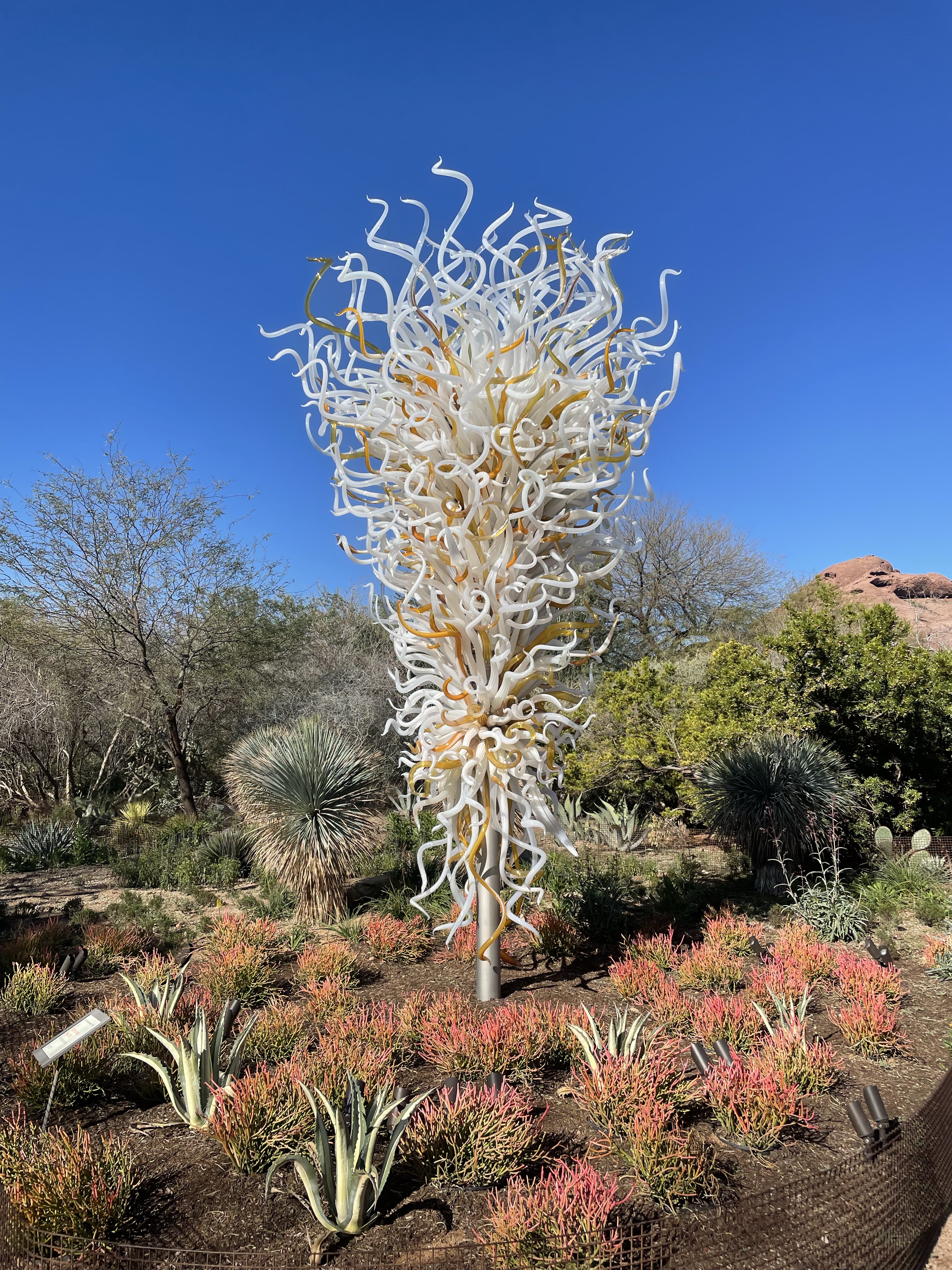
As for the Chilhuly, my favorite pieces included a giant gold, cream and white swirling tall collection of twisted tubes that reminded me of a yucca in bloom. My other favorite was a grouping of red, orange and purple reed like glass that made me think of flamingos. Of course, for anyone who knows me well, I loved the blue reeds!

I will admit, that it was not until we were leaving that we realized there was another exhibit of Chilhuly glass in a  gallery.  But we did not have time to admire it.  We had timed tickets for our second glass adventure.

 I really knew nothing about Taliesin West before this trip.  I have driven past Taliesin East in Wisconsin and been to a Frank Lloyd Wright house at Crystal Bridges in Bentonville. (See Blog Below about another Chilhuly adventure there.). But I really had not much information about Taliesin West until I learned about the Chilhuly exhibit.  Then I had to go and see the compound and the art glass.

Throughout the grounds, Chilhuly glass was displayed in ways to enhance the prairie style buildings.  My favorite, once again, mixed white gold and cream, with some sparkle right at the center of the complex, near the bubbling water pond.  The mass amount of red glass reeds displayed around the front of the home, some in dyed black water, was also fascinating.  And the view from the apex of the higher ground as spectacular.  Well worth the visit!

Drafting room

As for Taliesin West.  Wow.  His original plan to keep all the buildings open must have seen like a good idea.  But when I think about the heat in Phoenix, I am glad he gave in to his wife and closed the buildings in adding air conditioning!  I guess I am not a Frank Lloyd Wright purist.   For me the most interesting parts were the actual drafting room where other architects came to study with him and the small theater. 

I loved my day of Chilhuly, being with my friends, and enjoying these two special places in the Phoenix area. A double dose of Chilhuly was definitely worth it for me.

Chihuly, Stunning

Musical Instrument Museum Brings Magic and Joy To Your Soul

2 Mar

I found another favorite museum! 

Recently my husband and I went to Phoenix.  He went to a meeting, while I visited with two of my wonderful college friends for a mini reunion. In this blog I will discuss one of the three sites that we decided to visit. 

Our first stop on our whirlwind tour of Phoenix was the Musical Instrument Museum.  I do not even know where to begin to describe this delight of the senses. 

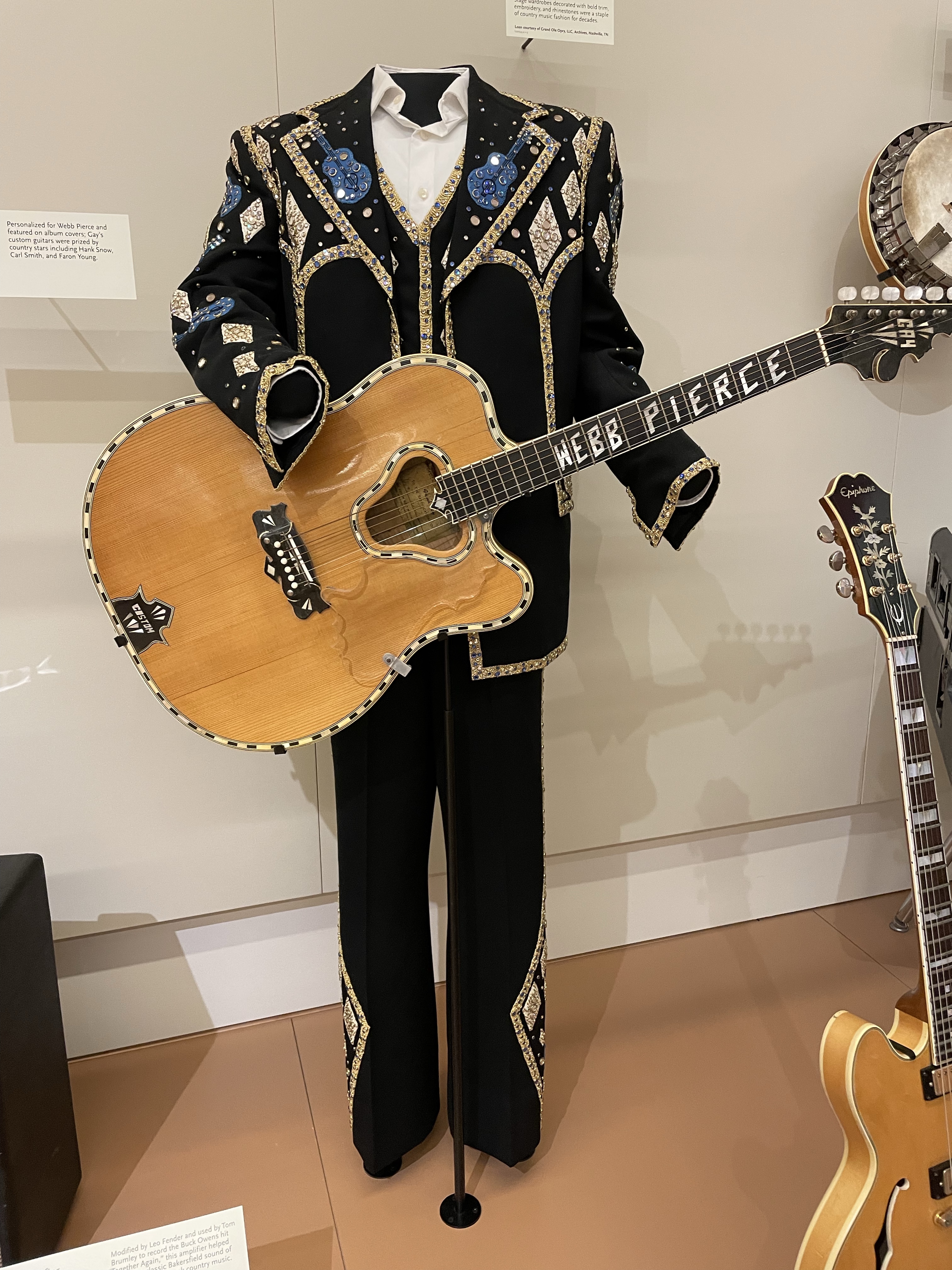
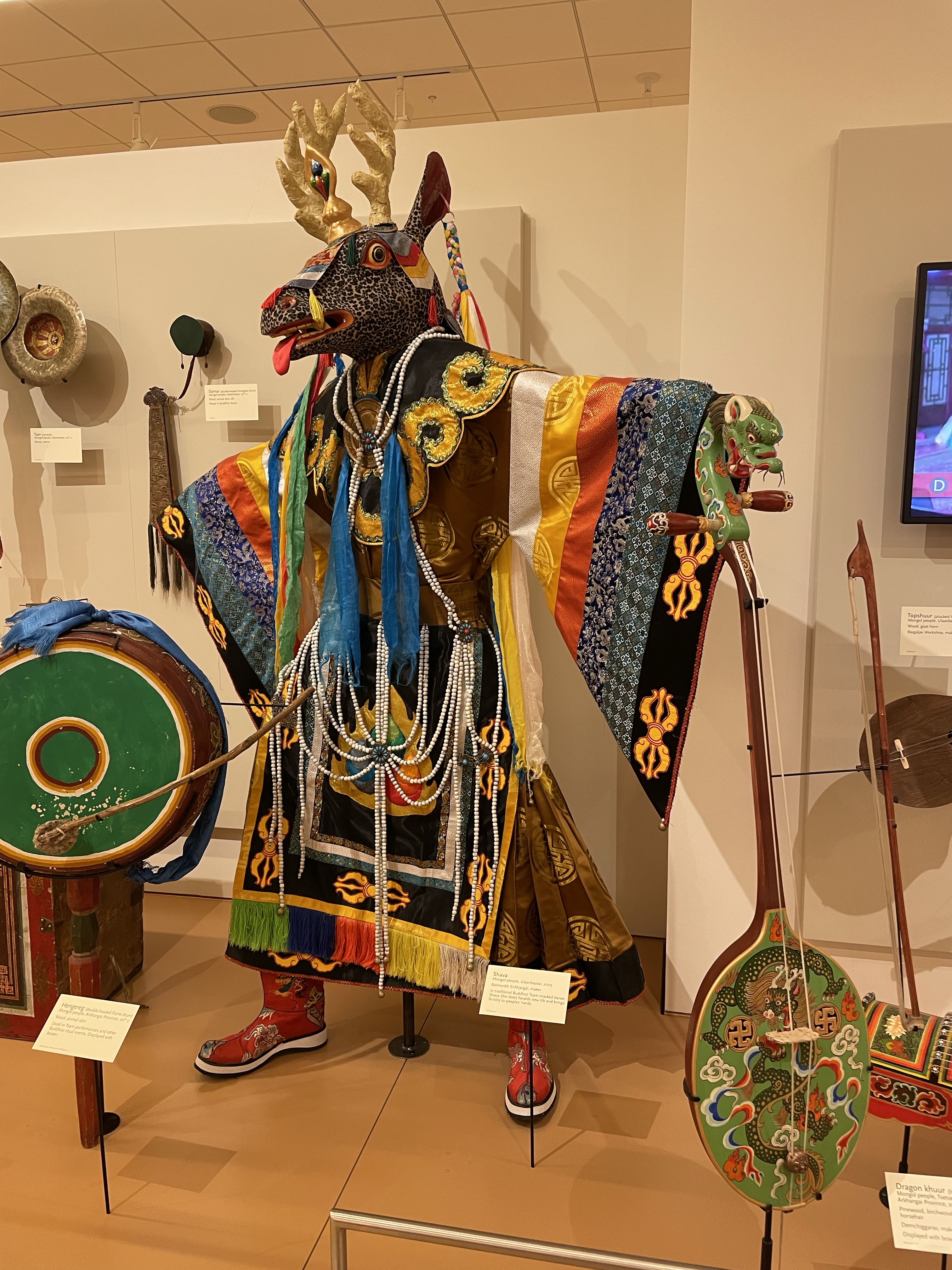
Each display is a combination of color and sound, showing the clothes and the instruments of each area pictured.  The extremely wonderful added bonus  at most displays is a short video at showing how the instruments are played and their sound, also showing how the clothing is worn for ceremonies, rites, parades and events.

The museum is divided into geographic areas.  We decided to start with the music of Latin America and the Caribbean.  We spend two hours walking through this one section of the museum. It is overwhelming and informative.  Your headphones pick up the music of each display as you walk closer.  It draws you in and then the instruments catch your eye and sometimes colorful clothes catch your eye.

Display after display calls out to you.  At times you do not know where to look next, so you go to the music that is dancing in your ears. 

I was intrigued by the display of recycled instruments from Paraguay.  These are not instruments someone has passed down, rather they are musical instruments made from trash and scrap metal. Honestly, the Recycled Orchestra of Centeura drew me in.  I listened to the video several times. This children’s orchestra in Asuncion, Paraguay, is amazing.  All of their instruments are built from trash in a landfill!  I was so intrigued, I looked it up online.  The link to the Wikipedia article is below.

I have not been so taken by children’s music since I saw the children’s school for steel drums in St. Maarten.  (See blog below.)

When we had exhausted ourselves viewing all of Latin America, we decided we had to have lunch in Café Allegro before we tackled another exhibit hall.  We still had Europe, United States and Canada, Oceania, Africa, Middle East, four areas of Asia and more.  There was so much to see, we finally realized we were not going to see it all.

On our way to lunch, we heard piano music.  Below was a grand piano with people in line to play.  It was fun to listen to the different styles of music people chose.  Besides playing the piano, visitors can also go to the Experience Gallery where they can try all sorts of instruments.

After lunch we went to Africa and then we went to Europe and finally to North America.  We saw instruments made from every object possible:  tree trunks, gourds, pottery, ceramics, sticks, string, tin cans, steel drums, boxes. Imagination and talent can turn anything into music. 

 In my attempt to be truly honest, I will tell you that in the other exhibit halls we visited, we were unable to look at every display.  It is sensory overload.  I highly recommend just choosing one hall to go through and not to try to see it all. Instead plan to go back another time if you can. We never made it to any of the Asian exhibits or downstairs to the Mechanical Music Gallery or Experience Gallery or Encore Gallery.

As I looked through the Museum, one thing was obvious, no matter where people lived, or what materials they had, or what their circumstances were, everyone wants to make music. There are so many guitar-like instruments, and harp-like instruments, and wind style instruments.  All were representative of the continent and the culture of the people who use them.

We did not have the opportunity to go to a concert there.  But if I lived in Phoenix, I know its 300-seat theatre would be a favorite spot.

Even the bathrooms provide a musical interlude offering different songs to sing as you wash your hands!!!

On my way out, I purchased one of the magnets that reflects the Museum’s theme, “Music is the Language of the Soul.”  As we danced and sang and boogied our way through this museum, I can attest that this is a museum that enlightens bringing magic and joy to the soul through the language of music.

www.mim.org

https://en.wikipedia.org/wiki/Recycled_Orchestra_of_Cateura#:~:text=The%20Recycled%20Orchestra%20of%20Cateura,collected%20from%20Asunci%C3%B3n’s%20Cateura%20landfill.

Barbie Dolls, Fashion and Kindness

15 Feb

Growing up in the 60s, my friends and I were enamored of the newest toy, a Barbie doll, which were first sold in 1958.  I do not remember when I got my first one, but I was probably 7 or 8, in the early 1960s.  All I know is that the world of play time changed forever. 

At the time, we often were outside playing in our backyards or in the driveways or even in the streets!  Our homes in North Bergen, were close to each other making it was easy to get together. My neighbor, Dorothy, and I often played with our Barbies.  Each day we created a new story and chapter in the lives of our dolls.  It did not matter if we were indoors or outdoors, we could take our Barbies everywhere to play. 

The only one who was not enamored of our dolls, was my brother.  He and Dorothy were the same age, I am a bit younger, so the three of us often played together. Before Barbies, we would play ball in the driveways, or stoop ball in the front.  We had imaginary horses made by the cement fence that divided the property.  We would walk along the fence, we would dig in the backyards, we were often a threesome going on great adventures within the two backyards or along Third Avenue.

But the year the Barbies enter our lives, a major change began. My brother did not want to play with the Barbies and often would try to destroy our imagined home. Sometimes it was a war zone in our driveway, backyard or home, as he came through as the super hero/villain and wrecked havoc. Looking back as an adult, I know he felt left out. So I feel badly. But not then!

The other issue was my sister, who was four years younger. Dorothy was an only child and did not enjoy my mother’s instructions to allow my sister to play with us. It is really hard to be an older sister sometimes. Truthfully, we really did not want to play Barbies with her. It was just too difficult to plan our more ‘mature’ scenarios with a four-year-old. (Of course, now I am sorry we left her out.)

One way of avoiding these issues (known as my siblings) was to go across the street to Livia’s house.  She also liked to play with Barbies.  We did not play Barbies with her that often, but every once in a while we were invited into her home.  That was actually a big deal!  Livia’s older sister, Cheryl, had a birthmark that distorted one side of her face. It was red and wrinkly and stretched from the top of her forehead to her mouth, covering one side of her face.  The other side was perfectly normal.  Cheryl did not come outside to play.  But when we went to Livia’s house, Cheryl would often play with us.

The other interesting fact about their house was that their grandmother made the most fantastic Barbie clothes. WOW.  She made them for us as well.  Of course, Cheryl and Livia had the most extensive collection.  Why buy clothes, when their grandma could make the best?  I coveted those Barbie clothes.  I did have a few.  I am not sure if my Mom paid for them.  Or if Dorothy and I were given them because we would play with Livia and Cheryl and never said a word about Cheryl’s face.  My Mom made it very clear to me when I saw her once on the street, before I went over to their house,  that Cheryl was just like me and I was to be kind and polite.

So I was!  And Cheryl was just like us, but perhaps very shy. For me, Cheryl’s face became connected to homemade Barbie clothes in my mind.  Making them more precious because playing with Cheryl and being kind was so such an important directive in my home.

Recently I realized another connection.  My friend Dorothy and I still talk about growing up on Third Avenue and our childhoods in North Bergen.  In this conversation we talked about going over to Livia’s house.  We were remembering the wonderful Barbie clothes, when it hit me that Dorothy might have gone into fashion design and attend the FIT, because of the exposure to these magnificent Barbie clothes. And I asked, “Do you think it was these Barbie clothes that made you go into fashion?”  Dorothy’s response, “I never thought of that.”   But I think it did. Because she soon was drawing and making paper doll clothes all the time, then as she got older she was sewing and designing real clothing.   I think all from going to Livia’s house on Third Avenue.

Years later, when my daughter had her own Barbie dolls, I searched out craft people who made Barbie clothes and purchased many outfits for my daughter’s dolls.  My favorite was a doll dressed in the most glorious wedding gown.  It stayed high on a shelf in my daughter’s room with her doll collection.  The Barbie clothes, and her doll collection are now packed away in my basement.  Memories perhaps waiting for another generation.

Each time I purchased a doll outfit and dressed the Barbies with my daughter, I did think of ]Livia’s grandma, the time playing Barbies with the girls, and those beautifully made Barbie clothes in the 1960s.

Mugs Bring Joyful Memories of Nungesser Lanes

8 Feb

Karyn S., whose family started the Grasshopper Salon on Bergenline Aveune in North Bergen, made many of us OLD Time North Bergenites happy with her recent post about Nungesser Lanes coffee mugs that she found in the salon’s basement.  She offered them free to anyone who wanted one or two on a North Bergen Facebook page. The comments just flowed from people who had happy memories and would like a mug for themselves or a family member.  I was one of the many people who was excited to see the mugs because of my experiences bowling and meeting up with friends at the bowling alley, we called “ Nuggesser’s.”

My two mugs!

From the time I was three until fourth grade, I lived on Third Avenue between 85th and 87th streets. Then we moved to Boulevard East and 78th Street, which is on the other side of what was then Hudson County Park (now Braddock Park). It meant my siblings and I had to also go to a different elementary school. Switching from Horace Mann to Robert Fulton was difficult. I was leaving all my friends behind. When I look at a map now, it was not so far away. But when I was a child, it seemed like hundreds of miles, while in reality it was just one mile away.

My parents found a solution for my brother and me to keep in touch with some friends.  They signed us up for a bowling league at Nungesser Lanes!  We played on the league for one or two years.  I don’t remember every single meet.  But I do remember my first time getting two strikes in a row. The magic of the points adding up when that happens was so amazing to me.  I loved that moment.  I remember the noise of the bowling, finding the right ball and shoes, and just being with our friends!

I remember my Dad dropping us off at the front parking lot on rainy days and sometimes picking us up. I know we played on the weekends, because we definitely did not do activities in the evenings after school.  In those days, you were home!  Sometimes, after bowling, we went to a friend’s house.  Looking back, I am sure that the parents arranged these in advance.  We would go to their house, or they would come to ours.  A definite break for all of our parents.

As a special treat, we would sometimes stop for White Castle hamburgers after bowling.  You would buy them by the half dozen.  Honestly, I did not like them that much.  I’d rather just eat the fries.  The place I liked better was called Steak and Shake and it was just up the road, or so I remember.

I believe my brother and I sometimes walked from our new home on 78th Street to Nungesser’s through the park, a one and half mile hike. But I think that was when we were older. I vaguely remember meeting up with friends at White Castle for lunch, and then perhaps bowling. The main thing was to be together.

We would walk up 78th Street to Park Avenue and enter the park on a path by the tennis courts.  We would pass the playground and meander along the paths, sometimes cutting across the grass, coming out on the opposite end, across the street from Nungesser’s.  It was worth the energy spent because on the other side of the park were our friends.

To say the post about the mugs brought back happy memories does not do it justice.  I really, truly wanted one, but I live in Kansas now.  I felt it would be an imposition to ask Karyn to mail it to me.  But my good friend, the one I used to bowl with when we were children, told me I had to call. She said after a long talk with Karyn, my friend was sure she would send me a mug.

I followed my friend’s advise.  She was right about Karyn, who I also had a fun chat with about North Bergen, and how close I once lived to where her salon is located.  I asked about the mugs and their discovery. She told me that the basement was flooded in a bad storm, and when cleaning it out, they found the mugs in wet boxes.  Her parents once bowled at Nungesser Lanes, so she believes they have been there for decades.  

Karyn did a wonderful Good Deed when she decided to share the mugs with others who remember Nungesser Lanes.  From the over 100 comments on her Facebook post in North Bergen, Now and Then, and the Memories, many others were as happy as I was to ask for a mug.

Karyn was also kind enough to mail mine to me!!! She was the post office was not far away, and she would send them. SO sweet to do that !!!  I was so excited when my mugs arrived yesterday.  (Yes, I did pay for the shipping!!)

Living in Kansas, I often hear people say how abrupt and unkind people in New York and New Jersey are to others.  I explain that is not at all true.  Karyn is an example of the many, many kind people I grew up with in North Bergen. 

I Wish We Could Be Using Solar Panels

21 Jan

Twenty years ago my husband became obsessed with climate change and over population.  He was concerned that the world would not be able to survive as water resources would be depleted and the world suffered through the impact caused by the changing climate.  He started talking about the need to use the sun for energy and stop the use of fossil fuels.  His focus was on solar panels and electric cars.

For his midlife crisis, he acted! Fifteen years ago, we ordered solar panels for our home.  We became the first home in Johnson County, Kansas, to retrofit a private home to solar energy.  It was quite an experience.  We found a company to assess our home for the panels.  A friend of ours worked at Black and Veatch, an engineering firm.  She took the proposal to work, where several engineers reviewed it and made some suggestions.   In the end we decided to put up ten solar panels, as well as add eight back up batteries.

It took a while to get everything ready.  Permits were needed.  The panels and batteries had to be ordered. The roof needed to be reinforced.  The city inspector was at our home several times, climbing into the attic and checking the wiring through the house.  She was quite excited to be part of this retrofit. Eventually the new rafters in the roof were approved; the electrical wiring was approved; the panels were put on the roof; and after months of anticipation the solar panels came online!  It was exciting.  Our neighbors came out to see the panels as well.

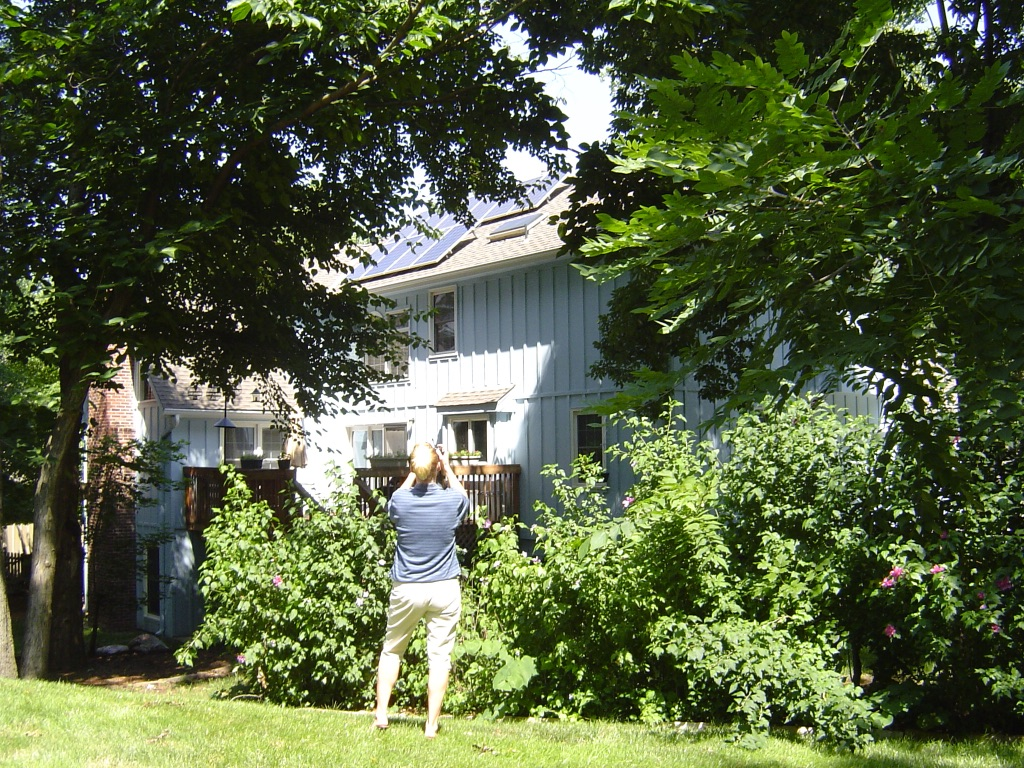
Solar panels on our home November 2006!

We had some issues at first with the electric company, KCP&L.  Even though there had been some contact with them about the solar panels, it had not gone to the right people.  We kept having KCP&L service people come out to check our meter, as it was going backwards.  We were accused of turning it upside down!   Who does that?  People who do not want to pay, we were told.  I kept showing them the solar panels and trying to figure out who we needed to talk to at KCP&L.  Finally, a woman repair person arrived to once again accuse us of moving our meter.  I took her to the back yard where she could see the solar panels on the roof. She had the aha moment and understood the issue.  She promised to look into it.

Meanwhile, we wrote to our state senator, John Vratil, who was a great help.  Through him, we got in touch with Dave Wagner at KCP&L.  From there on the process got easier.  Finally in August 2007, resolution of the issue occurred. First KCP&L installed two different meters on our house.  One for incoming electricity and one for outgoing.  On the day these two meters were put in, we had about 11 KCP&L staff coming out to help and watch the installation.   They also put a special shut off level on the house and a commercial surge protector.  It was really exciting for my husband and I, and for KCP&L. 

Dave Wagner was one of the people who came out for the event, as well as a young woman from their media department.  She took lots of photos, as did I, to document the occasion. My husband took several of the KCP&L personnel into our basement so that they could see the backup batteries!   We explained that not only were our electric bills cheaper due to the solar energy, but also due to the panels capturing the ambient heat and keeping the house cooler.

We were actually highlighted in KCPL’s newsletter and were on the news…rather our house was in the newsletter and on the news.  Eventually KCPL developed one meter that could track both in and out electricity, known as net metering.

For 14 years we lived happily in our house.  When the power went out, we had electricity for eight important elements, including the refrigerator, the furnace fan, and lights in several rooms. During the spring, summer and fall, we saved at least $100 a month in electric bills.  And during the brutally hot months of summer, even more!

Two years ago, we decided to downsize from our home of 35 years and move into smaller reverse two story villa.  The one thing we did not count on was the HOA refusing to allow us to have solar panels, even with a rolling black out in the winter of 2021.   There was a HOA meeting where the topic came up.  Among the negative comments included that solar panels were ugly. Not so.  They also did not know anything about the new technology.  Supposedly there was to be a committee formed to discuss solar panels. Not…. The former president of our HOA, who has moved away, told us the only way we would get solar panels was to have the city or the county or the state removed that restriction from HOAs. 

When we first moved to Johnson County in 1985, many HOAs demanded that all homes had to have wood roofs! What a joke. Each Fourth of July, and whenever there was a thunderstorm, some homes had roof fires.  Around 1999 this clause eliminated from many homes associations due to Overland Park passing Ordinance No. BC-2167 which prohibited the enforcement on covenants which prevented homeowners from putting on composite shingle roofs!  The community, and I believe the insurance companies, help make this change.  Now very few homes still have wood roofs!

Johnson County’s ban on smoking in businesses and most public places were enacted on January 2, 2008. My husband, a pediatric allergist, was one of the people who testified at a commissioners’ meeting asking to enforce a ban on smoking.  In March 2010, then Kansas Governor Mark Parkinson signed a law forbidding smoking in Kansas restaurants.

When the community came together, action occurred once again. We now can eat smoke free in any restaurant!

If citizens could make a change with these two issues: public smoking and wood shingle roofs, I am hoping that we can do it again.  I encourage everyone who lives in Johnson County to write to the Johnson County Commissioners as well as their Kansas State Representatives and Senators to work for change. 

Johnson County Commissioners are:

First District: Becky Fast. Jocogov.org/beckyfast

Second District: Jeff Meyers. Jeff.meyers@jocogov.org

Third District: Charlotte O’Hara. Charlotte.ohara@jocogov.org

Fourth District: Janee Hanzlick. Janee.hanzlick@jocogov.org

Fifth District: Michael Ashcraft. Michael.ashcraft@jocogov.org

Sixth District: Shirley Allenbrand. Shirley.allenbrand@jocogov.org

Together, perhaps we can make solar power and renewable energy an option throughout Johnson County, Kansas.

Mysteries, Mysteries, Mysteries: The Continuing Saga of My Grandfather’s Family

17 Jan

It has been a crazy investigation that started when I found a birth notice for a daughter named Rossie Rosenberg for my great grandparents.  I could not find any other information about her.  Just that one document.  So, I posted on my favorite Facebook group for help.  Once again, another Tracing the Tribe member came through…in a GIGANTIC way. 

First of all, a MAJOR thank you to Sherrie V. who connected the dots and solved the mystery of Rossie Rosenberg.  She was born on May 3, 1904.  But her name did not show up in other records.  However, another child, Minnie/Marion/Muriel does appear.  She was born on May 5, 1904.   Close enough.  I have to assume they could not think of a name when their last of eight living children was born, so just called her Rossie.  Once she got home, a final name, Minnie, was selected.  The mystery of Rossie/Minnie is now solved.

I do know that Muriel got married in 1934 to a man named Harry Moskowitz and they had four children.  But what makes it very evident that this is the right Muriel Rosenberg Moskowitz, is that she named her first son Stanley RITT Moskowitz (He has passed away so I mention his name.).  Ritt was my great-grandmother, and Muriel’s mother’s maiden name, which really helped in following the trail.

But Sherri did not stop with Muriel. Something caught her eye about my grandfather’s oldest brother, Samuel.

First some back story.  My grandfather’s oldest brother disappeared.  I could not find him anywhere except on census documents up until 1915.  However, now I know that I did find him, I just did not realize what I was finding.

My grandfather never mentioned his family.  When I spoke to my grandmother about her family, she filled me in a bit about his family, but she was not very forthcoming.  She told me that they were all crazy.  Her information was basic and not totally correct.  In her rendition, he was the oldest of six children.  He supported them because his father ran off and abandoned the family.  He helped put his younger brother through law school, he helped his sisters go to school.  And then they left him.  (See blogs below for information on them.)

Her most important message to my sister and me, was “Be careful who you marry.  Check out the family.  You have to be sure that they are not crazy.  Look what happened to me.”  My sister remembers this being told to us over a long weekend when my grandmother stayed with us.   But that is not the only time she told this story.  She repeated over and over again to me when I was dating my husband and finally engaged. 

My grandfather, just so you understand, was not the oldest of six children.  He was really the third of eight children who survived childhood.  My great-grandmother Sarah, had 12 births and 8 living children.  I found Grandpa’s older sister, Celia, who died at age 24.  (See blog below.)

But I never could find Samuel…till now.

Sherri sent me New York and Federal census lists starting in 1900 through 1925. Many of them I had seen before and had acknowledged as my family. Others I had looked at and thought no, it can’t be them. But with Sherri, I could see how my great grandfather could be listed as Aaron and not Abraham, especially when all the other names and dates matched up. But she had a bit of knowledge that I did not know about the Kings Park State Hospital. A place which I never heard of before, but I have learned much more. Now my grandmother’s rants and stories all make sense.

In the 1915 New York census, it showed Samuel living at home, but listed his occupation as a farmer.  Before that, in 1910 he was the foreman at a tailor shop. When I saw this, I thought, hmmm this is why he disappeared. He left the tailor business and tried his hand at farming. Perhaps he farmed in New Jersey or Long Island and came home to sleep at night.  Okay, I was naïve.  But I honestly could not understand why he was a farmer.

Sherri posted the following note: Is there any anecdote about one of the ‘kids’ being hospitalized? The occupation of “farmer” in the 1915 census makes me wonder whether Samuel was institutionalized at the Kings Park State Hospital which used farming as therapy for mental illness. There is a WW1draft registration and census records there through 1940 for a patient named Samuel Rosenberg, b. 1888. It appears he died in 1944 but I don’t see a burial online.”

Wow! That put a shock through my system. I had seen the WW1 draft form, which I found when I found my grandfather’s and other great uncle’s registration. But I assumed it was not him. And since my grandparents never spoke about him, and I think my Dad never knew about him either. But then my brain started working and connecting and thinking: Grandma! She probably knew all about the crazy brother, hence her tirade on checking out families before you got married. If he died in 1944, I wonder if my grandfather was contacted. Since his mother had died in the 1930s. Perhaps that is when grandma found out about the crazy brother who she knew nothing about.

I had found the military registration for a Samuel Rosenberg in Kings Park, but I just blew it off. I had no idea that a farmer could mean a patient/inmate in the hospital. But now I had to know more. And Wikipedia had the information. Kings Park Psychiatric Center opened in 1885. It was unique in its efforts to actually help people. The idea was to be a farm community where patients worked or helped on the farm as part of their treatments. My great uncle being listed as a farmer was the information Sherri needed to understand what happened. Why was he still listed on their census form? I am not sure. But perhaps because they did not want to say he was mentally ill.

In 1895 the hospital was over-crowded and the state of New York took it over, renaming it Kings Park State Hospital. The residential area around the hospital was also called Kings Park.  The hospital became self-sufficient and grew its own food.  It finally closed 100 years later in 1996.

Over the years there are a few records of Samuel.  And I will say it is a bit difficult to see the words inmate after his name, as well as the words insanity!  What would he be today, bi-polar, psychotic, schizophrenia?  I have no idea, but I cannot help but wonder!

It also made me think about my great grandparents getting divorced by the 1920 census. In those days people did not divorce that easily.  It was considered a Shanda, a shameful event.  But Sarah is divorced and head of the household in 1920.  Celia is dead by the time of the census and Samuel is no longer listed as part of the family, while the six other children are living with her. Abraham is gone.

I think about being a parent.  With one child, who is  in hospital for mental illness by 1915, the age of 27, and another child that dies in February of 1920 at the age of 24, perhaps the stress was just too much.  Or perhaps one of them was also a bit crazy! We will never know why they divorced.

In any case, I am not quite done with my research.  I am trying to get a copy of Samuel’s death certificate, information on his burial and finally perhaps his records from the hospital.  Actually, when I say I am trying, I am hoping my sister takes care of the paper work for the family.  She has a talent for details!

I will admit, while it is nice finally knowing what happened in my grandfather’s brother, I would liked to have found out that he had a family and did something special. Finding him as the inmate in a mental health institution is just sad.

I am left with just one mystery. I just need to find out what happened to my great grandfather!  Where did Abraham go!

(I want to thank Evan W. for all his help in the past in originally finding some of the documentation.)

https://en.wikipedia.org/wiki/Kings_Park_Psychiatric_Center

https://www.cdc.gov/flu/pandemic-resources/1918-commemoration/1918-pandemic-history.htm

Relating To The Kuchisabishii Feeling

7 Jan

Why are Japanese words so relatable?

My newest Japanese word describes me so well:  Kuchisabishii is the Japanese word for eating when not hungry.   It means “Lonely mouth” or eating just to fill your mouth because you are stressed or bored.  I absolutely relate to this feeling.

During the last two pandemic years, much of what I have put into my mouth falls under these categories.  But honestly, not as often as I once would have because since January 2017, I have been an active member of Weight Watchers (WW).  In fact, during the first four months of Covid, I kept very strictly to my program allowing me to reach my goal weight in June 2020 becoming a life member.  I lost 48 pounds in all.

I kept it all off for until January 6, 2021.  There were several reasons why I started to gain weight.  The first was political.  Watching the attack on the Capitol truly stressed me out.  For a week I was in full kuchisabishii mode.  I wanted to eat even though I was not hungry. I just needed to fill my lonely mouth mainly with chocolate and salty snack foods. Food released something in my mind that helped me cope! The feeling of chewing and the wonderful textures delighted my tastebuds.

But it wasn’t only political stress that got me eating.  Up until Januay 2021 I was participating in virtual WW workshops with local leaders which included a few of the people who had been at my meetings before Covid. After January, the last of my local workshops with leaders I knew, was cancelled. The meetings were now either national or at times that did not fit my schedule. 

Finally, there was COVID.  After a while the stress and the worry of avoiding the pandemic got to me.  Even with my vaccines and my booster, I felt uneasy.  Perhaps because so many people still did not want to be vaccinated or wear masks.  I began to see others as the enemy, which is so against my normal attitude. This all made me want to eat…for no reason.

With no workshops to give me the moral support I needed and the stresses of the world, I reverted to some hard core Kuchisabishii.  I was not hungry, but my mouth was lonely for food. I just wanted to chew on something!

To be honest, I gained almost 12 pounds this year.  The good news, is that my original loss was almost 50 pounds, so I am still over 35 pounds lighter than I was when I started my healthy eating program.  I might have eaten more than the portion called for, but I did not revert back to my extremely bad eating habits.  I did not take a bag of peanut butter M&Ms in my lap and just eat.  Instead I took ten or 12 M&Ms and slowly ate them. 

A year has passed since the world upset my equilibrium. Although the world is still not where I want it to be, I am now going in-person to WW meetings.  After a year of not following sensible eating and relying on kuchisabishii to get me through these uneasy times, I decided I had enough.  I plan to bulk up on my vegetables, stick to eating the Zero point foods and do something else when I feel stressed!

I still love the word, kuchisabishii, but I am not going to let unintended eating define my life.

https://nihongomaster.com/japanese/dictionary/word/65067/kuchisabishii

Oy Vey Rosie Rosenberg!

30 Dec

Somewhere out there is more information about my Grandfather’s supposed sister, Rose/Rosie/Rossie, who was born on May 3, 1904, and died before the 1910 US census. 

First, I have to start by saying, I have known for a while that though we were told my grandfather was the oldest of six siblings, I know that he was actually the third oldest of 8 siblings who lived to adulthood.

I also know that his mother gave birth to 12 children.  For three I have no records, so I assume they were still births.  However, for one, I have a name and a date of birth.  Rose/Rosie.  That name touches my heart.  My father’s nickname when he served in Korea was Rosie.  To this day when I visit a memorial stone I put in the local Korean War Memorial, I always bring a rose.

But he never knew he had aunts who died tragically young: one named Celia, who lived to 24, (see blog below) and Rosie, who probably only lived for a couple of years or less.

But I cannot find Rosie except for this one document which includes her birthdate and her parent’s names.  I know it is correct, because it has Sarah Ritt/Rith for the mother’s maiden name. Also the family did live in Brooklyn in Kings County. I am not sure about the street. I know at one point they lived on a Sackman Street. But that was later. And I have found that this family seemed to move a bit.

Also I know Rosie was born before the youngest daughter Minnie/Muriel.  I remember seeing her name in a list of the family members at some point after 2017.  At that time, I wrote a blog about searching for my grandfather’s family.  Someone sent me an email or a private message with information about all the children from research he/she had done.   At the time I did not believe it was correct because I was still under the assumption that grandpa was the oldest of six, not the third of eight, or even nine.  But somewhere along the way I have lost that document.  And now I need it.

That teaches you to have absolutely NO assumptions about your family’s history and to never disregard a document.

I have found several Rosie or Rose Rosenbergs who died between 1905 and 1909. I am not sure if any of them is my family’s Rosie. Since her sister, Celia, was buried in 1920 at Montefiore Cemetery in the Queens, I was hoping to find Rosie there as well. But the only Rose Rosenberg buried in Montefiore, Springfield Gardens, had no date of birth or death. Could it be her? The memorial ID number is 148979659. But there is no other information or photo.

I am hoping someone who researches better than I can find out more about Rosie! I used Ancestry and Family Search as the two sources for the information I do have. Thank you!