Archive | Yiddish RSS feed for this section

Giving Tzedekah is Entwined In The Essence of My Soul

22 Dec

For the past week I have been writing checks. It is the time of year when every charity I have ever donated to sends me reminders. Many of them I give to throughout the year. But at the end of the year, as much as my husband and I are able, I give more: to Harvesters, the food bank; to domestic violence shelter, to organizations that help children; to Jewish charities, to schools. The list goes on and on.

I was taught that you have to give to others. Not just money but time. Volunteering is an important part of my life. In the years when I was not working, I volunteered so much that it seemed I had several jobs. Yes I do have favorite organizations I for which I do most of my volunteering. But there are many that I do one-time events when asked by friends.

My favorite volunteer job is chairing a scholarship committee for the Greater Kansas City Section of National Council of Jewish Women. I became a member of NCJW because of scholarship, and I recently realized that I have been on this committee for almost 30 years. WOW.

As chair, I keep my committee going. Our numbers had fallen. But over the past three years, I have been able to have six or seven new members join. And this past year, I have gone after even younger women. We need continuity. Keeping the scholarship committee alive and well is important to me.

Each year we provide college scholarships for almost 30 students. They come to us first as high school seniors. And if they get our scholarship, they can continue it for all four years of college as long as their grades are relatively good and they still have financial need.

Over the years we have provided many scholarships for students who are the first in their family to go to college. And many have had hardships that make the committee members want to cry. As chair I am fortunate to read all the thank you notes that they send. And see the difference we have made in the lives of these students.

I often wondered when did the importance of volunteering and helping others first become so important to me? I honestly cannot remember a time when I was not involved in something. In high school I was a Candy Striper, a hospital volunteer. In college, I chaired and served on many committees to help others, including the first ever Orientation Committee.

Even my jobs have focused on not for profit work. It is in the essence of my soul.

My father was the president of his synagogue for 11 years. I think this has to be a record! My parents helped people and taught us to care for others. It was important to them that we had a ‘gutah neshama,” a good soul. It was important to be a mensch.

A favorite saying of my Dad’s was “You have to be able to get up in the morning at look at yourself in the mirror, and like what you see.”

Giving to others; understanding Tzedakah, righteousness, was important.

My Grandparents in the Catskills in July  around 1954. It was my Grandma's birthday.

My Grandparents in the Catskills in July around 1954. It was my Grandma’s birthday.

Today I received an email that shook me up in a way and made me realize that the need to do tzedakah came not just from my parents, but also my grandparents.

Through this blog I am in contact with several people who I knew as a child in the Catskills. Several have reached out to me over the year and asked if I remember certain people or places. One reached out to me in the past week. It is someone we knew not only in the Catskills, but in New Jersey as well. His mother is still alive. And he sent me this message:

“…she (his mother) was always grateful to your grandfather for helping my parents out when my brother and I were babies:  Even though the rent on the bungalow was ridiculously cheap, my parents were broke and Mr. Amsterdam (as she still calls him) let my parents pay out the summer rent through the entire winter a little bit at  a time. Otherwise we would have been stuck in steamy Hudson County.“

I have to be honest, I cried.   My grandparents were very quiet people. But I already knew that during the Great Depression, they allowed many people to buy groceries and bread from their bakery on credit, even though they knew they would not be paid. My Mom told us the story of people coming back years later to pay their debts.

But I never knew that they had allowed people to pay off the summer rent during the year. This was a major mitzvah. The cities in the early 1950s were not safe for children in the summer time; it was the season of polio.

I always knew my grandparents were righteous people.   And I know now that giving tzedekah is entwined in the essence my soul from my parents and my grandparents.

The Nuances of Nu!

4 Dec

It is amazing how two little letters can have so many meanings. Just an inflection of the voice, a shrug of the shoulders, a smile on the face, a touch of the hands, and ‘Nu” means something totally different.   It is not that surprising though, ‘Nu” is a Yiddish word. And translating it would be almost impossible.

Nu?

As a question “Nu” lets you say in one word so many sentences: Are you okay? Did everything go well? What are you planning to do? What will happen? What is the story? Do you need help? What do you need? What can I do?

All those questions from one two-letter word. But all are questions to show concern for another person.

Nu!

As an exclamation “Nu” has a different meaning. For a mother, this version of “Nu” is very important. Nu! Did you get your homework done?! Are you ready?! Let’s get going! I have had enough! Get your act together! Listen to me! What is going on here!

Mothers and fathers who use Yiddish have been asking/demanding of their children the “Nu” demand for generations. I can still hear my Grandmothers or my Mom saying “nu!” to me in my head.   Who needs a conscious when you have “Nu”?

There is another parental use of “Nu.” This is used for an older child with a long-term partner. This is the “are you getting married? What is happening? Nu? What is the story here? Do I get to plan a wedding?

Then there is always the parents’ very happy “Nu!” The Nu of joy comes about when you are almost a grandparent and you call to ask Nu? What does the doctor say? When? Or you can call your friends and say, “ Nu! I am a grandparent!”

So, Nu?

This more gentle version of the “Nu” question is more comforting. This is when you take someone’s hand in yours and try to offer comfort.   This is the compassionate Nu.

You went for your Mammogram today? So nu? How did it go?

Your Mom or Dad is sick? So nu? How are things going for them and for you?

Your child is having problems? So nu? Can I help?

You are depressed? So nu? You have friends, are you getting help.

The compassionate ‘Nu’ is very important. It is beyond just friendship. I think it shows compassion for acquaintances as well as close friends. So nu, I will be there for you. Don’t worry is part of tzedakah and rachmanis. We need to show others how we care. And the right ‘Nu’ at the right time can help.

Oy, Nu!

The Oy Nu is much more intent. The Oy Nu offers sympathy on a much higher level. Your parent passed away, “Oy Nu!” What can I do to help with the shiva with comforting you.

Your child was in a car accident. Oy Nu!

The Oy Nu! Is sort of an ‘I cannot believe that happened.   How? Why?’

A definition of “Nu” says it means “so.” But that is not really correct. It has many more meanings than that! Nu is nuanced. It is a small word with big aspirations. With intonations, inflections, shrugs and sighs, flashing eyes and temper, each of these changes the meaning of Nu.

I cannot imagine a world without this word. The nuances of ‘nu’ keep language fun and exciting, as well as simple. With one word, I can say so much!

My Five Levels of “OY”

4 Nov

I recently realized that in my mind there are actually five levels of Oy. These five different levels provide me the ability to express sorrow or sadness with an oy-statement.

The first, of course, is the simple ‘oy.’ This mean ‘oh’ or ‘ouch.’ I use OY when my cat jumps on my stomach or I drop something. Sometimes I use oy when someone is telling about an embarrassing experience they had. A response of “Oy” is always appreciated.

I never use oy when something bad has happened. It is usually used for events that are a little bit funny. I guess someone slipping on a banana peel without getting hurt would be an oy moment.

It sometimes has an “I cannot believe I did that,” feeling. After you do it, you think, “Oy! Why did I do that!”

But when I say “Oy Vey” I have amped up the response. Now I have feelings of woe, which is exactly what “oy vey” means, “oh woe!” I think the following is a good example of an oy vey experience.

The summer of 2013, on Fathers’ Day, my husband and I were at a party. During the party a storm blew in to the area. It was tornado weather in Kansas. We all took shelter in the house. Although the wind blew and the rain came down, it was not too bad where we were.

All those branches on the ground should be in the tree.  Oy Vey

All those branches on the ground should be in the tree.         Oy Vey

However, when we got home, OY VEY!!!   Our beautiful Sugar Maple was destroyed in a microburst of rain and wind. Branches and limbs were all over our front yard. Part of our fence was crushed.   It looked like a disaster zone in our neighborhood. And our house seemed to be the epicenter.

But it was only an Oy Vey, the second level of oy, because no one was hurt. No homes were damaged. Yes, the tree was going to have to be taken down, but in the long run it was just a second level oy experience.  My son and his friends came over and helped my husband collect all the branches and to get the big branch off the fence. Those branches were big and heavy!

The next day I called the tree service we use. Luckily they had trimmed that tree just six months before, which probably lessened the damage. I will admit watching the tree service actually take the tree down was a second oy vey experience. It was a very large tree! But they took care of everything, while I watched and took photos…all the time chanting, “Oy Vey!”

“Oy Vey Iz Mir” is a much stronger, “Woe is ME! “ When I say the entire sentence, then I am really worried. When I say, “Oy Vey IZ Mir,” something horrible has happened.   Someone I know is sick. Or an elderly parent is in hospice or has passed away. Sometimes I say that when someone has lost a job. It is a statement for a calamity, but not for a tragedy. Or maybe something scary has occurred.

When I was a child in the Catskills, the boys who lived in the house next door were shooting BB guns and aiming at a target made of wood. The BBs ricocheted into our yard. All I remember was the leaves rustling and my Dad, who had served in Korea, jumping on us yelling, “Get Down!! Get Down!!!”

One of my grandparents said “Oy Vey iz mir.” I think both because of the guns and because of Dad’s reaction. He stormed over to the house and yelled. After that there were no BBs for a while. Then I think they built a target with straw behind it. But that “Oy Vey iz mir” has stayed with me!

I think the English saying, “Woe is me” is an example of Yiddish phrasing in English. I have woe. I feel woeful. I am sad. Those are all English. But in Yiddish, Oy Vey iz Mir. Oh woe is me!!!

For a tragedy I have my fourth level of Oy. That is seven oys in a row followed by Vey Iz Mir.   “Oy oy oy oy oy oy oy vey iz mir.” That is when I feel absolutely terrible about what I have just heard: when some one has had a true tragedy. What could that be? A young person has passed away.   Someone’s son or daughter has been in a serious car accident. During my children’s teen years, there were unfortunately several times when the fourth level of oy was invoked.   A suicide is a definite fourth level of oy. Where I might forget why I used the first three levels of oy, when I have a fourth level of oy moment, it lives with me forever.

When I reach this level I usually need a piece of chocolate and a glass of tea. When I say this I know that I would love to speak to my Mom or Dad and debrief. The fourth level of oy moments are the times when I end up making phone calls or sending out emails to let others know, so that we can band together and help.

But I said there are five levels of Oy. So what could be worse than level four? Well there is level five, when I say, “Oy, a Bracha.” With this I am saying “woe is me, we need a blessing.” With the fifth level of oy I am calling on God to help.

When war breaks out in Israel, it is an “oy a bracha,” moment. With a daughter living in Tel Aviv and many family members throughout Israel, the threat of weapons, rockets, war, and destruction makes me very anxious.

For me 9/11 was a fifth level oy moment. We needed all the blessings we could get then. And so for me, it was saying “Oy, a Bracha!” Help us, bless us.

My five levels of oy have been part of my life as long as I can remember.   I am glad that most of my oy moments are level one and level two oys. But I am also glad I know a bit of Yiddish so I have a way to express exactly how I feel.

Traditions Survive Across Generations

4 Oct

My grandfather was a Cohen. Born in Poland, he took this role seriously. Cohanim lead off the aliyot at synagogue; they have to be present at a “pinyon ha ben,” the ceremony for the redemption of the first born. They cannot marry a divorced woman. They do not go to the cemetery or funeral except for a very close relative. And for me the most intriguing, they lead the dukhanen on the high holidays

When I was a little girl I loved to go sit with Grandpa in shul. He had a large tallit ( prayer shawl) and would wrap me into it as I sat next to him. Whenever the Shema was said, he would lift his tallit so it covered his head and face. “Why do you do that?” I asked. Most of the other men just kept their tallit on their shoulders.

“When I say the Shema I speak to G-d,” he told me. “When you say the Shema you have to cover your eyes, ” he told me, “and think about the prayer .” To this day whenever I say the Shema I put my right thumb on one eyelid and my forefinger on my other eyelid to keep my eyes closed, just as Grandpa taught me. And I think about the words I am saying. I taught this to my children.

Because Grandpa was a Cohen on special holy days he would perform the priest prayer, the dukhanen, with other Cohanim descendants. They would be dressed in white kittals, robes, over which they wore their tallit. When they entered the sanctuary they stood at the front if the congregation and covered their heads with their tallit.

At this point my Mom told me to look away. “When the Cohanim chant this prayer they speak to G-d and his light comes. If you look once, you will go blind in one eye. If you look twice you will go blind. If you look the third time you will die,” she said.

How can you possibly die if you are already blind? Okay she admitted you cannot die, but still you must turn your face away and not watch. To this day I do turn away. I still cover my eyes. But sometimes I sneak a peek. And I said the same thing to my children.

Many congregations no longer do the dukhanen , but my congregation continues this tradition. At Rosh Hashannah this year, as I watched the Cohanim walk in and prepare for their chant I remembered my grandfather. In my mind I could see him walking to the front of the room.

My father was not a Cohen. As an Israelite, he had no special role, but he loved his Judaism and his congregation. My Dad was president of his synagogue for 11 years. A record I am sure. He worked to pass his love of Judaism to his grandchildren. Before each of my children’s bar/bat mitzvah, my parents came to stay with me. My Dad studied with them each day for the week before the service, listening to them chant Torah, helping. He was so proud as each of his six grandchildren reached this important day.

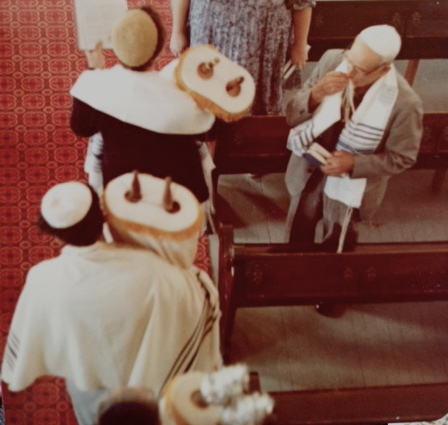
Grandpa kissing his tallit after touching the Torah.

Grandpa kissing his tallit after touching the Torah.

As the Torah comes through the aisles before being returned to its resting place behind the curtains and the doors, beneath the everlasting light,  I touch it with my siddur.  My Mother taught me to do this, as I watch the men touch it with the fringe of their tallit.  This I also taught to my children.

When I go to shul, I am never alone. Even if my husband is not with me, in my mind I see my grandparents and parents. When I chant the Amidah, standing with my feet together, I gently sway back and forth, Schukling. My children would sway with me when they were little. Sometimes my children would lose my rhythm and sway into me. Now just my husband is with me. And he sways into me sometimes with a lilt in his eye.

My husband is a Levi.  Although he does not participate in the dukanen itself, he is called out before it to help the Cohanim prepare.   Many times, he does not have to do anything, because there are more Levi than Cohanim. But he goes, he says for the exercise.  But I know that it is a tradition that remains.

When we daven together, I feel the bond lasts across the generations.
As I recently stood to say Yahrzeit for my Dad, my son was with me. He now wears my Dad’s tallit. On his head was one of my Dad’s caps. As I stood, he lean my Dad’s hat against my hand. When I sat, he turned and said,” I thought you would want Grandpa near to you.” And I did.

But when I am in shul they are always with me. Their voices swirl among the other voices chanting.

Sharing Yiddish and Superstitions in Kansas

8 Sep

One of the most difficult adjustments I made when I moved to Kansas is to stop speaking Yiddish. In New York and New Jersey it seems even those who are not Jewish know the most important Jewish words: schlep, gonif, meshuganah, punim, shayna, tottale, madelah, gor nish, keppi, kibbitz, yenta, mishpocha and more!

I never had a problem slipping in a work of Yiddish when I was talking with friends. But then I moved to the Midwest. And I realized that even Jewish people here did not speak Yiddish. Not even the English/Yiddish I spoke.

The little bit of Yiddish I spoke to my own children was about all I heard most of the time, except when I made my yearly journey back East to visit family.

So when I discovered someone with my knowledge base I was thrilled. It was actually someone I knew for years, but we just did not speak about our childhoods and our American/European Yiddish upbringings.

We not only had the Yiddish in common, we had the superstitions.

One of the early indications that she and I spoke the same language had to do with a bindle. That red thread you wear to keep the evil eye, the ayin hora, away. We discussed bindles an entire evening. I told her about the red bindles I had placed on my children’s cribs. I told her that when I was pregnant with my first child, the only thing my Grandfather asked me to do was to put a bindle on the crib. And so I did. I also put one on the highchair, the car seat and playpen.

To this day I have bindles on our cars. There are the bindles I put on each of the kitchen chairs. One of my friends, who heard the conversation, said, “I thought those ribbons were for the cats to play with. “ Nope, there were all red. Whenever we get a gift with red ribbon, it goes somewhere in the house to act as a bindle. I figure if someone gave me a gift, the red ribbon has positive energy.

My friend made her son wear a bindle when his wife was pregnant. I carried a bindle when my husband had surgery. It doesn’t hurt! And I believe it helps. And for extra good fortune or ‘mazel,’ I tied 18 knots in to the red yarn, as did my friend’s son!

I told her that the one on my son’s car had fallen off, and I had not put a new one on yet. She encouraged me to do it soon. And I did. A few weeks later he had a tire problem. It started on the highway, but did not get bad till he got home. The bindle worked! So I am keeping it there.

But do not worry, even when his car did not have a bindle, my son’s car did have 18 cents to keep it safe. Now it is just double safe.

Which brings me to money in cars. Last summer my husband and I sold two of our cars to neighbors. Each car had multiples of 18 cents in them. In Hebrew the word for life are the two letters that add up to the number 18, so multiples of 18 are considered lucky. When we sold the cars, I left the money in the glove compartments. The boy next door brought me back all the things he found in my car that I did not get out before he took it, including the money. I gave the money back. I have known him since he was three years old. I want him safe as well.

The other neighbor, who bought my other car, I exchanged the ‘gelt’ (money). My parents had given me the 36 cents in that car. And since they are no longer alive, I wanted to keep their coins. I gave my friend an equal amount to keep in her car. My two non-Jewish, Kansas neighbors are happily driving around with good luck money in their cars!

Yes, we are a little superstitious in our Yiddish beliefs. But they are important!

Which is obvious about our next Yiddish/European Jewish belief. One day, at a holiday meal, my friend asked me, in front of her son, “What did your Mom do when you got your period for the first time?” My answer, “It wasn’t my Mom, it was my grandma and she slapped my face.”

”I knew you would know!” She exclaimed. “I knew it.” She then told me her somewhat sad story. I will not repeat it because it is her story. But I will say, I felt badly for her when I heard what happened.

Our conversation went downhill for her son. He left. Even though he is a doctor, he just did not want to listen to this discussion. But my friend and I had a great time talking superstitions and Yiddish.

Of course she grew up in New York and spent her summers in the Catskills. I grew up in New Jersey and spent my summers in the Catskills. We cannot help but share many experiences about growing up that people who grew up in Kansas and Missouri just do not understand.

We can spend hours talking about our childhoods. And we have! Our discussions bring back so many happy memories.

I think we need to spend a day speaking about Yiddish expressions. My grandparents would say, “Hock mir nicht ein Chinok,” to mean stop bothering me.   It really means ‘don’t bang the tea kettle,’ but it makes sense. My favorite was “Ge Loch in kupf in Vald.” I might not be spelling it correctly. But it means go bang your head against the wall. That was their favorite saying when we said we were bored.

As my children in their 20s and are dating now, I remember my grandfather telling me that there is a “‘lid for every pot.” And I say “From Your Mouth to God’s Ears,” to a friend who has just made a prediction that I would like to happen, when I want something good to happen.

The Jewish superstitions, Yiddish sayings and language will always be with me, wherever I live. But it is nice to have someone to share Yiddish and superstitions in Kansas.

I believe Mystically and Magically Great Grandma Chava Watches Over Me

22 Aug

Chava Amsterdam

Even though I was born long after the Holocaust ended, I have a connection that defies logic. I am named for my great grandmother Chava. She was hidden during the war and was murdered when she returned to the farm her family owned by the people who occupied and stole it. I have been told that she was shot in the head.

I learned about her when I was 11 years old. Before that I only knew I was named for Grandpa Nat’s mother. And that was all.

But when I was 11 years old, living in North Bergen, NJ, I had a major fight with my younger sister. I ran after her screaming, “I am going to cream you.”   As she ran away from me, I felt a giant tug on my pony tail. My gentle Mom was dragging me to the sink. “Never use that word in my house. Never. They burned your Grandpa’s family alive in the fires of the crematoria of Austzvitz. You will never use that word in my house.”   And then she put soap in my mouth. I have never, ever forgotten that.

I never even thought of the slang word, “cream” meaning ‘to kill,’ had anything to do with the holocaust. But in my mother’s mind it meant crematoria. And perhaps she was right. I have not found a reference for it. But it does not matter. What it did do was open up a conversation.

My Mom was the gentlest person around. For her to do this, something horrible must have happened. And so I learned about the Shoah. I learned about my grandfather’s family and how they died: some of it, not all of it. Some came later.

But mainly I learned about Grandma Chava.

I thought about her so much, I started speaking to her in my mind. When I was worried about something, I spoke to her. When I was scared, I spoke to her. I knew she had been through so much that perhaps I could gain strength from her. And she would not let that happen to me. One generation was enough. When I was worried, I imagined her near to me.

When my son was little and afraid to sleep alone at night, I once told him that there are angels guarding him. And I mentioned my great grandma. I will admit this backfired. When my son was about 8 we went to see a production of “Footloose.” When they sang the song with the lyrics, “Somebody’s eyes are watching you,” he had to leave the theater. He told me he thought about my great grandma and her watching him. So I changed that image for him.

But for me, thinking of my great grandmother was always helpful. I did not think about how she died or what happened to the family. I thought that she would never let it happen again.

Often my Grandma Thelma, who had spent six months living with Grandma Chava in Europe, would say, “You are so much like Chava. She also was shreier or a machshafer or chachama.” Whatever she wanted to compare me with that day.

But basically Great Grandma Chava was a strong-willed person, as was I growing up. And I think I still am.

Because I was named for Grandma Chava, I was given jewelry that was hers and embroideries that she made. I now have a picture of a bird she embroidered hanging in my dining room. I was given the matzah cover she made for Pesach, which I have since donated to a museum. (See my blog: “Watching Antiques Roadshow Inspired Me to Donate my Great-Grandmother’s Matzah Cover.”)

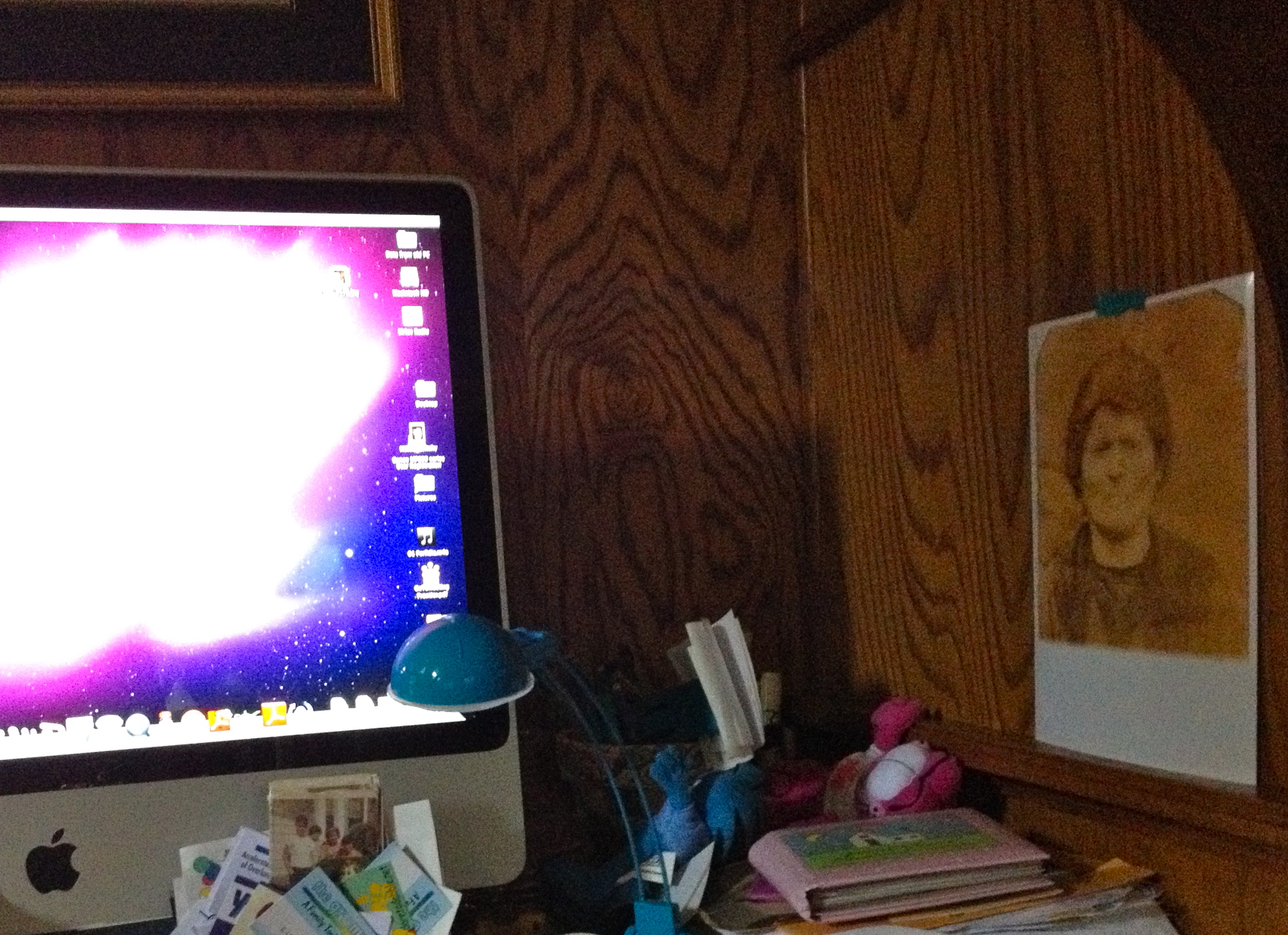
Recently we found a photo just of her. My Grandpa looked like his mother. My brother looks like her. One of my nieces looks like her. And I held her photo up to my daughter and there is a resemblance as well.

As for me, I look like the determination you can see in her face. She is staring straight at the camera, and in my eyes she is so strong.

My desk with Great Grandma Chava watching.

My desk with Great Grandma Chava watching.

I enlarged the photo and hung it by my desk so I can see her whenever I am working. Because I always have and still feel that she is my guardian angel. We share the same nechama, the same essence.

Almost all of her children and grandchildren died in the Shoah, except my Grandpa and his family because he was in the USA. There were no grandchildren till years after the Shoah. My older boy cousin was named for my great grandfather, who also perished. And I, the oldest girl, was named for Chava.

So I sit at my computer working. And I turn my head slightly to see her. The world of magical thinking makes me believe that she knows we survived. That she knows her great-great granddaughter has moved to Israel. That she is not only looking over me, but also over my daughter.

As rockets fall in Israel, I think, ‘never again.’ Another Chava cannot lose her daughter to the hatred of anti-Semitism. And I believe, mystically and magically, that Great Grandma Chava is watching my daughter as well. And I feel her ruach, her comforting whisper. All will be well.


Schreier: screamer/yeller

Machshafer: witch

Chachama:  Smart one/intelligent

Nechama: soul, essence

Ruach: wind, spirit


http://lyrics.wikia.com/Footloose:Somebody’s_Eyes


Old Photographs Bring Memories to Life

19 Aug

My siblings and I recently spent a weekend together cleaning the attic, basement and garage of a house in the Catskills that our family has owned for well over 50 years.   And although our parents made an effort to clean out some of our grandparents’ items when they inherited it, it still was quite full.

It has been a process. This was our final weekend of cleaning. My brother with some help from his son and a friend, had already moved out the old metal bungalow furniture and moved in furniture from our parent’s apartment.

We had cleaned out clothing and personal items. We had moved out some items that we wanted in our respective homes. But now it was time to get rid of the stuff that had just collected and decayed over time.

My brother ordered a 20-cubit yard dumpster that he demanded be filled by the end of the weekend. My sister and I thought he was crazy. There was no way we would have that much junk. We were wrong. And it was, amazingly, filled. The house is now in order. Clean, organized and ready for us to use it. We had a feeling of accomplishment by the time we were done.

Two of my nieces were there as well. And the four women, my sister and my nieces and I did the heavy emotional work, we went through thousands upon thousands of photos. We sorted them for each family. We made piles for our cousins. There were some we just discarded and put into the dumpster. And then we put together the ones we all wanted for me to take home and scan into my computer, for I am the family archivist. I will make digital copies and send them out to everyone.

Front Great grandpa USA Visa

The treasures we found included our great grandfather’s passport and 1936 visa to come to the USA from Poland. Our grandparents worked diligently to get the paper work accomplished to bring him and my great aunt to the USA. It saved their lives. My Mom would tell the story of going to Ellis Island with my grandparents to get them when they arrived from Poland.

Years later, when my children were little, we went with my parents to Ellis Island. My Mom asked, “Where are all the cages?” The main room was a large empty space. But on the wall were photos of what the room looked like in the days it was in use. And the metal bars between lines of people could have looked like cages to a child. We think that is what she saw.

In the bags and albums, we found photos of people in Europe from before the Shoah. And wondered how many of them perished? We found photos of our great aunt Tova and our great grandmother Chava. Photos we had never seen before. Our great grandmother is young in this photo. My brother and niece have her mouth. We know they both perished, along with many other family members.

Photos of our parents taken in Hudson County Park, North Bergen, NJ, in the 1960s were also a rare find. They were dressed up, obviously ready to go out somewhere. Mom even had white gloves on… white gloves and a sort of ‘mini’ skirt: an interesting combination; a transition between two generations, two styles of dress. There are no full skirts here.

We found pictures of our aunts and uncles from both sides of our family, grandparents, great aunts and uncles; photos of us and our cousins when we were little. They were wonderful finds. We even found three photos taken during the Woodstock weekend in 1969. We thought all of them had been lost years ago when my Dad tried to mail them to me and the envelope broke while in route.

My nieces loved one photo in particular, of my brother, sister and I when we were in our teens. We hate it. But the girls wanted to keep it as ‘blackmail.’

We found wonderful documents: the list from our parent’s wedding; some of Dad’s school papers, and his army paper, a telegram he sent his parents from the army. One of his school papers said he was in the choir in high school. We all laughed, Dad could not carry a tune!

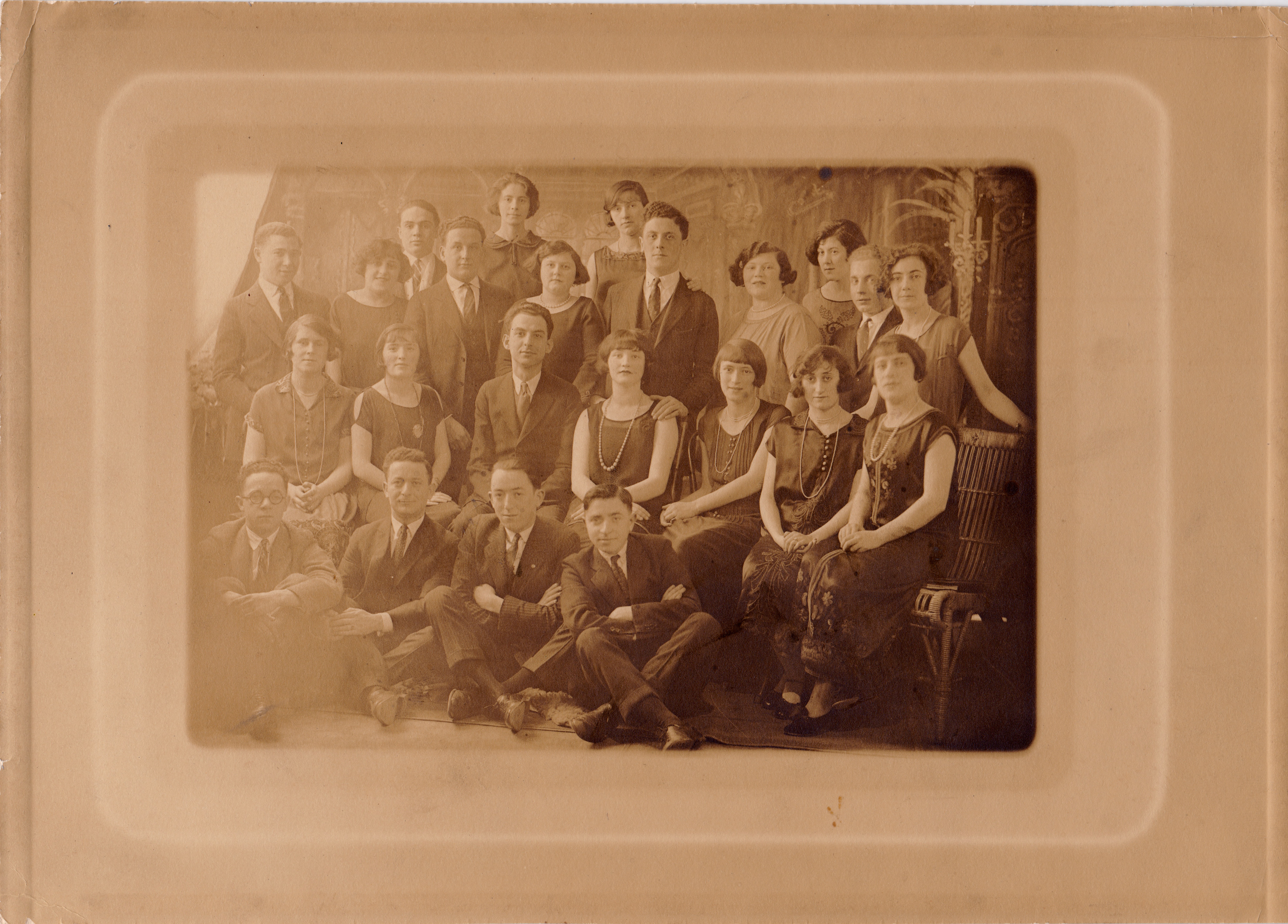
Grandma Thelma graduation from night school she is second in middle row

A favorite was group photo of our Grandma with the other students, when she graduated from night school, after immigrating to the USA in the 1920s.

The attic held a bonanza of information! We actually thought we had found it all because previous cleanings we had found 8mm movies that my brother had turned into DVDs and other photos that I had used to make a book of family history.

But the most amazing find was a photo album of my grandmother from before her marriage. There was one young woman in many of the photos with Grandma. We were sure it was her best friend and cousin, Katie. But there were no names written on any photo. It was so frustrating. But then we found a more recent photo with my grandparents and another couple. In this one the woman was identified. And yes it was Katie. My sister and I were so excited!! When we compared her face to the young women in the photos we knew that we had discovered and identified our lost relative.

There are many photos in the album that were taken in Europe. On the back many are inscribed to my loving cousin, Tova, in Yiddish and in German. I think they are photos given to her before she left Poland for the United States in 1922.

I have that album with me now. I am going to try to match some of the unnamed people with photos that we have where people are identified. I have already found photos of my grandmother’s siblings.

It is a puzzle, and I am determined to make as many matches as possible because these old photographs bring my grandparents’ and parents’ memories back to life.


“Abi Geszunt, Zie Geszunt “: As Long As You are Healthy, Be Safe

10 Jul

I have a vested interest in the survival of the state of Israel. Besides being the home to the descendants of my relatives who survived the Shoah, and to family members who made aliyah from the US over the years, it is also the home of my daughter.

For a year in 1974-75, I studied at the Hebrew University in Jerusalem. I met many young men and women who had survived the Yom Kippur War, and were still in shock over what had occurred. Those who had served in the Sinai, I think were forever scarred by the horrors they encountered and the many deaths they saw. We lived on edge that year, never knowing if there would be a flare up.

But that year changed my life. I instilled in my children a love of Israel. I took them to Israel on a family trip. I told them how our family moved there. I wanted them to understand the importance of having a Jewish homeland.

I never hid from the dark side of Israel: the harsh realities that Israelis must face each day. Let terrorists sneak in, or build a wall/fence?   Show weakness, and then more will die. Be strong, because if Israel is not strong, then the country will be destroyed. It is difficult to live with these pressures. But while we must still be strong, we must also be compassionate.

My daughter took my words to her heart.   During the summer of her junior year of college, she studied at Tel Aviv University. Then she went to Israel after finishing college and studied for two master’s degrees there. At Ben Gurion University of the Negev she earned a master’s in Middle Studies, and then went on for a second master’s on the Politics of Conflict.

She spent a year back in the USA, where she interned at Planned Parenthood in Kansas and was a substitute teacher at the Hebrew day school she attended as a child. But then she decided that she had to make aliyah –that living in Israel was the only option for her.

Abi Geszunt. Zie Geszunt. When I went to Israel for my one-year program, my Grandma Esther would send me articles from the newspaper about what was happening in Israel. Her notes said, “You could kill me in other ways.” Grandma Esther was the queen of inducing guilt. But I still went. My Grandpa Nat said, “Abi Geszunt. Zie Geszunt.”

My husband and I went to see our daughter when she was studying for her first master’s degree. We were standing at the Air Force Museum (in the Negev) with a young soldier when several Israeli fighter jets took to the air. The soldier and I looked at each other. And I knew that soon life in Israel would change.

Before I left for the US, I told my daughter, “Be careful. (Abi Geszunt). Something is brewing (Zie Geszunt).”

And a few days later Cast Lead began. I was on the phone with her one day when the sirens went off. “Mom,” she said, “Don’t worry if the phone disconnects. That often happens when a rocket hits.” She had 60 seconds to take cover.

“Where are you? Is your head covered?”

“I am under my desk. Don’t worry, I have my hoodie on.”

I heard the rocket hit. I heard her roommate tell her to stay down, that another one would come. I heard the police loudspeakers telling people to stay inside. And my hair turned whiter. I prayed. Abi Geszunt. Zie Geszunt.

And so when events in Israel flare up, I become somewhat anxious.

The past few weeks have been horrible with the abduction of the three Israeli teenagers. And when they were found buried in a field, I felt the same horror everyone else felt. But my world changed a bit when I found out that a group of Jewish settlers were the possible murderers of an Arab teenager, a revenge event.

In my mind Jews do not participate in senseless hatred. And two wrongs never make a right. Those who killed Mohammad Abu Khedair are just as evil as those who killed Naftali Frankel, Eyal Yifrach and Gilad Shaar, the Israel Jewish teens.

Those who preach hatred against all Arab Moslems are wrong. Target the evil! Hamas is evil in my opinion. The teaching of hatred is wrong in my mind. The constant bombardment of rockets into Israel, into civilian territories, is evil in my mind. But we must remember there are people on both sides who want this seemingly endless cycle to end.

In my heart, I knew the death of the Moslem youth would just put more credence to Hamas for the ever increasing bombardments. I knew there would be an escalation of hostilities. I guess I expected the Hamas response. It was as if they were looking for a reason to escalate the bombardments into Israel, to bait Israel into attacking them.

Now it has happened. Bombs are flying back and forth. People are dying. Young men are being called up for military duty. Smoke rises over the cities and the Gaza. The rockets from Gaza reach further than ever before. Jerusalem and Tel Aviv are in the bull’s eye.

The Middle East is more stressed than it has been in years.   Iraq, Syria, Lebanon, Egypt all in some degree of turmoil; ISIS declaring itself the new caliphate; Iran and it’s nuclear goals… all of these are potential dangers to Israel and the world.

I see what is happening in Israel, and I worry. Not only for my daughter’s physical well being, but also for the mental and moral wellbeing of her and any family she might one day have. However, I had one less fear this week, as my daughter is in the US for our niece’s wedding until the weekend.

I taught my children that racism and baseless hatred was wrong. I have worked for years on interfaith events and building bridges between people of all religions. More than anything else I want an end to this endless cycle of violence.

My daughter returns to Israel this weekend. She returns to the new life she has made for herself. She will leave the safety of Kansas. And I cannot stop her.

All I could do is say, “Abi Geszunt. Zie Geszunt.” As long as you are healthy; be healthy. Of course, what I am really saying is, “Be safe!”

Be Safe everyone!


“Abi Gezunt” song by Molly Picon. http://www.milkenarchive.org/works/lyrics/547

A Strand of Pearls is Not Just Jewelry, It is a Circle of Love

6 Jul


To me wearing my pearls infuses them with love.

To me wearing my pearls infuses them with love.

I wear two strands of pearls to every family wedding. One strand, the longer one, belonged to my mother-in-law, Lee. She died when she was only 59, but I know that she would want to be at every wedding of her grandchildren and family members. The other strand, is slightly shorter, but has a lovely clasp. It belonged to my Mom, Fran. She also loved weddings and would want to be at every family wedding! Amazingly both strands of pearls have the same size pearls. And they look so good together.

Last night I wore the pearls to the latest family wedding, our niece. The pearls came up in conversation, and I told my brother-in-law, and another nephew and niece, why I wore two strands. My brother-in-law said, “I know they are here.” And my nephew and niece, who knew my Mom but not his own Grandma, said, “Your Mom would have loved the weddings.” And it is true.

It makes me feel as if these two wonderful women were there with us when I wear these necklaces. Pearls are so warm. And to me their glow sends off the warmth of love.

Pearls have much meaning in my family. My grandmother had opera length pearls. And my mother had them made into three necklaces, once for each of her granddaughters. As they turned 18, each girl was presented with the pearl necklace from my mother.

Unfortunately she passed away a few months before the youngest turned 18.   My Dad had us present the pearls to my niece in the hospital where my mother was soon to die. I know it was a difficult time for my niece. But I hope as time has passed she realizes how much her grandparents loved her and how important it was for my Dad, her Grandpa, that she get the pearls while Grandma was still alive.

My Great grandmother, for whom I am named, gave my Grandma a strand of pearls in Europe in 1932. They would have been mine. But another relative stole the pearls while she was in Europe. She always suspected who had taken them.

Over 40 years later he wrote her a letter. He had survived the Shoah, but his entire family had been killed, his wife and his children. He blamed himself. He believed that if he had not stolen the pearls, they would have lived.

I know this because I met him. I was living in Israel at the time. My Grandma Thelma wrote to me to meet up with “the goniff.” He was going to give me 400 lira…about $100 at the time. I was to take some of the money and buy myself something and give the rest of the money to my great uncle.

I met Zissel and he told me his story. He was a sad, sad man. He told me how his family had died and the horrible things that occurred to him. He told me how he had stolen the pearls.

“Your grandmother went into the bathroom to bath. When she came out the pearls were on the sink. I thought, she lives in America; she is rich. I can use these pearls more than she can. And I took them. Now everyone is dead, and it is my fault.” Zissel and I both cried as he told me the story. I was only 19 years old. The pain of that day lives with me. He believed if he paid my Grandma back, it would take away some of the guilt. I hope it did.

I began to visit him whenever I was in Tel Aviv. He worked in a bakery across from the giant shuk. I would meet him there, get a pastry and tea and talk to him Sometimes I would go back to his apartment.

When my parents came to visit me in Israel, I took them to see Zissel as well. His Yiddish was much better than his Hebrew. So when my parents came, he spoke mainly to them in Yiddish. He told more stories. And my mother and I cried along with him. I hope that his sad soul found peace.

The pearls were a bond between Zissel and me.

And so for me pearls, any pearls, have a story to tell. My mother-in-law’s
pearls and my mother’s pearls will be filled with joy as they experience only happy events. Every wedding will bring happiness to these pearls. And the sadness of the pearls that Zissel took will be wiped away.

The pearls my daughter and nieces have are also filled with love. And when I see them wearing my mother’s/grandmother’s pearls, their great-grandma, I know that the love of these two women are surrounding them.

A strand of pearls is not just a piece of jewelry, it is a circle of love.


How World War I Saved My Family or My Grandpa Was A Draft Dodger

25 Jun

World War I changed the world! One hundred years ago, Europe became a place of desolation and devastation. Young men from both sides were killed. Millions perished. From all I have read, it was horrible. The use of gases so horrific that laws were later passed banning the use of these and all future chemical weapons. We know that sometimes they are still used. But the world peoples are united against them.

For my family, World War I actually saved my branch of a family. My Grandpa Nat, you see, was a draft dodger.   As he would explain it to me, Jews in Galicia did not really have a chance in the military. They were often put in the worst positions, meant to die. And if they survived, they were conscripted for 25 years. So they never were able to live a Jewish life or return to their families again.

In 1918, when my Grandpa was about 18, his life changed; he received the dreaded notice that he was to report for military duty. It sent his family into action. Nissan, as he was known in Europe, had to be smuggled out of Galicia to save his life.

Thus began my Grandpa’s two-year journey to salvation and survival. He left his home in the middle of the night with just those things he could carry and wear. His intention was to get to British Mandate of Palestine and join the efforts to create a Jewish homeland. But his first goal was to get to his cousins in Belgium.

He wandered through Europe during the battles of 1918 and the aftermath of the war. Slowly making his way to Belgium. He had no real passport. Instead he was using the passport of a dead cousin.

Eventually he made it to Belgium and his cousins. Their reaction to his wish to travel to Palestine was, “Why go to Palestine? It is a desert! Go to the United States, to the Golden Medina. You have an Uncle there. He will help.”

So my Grandpa contacted his Uncle Julius, known as Uncle Yidel to us all, his mother’s brother. Uncle Yidel agreed to sponsor Grandpa to the United States.  But he had one problem, he had been robbed along the way and had to work to earn the money to pay for his trip to the United States.  But finally, after about nine months, the last leg of his journey began. Fortunately for him, his uncle did sponsor him, because when he arrived in the port of New York City, and the immigration site of Ellis Island, he had just a nickel. Without a sponsor he would have been sent back to Europe.

Grandpa often would tell us that we could be whatever we wanted to be. “Look at me,” he would say. “I came to this country with just a nickel in my pocket. And look at what I have.” So we learned early on not to complain to Grandpa and to never give up!

I tried finding my Grandpa’s immigration information from the Ellis Island sites, but could find nothing. My Grandma’s was easy to find. So I often wonder what that passport actually said. And how old he was supposed to be? But in 1920, immigration procedures were not as intense and documentation was not as precise as it is now.

Tanta Molly and Uncle Yidel

Tanta Molly and Uncle Yidel

Uncle Yidel and his wife, Tanta Molly (also known as Malchik)  welcomed Grandpa.

Growing up in Europe, my Grandpa had been a yeshiva brocha, a student of Torah. He had a beautiful singing voice, and perhaps might have been a cantor. But instead, somewhere along the way, he learned to be a baker. When he first came to New York, he worked two jobs. One as a butcher, the other as a baker.  But it is as a baker that he prospered in America. He and Uncle Yidel started a bakery eventually owning a building in New York City. (My Grandma told me that when Grandpa proposed he told her he had a place. She thought he rented an apartment. She did not realize he owned the building!)


Grandpa in his bakery in West New York, New Jersey, 1942.

Grandpa in his bakery in West New York, New Jersey, 1942.

They separated the business after my grandparents married, and Grandpa and Grandma opened a new bakery in Linden, New Jersey.  But in the early 1930s, when my grandmother took their children to Europe for six months, Grandpa sold the bakery in Linden and opened a new bakery in West New York, New Jersey.  He kept this bakery for over 35 years.

Grandpa had many cousins in the United States. His parents were first cousins. So he was double cousins to many of the family. They helped him settle in. But Uncle Yidel was the most important. Uncle Yidel and Tanta Molly were always a part of our lives. They had one son, Ezra.

Whenever we went to see them, we were welcomed in Yiddish. Tanta Molly would come running out to hug us. She would call out our Jewish names: “ Tovaleh, Fagaleh, Chavaleh!” I asked my Mom, “Why does she put an ‘aleh’ on all our names?”

“It means little,” my Mom replied. “Well that did not make sense, Tanta Molly is littler than us!” Was my response. “It means she loves us,” Mom laughed as she said that. Later I found out the ‘aleh’ did mean little, but really was an endearment.

My Grandpa always missed the hills of Galicia. He often told me that he bought his property in the Catskills because it made him think of his home and his childhood. Many years latter when I traveled to that part of Europe, I saw he was right. The rolling, low mountains and hills do look like the Catskills.

My Grandpa forever missed his family. World War I did save him. He came to the United States. But his parents, siblings, and many aunts/ uncles/cousins stayed in Galicia. They all perished in the Shoah.

My Grandpa Nat was a draft dodger, but he never stopped fighting for the right to practice his beliefs and to protect his family in the USA. He loved America. He never traveled outside of the United States. When asked, his reply was always:

“Why would I ever want to leave here? It is the best place in the world.”