Archive | Travel RSS feed for this section

Visiting the Van Vleck House and Gardens

3 May

Another delightful site to visit in Montclair is the Van Vleck House and Gardens.  Once a private estate, the house and its gardens were donated to The Montclair Foundation in 1993 by the heirs of Howard Van Vleck, who owned this Italianate villa.  The house was built in 1916.  While other homes once were on the estate as well, this is the only house that still remains.

img_3092

img_3108

The original main entrance to the house on Van Vleck Street.

The gardens are open to the public for free every day!  No holiday closures!  The lovely house is used as a center for nonprofit groups for meetings, events, and fundraisers.  I actually saw people having a yoga class in one of the rooms! What a spectacular yoga studio!  The windows overlook the gardens!

The house and gardens were a short walk from the Montclair Art Museum, just along Upper Mountain Avenue.  Our visit came after several days of rain, so all the grass was lush.  But the blooming season, except for the daffodils was not yet in progress.  I think by the end of May these gardens will be stunning.  When we saw them, everything was greening up, but not much was flowering.

img_3101

The formal garden in the back of the house.

There are several walkways and levels of gardens.  The formal gardens behind the main house are lovely. Staff members were setting up for an event when we were there, so we tried to stay out of the way. Although not much was blooming yet, it was a great place to get a good walk in a lovely setting.

img_3097

One of my favorite spots.

The Upper Lawn had several stations to check out.  You can download the Van Vleck house’ app and learn about the different areas using codes on the signs.  I liked an area on the upper lawn that had many daffodils and a bird house.  When you walk across the upper lawn, you come to the Mother’s Garden and then to a percola that was renovated.

At first, I was not sure if you were allowed to walk on the lawn, as there were no paths. But seeing the information signs across the way gave me some confidence that this was acceptable.  Also the Garden Etiquette flyer we picked up at the Visitor Center, says, “Walk only on the pathways and grassy areas.”  So we did!

img_3094

The Visitor Center with an Ap sign.

The children’s butterfly garden should be lovely as well. It is located behind the Visitor Center. (Where there are good restrooms.  Always important when walking.)  I also liked the colorful signs with details about insects and disease impacting trees and what to look for that lined the path from the butterfly garden to the front of the Visitor Center.  I was glad to see on the website that there are many children and family activities planned throughout the spring and summer.

img_3095

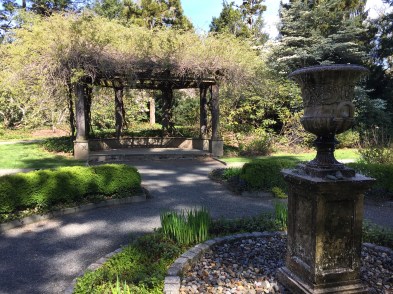
The pavilion by the Tennis Garden.

We did not go on the Rhododendron Walk.  It was somewhat muddy and damp, and I was not in the right shoes for that.  However, I did enjoy the Tennis Court Garden, planted where the estate’s tennis court once stood.  To the side is little pavilion.  I could, in my mind, see people resting there between sets of tennis, or watching those playing while enjoying the shade.

I hope to go back to Montclair and visit the Van Vleck gardens when everything is in bloom!


To learn more about the gardens and home, go to: www.vanvleck.org


A Little Gem, the Montclair Art Museum

1 May

img_3053

I just spent five days in Montclair, New Jersey, visiting my sister who recently moved there.  When we drove to her apartment, we passed the Montclair Art Museum.  Outside many of its trees were covered with crochet and fiber art works, my attention was immediately captivated.

She knew what I was thinking.

“Yes, we are going.  I knew you would want to go.” And I did.  I crochet; I knit; I sew; I have embroidered; I do candlewick embroidery; I needlepoint.  In simple terms, I love fiber arts.  And this display was calling my name.  I wanted to take photos of the trees from her moving car.  But she told me to calm down.  We could actually easily walk over to the museum

img_3056

On exhibit at the museum is the 2019 new Jersey Arts Annual – Crafts, “New Directions In Fiber Arts.”  It will be at the museum until June 16, 2019.

There was felt art, and crochet art, and quilt art.  Each of the 32 artists have their own specialty.  Each is special.  But I must admit, I have my favorites.

One artist, Jeanne Brasile, does water color and embroidery over braille newspapers.  I loved the geometric shapes and the colors of her work. They are delightful. Another, Robert Forman, makes yarn paintings.  I liked how the yarn formed another painting over the existing work.  You sort of see two different works of art at one time.  Geri Hahn sees art in musical sounds.  Her work on fabric looked like butterflies dancing to me. So Yoon Lym’s lovely felt painting looked like a water color.  I also enjoyed the story quilt by Faith Ringgold.

But every artist’s work had something to intrigue.  I enjoyed that each one wrote a statement about their work.  I, of course, read every one.  But I also purchased the booklet that went along with the exhibit to help me remember.  Actually, I should be honest, my sister purchased it for me, as she is a member.  Thanks!

img_3047

I also liked that scattered among the art works were little signs called Family Threads for family activities and questions.  This made the the exhibit much more interactive and family/child friendly.

The fiber exhibit was not the only gallery that I enjoyed.  Currently, the “Undaunted Spirit: Art of Native North America” is also on display until mid-July.  Part of the display, the baskets, I believe, are always on display.  The gallery that housed this exhibit, The Rand Gallery, is named for Annie Valentine Rand, and some of the many Indian art baskets and art works that were collected by her and her daughter, Florence Rand Lang, are on display there.

In March, my husband and I  spent a week on the Navajo and Hopi Indian Reservations in Arizona, so I was fascinated by the many baskets which reminded me of what I saw in Arizona.  But seeing the art work of the Plains Indians also called out to me as I live in Kansas and enjoy seeing Indian Art locally as well.

My sister and I loved walking through the room filled with George Inness paintings. Many showed scenes from Montclair in the late 1890s.   My favorite was the Niagara Falls and Winter Moonlight.

Outside of the walled museum, there are art sculptures on display.  But for me the fun was walking to each tree and seeing the fiber art that encompassed the trunks and some of the branches of the trees.  I love seeing yarn bombing examples.  I felt a bit badly as it rained several of the days we were there which was dampening to the art and to the spirit.  Luckily, a break in the rain helped our visit to the outside grounds more enjoyable.

The museum is closed on Mondays and Tuesdays, and open from 12 – 5 pm on the other days. To find out more about the museum and its programs and events go to  www.monthclairartmuseum.org


Adventures in Mathematics at the National Mathematics Museum

29 Apr

After a losing hope about the state of mathematics in the world, I was delighted to learn about and visit the National Mathematics Museum (MoMath)in New York City. Located at 11 East 26 Street, it opened to the community in December 2015. It is worth the trip!

From the Pi symbol door handles to the hologram engraved art work, each inch of this museum is filled with interesting sites and many interactive activities! I loved riding a bicycle with square wheels. It was a little hard on the rear! But fun.

We three adults were having as much fun as the children. There are two floors of activities that parents and children can work on together. Some are math and logic problems to solve. Others are just fun activities like watching your arms branch out into fractals in a living tree exhibit.

I wish I can tell you my favorite activity, but I cannot since so much of it was great fun.

There is also a room where temporary exhibits are housed. When we were there it was unbelievable math art that has to be made through 3-D printers. And fantastic origami art.

The gift shop is packed with educational games and activities to buy. More important this museum is open every day except for Thanksgiving! Need something to do with your children school age and older, go here! There are events and activities listed on its website which I put below.

It is an easy walk to Madison Garden Park where you can sit for a bit and people watch, take great photos of the flatiron building and buy lunch or a snack.

Being there gave me hope. There are parents and children and grandparents interested math and learning. I did not see one frown while there, I just saw adults and children intrigued by what they were seeing and learning while having an adventure at the MoMath!

Www.momath.org

Counting the Hogans Leads Us to Learning More About The Navajo People

28 Mar

As part of our Road Scholar trip we were often on the road in a bus going from one place to another.   I need activity.  I remember when my children were young finding something to count along the way: water towers, yellow cars, different license plates, helped.   Soon I found myself counting the hogans.  Joining me was my partner in anxious inactivity, we traveled with another couple, and the husband and I share this trait.  We sat by the windows and started counting.  I must say that I was better at discerning the shape of hogans better than he.

What is a hogan and why count them, you might ask?  I am glad to explain.

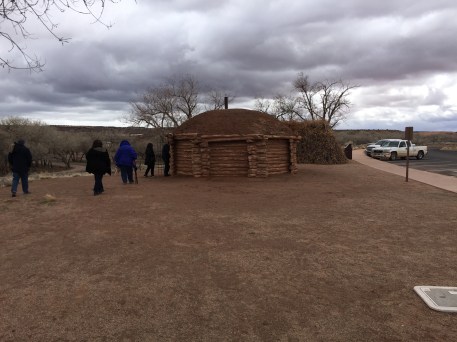
A hogan is a Navajo hut/home.  Originally there were two types.  The simple, smaller, tipi style Hogan was called a male hogan. They are made of wood covered in mud. These were usually used and lived in by single men.  But anyone could live in them.  It is not gender assigned in that sense.

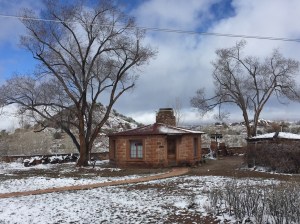
A beautiful stone Hogan on the grounds of the Hubbell Trading Post.

The other, female hogan is much larger.  It is often multi-sided ranging from 6 to 9 sides, with differing explanations why. But one guide told us a nine-sided hogan is to represent the nine months of pregnancy.   Both males and females can live in a hogan.

The opening of a hogan always faces east to welcome the morning sun.

Although many Navajo families still have a hogan on their property for ceremonial reasons, most no longer live in hogans.  However, that is not an absolute.  They are inhabited as well.  They can also look different now.  No longer are they just mud-covered beams of tree trunks and branches, they can be made of brick, stone, wood, shingles and siding.   We saw it all.  Some have had additions put on to make them bigger.  Others stand alone and silent, somewhat decaying.  Others have had windows installed — no longer with just an opening in the east and on the ceiling to let the smoke from the stove or fire vent.

We saw our first hogan in the Heard Museum in Phoenix.  The guide explained to use how they were built and why they were used.  Being that it was inside and enclosed in the museum, it did not face the elements ,and you really could not tell that it was facing east.  But it was interesting to see.

img_2281

Hogan at Canyon De Chelly

The second hogan we entered was at the entrance to the Canyon De Chelly National Monument on the grounds of the Welcome Center. This hogan was outside.  Our guide told us stories about his family and what his grandmother told him about the meaning in parts of the hogan.  Much we had heard from our guide at the museum, but his tellings were more authentic.  Our Road Scholar guide explained later that different families have slightly different opinions. And she did correct one bit of information he gave us.  Thank you Azalia!

img_0078

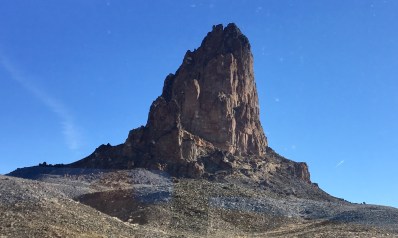
Agathla Peak or El Capitan 

Our third entrance to a hogan was at a rest stop near El Capitan.  First the beauty of the surrounding area as we drew closer to Monument Canyon was stunning.  Seeing El Capitan, or Agathla Peak, an ancient volcanic plug in the horizon was amazing.  We eventually got much closer to it.  So at first I did not notice the hogans, but there they were with some information about them.

The rest stop featured two hogans, both the male and the female.  Thus for the first time we could enter the smaller one and see how it was made. I loved seeing how the interlocking forked branches and tree trunks formed the top of the male hogan.  To be honest, it was quite small, and I can see why it has gone out of use.  Unless you are camping or living off by yourself, there is not much room but to sleep and take shelter, so it is not a great living situation.

The female hogan is much better for families or daily living. The way the logs were formed for these is much more intricate, with layers of logs forming a design in the ceiling.  Some female hogans have the side logs layered horizontally. Other are formed by longs standing upright, vertically around the exterior.

So why count hogans? Well as we drove through the Navajo reservation, we had plenty of time on the bus.  And although much of the scenery was breathtaking, there were also many areas where we drove through empty dessert, except every so often we would see a group of homes where a family had its compound.  And there, among the more modern homes was often an original or remodeled hogan.   So we did what any child would do on a long trip, we found something to count and to discuss.  We counted 15 hogans.  They were a variety of colors, symmetry, materials, and shapes as we saw several connected to other additions.

Counting hogans led us to discuss what we were seeing.  How do people live out here in the middle of nowhere?  We found that solar panels have helped with electricity.   That water has to be brought in.   That addresses are basically non-existent.  Residents of these isolated compounds tell visitors to go to a certain highway marker and turn either left or right and follow a dirt road to get to their homes.

I am glad we started counting hogans because this led us to learn more about the Navajo people and their life on the reservation.


Navajo Tacos, Fry Bread, Challah and the Shehechiyanu

26 Mar

Part of the learning that we experienced on our trip to the Hopi and Navajo reservations was eating some of the typical foods, focusing on fry bread, corn mush and hominy, Navajo Tacos and a beef/lamb stew.

I realized that the only bread I was going to find on the reservations was fry bread.  Made of just a few ingredients, the important part of fry bread is that it is fried, traditionally in lard, but when we had it, fried in either olive oil or Crisco.  We were fortunate in that we experienced food prepared by family members of our guides.

The first meal was prepared by our native Hopi guide’s (Raymond) wife.  She made corn hominy, which took hours to prepare, fry bread, and a pepper, as well as a bean and beef mixture that you eat on the fry bread.  After the meal his wife explained how she cooked it, about the four colors/types of corn: blue, red, yellow and white.  It was important that we understand that anyone who shows up at their home is always welcome to join the meal.

Our second home cook meal was made by Azalia’s, (our Navajo guide) mother and aunt.  This included Navajo tacos, which is fry bread, beans and meat mixture, lettuce and tomatoes.  They also had a soup/stew and blue corn mush (sort of looks like cream of wheat).

The best part about this meal, is that they showed us how to make fry bread and several people attempted to make it.  While some tried to make it, I took photos.  I learned that fry bread is made sort of like a little pizza.  The dough is thrown and formed.   Then instead of baking, it is fried.  Before you put the circle of dough in the pan, you have to wait for the oil/Crisco to be steaming.  As the fry bread cooks, it bubbles up.  Then as it turns a bit golden brown, it is ready to come out.  At this point I found the way I like to eat fry bread, dip it in honey. Or pour honey over the bread.  Delicious.  It sort of reminded me of a Louisiana, New Orleans beignet.

I have to admit, we had a small Jewish moment over fry bread.  One of my newly made friends was so excited about her completion of the fry bread, that I told her we needed to make a blessing.  Since she is also Jewish, I thought a Shehechiyanu, the blessing over doing something for the first time would be appropriate. Five of us stood together and blessed her accomplishment.  It made sense, as the Navajo and Hopi are very spiritual people.

The other exciting part is that our guide’s mother gave some of us some blue corn kernels to take home and plant!  I am hoping it will grow in Kansas.

It interesting to see was how she fit so many people into their home.  This is a common occurrence in their culture, where everyone is invited to special events, and like the Hopi, anyone who shows up is feed!.  They took boards and covered them with white paper, and put on stools.  We used that as a small table.  It worked great!

I enjoyed the educational component of the Road Scholar journey.  Often, I am telling others about my cultural foods, especially the ones that we make during Passover like charosets.  Having meals made by experienced members of the Hopi and Navajo tribes was so special to me, that they took the time to give us this experience.  It was a joy to be a part of this group.

However, I will admit, that by the time I got home, I was happy to have a piece of my culture’s favorite carbohydrate, a slice of challah.

When A Trading Post Becomes A National Park or A Grand Canyon Hotel!

23 Mar

Part of our tour of the Navajo and Hopi reservations were visits to different trading posts and shops along the way.   But nothing prepared me for the wonderful Hubbell Trading Post National Historic Site in Ganado, Arizona.

First you need to know that I love historic homes.  Show me a home museum, and you have shown me the spark of joy!   The Hubbell Trading Post combines the history of trading between the outside world and the Navajo as well as a historic home.

The trading post itself was an important commerce arena for the Navajo.  John Lorenzo Hubbell, his wife, Lina Rubi, and their children were friends to the Navajo people.  Although they made money off of them through the trade of their native art works for goods sold at the trading post, they cared about the people.  This shows in the fact that the Hubbell Trading Post was under the business eye of the Hubbell family from the 1880s until well past Hubbell’s death in 1930.  In fact a member of the Hubbell family ran the trading post until  1967, when his daughter-in-law Dorothy Hubbell sold the post to the National Park Service.

The Trading Post still works as a trading post today along with the US post office at the post.  Today it is managed by the Western National Parks Association, with the profits going to programs of the National Park Service.

But seeing and shopping at the Trading Post is not the only highlight of this visit.  We also had the opportunity to see the Hubbell home, which sits behind the trading post.  The big central room has three doors on each side leading to the bedrooms used by John and Lina and their children.   We did not see the kitchen, which was a separate area.  But we were happy to see the house.  It was a snowy cold day and they allowed us in, with the caveat that we had to take off our shoes!!!  BRRRR.

The original woven rugs are no longer on the floors, but the recreations are also stunning.  The walls filled with painting and art work, the ceilings covered with woven baskets, the giant wooden beams, the high ceilings, the unusual lighting, all create an atmosphere that gave me joy.

img_2271

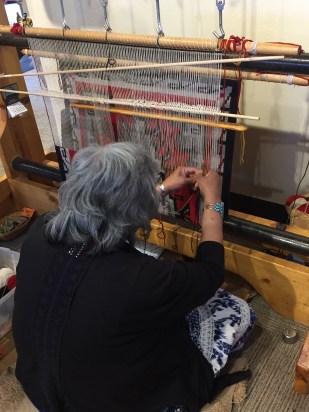
The Visitors’ Center a few steps away from the Trading Post was also a great stop.   Inside you can pick up brochures, learn about the history of the trading post. The display about weaving was wonderful.  The best part was the opportunity to watch a woman weave in the traditional manner.  Well worth the visit!

Seeing the Hubbell Trading Post would have been enough for my trading post desires, but we had an additional bonus. The last night of our trip was spent at the hotel at the Cameron Trading Post. Just over 100 years old, (founded in 1916) it is just one mile from the Grand Canyon and just steps away from the Little Colorado River.

img_2511

The enormous store or trading post is filled with items from the Navajo and Hopi.  It was a feast for the eyes, but not for the wallet!!!  We went through the shop many times on our way to the restaurant, and just for entertainment.     The dining hall was a work of art itself with its tin ceiling, wonderful rock fireplace, rug hangings and antique windows.

We enjoyed the night in our spacious hotel room where we could easily go out and see the bridge that spanned the river.

img_2515

I was glad that we were able to learn the history of trading posts that were positive for the Navajo and Hopi peoples.  It was exciting to spend time at them and to learn about the importance in the past and their continued importance now.


What I learned About Hopi Pottery and Navajo Jewelry

21 Mar

As part of our study of the Hopi and the Navajo cultures, we did not just go to museums, we also learned from people who live on the reservation.   Learning about the crafts of Hopi pottery and Navajo silversmithing increased our knowledge about how these crafts passed from generation to generation forming a bond that helped their families survive harsh times.

On the Hopi reservation we met and watched Dorothy Ami as she taught us the art of Hopi pottery. Although her first interest in pottery was just for enjoyment, she eventually apprenticed herself to her cousin, Mark Tahbo, who was a well-known Hopi potter. Both Dorothy and Mark were descendants of Grace Chapella, who learned her craft from one of the original Hopi women who re-introduced pottery to the Hopi Reservation, Nampeyo of Hano.

Our morning with Dorothy was inspiring as we watched her create a pottery bowl; viewed her finished items, and watched her finish painting another bowl.   She spoke to us as she worked explaining the history of Hopi Pottery, about her family, and the way the clay and sandstone come together to form a pot.

Hopi pottery is not spun on a wheel, instead it is made by free hand. She mixes the clay and sandstone, using different colored clay for different types of pottery. She knows when the mixture is ready by tasting it! To make a pot she first forms the first bowl.  She then makes coils of clay and builds the pot, which she then smooths and then burnishes with a river bed rock.

“I let the clay take over,” she told us.  “I cannot force it into a shape.”  After she burnishes a pot that is formed, she thinks about the design for that pot and draws it on a piece of paper.  She knows what each color clay turns when it is fired.  And what the different natural colors that she uses to paint turn as well.

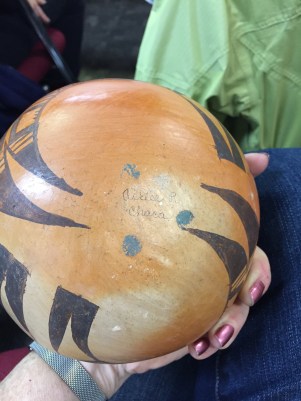
Her pottery pieces were lovely.  To see them in each stage, being formed, burnishing, painting, painted but not fired and then fired, added to my appreciation of what she does and how her art has helped her family survive in a situation where many are unemployed. Hopi pottery making is a skill and a craft that spans generations.  Her children and grandchildren are also now making pots.  And one of her prized possessions is a pot that her grandmother made that she was able to purchase off of EBay!

img_2185

Dorothy’s grandmother’s pot.

Our guide, Azalia Begay, is also an artist.  A member of the Navajo Tribe, Azalia learned the craft of jewelry making from her grandfather who was also a silversmith.  Like those who learn Hopi pottery, the Navajo who learn silversmithing always have an opportunity to have an income in a tight economic situation as exists on the reservations.

For the Navajo people, the art of jewelry making came mainly after they were forced off their lands in the Canyon De Chelly and forced to walk to Fort Sumner in New Mexico.   Many learned the skills of blacksmithing while they were imprisoned for four years at the Fort.  When they returned to Arizona and their Reservation and lands, the skills they learned as blacksmiths became skills that could be used for silversmithing and jewelry making.

The use of turquoise came even later.  The color of turquoise represents the sky to Navajo and it is a symbol of good fortune.  In the late 1800s the Navajo artists combined their silversmithing with the turquoise and an art form was created.  Azalia told us the differences about natural, stabilized, re-constituted and block turquoise.  Don’t ask if it is real.  All of these are real to a degree.  Ask more detailed questions!!!

Azalia uses silver, turquoise and coral to make her lovely designs.  We had the opportunity to watch her make a piece of jewelry as she told us the story of how she learned to make jewelry from her grandfather and the story of the first pendant she made.

After her demonstration, she asked if we would like to see her work.  Of course we did!  There were three pieces that I fell in love with and would like to own.  That was a bit out of reach.  But one piece called my name, and since it was soon to be my wedding anniversary, I thought I needed it.  Azalia makes turquoise and coral into beads.  My necklace is a five-strand turquoise beaded gem!   The other two pieces I loved were also purchased by women on our trip.   We all were delighted with our new original and one of a kind Navajo jewelry.

An added bonus of buying the anniversary necklace was that Azalia helped me search for the perfect pair of earrings to wear with it. We found them from a jewelry vender at the stop in Monument Valley by the John Ford Point, which also has meaning in my life. ( See blog below.)

Learning about a culture includes learning about the crafts that they use to beautify the world around them.  Learning about Hopi pottery and Navajo jewelry enhanced my knowledge about life on the reservations.


 https://zicharonot.com/2019/03/16/monument-valley-invokes-images-of-my-dad/

https://www.adobegallery.com/artist/Mark_Tahbo7775040

https://www.adobegallery.com/artist/Dorothy_Ami196281153

http://aroundtherez.blogspot.com/p/navajo-artist-profile-azalea-begay.html


Pueblo Grande and the Heard Museum Starts Our Quest into Native Cultures

19 Mar

We recently went on a Road Scholar program to learn about the Hopi Mesas and Navajo Lands of Canyon de Chelly.  Our first stop on this journey was Phoenix, Arizona, where we met up with the group of 34 including our two guides.

Before it started, my husband and I discovered the Pueblo Grande Museum and archeological park.  We arrived hours before our first program was to start, so decided to walk from our hotel to a restaurant nearby.  Right across the street from this museum.  What a delightful accident.

First stop, when entering the museum was a short movie about the Hohokam people and this site. It helped to adjust our minds back in time to the lives of those who lived here.  The museum showed us what was found in the site and explained more the way of life.

After we exited the back door, we walked through the grounds and the 2/3 mile loop around the ancient platform mound, which dates to the 1400.  We saw the evidence of the Hohokam people’s irrigation canals and homes.  We were amazed by the large oval ballcourt that was used, they believe from 750 – 1200 AD.    This court was my favorite part of the archeological site, but for many it was the mound. Later in our trip, after I had been on the tops of the Mesa’s where the Hopi live, I could imagine that this platform was built to imitate the mesas.  I don’t know if this is true, but it is my vision of the site.

This was a wonderful way to learn the history of the Pueblo people, the ancestors of both the Hopi and Navajo.

Later that evening, our official program began.  We would go in the morning to our first stop on the official agenda, the Heard Museum in Phoenix.  I had been there before, but without the help of a museum docent.  Having this knowledge helped us understand what we were looking at during the tour of the arts and history of the Navajo people, which is highlighted at the museum.

We saw the pottery, weaving, baskets, wood carvings and jewelry made and designed by the native peoples of Arizona.  I cannot say one was more beautiful than another because each type of art was magnificent in its own way.

img_2131
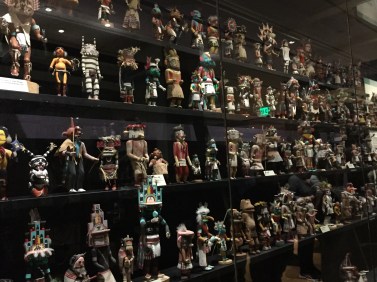
The walls filled with Kachina/Katsina spirit carvings opened my eyes to how these carvings changed over the centuries. And the history behind them revealed part of the culture, how they were used to teach young girls about the spirits that bring rain and information.

img_2123

Seeing the multitude of baskets and pottery and rugs along the walls of the museum, showed me how these home arts went from useful and decorative to now works of art.  The workmanship in the making of these crafts amazes.

Finally, the silver and turquoise and coral jewelry that the Navajo peoples make is stunning.  This is a skill that they learned after the Long Walk, when the people of the Navajo needed to rebuild their community. And the tools and skills they learned in blacksmithing helped them to turn these skills to jewelry design. While the turquoise was considered good fortune as it connected to the blue of the sky.

After our time with the docent, many of us went upstairs to an older section of the museum to view the newly redesigned exhibit on Native peoples and the boarding schools they went to in the late 1800s, early 1900s. These schools were seen as a way to assimilate the children into the Anglo-European culture.   Many still go to boarding schools today, as the people in the reservations are so spread out.  But no longer are they told to not express their own culture.

Day one ended with a long bus ride to the Hopi Reservation and then a two-day stay at the Hopi Indian Cultural Center on the Second Mesa.

Canyon De Chelly, The Most Lovely Grand Canyon

18 Mar

Visiting Canyons seems to be my newest craze.  I have written about seeing three grand canyons in the blog below.  This past week I visited what I think is one of the loveliest canyons: Canyon De Chelly, a National Monument and National Historic Place, located in Arizona on the Navajo Reservation.

Covering over 131 square miles in three canyons that merge together, Canyon De Chelly has been the home of the Navajo people, or Dine, for hundreds of years.  The Canyon itself ranges from 30 feet deep, where you can enter it near the town of Chinle, to over 1000 feet deep.  Its red sandstone cliffs are amazing to see.  The ancient pueblo homes of the original inhabitants can be viewed from the top of the Canyon as well as some by tours to the bottom.

There is more than just beautiful scenery and astonishing sites to be seen, there is the history of the Navajo to be learned.

img_2297

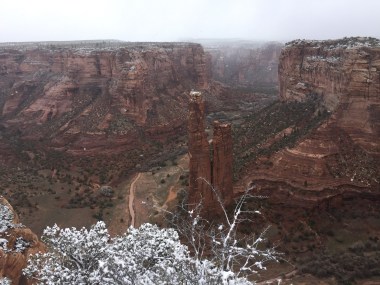
Spider Rock

We visited the rim alongside Spider Rock, where the Navajo believe that the Dine emerged into this world. She helped her people learn skills and protected them.  The Spider Rock is an amazing natural stone structure. To see its reach to the sky from the bottom of the canyon helps to envision the Navajo legends about the Spider Woman who lived there.  How else could one get up there?  It is just majestic as it reaches over 800 feet from the bottom.

Pueblo dwellers also lived in the Canyon.  You can still see the remains of their structures at White House and the Mummy Cave, as well as at other spots.  We viewed these two sites.  And they are amazing that so many centuries later the buildings are still recognizable and seem to exist outside of time.

But it is not only the formations and the ancient pueblos that make Canyon De Chelly special, it is also the history.  Navajo peoples have lived in the valley for centuries. It is here that they had their orchards and their farms.  It is here that Kt Carson, under the auspices of the US government, invaded the canyon to remove the Navajo. He used a scorched earth policy to destroy and starve the people in the Canyon. In an act of terror and misguided desire to cleanse the canyon of its native peoples, thousands were killed and rounded up for a long and treacherous march to New Mexico in 1864, where the Dine were kept prisoner at Fort Sumner for four years.

Finally, in 1868, the Navajo people were allowed to return home to their Canyon and try to rebuild their lives on what was now a protected Reservation. They were not returned to all their lands, but part of them.  This beautiful site still carries the memories of those who did not survive.  Some families still have claim to the land in the canyon’s valley. They still farm there and live there in the summer months.  To learn what happened to the Navajo/Dine people was depressing.  To see how harsh the US was on the first peoples made me want to cringe. But I felt some lightness of spirit to see that the canyon has been returned.

We visited the Canyon in March, where it was not supposed to be snowing, on a Road Scholar educational program.  It was informative and wonderful.  I must say the snow enhanced the beauty of the stone and the canyon.  Although we were unable to go to tour the bottom of the canyon as planned, due to the water and mud, seeing what we did was more than enough to make us deem this the loveliest of the Canyon’s we had seen.

I am glad that we decided to not just go to the Canyon De Chelly, but to have two excellent guides, one Navajo and one Hopi, from the Road Scholar program, who guided us through the two reservations and explained the history of their peoples as well as the magical and beautiful places we visited.

My Third Grand Canyon: Waimea Canyon, Kauai


Monument Valley Invokes Images Of My Dad

16 Mar

Monument Valley straddles Utah and Arizona, but for me it straddles my childhood and adulthood. I often watched old John Ford movies with my Dad, who was a major John Wayne fan. My job was to iron on the weekends, exactly when these old movies were on television. It gave me something to watch as I suffered through this chore and created a bonding time with my Dad.

Dad loved any John Wayne movie, military, westerns, Irish themed. I was more picky. There were three I loved. “The Quiet Man,” “The Searchers” and my favorite of all, “She Wore A Yellow Ribbon.” The last was filmed in Monument Valley, so I knew that one day I would make the trek to see this spectacular site. Finally I made it. It was more than I anticipated.

The visit came on the last touring day of a weeklong Roads Scholar program learning about the Hopi and Navajo Peoples and visiting their reservations. Monument Valley is located in the Navajo Reservation. It was worth the wait. Usually I write about my trips in order. But the emotional impact forced my mind to focus on this experience.

We arrived soon before lunch at the Goulding’s Trading Post, where we had time to visit some of the sites before we had lunch and continued into the valley. The movie crew used some of the outside of the buildings for the movie, including a storage building that became the office of Captain Nathan Brittles. Of course that was my first stop. John Wayne played this character in the movie. And although it is a small space lined with movie memorabilia, it touched a nerve in me. I started to cry as I exited the building, just missing my Dad.

The after lunch experience created moments of awe. As we toured the valley, stopping at many vistas along the way, including John Ford Point, and seeing sites that were visible in the movie, I kept thinking about my Dad. He would have LOVED seeing Monument Valley! He would have told me about every scene with a bit of Goulding’s or the Valley were in.

Dad would have relished the beauty of the valley. The bright red sand stone and majestic buttes would have inspired him as they inspired me. There are no words. Majestic is too small! Unbelievable is too trite! Incredible is ridiculous! Photos do not do it justice. Traveling along the 17 mile loop and listening to the young Navajo guide tell you the names given to the buttes and why they were named is a little surreal.

John Ford’s Point.

These buttes do not need names. They need appreciation! Each one still a work in process as the cold and water still invade the sandstone and split through the crevices causes giant portions of stone to fall and then crumble at the base.

I really felt Dad was with me in Monument Valley. Another woman on my trip was also on a pilgrimage in tribute of her husband who had passed away. He also loved old John Wayne movies. We decided that they were up there together watching us as we toured this site. And at the final stop on our tour of the Valley, she played her flute for the group. Her haunting melody swept across the silence, its lament echoed the sadness in my heart that my Dad never made it here. But at the same time the echoes of the music, the unbelievable, majestic and fantastic vistas brought me joy. Because I was there and in remembering my Dad I keep him alive.

I am so fortunate to have found the perfect educational program, great guides and wonderful experience to remember my Dad.