Archive | Memories RSS feed for this section

Woodstock Memories: A Walk On West Shore Road

30 Jul
The hoards of people walking towards Woodstock toward Hurd Road on West Shore Road. The hoards of people walking towards Woodstock toward Hurd Road on West Shore Road.

How does one write about the Woodstock Festival of 1969? Forty-five years have passed, but when I close my eyes I can see the chaos of thousands, hundreds of thousands of people on roads not made to carry them. I can hear the music and the constant noise. I can feel the vibration of the ground of the bass drums. I hear the loudspeakers telling people what is happening. I smell the rain and the pot.

I was 14 when Woodstock came to me.  It was a weekend that I am unable to ever forget.

I worked at the bakery in Kauneonga Lake. Located next to the Post Office, it was only opened on the weekends usually in the mornings. But sometimes I worked till 3 pm. This weekend was to be like all others. My Dad drove me to work, as the store was about a mile and a half from our bungalow, and I was running late that morning as cousins had come to visit the night before, and I had to be at work by 8 am.

However, the day did not progress as normal. More and more people were coming into town. And then the woman I worked with said, “Someone has paid for all the food in the store, so we can give it away for free to all these hippies.”

And there were lots of young people, who looked like hippies. I always thought it was strange that the food was paid for, and then a crew with a camera came into the store to film as hundreds of people tried to come in and get free food. It was chaotic. We were working like crazy to give the food away. Put it in bags. I turned away from the camera.   It was hectic and somewhat scary for me. It was not a big room, and people were squashed inside against the display cabinets. And I was very shy.

When the food was all gone, and the people emptied out. And the camera crew left. We put a closed sign on the door and locked it. I called my Dad. “I can’t come and get you. The roads are a mess. You will have to walk home. Be Careful,” my Dad said. “Stop at the colony if you need to.”

The bungalow colony my grandparents owned was about two-thirds of the way to our bungalow, which was further up West Shore Road, one of the two main roads that led to the Woodstock concert held on Max Yasgur’s farm on the corner of West Shore Road and Hurd Road. I had relatives staying at the bungalow colony. I knew I would be safe there, if needed.

After I got off the phone, I looked outside. Cars were just stopped in the middle of the street. The center of town was overrun. People were abandoning their cars and walking, walking up to Woodstock, to Yasgur’s farm.

A few moments later there was a knock at the door. A black man from town, whom we all knew, said,  “I am going to walk you home. You cannot go walking alone in this mess.” I think my Grandpa must have called him, because how else would he know that I needed to walk home? So off we went. He was holding my hand and guiding me through the throngs of people.

“Don’t worry,” he said. “I will get you home.”

I know everyone talks about how wonderful Woodstock was and how it was the peaceful event that brought together music, love and drugs. How everyone lived in harmony for three days. But on that walk, I saw an ugly side to Woodstock. Sorry, but this is my memory.

As we walked down the road people were yelling at each other. The town people who wanted the cars to move. The people in the cars who wanted to move their cars. Then there were also the hordes of people who were just walking and laughing. They seemed to be having a somewhat good time.

I was calming down, until we came upon a little Volkswagon ‘beetle’ car. Inside a white man was punching a white woman in the face. They were probably in their 20s. Blood was running down her face. The man with me, pulled open the car door and grabbed the man’s hand. And he yelled at the girl, “Get out of the car!”

“But it’s my car!” She cried.

“It is not going anyway,” my now hero yelled. “Get out of the car.”

We were right in front of my grandparent’s bungalow colony. I saw my other grandmother and aunt among the women standing there. They opened the gate, and grabbed the young women, towel in hand to wipe the blood off her face and stop the bleeding. “Come with us.” I remember them saying. “We will call your parents.”

My grandmother called over to me. “Are you okay? Can you make it back to the house?”

I nodded yes and pointed. “He is going to walk me home.” She nodded in return. “Okay, I will call and tell them you are on the way.” I think she was a little shocked about who was walking with me.

We continued walking toward Woodstock and home: up the hill past the White Lake Estates, Finks and Top Hill. To my grandparent’s private home, where our bungalow was located.   My Dad and Grandpa were waiting for us at the end of the driveway. They shook my companion’s hand.

“Thank you,” my Grandpa said. “Come up to the house for something to eat and a schnapps.”

]Our property looked different. Grandpa and Dad had let four cars or campers park along the driveway. They had run a hose down from the house to the end of the long driveway. It ended in a large aluminum basin. A sign said, “Free Water.” Cups floated in the water, when they were not being used by the people walking by.

“Where are their mothers?” My Grandpa said while holding his head and staring at the endless line of young adults walking by. Some of the girls looked very young.  It was these girls that brought on my Grandpa’s lament, “Where are their mothers?”

Then he walked back to the house for lunch and schnapps with my Dad and my walking companion. My Grandpa really needed a libation that day!

I remember much more of Woodstock. I remember sitting on our front lawn and just watching the people go by. Woodstock itself was another mile or so up the road.   I remember listening to the music. We could hear it from our home.  I remember that the noise went on all night long.  We heard either the sound of music or sounds of people in the usually still Catskill’s nights.

My brother and his friend; my cousins and many others I knew walked up the hill to the concert. I did not. My parents said no!  My brother, who was a year older was allowed to go, but not me.  It did not really matter, in a way we were in the middle of the concert anyway.

And then you know, the rain started. My brother talked about sliding down the hillside. My cousin took all the food my mom packed, not realizing my brother and cousin would never be able to meet up at the concert. We always teased my cousin about ending up with the food! The blankets disappeared into the mud of the hill. The humans did not disappeared, but when they came home Sunday night/ Monday morning, they were all muddy messes.

For weeks after,  the cleanup continued. Poor Max Yasgur, he became a pariah – a scapegoat in town. There were lots of very angry people.
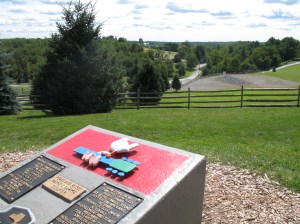
The view from the Hurd Road Woodstock Monument. Looking toward West Shore Road.

598.jpg”> The view from the Hurd Road Woodstock Monument. Looking toward West Shore Road.

Woodstock. It was something special for many people. I changed after that weekend. I saw the world in a different light. I saw the worst in people, as the man beating a woman; yelling and anger.  I saw the best in people, as in my companion on the journey home. I learned the color of skin meant nothing. The person inside is the most important. A lesson I have carried with me my entire life.


The big metal container is what we filled with water. This is our driveway. My Dad let some people park along the sides of it.
People walking from Kauneonga Lake. My Dad is with the camera.

https://zicharonot.wordpress.com/2014/08/11/taking-a-walk-up-to-hurd-road-to-the-woodstock-site/

http://www.mapquest.com/maps?city=Kauneonga%20Lake&state=NY

http://en.wikipedia.org/wiki/Woodstock

http://www.bethelwoodscenter.org/the-museum

http://www.britannica.com/EBchecked/topic/647675/The-Woodstock-Music-and-Art-Fair
http://en.wikipedia.org/wiki/Max_Yasgur

Movie Night in the Catskills Was A Wonderful, Magical Night

24 Jul

It was our Saturday night tradition at the Ritz Theatre in White Lake, NY. In the late afternoon, early evening, we children would go to the early movie with our grandmas: Grandma Esther, Grandma Rose, Grandma Thelma, Mrs. Anoff. They chaperoned about nine or ten children and kept us safe.

Our dads would drop us off at the front of the theater with money for the movie and snacks. We were supposed to be very careful there as it was at the intersection of 17B and 55. So there actually was a bit of traffic.

I think our grandmas would collect all the money and pay. However, when we got a little older, we were allowed to buy our own tickets. If you were under 12 it was one price, over 12 you paid the adult fare. It was always sad when someone had a summer birthday and turned 12. They now had to pay much more!

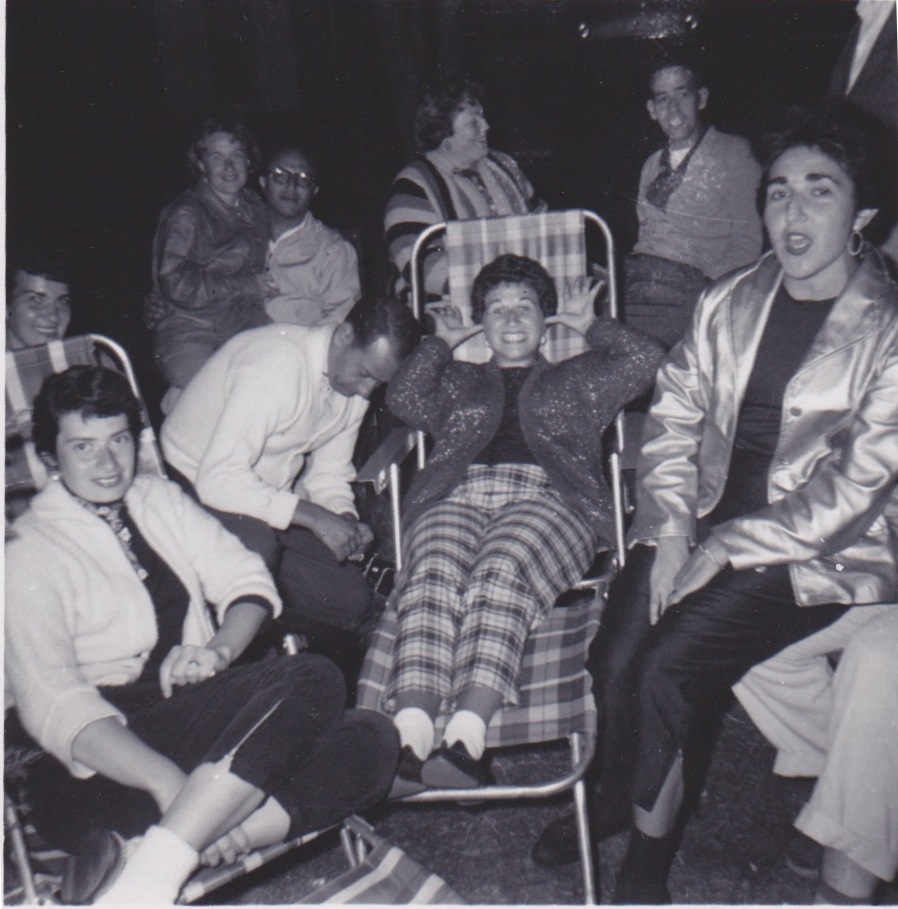
Our parents, in the early 1960s.  Kauneonga Lake, NY.

Some of the parents, in the early 1960s. Kauneonga Lake, NY.

Our fathers, in the meantime, would then go home to get ready for Date Night with our moms. It was their special time together.

We would watch whatever movie was showing that week. The movie I remember the most was “To Cast A Giant Shadow” about the Israeli War of Independence and Colonel David “Mickey” Marcus, the American officer who helped with ending the siege of Jerusalem. It actually had a major impact on my life choices.

For this movie, I sat next to my Grandma Rose.   Grandma Rose, was really my cousins’ grandma, but that did not matter. We shared grandmas in the Catskills. In any case, Grandma Rose lived through the siege of Jerusalem with her husband, Grandpa Asher, and my Uncle Jack.

While we watched the movie, Grandma Rose spoke to me throughout, telling me what happened to her in 1948. She told me what really happened during the siege. What in the movie was true, what was just fiction. She told me about the lack of water and food. She told me about the day they finally left Jerusalem and how difficult that day was for her and Grandpa Asher. How she looked back knowing she might never live in Jerusalem, her Jerusalem again. She never did. They moved to the USA.

I was eleven years old when “To Cast A Giant Shadow” came out in 1966. But this movie and the story of Jerusalem stayed with me my entire life. It was because of this movie and Grandma Rose’ commentary, that I went to Israel eight years later to spend my sophomore year of college at the Hebrew University in Jerusalem. I lived in both the Givat Ram and the HaHasofim campuses.

I was able to go freely between both the old city of Jerusalem and the new city. I saw the places Grandma Rose had told me about, as well as, the places I saw in the movie.

While I was gone, Grandma Rose passed away. My parents did not tell me. They did not want it to be in a letter. In those days we had no cell phones, no computer, no Skype. I found out when I got home. I was heartbroken.  I wanted to tell her all about the Jerusalem, where I lived and how it had returned to one city.   But I never got the chance.

But I always remembered that one movie and Grandma Rose.

Movie night was always an exciting night. Without television, cable, VCRs, DVDs, Netflex, we looked forward to going to the movies one day a week. Even when we got older and did not need our grandmas to go with us, we would still go in a group to the movies. Then we would go to Poppy’s for ice cream after the movie ended. It was always a good time. Even on dates we went as couples with someone else. It seemed odd to go out with just one other person. Sometimes we even ran into our parents at the ice cream parlor. So strange, so different from when we were children.

Because when we were young, our dads would come to pick us up after the movies. When we were settled in back at our bungalows, the parents would go out. They were dressed up, looking fine. Many times they were just going to the movies as well. Sometimes, they went to a show at one of the many hotels or bungalow colonies to see a comedian or musical. It was a wild time in the Catskills.

We always knew when they went to a show because they came home with one of those keychain photo viewers. We loved them. I found some when we cleaned out my parent’s apartment and I brought one back to Kansas with me.

My parents always went out extra special on Fathers’ Day weekend because their wedding anniversary was June 17. They had spent part of their honeymoon at Grossinger’s before heading up to the Finger Lakes and exploring on their own. So a special evening out at Grossinger’s was often their anniversary celebration destination.

Movie nights changed after the Ritz in White Lake closed. We then traveled to Liberty or Monticello to go to the movies. But the magic still remained. Movie night in the Catskills was a wonderful, magical night.

Finding Salamanders and Relaxing in the Black Forest

13 Jul

One of my favorite activities during my summers in the Catskills was finding salamanders. I loved those little orange lizards that lived in the moss hidden in the forest of the Catskills. I have not seen any for years, but they were plentiful when I was a child.

My parents encouraged my interest in nature, so much so that my Dad built a terrarium outside of our bungalow. It was about three feet by four feet, built with wood and chicken wire, right underneath our kitchen window. My brother and I spent a lot of time catching toads, frogs and salamanders to put into our terrarium, but the rule was that they had to be return to the woods when the summer came to an end.

My sister, me, and my brother facing our bungalow. Behind us you can see Kauneonga Lake. About 1962.

My sister, me, and my brother facing our bungalow. Behind us you can see Kauneonga Lake. About 1962.

While my brother went for the frogs and toads, my favorite creature to find was the salamander. I would search in the moss along trails in the woods. They were difficult to find because they could change colors like a chameleon and match the plants that surrounded them. But usually they were a dull orange color.

Then I would take the moss and the salamander back to our terrarium to become part of our nature center. At night, when the windows were open, we could hear the sounds of the frogs coming from the terrarium. It drove my Mom crazy, but she did not complain too much. She knew that I loved to spend hours watching the lizards residing there.

When I was not searching for my lizards, my friend, Vicki, and I would often go on walks to what we called, the “Black Forest.” This was an area of the woods behind my Grandparent’s bungalow colony that was all pine trees. Vicki and I loved to go there and play imagination games.

Because of the denseness of the trees, there was not a lot of sunshine filtering through the woods, and the ground was covered with pine needles, so not many plants grew. It was a mystical place. So silent, with the shadows of the trees dancing on the pine needles, it was the perfect place for a picnic and imagining. It was so quiet, we were able to hear people coming down the trail and hide before they arrived. It was our private place and we did not want to share it when we were there.

To get to the forest we had to walk past the blueberry patch, past the last bungalow in the row, to a place far away from the parents and the swings. We entered the forest near a large growth of ferns and moss. It was here that I could often find salamanders. But that I could do on the way home, not when we were going into the woods.

After we entered the treed area, we would walk along a path that had been created by years of children walking to the “black forest.” I do not know who was the first one to go there. But there were many boys who were much older than Vicki and I. So I assume one of them taught us the way. I just know that traveling along that path and walking back to the pine forest was an important part of our summer adventures.

Most of the walk was through regular woods, but then we would come upon it — the area where only pine trees grow. In that one special place we would lie upon the bed of pine needles and dream. The mounds of pine needles were so comfortable. We share our inner thoughts and secrets. When we were there, we were away from all the boys: our brothers and all my boy cousins. It was a wonderful escape.

Sometimes some of the boys would go with us. But the atmosphere changed when the boys came. Honestly, I liked it best when Vicki and I went by ourselves.

When I look at maps now and satellite images, and I see how far we wandered into the woods, I wonder what our parents would have thought if they knew how far we actually went? It was a different time, but we did get in trouble sometimes. And there was no way to reach our parents, we just figured it out ourselves.

One time we walked out of the pine forest area into some fields. A man came running after us and told us to stay off his property. That was scary. Usually we did not see anyone there. The woods were large. But in reality we knew that if we kept walking, on the other side were those fields and other private property and then Horseshoe Lake Road. We could not get lost. I think I actually walked that way once. But after the man scared us away, we almost always went back through the woods to the bungalow colony.

We had wonderful times wandering on our own. Having picnics that we packed ourselves. Filling our minds with memories that can never be erased. I close my eyes and I can smell the pine needles, their sharp fresh scent. I can feel the crush of my body on the mounds of needles as I looked up to the sky shimmering through the branches. I am back in the ‘black forest’ planning my next acquisition of a salamander and just having a wonderful day with my best friend.

“Abi Geszunt, Zie Geszunt “: As Long As You are Healthy, Be Safe

10 Jul

I have a vested interest in the survival of the state of Israel. Besides being the home to the descendants of my relatives who survived the Shoah, and to family members who made aliyah from the US over the years, it is also the home of my daughter.

For a year in 1974-75, I studied at the Hebrew University in Jerusalem. I met many young men and women who had survived the Yom Kippur War, and were still in shock over what had occurred. Those who had served in the Sinai, I think were forever scarred by the horrors they encountered and the many deaths they saw. We lived on edge that year, never knowing if there would be a flare up.

But that year changed my life. I instilled in my children a love of Israel. I took them to Israel on a family trip. I told them how our family moved there. I wanted them to understand the importance of having a Jewish homeland.

I never hid from the dark side of Israel: the harsh realities that Israelis must face each day. Let terrorists sneak in, or build a wall/fence?   Show weakness, and then more will die. Be strong, because if Israel is not strong, then the country will be destroyed. It is difficult to live with these pressures. But while we must still be strong, we must also be compassionate.

My daughter took my words to her heart.   During the summer of her junior year of college, she studied at Tel Aviv University. Then she went to Israel after finishing college and studied for two master’s degrees there. At Ben Gurion University of the Negev she earned a master’s in Middle Studies, and then went on for a second master’s on the Politics of Conflict.

She spent a year back in the USA, where she interned at Planned Parenthood in Kansas and was a substitute teacher at the Hebrew day school she attended as a child. But then she decided that she had to make aliyah –that living in Israel was the only option for her.

Abi Geszunt. Zie Geszunt. When I went to Israel for my one-year program, my Grandma Esther would send me articles from the newspaper about what was happening in Israel. Her notes said, “You could kill me in other ways.” Grandma Esther was the queen of inducing guilt. But I still went. My Grandpa Nat said, “Abi Geszunt. Zie Geszunt.”

My husband and I went to see our daughter when she was studying for her first master’s degree. We were standing at the Air Force Museum (in the Negev) with a young soldier when several Israeli fighter jets took to the air. The soldier and I looked at each other. And I knew that soon life in Israel would change.

Before I left for the US, I told my daughter, “Be careful. (Abi Geszunt). Something is brewing (Zie Geszunt).”

And a few days later Cast Lead began. I was on the phone with her one day when the sirens went off. “Mom,” she said, “Don’t worry if the phone disconnects. That often happens when a rocket hits.” She had 60 seconds to take cover.

“Where are you? Is your head covered?”

“I am under my desk. Don’t worry, I have my hoodie on.”

I heard the rocket hit. I heard her roommate tell her to stay down, that another one would come. I heard the police loudspeakers telling people to stay inside. And my hair turned whiter. I prayed. Abi Geszunt. Zie Geszunt.

And so when events in Israel flare up, I become somewhat anxious.

The past few weeks have been horrible with the abduction of the three Israeli teenagers. And when they were found buried in a field, I felt the same horror everyone else felt. But my world changed a bit when I found out that a group of Jewish settlers were the possible murderers of an Arab teenager, a revenge event.

In my mind Jews do not participate in senseless hatred. And two wrongs never make a right. Those who killed Mohammad Abu Khedair are just as evil as those who killed Naftali Frankel, Eyal Yifrach and Gilad Shaar, the Israel Jewish teens.

Those who preach hatred against all Arab Moslems are wrong. Target the evil! Hamas is evil in my opinion. The teaching of hatred is wrong in my mind. The constant bombardment of rockets into Israel, into civilian territories, is evil in my mind. But we must remember there are people on both sides who want this seemingly endless cycle to end.

In my heart, I knew the death of the Moslem youth would just put more credence to Hamas for the ever increasing bombardments. I knew there would be an escalation of hostilities. I guess I expected the Hamas response. It was as if they were looking for a reason to escalate the bombardments into Israel, to bait Israel into attacking them.

Now it has happened. Bombs are flying back and forth. People are dying. Young men are being called up for military duty. Smoke rises over the cities and the Gaza. The rockets from Gaza reach further than ever before. Jerusalem and Tel Aviv are in the bull’s eye.

The Middle East is more stressed than it has been in years.   Iraq, Syria, Lebanon, Egypt all in some degree of turmoil; ISIS declaring itself the new caliphate; Iran and it’s nuclear goals… all of these are potential dangers to Israel and the world.

I see what is happening in Israel, and I worry. Not only for my daughter’s physical well being, but also for the mental and moral wellbeing of her and any family she might one day have. However, I had one less fear this week, as my daughter is in the US for our niece’s wedding until the weekend.

I taught my children that racism and baseless hatred was wrong. I have worked for years on interfaith events and building bridges between people of all religions. More than anything else I want an end to this endless cycle of violence.

My daughter returns to Israel this weekend. She returns to the new life she has made for herself. She will leave the safety of Kansas. And I cannot stop her.

All I could do is say, “Abi Geszunt. Zie Geszunt.” As long as you are healthy; be healthy. Of course, what I am really saying is, “Be safe!”

Be Safe everyone!


“Abi Gezunt” song by Molly Picon. http://www.milkenarchive.org/works/lyrics/547

A Strand of Pearls is Not Just Jewelry, It is a Circle of Love

6 Jul


To me wearing my pearls infuses them with love.

To me wearing my pearls infuses them with love.

I wear two strands of pearls to every family wedding. One strand, the longer one, belonged to my mother-in-law, Lee. She died when she was only 59, but I know that she would want to be at every wedding of her grandchildren and family members. The other strand, is slightly shorter, but has a lovely clasp. It belonged to my Mom, Fran. She also loved weddings and would want to be at every family wedding! Amazingly both strands of pearls have the same size pearls. And they look so good together.

Last night I wore the pearls to the latest family wedding, our niece. The pearls came up in conversation, and I told my brother-in-law, and another nephew and niece, why I wore two strands. My brother-in-law said, “I know they are here.” And my nephew and niece, who knew my Mom but not his own Grandma, said, “Your Mom would have loved the weddings.” And it is true.

It makes me feel as if these two wonderful women were there with us when I wear these necklaces. Pearls are so warm. And to me their glow sends off the warmth of love.

Pearls have much meaning in my family. My grandmother had opera length pearls. And my mother had them made into three necklaces, once for each of her granddaughters. As they turned 18, each girl was presented with the pearl necklace from my mother.

Unfortunately she passed away a few months before the youngest turned 18.   My Dad had us present the pearls to my niece in the hospital where my mother was soon to die. I know it was a difficult time for my niece. But I hope as time has passed she realizes how much her grandparents loved her and how important it was for my Dad, her Grandpa, that she get the pearls while Grandma was still alive.

My Great grandmother, for whom I am named, gave my Grandma a strand of pearls in Europe in 1932. They would have been mine. But another relative stole the pearls while she was in Europe. She always suspected who had taken them.

Over 40 years later he wrote her a letter. He had survived the Shoah, but his entire family had been killed, his wife and his children. He blamed himself. He believed that if he had not stolen the pearls, they would have lived.

I know this because I met him. I was living in Israel at the time. My Grandma Thelma wrote to me to meet up with “the goniff.” He was going to give me 400 lira…about $100 at the time. I was to take some of the money and buy myself something and give the rest of the money to my great uncle.

I met Zissel and he told me his story. He was a sad, sad man. He told me how his family had died and the horrible things that occurred to him. He told me how he had stolen the pearls.

“Your grandmother went into the bathroom to bath. When she came out the pearls were on the sink. I thought, she lives in America; she is rich. I can use these pearls more than she can. And I took them. Now everyone is dead, and it is my fault.” Zissel and I both cried as he told me the story. I was only 19 years old. The pain of that day lives with me. He believed if he paid my Grandma back, it would take away some of the guilt. I hope it did.

I began to visit him whenever I was in Tel Aviv. He worked in a bakery across from the giant shuk. I would meet him there, get a pastry and tea and talk to him Sometimes I would go back to his apartment.

When my parents came to visit me in Israel, I took them to see Zissel as well. His Yiddish was much better than his Hebrew. So when my parents came, he spoke mainly to them in Yiddish. He told more stories. And my mother and I cried along with him. I hope that his sad soul found peace.

The pearls were a bond between Zissel and me.

And so for me pearls, any pearls, have a story to tell. My mother-in-law’s
pearls and my mother’s pearls will be filled with joy as they experience only happy events. Every wedding will bring happiness to these pearls. And the sadness of the pearls that Zissel took will be wiped away.

The pearls my daughter and nieces have are also filled with love. And when I see them wearing my mother’s/grandmother’s pearls, their great-grandma, I know that the love of these two women are surrounding them.

A strand of pearls is not just a piece of jewelry, it is a circle of love.


For Me the Fourth of July Echoes With Memories of My Dad and John Philip Sousa Marches

2 Jul

“Get up, get going, you are wasting the best part of the day,” my father would say early on a Saturday or Sunday morning. As teenagers all we wanted to do was sleep in on the weekends. But my Dad often had other ideas. He had chores he wanted us to do. If the talking did not work, he would play his favorite John Philip Sousa marches to wake us up. Heck, he would play marches all the time. He loved his Sousa marches.

I think we were the only children in North Bergen and the world who did their chores to John Philip Sousa marches. I can still see us lining up as a joke with mops and brooms marching around our house while the music blared. We would try to clean in time to the music. Well I would: vacuuming in time, dusting in time, ironing in time.

Dad loved his Sousa. Whenever I hear a march, I get the urge to clean. But I am able to resist. However, I do think of my Dad and his Arthur Fiedler and the Boston Pops collection (RCA Victor Label) of John Phillip Sousa marches. I can still hear “Stars and Stripes Forever” on an endless loop in my mind. But Dad had an entire collection of the Sousa marches. And we learned them all!

Needless to say, the Fourth of July was Dad’s favorite holiday. Those Sousa records would come out days before the Fourth as Dad prepared. You know my Dad could not sing at all. He tried, but he had no sense of pitch when he sang. But he would conduct along with the music, swinging his arms as if he was really in charge. I can remember seeing such joy on his face while he listened to the music.

His second favorite march was “Hail to the Chief.” Played whenever the President of the United States enters a room, with first the “Ruffles and Flourishes” introduction, “Hail to the Chief” made my Dad happy. In our house, he was the chief. And when he played that song he was letting us know who was boss. He would talk about his dream of one day having the song played for him.

And it happened. Dad served as president of his synagogue for 11 years. At a dinner honoring him, I mentioned his love of this song and his love of Sousa,   and his dream of hearing it played for him one day. When he came up to do his speech, the dance band spontaneously played “Hail to the Chief” in his honor. My Dad welled up with tears. He really was the President and he felt so honored.   I think my Mom, my siblings, our spouses and the two grandchildren there also cried out of pride and joy for Dad.

Dad did not only play his music on cleaning days. He brought his Sousa collection up to the Catskills. Since we had a very private four acres of land, he was able to play his Sousa as loud as he liked. And he liked to blast it out. I still have the sound of those brass instruments echoing in my mind.

And the times he got to see  any orchestra that played the marches live…Oh my!  That was the best for my Dad. Hearing the music live was even better than records or CDs. But I will say, his Arthur Fiedler records were his favorites.

When I think of his love of Sousa marches, I must also say that he loved the sight of a bald eagle.   Imagine my Dad, a proud veteran wearing an eagle or an American flag t-shirt, listening to John Philip Sousa marches on a relaxing weekend in the Catskills. Well he was relaxed, we were all wound up with the resounding booming music of Sousa.

Sousa wrote music for over 50 years! So there are quite a few marches to listen to over a weekend. He actually wrote almost 140 marches. And my siblings and I probably heard all of them at one time or another.

Among my favorites are the “Semper Fidelis March” written for the U.S. Marine Corps; “The Thunderer,” and the “U.S. Field Artillery,” which is the march for the US Army. (Sousa actually revised this melody, which was written by someone else.) Dad would ‘sing’ along with this last one, because it is the music to “The Caissons Go Rolling Along.” As a proud army veteran, he loved to sing this song.

For me the joys of the Fourth of July are not just the picnics, bar-b-ques,  the fireworks and the celebration of our country. For me  it is also time to listen to John Philip Sousa marches and remember my Dad.


Arthur Fiedler and Boston Pops “Stars and Stripes Forever’: http://www.youtube.com/watch?v=cmdyobr77IA

Marine Band plays “Hail to the Chief.” : http://www.whitehousehistory.org/whha_exhibits/marine_band/audio_marine-band-03.html

John Philip Sousa’s Marine Band playing “Semper Fidelis March”: http://en.wikipedia.org/wiki/File:John_Philip_Sousa_-_U.S._Marine_Band_-_Semper_Fidelis_March.ogg

US Army Band plays, “The Caissons Go Rolling Along”: http://en.wikipedia.org/wiki/The_Army_Goes_Rolling_Along


Space…Astronomy….and the First Walk on the Moon

29 Jun

Forty five years ago, Neil Armstrong and Buzz Aldrin walked on the moon.  Their adventure encourage so many children to dream of going into space as well.  Here is how it impacted my family.

My husband is the space nerd in my life. He watched the original “2001: A Space Odyssey” 21 times when it first came out. He helped start the astronomy club in high school and helped to make a six-inch reflector lens for the school’s telescope.

Eventually he went to CalTech, in Pasadena, CA, to study astrophysics and quantum mechanics. He spent a summer up on Mount Wilson doing research with a large telescope. He loved his time at CalTech. But he realized that there were others much more talented then he in physics, and left CalTech to become a doctor of medicine.

When I met him, he was in medical school. But the quest and the conquest of space was still an important part of his enjoyment. He loved learning about space. On one of our first dates he showed me the constellations. His “Sky and Telescope” magazines have been coming monthly to him for the entire 37 years we have been a couple. And yes, he does watch “The Big Bang Theory” on television each week.

His love of the night skies has influenced many of our vacations. A trip to Hawaii included a tour to the top of Mauna Kea where all the giant telescopes look to the sky. We saw the green flash at twilight and watched as the telescopes opened their eyes for the night, including the twin Keck observatories. We were standing in front of the CalTech Submillimeter Observatory telescope as it opened. My husband gleefully spoke to the students and staff inside. Oh heaven!

We then traveled partway down the volcano to look through much smaller telescopes to view the Milky Way galaxy, as well as constellations like the Seven Sisters and others. They are so much brighter and intense on a clear night on a high mountain in the middle of the ocean. We even saw twin suns, one a blue cooling star.

For a vacation in California, we went to the first ever SETI (Search for Extraterrestrial intelligence) Conference in Santa Clara during August 2010. We joined in the celebration of the 50th anniversary SETI program and honored Frank Drake, who founded SETI, on his 80th birthday.

I have even been on a private tour of MIT so Jay could see its campus and the graft of the apple tree that dropped an apple on Isaac Newton. Yes, the tree exists in a private courtyard at MIT!

To make her Dad happy from the moment she was born, our daughter was born on the 24th anniversary of John Glenn’s historic orbits around the Earth, the day after the MIR Space Station was launched, and during the time in 1986 that Halley’s Comet was in sight. What a daughter!  What a happy Dad! We really thought she would work for NASA one day.

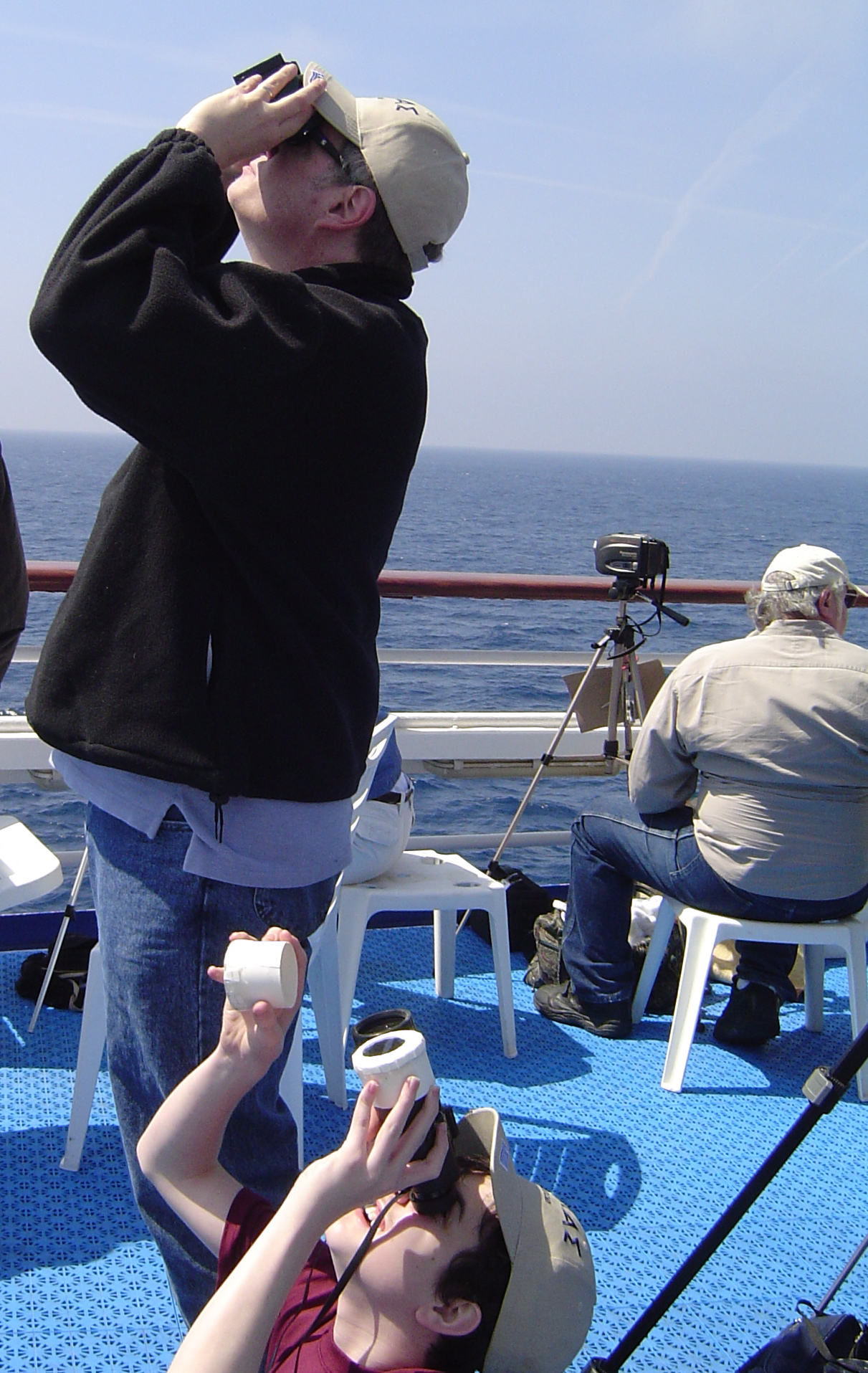
My husband and son watching the start of an eclipse from a cruise ship near Greece.

My husband and son watching the start of an eclipse from a cruise ship near Greece.

Our children have benefited from their Dad’s sky obsessions. We have witness the aurora borealis in Alaska. Watched the Perseid’s meteor shower while lying on the ground at a castle in Hungary. They have traveled with us to stand in the moon’s shadow and experience the eerie silence of a total eclipse of the sun. We journeyed three times so far to the sweet spot where the longest duration of eclipse was to be found: the Caribbean, Hungary and Greece.

While wearing welders’ goggles to protect our eyes, we have reveled at first contact and then “ooohed” at the diamond ring that occurs immediately before totality and the aurora of the sun. We marveled that each aurora is slightly different. And enjoy those few minutes of staring straight at the sun during totality without worrying about eye damage.

Total Eclipse of the Sun 1998.

Total Eclipse of the Sun 1998.

With a six-inch reflecting telescope in our garage, our children experienced seeing the different planets and space elements up close. Our neighbors have, at times, turned off all their outside lights for a viewing party. We have watched lunar eclipses and meteor showers from our front yard. We stood outside our home with binoculars to see the comet Hale-Bopp streak by…even though it was not that great, to be honest.. and watched the transit of Venus from our back deck. Our son took an astronomy class in both high school and college so he could learn more about the sky.

My children and husband watching the transit of Venus across the sun through shadows.  My daughter has her welder's goggles on for when she actually looks at the sun.

My children and husband watching the transit of Venus across the sun through shadows. My daughter has her welder’s goggles on for when she actually looks at the sun.

As a 40th birthday gift, I sent my husband to Adult Space Camp in Huntsville, where he envisioned what life for him would have been if he did not have a heart murmur and could have been a doctor/astronaut. He bought an official NASA blue jumpsuit, which he wore for many years on Halloween to the children’s hospital where he works.

Both my children have attended parent/child space camp in Huntsville, Alabama, with their Dad. And my daughter attended four additional years of Space Camp: two years in Hutchinson, Kansas, at the Cosmosphere, where we have been members for over 20 years; and two years at Huntsville.   At Space Camp she got to meet Eugene Cernan, the last man to walk on the moon, and have him autograph a book! We have all read books by John Glenn, Homer Hickman, and others who worked in the space program.

Originally she wanted to be an astronaut, but while in high school, at space camp in Huntsville, she changed her mind. “An astronaut came to talk to us,” she told me.  “He said that he was part of the ‘penguin’ group, the group of astronauts who will never fly.” WIth this information, my daughter decided it was not practical to plan on being an astronaut.

Through all this, I remain an interested accomplice because I also have a profound interest in space. Mine does not date to the movies or to my studies, but rather to July 20, 1969, when the “eagle” landed on the moon.

The anticipation had been increasing for over a week as Apollo 11 raced through space. At the bungalows that is all we could speak about as the spaceship reached each hurdle and passed on to the next step in its voyage. Would the rocket take off safely? Would they reach orbit around the moon? Would the landing ship detach correctly? Would they actually land on the moon?

In those days, 45 years ago, we did not have good television reception in the Catskills. In fact, the summer was ‘no television’ time. Most people did not even have a television in their bungalows.

But my grandparents had a year-round house with television reception. And a special exception was made for the moon landing. We were allowed to stay up so late that night. Many of us squished into a small space, sitting together on the floor, chairs, and couch, others standing as we watched the grainy black and white television.

Reception was going in and out, as Neil Armstrong and Buzz Aldrin landed on the moon. We stayed awake as Armstrong became the first man to walk on another surface besides Earth. We were mesmerized by the events. The adults were silent until both Armstrong and Aldrin were safely walking on the surface of the moon. Then there was cheering and a feeling of such excitement.

It was the event of the summer…till then. (Less than a month later, another closer event would also change our world: Woodstock.)

We were elated, exhausted, and extremely proud of what the United States did that night. Apollo 11’s crew members were our heroes.   What a night!

Then came the next round of anticipation. Would they be able to take off from the moon? Would they be able to connect with the orbiting Apollo 11 ship? Would they reach home? YES! They did!

During those July weeks, my interest in space and the night skies became forever part of my life. Now each time I travel with my husband to another planetarium (he wants to go to every one in the USA); or another space museum; or another eclipse; I feel that excitement bubble up. I am 14 again, watching the first men walk on the moon. We might have come to our love of space from separate places, but we share the excitement that the sky offers each and every night.

How World War I Saved My Family or My Grandpa Was A Draft Dodger

25 Jun

World War I changed the world! One hundred years ago, Europe became a place of desolation and devastation. Young men from both sides were killed. Millions perished. From all I have read, it was horrible. The use of gases so horrific that laws were later passed banning the use of these and all future chemical weapons. We know that sometimes they are still used. But the world peoples are united against them.

For my family, World War I actually saved my branch of a family. My Grandpa Nat, you see, was a draft dodger.   As he would explain it to me, Jews in Galicia did not really have a chance in the military. They were often put in the worst positions, meant to die. And if they survived, they were conscripted for 25 years. So they never were able to live a Jewish life or return to their families again.

In 1918, when my Grandpa was about 18, his life changed; he received the dreaded notice that he was to report for military duty. It sent his family into action. Nissan, as he was known in Europe, had to be smuggled out of Galicia to save his life.

Thus began my Grandpa’s two-year journey to salvation and survival. He left his home in the middle of the night with just those things he could carry and wear. His intention was to get to British Mandate of Palestine and join the efforts to create a Jewish homeland. But his first goal was to get to his cousins in Belgium.

He wandered through Europe during the battles of 1918 and the aftermath of the war. Slowly making his way to Belgium. He had no real passport. Instead he was using the passport of a dead cousin.

Eventually he made it to Belgium and his cousins. Their reaction to his wish to travel to Palestine was, “Why go to Palestine? It is a desert! Go to the United States, to the Golden Medina. You have an Uncle there. He will help.”

So my Grandpa contacted his Uncle Julius, known as Uncle Yidel to us all, his mother’s brother. Uncle Yidel agreed to sponsor Grandpa to the United States.  But he had one problem, he had been robbed along the way and had to work to earn the money to pay for his trip to the United States.  But finally, after about nine months, the last leg of his journey began. Fortunately for him, his uncle did sponsor him, because when he arrived in the port of New York City, and the immigration site of Ellis Island, he had just a nickel. Without a sponsor he would have been sent back to Europe.

Grandpa often would tell us that we could be whatever we wanted to be. “Look at me,” he would say. “I came to this country with just a nickel in my pocket. And look at what I have.” So we learned early on not to complain to Grandpa and to never give up!

I tried finding my Grandpa’s immigration information from the Ellis Island sites, but could find nothing. My Grandma’s was easy to find. So I often wonder what that passport actually said. And how old he was supposed to be? But in 1920, immigration procedures were not as intense and documentation was not as precise as it is now.

Tanta Molly and Uncle Yidel

Tanta Molly and Uncle Yidel

Uncle Yidel and his wife, Tanta Molly (also known as Malchik)  welcomed Grandpa.

Growing up in Europe, my Grandpa had been a yeshiva brocha, a student of Torah. He had a beautiful singing voice, and perhaps might have been a cantor. But instead, somewhere along the way, he learned to be a baker. When he first came to New York, he worked two jobs. One as a butcher, the other as a baker.  But it is as a baker that he prospered in America. He and Uncle Yidel started a bakery eventually owning a building in New York City. (My Grandma told me that when Grandpa proposed he told her he had a place. She thought he rented an apartment. She did not realize he owned the building!)


Grandpa in his bakery in West New York, New Jersey, 1942.

Grandpa in his bakery in West New York, New Jersey, 1942.

They separated the business after my grandparents married, and Grandpa and Grandma opened a new bakery in Linden, New Jersey.  But in the early 1930s, when my grandmother took their children to Europe for six months, Grandpa sold the bakery in Linden and opened a new bakery in West New York, New Jersey.  He kept this bakery for over 35 years.

Grandpa had many cousins in the United States. His parents were first cousins. So he was double cousins to many of the family. They helped him settle in. But Uncle Yidel was the most important. Uncle Yidel and Tanta Molly were always a part of our lives. They had one son, Ezra.

Whenever we went to see them, we were welcomed in Yiddish. Tanta Molly would come running out to hug us. She would call out our Jewish names: “ Tovaleh, Fagaleh, Chavaleh!” I asked my Mom, “Why does she put an ‘aleh’ on all our names?”

“It means little,” my Mom replied. “Well that did not make sense, Tanta Molly is littler than us!” Was my response. “It means she loves us,” Mom laughed as she said that. Later I found out the ‘aleh’ did mean little, but really was an endearment.

My Grandpa always missed the hills of Galicia. He often told me that he bought his property in the Catskills because it made him think of his home and his childhood. Many years latter when I traveled to that part of Europe, I saw he was right. The rolling, low mountains and hills do look like the Catskills.

My Grandpa forever missed his family. World War I did save him. He came to the United States. But his parents, siblings, and many aunts/ uncles/cousins stayed in Galicia. They all perished in the Shoah.

My Grandpa Nat was a draft dodger, but he never stopped fighting for the right to practice his beliefs and to protect his family in the USA. He loved America. He never traveled outside of the United States. When asked, his reply was always:

“Why would I ever want to leave here? It is the best place in the world.”

A Ride Around The Park

22 Jun

“Please Daddy! Please! Please! Please! Take us for a ride around the Park!!!”

Hudson County Park in North Bergen was one of our favorite places to go. We lived on 78th Street just off Boulevard East, and would often walk to the playground and the lake.   But our favorite thing to do with our Dad was to drive ‘around ‘ the Park.

Whenever Dad was driving us home, we would plead for this ‘treat.’ It was not a real ride around the Park. Instead it was a ride around the traffic circle in front of the Police Station. Dad would enter it carefully and then drive around the circle. If we were lucky he would do it two or three times. That was our very exciting “ride around the Park.”   My Mom thought we were all crazy, but we loved it.

Living by the Park was an adventure. Going to the playground was a favorite activity. We still had seesaws then and the merry go round. My brother was relentless in his active motions. I loved to go on the seesaw with him, a sort of excited fear. Would he let me go all the way up and down? Or would he jump off when he was down and watch me go flying? I had to hold on tight and have my legs ready to bounce!

As for the merry-go-round, this was a yellow circular toy on a pole. While some children sat on it, others ran in a circle while holding on to get it going as fast as they could, before they jumped on. It was not a good ride unless you felt like throwing up when you go off. And swinging was great fun. How high could we go and then jump off without getting hurt!

Children now no longer have these great fun activities. And to be honest, I do not know how my Mom kept from screaming at times. Although she did stop my brother from jumping off the seesaw, as I think seeing my sister and I fly through the air eventually made her nervous.

My brother and I rowing on the Lake in Hudson County Park.

My brother and I rowing on the Lake in Hudson County Park.

Walking around the lake was also fun. We always wanted to get to the island in the middle. We loved renting a row boat with my Dad and rowing over there.   But the best fun were the paddle boats. At first my legs were too short and my brother would yell at me to try harder, but eventually I could keep up with him. My sister was younger and would go with my Dad.

My Dad is rowing my Sister and me.  I think my Brother is taking the picture.

My Dad is rowing my Sister and me. I think my Brother is taking the picture.

When I got older, I would sometimes meet my old friends from when I lived on Third Avenue at Nungessers Bowling Alley or the White Castle. My Mom had strict rules, “Do not walk through the Park. Go up 78 street and then across Bergenline Avenue. “ Ha!   I always walked up to Park Avenue, entered the Park there and walked across.

When I got older, the rules changed. Something bad had happened in the Park when I was about 12 or 13. Now when I went to see my best friend, who lived around the corner on 77 and Park, our Dads would walk us. We would meet with our Dads at the top of 78th and Park Avenue. Eventually they calmed down. We were allowed to walk ourselves. But our Dads stood outside our homes and waited till they saw that we were together at the top of 78th street and then we would walk to the house we planned to play at!

Another friend of mine lived in red garden apartments next to where Stonehedge was built. I was allowed to walk to her place, but had to call the moment I got there! At the time I did not know what happened. But many years later, I was told that a girl was molested in the park. Something that was uncommon in the 1960s.

When I was in college I used the tennis courts at the Park. I spent two summers working in New York City. I would go into work with my Dad. One summer I worked at his office. My Mom and sister were in the Catskills. I think my brother was as well. In any case, Dad and I would eat dinner and then go to the park to play tennis. I played on my college’s inter-mural tennis team. So the summer practice at the Park was wonderful. On the weekends we would drive up to the Catskills.

I remember when the Boy Scouts held their giant Jamboree in the Park. My brother was in the Boy Scouts and he got to sleep in a tent at the park with thousands of other boys. There were tents everywhere! I wish I could find the photos. We could hear them at night, the noise was so loud!!!

Hudson County Park was an important part of my life. I do not think that a week went by, or even a few days, that we were not doing something in the park. Walking the trails or around the Lake. Meeting up with friends. Having a picnic. It was the best place to be.

When I was growing up it was Hudson County Park. No one called it North Hudson County Park. James Braddock was still alive. In fact, he lived up the block from me. We often saw him outside. He passed away when I was away at college. He actually died on my brother’s birthday. I am not sure when the Park was named for him. It is a great honor.

But to me, it will always be Hudson County Park. My memories for going for a ride around the park, or the playground, or the boats with my family and friends will cheer me forever.

Our Shul in the Catskills

18 Jun
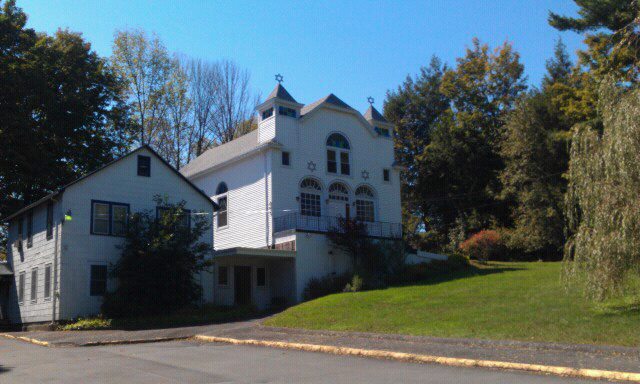
Temple in Kauneonga Lake. Temple in Kauneonga Lake.

(I wrote this a number of years ago. The Congregation is now 100 years old!)

Congregation Temple Beth El in Kauneonga Lake celebrated its 90 anniversary last summer. I only found out because my daughter asked me a question about the shul in the Catskills — the shul that three generations of her family had all attended.

To be honest, I was not sure that it even still held services. I live in Kansas now, and only go up to the Lake once each summer. Even less than I used to. When my parents were alive I would spend 7 to 10 days at our home in Kauneonga Lake with my parents and one or both of my children. But since they passed, at most I have spent a weekend.

So I checked. I went on line, and there it was a website for the congregation! I sent a donation in honor of the anniversary and in memory of my parents. And then I joined the congregation.

It brings back so many memories. The shul was founded in 1923. I think I started going there in the early 1960s. Maybe before. But my memories before then are not very accurate.

We spent every Rosh Hashannah at the shul on the hill in the Catskills. It was an orthodox congregation when I grew up. The women and girls sat upstairs in the balcony, while the men and boys sat downstairs. I actually liked sitting upstairs. We could look down on everyone and see what was going on, while we could be a little less formal.

But my Grandma Thelma and her good friend, Clara Wagner, rebelled one year. They said enough was enough. They did not want to climb the stairs anymore. So the congregation made a mehitzah for the downstairs and made the last three rows of seating for women. Grandma and Clara much happier, and keeping them happy was important. They were both very strong willed women!

I think they would be thrilled to know that there will be a woman rabbi there leading services this summer. Obviously men and women are sitting together and the mehitzah is down.

The shul was where we celebrated special events as well. My parents wedding anniversary was in June. One year, in honor of their anniversary, we held a special kiddish luncheon. My Grandpa Nat, a retired baker, baked plum cake after plum cake. Every oven was filled. Luckily he had saved many of his cooking trays.

The day of the kiddish was special. We were all there, family and congregation members. My Grandma asked Grandpa to sing in Yiddish for us. Grandpa had the best voice. His first song did not make my Mother happy. He sang, “Was is Geven ist Geven it Nitch Du.” My Mom said, “Daddy, why that song?” ‘What was, was and never will be again,’ is not what my Mom wanted to hear on her anniversary. (I think he was reliving her wedding, which occurred when my Dad was in the army on his way to Korea. It was a difficult time for the family, I have been told.)

My Grandpa laughed and then sang Tumbelalika and Schtetla Belz among other songs. There was some singing along, but mainly Grandpa singing to all of us.

We also celebrated my Grandma’s birthday there once or twice. Her birthday was in July. So perhaps her 70 or 75th birthdays were celebrated in the shul.

Grandpa was a cohen. He did not want to go to shul every week, but if no other cohen was available he went. In his younger days he would walk the mile or so to shul. But as he drifted near his 80s and older, he began to drive. He would park at Newman’s or across from Sylvia’s store and then walk the rest of the way. He just could not bring himself to drive all the way to shul on Shabbat.

I remember that a rabbi was hired that was a bit too orthodox for the shul. He put strings up around the syngagoue. As we walked to the shul, my Grandpa stopped and stood so still. “Vas Machts?” He turned to my Grandma. “I haven’t seen that since the shtetl!” He said. (Yes, he said it in Yiddish, but I don’t know how to write the entire sentence.)

I wanted to know what it was; it was an iruv. It makes a wall around the area of the synagogue or community so that people can carry things. You are not supposed to carry on Shabbat, but with an iruv up you can.

My grandparents had many friends at the shul. Among their closests friends were Abe and Clara Wagner. I can still see Abe, a plumber, down in a hole at my grandparents’ bungalow colony asking for some tool.   And my Grandpa laughing hysterically at the sight of the little red haired, highly freckled plumber in a hole.   Abe was so mad, “Stop laughing and hand me the tool.” But they both had a good laugh.

I remember going to their home many times with my Grandma and sitting and talking with Clara.

When Clara passed away, my grandmother was inconsolable for quite awhile. But when Abe remarried, she was welcoming to his new wife.

It was Abe who was there for my Grandpa when my Grandma passed away. We got the phone call from the hospital early on an August morning. My Grandpa refused to go to the hospital. He said, “She is gone, why do I need to go there.” They were worried about him at the hospital as he was in his 80s. So my Mom called Abe.

I can see it as yesterday. Abe spoke to my grandfather briefly, then he pointed at me. “Ellen, you come with me,” he said.

We went to the hospital, and while I signed my grandmother’s name over and over again on documents, Abe said. “Stay with them, I will be back.” At the time the emotion of signing Grandma’s name was all I thought of, nothing else.

We left when he returned. He had a big plastic bag of Grandma’s stuff. As we passed a dumpster, Abe told me throw it all out. “Your Grandpa doesn’t need any of that stuff,” he said.

I then turned to him and said, “Abe, I never saw Grandma.”
“Don’t worry, I took care of it,” He said.

And he did.

Grandma was buried in New Jersey, in our family plot. We, my parents, Grandpa and I, drove back to the Catskills from the cemetery. Grandpa sang, Johnny Mercer’s song, “Autumn Leaves” all the way back. “We promised each other that whoever remained would sing this song,” my Grandpa said. I still cannot bear to hear that song.

When we got to the house, all was ready. There was water by the door. There was a spread of eggs and other dairy items on the table. I am not sure if it was relatives or the Jewish community who prepared everything. But I know that many members of Congregation Temple Beth El came to sit shiva with my Grandpa. They were there for him for the many years he remained living at Kauneonga Lake.

My grandparents and parents always supported Congregation Temple Beth El. And as a community the people of the shul comforted my family.

I am so glad that services are still held at the shul on the hill, and that I have renewed my membership to support it and keep it alive.

http://congregationtemplebethel.org/

http://artists.letssingit.com/johnny-mercer-lyrics-autumn-leaves-wgtz6xc