Archive | Catskills RSS feed for this section

Come to the Firemen’s Festival! At Kauneonga Lake!

1 Jan

Anyone who stayed in White Lake and Kauneonga Lake in the 1950s, 1960s and early 70s remember the excitement that led up to the Fireman’s Festival. Even as I write these words I can hear the cry of the volunteer firemen as they drove up and down Route 55 and West Shore Road calling out: “Come to the Firemen’s Festival. This weekend! Come support the Firemen’s Festival.”

I still hear how they drew out the words “Fi- re- men’s – Fes-ti-val!” It was a lovely chant! And gave us so much joy when we heard it. The Firemen’s Festival was a highlight of the summer months.

Each year the volunteer firemen hosted a fundraiser on the empty lot in front of the elementary school that bordered the towns of Kauneonga Lake and White Lake. I was always so excited to go!

First were the signs around town telling us when the Firemen’s Festival would be held. Then the week before, the firemen on the truck would go through town letting us know exactly when. We all knew where.

It was an important fundraiser for these very important men (mainly men then) who helped so many!

At the Firemen’s Festival were all sorts of festival games like ring toss and hitting a weight to make it go to the top of the tower. There was a man who guessed your age.   There was food. There were prizes. There were so many people. It was a great time for all. I remember walking around with my parents and meeting up with friends, at which point we deserted our parents.   With a few dollars in your pocket you had enough money for activities to last the day.

The volunteer firemen had a significant role in the community. Now only did they fight fires, but they also came to the rescue of anyone who was in peril of drowning. At least once each summer the sirens would go off and the many trucks and cars of the volunteers headed toward the lake and the fire station. The volunteer firemen stopped whatever they were doing to help. They could not always save the person, but they tried.

They also had the firemen’s beach, which was located next to the ramp where people could put their boats in the lake on the Kauneonga Lake side. It was close to the fire station, just at the edge of the lake. It was where the firemen and their families could come to enjoy the lake.

The Firemen’s Festival was a way for them to raise the money to keep the station going and upgrade equipments as needed. They took no pay. It was just community members coming together to help. The way it is in many small towns.

Their coming together saved my father’s life in the early 1990s. There was no longer a Firemen’s Festival. The fairgrounds are now covered in knee-high weeds. But there is still a volunteer fire department.

In 1991 my Dad decided to cut some branches off the trees lining our driveway. At first my Mom and sister and her husband, Jerry, helped. But after a while, my Mom and sister decided to walk down the road to visit family. By that time the bungalow colony was closed, but people, including some family members had purchased all the bungalows. Jerry, who had poison ivy, took a nap.

Even though my Mom told my Dad to stop cutting while they were all busy, he did not listen. They are high trees. My Dad fell off the ladder and was knocked unconscious with a fractured skull.   When he did not show up to pick up my Mom and sister as planned, they called the house. They woke Jerry, who went outside and found Dad unconscious under a tree. He called 911.

The volunteered firemen responded. My sister said they saw cars flying past the bungalows and knew something was very wrong even before Jerry called them back. My Mom knew it was my Dad. My aunt or perhaps my cousins quickly drove them up to the house, where by this time many firemen and EMTs had gathered to stablize my Dad and get him to a hospital. Their cars lined our driveway.

Although he was first taken to the regional hospital in Harris, near Liberty, where he was further stabilized, his condition was so dire, he had to be taken to another hospital by ambulance. He was unconscious for a week. But he survived for another 18 years. Thanks to the firemen.

So whenever I think of the Firemen’s Festival, I always think of the firemen who years later were still helping those in need. I feel badly that the event to raise money for the firemen is no longer held. The Firemen’s Festival was a wonderful way to raise money and provide a wonderful summer activity. But with the changing nature of the bungalow colonies it was no longer feasible.

The work and the importance of the Volunteer Fire Department should never be undervalued. They deserve our thanks and high praise.

Loudspeakers Often Interrupted Life And the Quiet of the Catskills

30 Dec

Our bungalow colony was very small.   So we did not have loudspeakers to make event announcements and communicate phone calls. We could easily run over to the bungalow and get the needed person. And since we did not have a day camp or a casino or clubhouse, everyone would make plans while visiting during the day.

But we were so close to Fink’s Kauneonga Park, Top Hill, Sheppy’s and Friedmans that we heard all their announcements. To be honest, sometimes they made me crazy.

Phone calls, camp events, activities, emergencies, all were announced; sometimes over and over again. “Mrs. Shirley Katz, bungalow 7, you have a phone call.” The first time it was announced, it was very polite. But after a few minutes, the “Mrs. Katz, bungalow 7, you have a phone call,” had a much more emphatic tone.

Remember though that poor Mrs. Shirley Katz was up in the Catskills by herself. Her children were around. Her husband was not. She had to get everything settled before she ran to get the phone. Usually the couples arranged in advance when they would have the weekly phone call. But sometimes things just did not work out.

One summer, my friend Vicki was in charge of answering the three phones at Fink’s.  I was a mother’s helper that summer, also at Finks.   I took care of a little boy named David about seven hours a day, while his older siblings were in camp and his mom relaxed and played mah jonng. I think I earned $12 a week.

While I got to be outside, Vicki had to sit in the phone room waiting for phone calls. So often I would take the baby and sit with Vicki while she waited for calls. A most boring job except when the phone rang. We would sit on the back steps, play with the baby and visit while she waiting.

When a phone call did come in, Vicki would jump up to answer it. Then she was the voice on the loudspeaker, announcing who had the call and which phone to go to. Fink’s had three phones and people would get calls on the phone closest to their bungalows. Vicki also announced what movies were playing in the clubhouse. I find that amazing now, that a young teen had so much responsibility.

The main three-phone bank was at the main house where the Finks lived. So sometimes Mrs. Fink, who was also a friend of my grandmother, would give us snacks and something to drink. At times, she sat and visited with us or even let us watch television. That was a treat because most people did not have television reception in the Catskills.

If it started to rain, and I could not get back to the bungalow where David’s family lived, I would just stay at the ‘big house,’ until David’s Mom came an got us. She knew that we were safe with Mrs. Fink. So I do not think she ever worried.

I also took the baby to the front lawn and read a book while he sat in my lap. Sometimes I read out loud to him. I often wonder what happened to David. I read him many mysteries. Perhaps he is a lawyer or judge? He has to be about 45 or 46 now. I watched him for two summers, before I got a ‘real’ job. So I was 12 and 13.

The second summer, Vicki no longer answered the phones. She became a mother’s helper as well. I digress, but being a mother’s helper was a popular job for young teen girls and the moms at the colony.

Back to the announcements: Loudspeakers and announcements became part of everyday life. When I was watching David, sometimes I did not even notice that someone was being called. I was intent on what I was doing. Taking care of a baby is hard work! And little David just sat and played. He could ignore the announcements as well. He would just sleep through them when he was napping!

But for the people in the colony the announcements were very important.

“Tomorrow at Camp is color war day! Remember to dress your camper in the correct color T-shirt!”

“Tonight at the casino is bingo night! “

“This weekend the entertainment will be (insert your favorite low cost entertainer)!”

“Tonight’s movie is (insert a favorite from the 60s and70s). It will be shown at 7 pm.”

“Mrs. Levy, bungalow five, your son is at the concession stand. Please come and get him!”

“Alert, our-year old Bruce Gordon is missing. If you find him please take him to his Mother, Mrs. Gordon at bungalow 23! Let me know when he is found!”

“Ladies, the (type of peddler) is here at the main entrance.”

“The Good Humor truck is in front of the pool. Any one who wants a treat should come now!”

There were all sorts of announcements. And with four bungalow colonies nearby making announcements, we heard them all day long. I remember the one that started the day with the National Anthem. I think it was Fink’s for the day camp.   “Good morning campers! Let’s sing the Star Spangled Banner!” I hated that the announcement was so early in the morning, especially on days when I could sleep in!

Oh I cannot forget the overnight camps. Camp HiLi was just across Kauneonga Lake from our colony and our dock. We heard all their announcements as well. Some were food announcements, telling them it was time to go to the dining hall. Sometimes it was activity announcements and other times telling them to get ready for Shabbat. We could see the campers down at the lake and watch them scurry up the hill when certain announcements were made.

The loudest and most interesting of all the announcements, however, came during the weekend of August 15-18, 1969: Woodstock!!! Usually on the weekends there were not as many announcements because the dads were up, the camp was closed and there were not as many phone calls.

But during Woodstock, we heard all of the concert announcements.

“Let’s welcome Joe Cocker (or any other entertainer) to the stage.” Thunderous applause and the ground shook. YES it did shake with the vibration of the music and the bass and the people.

Each act was announced.   Bad drugs were announced. Food distribution was announced. I even remember the rain being announced. But really we all knew it was raining.

I loved hearing the Woodstock announcements. I remember lying in my bungalow listening to the rain, the music (we could hear it from our house) and the announcements. But those were out of the ordinary. Not the boring usual weekday announcements that could make me crazy.

Actually, the peaceful sounds of the Catskills cannot be remembered without also remembering the sounds of the loudspeakers over the quiet summer days.

Thanks to Vicki for remembering with me.   Also all the names of people in the announcements are fictional!

An Actual Announcement:  https://www.youtube.com/embed/lZ4bzu5Qi2U?version=3&rel=1&fs=1&showsearch=0&showinfo=1&iv_load_policy=1&wmode=transparent

Personal Mail Delivery at the Bungalows

27 Dec

Each summer before my brother could have a ‘real’ job, he had a job devised by my grandfather. Since my grandparents owned the small bungalow colony where we stayed each summer, they were responsible for certain amenities. One of these was mail delivery.

It was before the time of email and cell phones. Communications with people who had stayed behind in the City for the summer relied on mail.   And since most people did not have cars at the bungalow colony, someone had to walk into Kauneonga Lake and pick up the mail. It became my brother’s job when he was 10 years old.

Before him, he believes one of our cousins got the mail for a year. My Grandpa gave the job to the boys until they could get a real job. Then it was passed down to the next younger boy.

My brother got the job for several reasons. First, of course, someone did have to get the mail. Second, my brother was a grandchild. Third, my brother was an extremely active child. I think my grandfather was trying to give my Mom a break and also to wear my brother out. But honestly, nothing wore my brother out!

My brother’s morning went something like this.   Get up early. Eat a bowl or two of cereal. Then walk to the bungalows. We lived about 1/3 mile up the road from the colony in a bungalow behind our maternal grandparent’s home.

When he arrived at the bungalow colony he first went to the bungalow where our paternal grandparents and great aunt Minnie stayed to have the second breakfast waiting for him. Usually they had eggs, toast and cookies for him. My Grandma Esther was a great baker.   They had to give him enough energy to finish the walk to get the mail. I think she also gave him a nickel or so because he picked up her newspaper.

He would take the mail that people had given him or my Mom the day before, but first checking to see if anyone left him anything on their front steps, and set off for his journey into town.   Sometimes he was given additional jobs, like buy a newspaper at Vassmer’s.   Or buy stamps. So he always had a little bit of money that he needed to take with him and to keep track of it.

It was about mile or so walk into town. Sometimes he would have company. Another boy would walk with him. But other times he had to go on his own. If it was raining, he did not have to walk into town. The mail could wait. No one wanted him to get sick!

The post office to the left and the fire station to the right, across from the lake side on the other side of the grassy triangle.

The post office to the left and the fire station to the right, across from the lake side on the other side of the grassy triangle.

The town of Kauneonga Lake has a grassy triangle in the middle. Around it are the streets that lead to 17 B, West Shore Road and Swan Lake Road.   On the other side of the street were the stores on one side, the fire station on the other side, along with the buildings for the post office and the bakery.

Once he returned from his two-mile journey he would go to each bungalow and deliver the mail and whatever else they had ordered. It was a lot of work for a young boy, but he had a routine.

After he delivered the mail he would wander over to the bungalow where our Aunt Leona stayed. And, as he says, “If the timing was right I would deliver their mail and have my third breakfast.” That is right, breakfast number three. Goodness knows my aunt did not want him to go hungry! And since she was feeding her three boys, what was one more?

He ended his deliveries with my maternal grandparents. He would walk back up the hill to their home and deliver their mail. And have his fourth breakfast with our Grandfather.   My brother said that was usually burnt rye bread toast and coffee. It was burnt on purpose; Grandpa loved burnt rye bread toast! (Honestly I love it as well.)

Yes, my brother ate three or four breakfasts every single weekday morning.

But after he ate the fourth breakfast, Grandpa Nat would give him a chore to do before he could play: cut the grass, pick up leaves, or even straighten nails.   To be honest he and one of my cousins had the nail straightening job whenever they misbehaved.

He would come back to our bungalow and check in with Mom delivering the last mail of the day to her. I think she always asked him if he was hungry because my parents did not know at first that he was eating so many meals. Once they found out, they were amazed. Where was the food going? Did he have a hollow leg? He was so skinny!!! But he was able to pack it away.   I do not know how he did it.

The most amazing aspect is that he still had room for lunch a couple of hours later.

My brother enjoyed his four summers as the mail delivery service.   After he ‘retired’ and got a real job, I became the part-time mail person. Yes, I was a girl, but by then Grandpa had run out of boys.  So a change was made.

The next summer I worked at the bakery in town three or four days a week, and the bakery was in the building attached to the wooden building that housed the post office. So it made sense that I got the mail when I finished working. I only worked in the mornings. So the mail was delivered by lunch. And no, I did not get four meals!

The first summer I worked at the bakery, Grandma Thelma worked with me. But many days, when the store was not busy, she would just go and visit with Mrs. Driscoll.   In reality the post office was the center of town. You not only got your mail there, you also got all the gossip from Mrs. Driscoll.

I loved going to the post office with my Grandma.

While I walked to the left hallway where all the mailboxes were located, they would continue their discussions about Kauneonga Lake happenings. Sometimes when I got too close to them, they became quiet. So I knew to stay by the mailboxes or make believe I was looking at all the “Wanted” posters, so I could listen to all the gossip of the town.

I continued to get the mail one more summer, when I worked at the bakery by myself. But after that summer people started having cars at the bungalows and opening their own post office boxes. So they went to get their own mail.

We had the same mailbox for over 50 years, Box 792. We no longer have a mailbox in Kauneonga Lake. And of course Mrs. Driscoll and my Grandma are no longer with us. But my brother and I have wonderful memories of the post office and our years as the mail delivery service.

Thank you to my brother for sharing his memories and helping to make this an accurate description of a summer activity.

I Am Proud To Be A Cotton Thread Yarn Addict

25 Dec

I snuck over to the fabric store today. I needed one little spool of ribbon, but I knew it my heart it would be difficult to avoid the yarn aisles, especially the thread yarn that I use for crocheting doilies and table clothes. I am somewhat addicted.

I quickly found what I actually needed. But then, even with a creaky cart, I strolled over to the aisle with my favorite yarns: Aunt Lydia and Bernat Number 10 cotton thread yarn.

There were so many beautiful colors. So many colors I have not seen for a while. This is my favorite time of year. Right around the holidays the store seems to stock extra colors and extra yarns. New books filled with doilies patterns often appear.

Suddenly, I found myself in the right aisle, even though I had not been in the store for several months. The cart seemed to know the way on its own. I had a little chill of a thrill when I saw my yarns.

Yes hats and scarves are supposed to be here as well. A few are mixed in. Yes hats and scarves are supposed to be here as well. A few are mixed in.

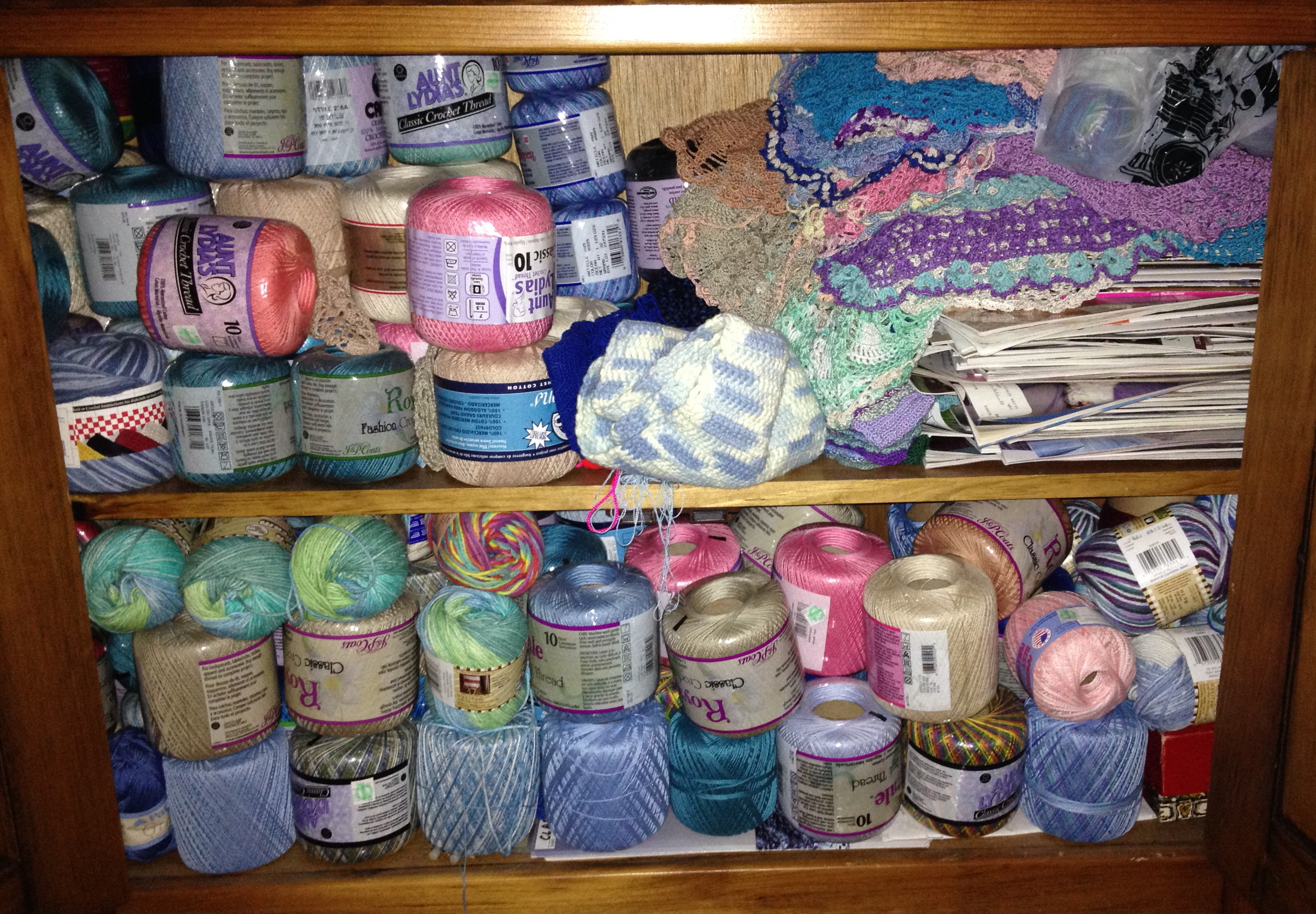
Did I need any yarn? NO. I have lots of yarn in my house. I have a cabinet filled with colored cotton yarn. I even have started putting my yarn in the closet. Where there is supposed to be hats and gloves, now yarn has taken over. But I bought so much today, that I do not think I will find enough room there. I might have to find a new storage area.

But I did get the most delightful colors: a deep plum and then a multicolored yarn that goes with it. I got turquoise and teal, bright coral and grey. I never saw grey thread yarn before.   It is lovely! I even found two books that I did not yet own. I own them now.

Thank goodness for the coupons I found on line. It did save me a little on my spending spree.

I must admit, I stood in the aisle for a good fifteen minutes going through all the yarns that I liked and checking to make sure they had the same dye lot code. This is important because even if the yarns are the same color, if the spools of yarn are not made at the same time with the same exact formula, they often a slightly off. As the doily or other crocheted article ages, it will fade differently with different dye lots.

As other people came into the aisle, I was a polite consumer. I did move my cart out of the way. But I stayed in front of the yarn I was inspecting. Luckily the two women who came down the aisle were looking at other yarns.

Sometimes I can control my yarn addiction. When my daughter still lived at home she would stop me from going to the yarn store. But she is out of graduate school, out of the country and living far away. This gives me free rein.   I could fill my house with yarn and she cannot stop me.

I filled my cart with new yarns! I filled my cart with new yarns!

I actually took a photo of the yarn as I was filling my cart and I sent her an email of it.   Yes, I did! I told her that she could do nothing to stop the addiction now. And buying yarn gave me enjoyment. I could envision in my mind what I was going to make. One of the items was for her!

To be honest, I am not the only person I know who has a yarn addiction. My friend, Sue, is much worse than me. For a while she was using a loom to make shawls and afghans. She had tubs upon tubs of wools and yarns in color-coordinated bins, divided by yarn types, colors and weight.

My yarn cabinet is stuffed with yarn, books and finished doilies. My yarn cabinet is stuffed with yarn, books and finished doilies.

I am beginning to think that is a good idea, as my thread yarns are just all thrown into a space in no order. My main yarn cabinet is a bit of a mess filled with yarn, books and finished doilies. When my husband, who loves to do jigsaw puzzles, told me that my yarn cabinet would make a great puzzle, I decided I might need some help. I think next time Sue is over, I am going to show her my mess and ask for help. She has always been much better organized than me.

An additional reason for my yarn addiction ‘issue’, concerns the debate of nature versus nurture. Although some of my yarn enjoyment is learned behavior from friends who also love yarn, I am not the first person in my family with a yarn issue. I definitely remember that my paternal Grandma Esther had tons of yarn as well. She was always making an afghan or a sweater for one of her children or grandchildren or great grandchildren.   I remember her forays to yarn stores.

Yarn stores are much more prolific in the Midwest, in the Kansas City area, where I live. But near to where my parents lived in New Jersey, I finally find one store where I could get cotton thread yarn when I was visiting. This was important because I sometimes finished all the yarn I brought with me. And to be without a project causes me some stress.

One time I was in the middle of a project when I ran out. I was in the Catskills, and I was desperate. One of my cousins was going to a store in Monticello. I gave her a small piece of yarn to try to match it. There was not much of a choice. My lovely sea foam doily has a beige border. Beige was the only color she could find.

Having yarn was especially important when my parents were ill and in the hospital. I spent hours crocheting in hospital rooms while I sat with a sleeping parent.   Crocheting calmed and soothed me. While crocheting I could control what was happening around me, the only thing I could control then.

Perhaps that is why I find discovering new yarn colors so exciting?   Crocheting is a pastime that relaxes me and takes away all tension.

So why should I feel badly about this yarn addiction? I will not. I love cotton thread yarn. I like getting new books and trying new patterns. It makes me happy. That is it! No more making excuses or sneaking to the craft store! I am proud to be a cotton thread yarn addict.

Giving Tzedekah is Entwined In The Essence of My Soul

22 Dec

For the past week I have been writing checks. It is the time of year when every charity I have ever donated to sends me reminders. Many of them I give to throughout the year. But at the end of the year, as much as my husband and I are able, I give more: to Harvesters, the food bank; to domestic violence shelter, to organizations that help children; to Jewish charities, to schools. The list goes on and on.

I was taught that you have to give to others. Not just money but time. Volunteering is an important part of my life. In the years when I was not working, I volunteered so much that it seemed I had several jobs. Yes I do have favorite organizations I for which I do most of my volunteering. But there are many that I do one-time events when asked by friends.

My favorite volunteer job is chairing a scholarship committee for the Greater Kansas City Section of National Council of Jewish Women. I became a member of NCJW because of scholarship, and I recently realized that I have been on this committee for almost 30 years. WOW.

As chair, I keep my committee going. Our numbers had fallen. But over the past three years, I have been able to have six or seven new members join. And this past year, I have gone after even younger women. We need continuity. Keeping the scholarship committee alive and well is important to me.

Each year we provide college scholarships for almost 30 students. They come to us first as high school seniors. And if they get our scholarship, they can continue it for all four years of college as long as their grades are relatively good and they still have financial need.

Over the years we have provided many scholarships for students who are the first in their family to go to college. And many have had hardships that make the committee members want to cry. As chair I am fortunate to read all the thank you notes that they send. And see the difference we have made in the lives of these students.

I often wondered when did the importance of volunteering and helping others first become so important to me? I honestly cannot remember a time when I was not involved in something. In high school I was a Candy Striper, a hospital volunteer. In college, I chaired and served on many committees to help others, including the first ever Orientation Committee.

Even my jobs have focused on not for profit work. It is in the essence of my soul.

My father was the president of his synagogue for 11 years. I think this has to be a record! My parents helped people and taught us to care for others. It was important to them that we had a ‘gutah neshama,” a good soul. It was important to be a mensch.

A favorite saying of my Dad’s was “You have to be able to get up in the morning at look at yourself in the mirror, and like what you see.”

Giving to others; understanding Tzedakah, righteousness, was important.

My Grandparents in the Catskills in July  around 1954. It was my Grandma's birthday.

My Grandparents in the Catskills in July around 1954. It was my Grandma’s birthday.

Today I received an email that shook me up in a way and made me realize that the need to do tzedakah came not just from my parents, but also my grandparents.

Through this blog I am in contact with several people who I knew as a child in the Catskills. Several have reached out to me over the year and asked if I remember certain people or places. One reached out to me in the past week. It is someone we knew not only in the Catskills, but in New Jersey as well. His mother is still alive. And he sent me this message:

“…she (his mother) was always grateful to your grandfather for helping my parents out when my brother and I were babies:  Even though the rent on the bungalow was ridiculously cheap, my parents were broke and Mr. Amsterdam (as she still calls him) let my parents pay out the summer rent through the entire winter a little bit at  a time. Otherwise we would have been stuck in steamy Hudson County.“

I have to be honest, I cried.   My grandparents were very quiet people. But I already knew that during the Great Depression, they allowed many people to buy groceries and bread from their bakery on credit, even though they knew they would not be paid. My Mom told us the story of people coming back years later to pay their debts.

But I never knew that they had allowed people to pay off the summer rent during the year. This was a major mitzvah. The cities in the early 1950s were not safe for children in the summer time; it was the season of polio.

I always knew my grandparents were righteous people.   And I know now that giving tzedekah is entwined in the essence my soul from my parents and my grandparents.

The Catskills’ Peddlers Brought Wares and Excitement

14 Dec

In the 1950s and 60s, when I was a child, weekdays in the bungalow colony were fun, but somewhat routine. Yes we played, we swam, we fished. We enjoyed being outside. But we were basically confined to an area whose boundaries were determined by how far we could walk.

In those days, most families only had one car, and that car was with the Dad, who had driven back to the City for the week. So during the week, we stayed put.

We were unable to go far to shop, and definitely could not carry too much back with us. A walk into town, Kauneonga Lake, to Vassmers, Newman’s or Sylvia’s S & G were the most we could muster. We could not go out for meals, except for the Chinese restaurant that was across the street or sometimes walk into town for ice cream at Newman’s. Those were our choices, until the late 60s early 70s when my grandparents were up and we had my grandfather’s car to use during the week.

The big excitement during the week, before we had a car, was when the peddler arrived with a station wagon filled with items for sale drove up the driveway. Some peddlers specialized in one item, like purses or linens; others carried a variety of many items.

I loved the arrival of a peddler car. Everyone would stop what they were doing and walk over to the car, where the peddler had already opened up the truck and started spreading things out: clothing, and linens, toys and dolls. It was a wonderful barrage of color and merchandise.

The moms would quickly pick through the items they needed. Sometimes we got clothing, because it seemed in the summer we were always growing, especially my brother. His jeans always seemed to shrink during the summer. But in reality he was just getting taller and taller. My Mom used to tell him that he would bankrupt the family because she had to buy so many jeans. But it was okay, I actually wore his hand me down pants then.

I remember the ‘muumuu’ dresses that the Moms wore during the week. The peddler often had a wonderful selection of these brightly colored, easy to wear dresses. My Mom got one that she loved. It had a multi-colored stripe like pattern. And along the edge was a white fringe. Once she got a ‘muumuu’ that she stopped wearing very soon after purchasing. It made her look pregnant. And with three small children, she definitely did not want that mistake to be made.

I still remember the day when we were shopping and someone she knew asked if she was expecting. I thought my Mom would collapse in the store. When we got home, she immediately changed. I never saw her wear that dress again.

My favorite memory concerns a doll. My Mom and Grandma promised me a new doll. I do not remember why. I must have either been very well behaved that week, or my brother destroyed my doll. In any case, I saw this lovely nurse doll. She had a beautiful white uniform, with warm brown skin. I loved her.

My Mom, my Grandmas and the peddler tried to talk me out of wanting that particular doll. But I would not back down. I loved the warm color of the doll. I wanted only that doll. And a promise is a promise. So they purchased the nurse doll for me. It was not until years later that I was told the doll was African American. At that age, to me, a doll was a doll.

Getting fresh food was also an important issue. I vaguely remember that we had milk and cheese delivered directly to the colony. But fresh fruits, vegetables and eggs were another story. Everyone helped each other. There was always at least one dad up during the week. And when he and his wife went shopping, they often had small orders from many families.

We also had trips to farms where we would go out into the fields and pick the fresh tomatoes, corn, string beans, peas and other vegetables. You paid by the weight. I loved to go. There was one up on Hurd Road and even further up on West Shore Road. There was also food sold at farm stands. One in White Lake on 17B was great for fresh corn and other vegetables. It was my Dad’s favorite stand.

When I think of my Dad, I always think of eggs! My grandfather was a retired baker, who continued to bake. So he needed lots of eggs. The Goldstein’s had a chicken/egg farm on West Shore Road near Happy Avenue. They were good friends of my grandparents, and they sold my Grandpa eggs wholesale. My Dad was in charge of getting the dozens of eggs that Grandpa needed. Over the years, others at the bungalow colony started asking for eggs. My Dad started taking orders and buying crates of eggs filled with large trays holding two and half dozen eggs per tray. He always took one of us to go with him. It was a treat!

Shopping in the Catskills was much more fun than shopping in Jersey. A grocery store had nothing on going directly to the farm. A clothing store was fun, but not the same a rummaging through the trunk of a station wagon. I still get a thrill when I see an old fashion station wagon! The Catskills’ peddlers brought wares and excitement to the bungalow colonies!

Waiting For the Dads to Arrive!

13 Nov
A weekend group dinner.

A weekend group dinner.

During the week our bungalow colony was ruled by women. Yes there was always at least one Dad up, taking his vacation and being a presence. And we did have a few grandfathers. But mostly it was the Moms running things. Taking care of us, the bungalows and any problems that arose, be it emergency medical runs due to childhood injuries, dealing with the rain and cold weather, or just disciplining children who were running a bit wild for the summer.

From Monday mornings to Thursday, life was just fun. The Moms were pretty relaxed. They played mah jong and different card games. They knitted and chatted. They took us swimming and went for walks.

They did the laundry, cleaned and went grocery shopping. It was peaceful and fun.

But on Friday mornings, life began to change. It was time to get ready for the Dads arrival. And now the Moms were really busy.

Plans were made!

Would they go to a show or a movie? Which Dad was staying up for the next week? What would they wear? Were they going to have a group dinner this weekend? We usually did. With two sets of grandparents and aunts and uncles, at least once during the weekend we all ate a meal together. (This was before we moved out of the bungalow colony and up to the ‘big’ house. After that we did not always join them for meals. )

The plans were intense. Everything had to be perfect for when the Dads arrived late on Friday.

They would work all day in the City and then drive up for the weekend. It was a weekly exodus from the city to rejoin their families in the Catskills. The traffic was intense especially in the 1950s and 60s before the new highways were built. It took at least four hours to make the journey — a trip that now takes about two hours.

The children were on high alert. You did not want to misbehave on Friday. If you did during the week, it was not too bad, you got punished by your Mom. She might say that she was going to tell Dad when he came up. But any event that happened on Monday, Tuesday or Wednesday was usually forgotten. However, misbehaving on a Friday was not a good idea. Moms usually remembered that!

We all got busy cleaning the bungalow and getting back into a semblance of order. Those little cabins were hard to keep clean and neat, especially with three little children. And even more difficult on rainy weeks when we were inside most of the time.

But on Friday, it was an all out effort to make the place look beautiful and cozy.

Often we were asleep when the Dads started arriving. But sometimes a Dad got off earlier and came up in time for dinner. Most of the time we were asleep when our Dad came up. And the excitement was on Saturday morning when we got to see him in the morning.

I think, looking back, that the Moms did love their time of freedom. It was much more relaxed during the week. The weekends were more hectic with shows, shopping and family activities.

We loved seeing our Dad and playing with him. Because our grandparents owned the bungalow colony, my Dad often had extra jobs to do on the weekends. But we all helped. It was just part of life!

The excitement of waiting for the Dads was sometimes too much. We would be so excited that we sometimes cried. And often we would bet which dad would be up first!

The fun and excitement lasted for just two days. On Sunday nights and early Monday mornings the Dads would leave once again. The quiet would return to the bungalows. And the slow, summer days would return until the next Friday.

Taking Trips Sometimes Bring Back Memories of My Parents

6 Nov

When I was a child, we never really traveled anywhere, except the Catskills. When there were school vacations, we might go visit an aunt and uncle in New Brunswick, but going on a trip that included a plane ride or a long car journey was unheard of to my family.

Each May we would go up to the Catskills for the Memorial Day weekend and get our bungalow open, aired out and ready for the season.   But then it was back to school for a month until the end of June when we journeyed up 17 to exit 104 and our summer home. But that was it.

My father traveled for his business. He went to Europe and California several times a year. He usually went to Milan and Como, Italy on business. Milan was/is the center of the fashion industry, and my Dad was in the textile/fashion industry.

Once in a while my Mom would travel with him, but not very often. She was a teacher and could not leave her class. She also did not want to leave us. But she did go to California and Milan several times.

When my parents were stilled alive, I went to Milan with my husband and son. My husband was speaking at a medical meeting there. My Dad told me in advance that I had to go to Como. He said it was a jewel of a city.

When we were asked if there was anything I wanted to do while there, I mentioned Como and the silk trade. I just wanted to find out how to get there.

Como

Next thing I knew, there was a private car with a driver/guide, as well as a translator, to take us to Como for a day and visit the Silk museum and school. This was the center of silk and textiles in Italy for many generations. I think they were amazed I knew about silk and Como. When most people mention Como they also mention George Clooney. But not me, for me it was all the textiles.

It was wonderful. The driver/guide had actually studied at the university there. Our interpreter really did not need to tell me what the guide was telling me. Once I got into the museum, I knew all about it from my Dad’s businesses, first his embroidery shop in New Jersey and then his textile firm where I had worked when I was in college.

The guide and I had a great time examining every machine and the display case. My son and husband walked around with the translator, while the guide and I bonded over textiles and jacquard embroidery machines.

That was many years after my father took his last trip to Italy. It had been years since his retirement and the closure of his business. I bought him a book about the museum. When I got back we spoke about Como, that jewel of a city. A day was not enough. I could spend a week or more there. It is lovely.

I remember my first plane journey. It was with my family. We used to get dressed up to fly in those days. No sweats and t-shirts! The winter break of my freshman year of college, my family went to Florida and stayed at the Fontainebleau in Miami. It was the vacation of a lifetime for us. We had never journeyed so far from home before. My sister, brother and I had a wonderful time just relaxing on the beach.

I do have one regret. My sister, who was a sophomore in high school, wanted to go to Disney World. There was a bus trip we could have taken. But I did not want to go, and my parents would not let my sister go alone. My sister and I finally did get to Disney World together and spent a day at Epcot. I felt like I had redeemed myself. I loved it! We had a wonderful time. I had been to Disney World many times with my husband and children. But going with my sister was special.

Forty years later I went back to the Fontainebleau with my husband. I stood at the pool and I told concierge that it had changed so much since I had last been there. He was so impressed with how much I remembered from the trip when I was 18 that he gave me a copy of a small book written about the hotel’s history as a gift. I was thankful. The photos in the book brought back so many memories of that earlier trip with my parents and siblings.

My parents’ biggest trip, without us, was when I was a senior in high school and they went to India for three weeks. They never forgot that trip. The highlight for them was going to the Taj Mahal, the tomb of Mumtaz Mahal, the wife of a Shah/emperor.   I saw the photos and remember my Mom’s telling me it was the most beautiful building in the world.

My husband has seen the Taj. He told me that the Taj Mahal was the most breath taking building he has ever seen. That even when he was leaving, he kept turning around to look at it again because it was so beautiful and amazing. His descriptions matched those of my parents’ recollections. And my interest in the Taj Mahal became more intense.

I have never gone to India, even though my husband has been there twice. But I made him and myself a promise. If he ever had to go to India again, and he was going to Agra where the Taj Mahal was located, I would go with him.

Later this year I will follow in my parents’ footsteps once again. I will walk up the path to the white marble tomb and see the building that fascinated my parents and my husband. I am going to see the Taj Mahal.


See:

https://zicharonot.wordpress.com/2014/04/22/becoming-an-adult-in-three-weeks-my-senior-year-of-high-school/

https://zicharonot.wordpress.com/2014/02/26/a-hudson-county-embroidery-shop-started-my-dads-career/


My Five Levels of “OY”

4 Nov

I recently realized that in my mind there are actually five levels of Oy. These five different levels provide me the ability to express sorrow or sadness with an oy-statement.

The first, of course, is the simple ‘oy.’ This mean ‘oh’ or ‘ouch.’ I use OY when my cat jumps on my stomach or I drop something. Sometimes I use oy when someone is telling about an embarrassing experience they had. A response of “Oy” is always appreciated.

I never use oy when something bad has happened. It is usually used for events that are a little bit funny. I guess someone slipping on a banana peel without getting hurt would be an oy moment.

It sometimes has an “I cannot believe I did that,” feeling. After you do it, you think, “Oy! Why did I do that!”

But when I say “Oy Vey” I have amped up the response. Now I have feelings of woe, which is exactly what “oy vey” means, “oh woe!” I think the following is a good example of an oy vey experience.

The summer of 2013, on Fathers’ Day, my husband and I were at a party. During the party a storm blew in to the area. It was tornado weather in Kansas. We all took shelter in the house. Although the wind blew and the rain came down, it was not too bad where we were.

All those branches on the ground should be in the tree.  Oy Vey

All those branches on the ground should be in the tree.         Oy Vey

However, when we got home, OY VEY!!!   Our beautiful Sugar Maple was destroyed in a microburst of rain and wind. Branches and limbs were all over our front yard. Part of our fence was crushed.   It looked like a disaster zone in our neighborhood. And our house seemed to be the epicenter.

But it was only an Oy Vey, the second level of oy, because no one was hurt. No homes were damaged. Yes, the tree was going to have to be taken down, but in the long run it was just a second level oy experience.  My son and his friends came over and helped my husband collect all the branches and to get the big branch off the fence. Those branches were big and heavy!

The next day I called the tree service we use. Luckily they had trimmed that tree just six months before, which probably lessened the damage. I will admit watching the tree service actually take the tree down was a second oy vey experience. It was a very large tree! But they took care of everything, while I watched and took photos…all the time chanting, “Oy Vey!”

“Oy Vey Iz Mir” is a much stronger, “Woe is ME! “ When I say the entire sentence, then I am really worried. When I say, “Oy Vey IZ Mir,” something horrible has happened.   Someone I know is sick. Or an elderly parent is in hospice or has passed away. Sometimes I say that when someone has lost a job. It is a statement for a calamity, but not for a tragedy. Or maybe something scary has occurred.

When I was a child in the Catskills, the boys who lived in the house next door were shooting BB guns and aiming at a target made of wood. The BBs ricocheted into our yard. All I remember was the leaves rustling and my Dad, who had served in Korea, jumping on us yelling, “Get Down!! Get Down!!!”

One of my grandparents said “Oy Vey iz mir.” I think both because of the guns and because of Dad’s reaction. He stormed over to the house and yelled. After that there were no BBs for a while. Then I think they built a target with straw behind it. But that “Oy Vey iz mir” has stayed with me!

I think the English saying, “Woe is me” is an example of Yiddish phrasing in English. I have woe. I feel woeful. I am sad. Those are all English. But in Yiddish, Oy Vey iz Mir. Oh woe is me!!!

For a tragedy I have my fourth level of Oy. That is seven oys in a row followed by Vey Iz Mir.   “Oy oy oy oy oy oy oy vey iz mir.” That is when I feel absolutely terrible about what I have just heard: when some one has had a true tragedy. What could that be? A young person has passed away.   Someone’s son or daughter has been in a serious car accident. During my children’s teen years, there were unfortunately several times when the fourth level of oy was invoked.   A suicide is a definite fourth level of oy. Where I might forget why I used the first three levels of oy, when I have a fourth level of oy moment, it lives with me forever.

When I reach this level I usually need a piece of chocolate and a glass of tea. When I say this I know that I would love to speak to my Mom or Dad and debrief. The fourth level of oy moments are the times when I end up making phone calls or sending out emails to let others know, so that we can band together and help.

But I said there are five levels of Oy. So what could be worse than level four? Well there is level five, when I say, “Oy, a Bracha.” With this I am saying “woe is me, we need a blessing.” With the fifth level of oy I am calling on God to help.

When war breaks out in Israel, it is an “oy a bracha,” moment. With a daughter living in Tel Aviv and many family members throughout Israel, the threat of weapons, rockets, war, and destruction makes me very anxious.

For me 9/11 was a fifth level oy moment. We needed all the blessings we could get then. And so for me, it was saying “Oy, a Bracha!” Help us, bless us.

My five levels of oy have been part of my life as long as I can remember.   I am glad that most of my oy moments are level one and level two oys. But I am also glad I know a bit of Yiddish so I have a way to express exactly how I feel.

Old Movie Memories Invade My Mind

2 Nov
Our grandparents purchased this house in 1962,  a few years after the last movie was filmed.

Our grandparents purchased this house in 1962, a few years after the last movie was filmed.


In the attic of our home in the Catskills, my brother found a box of old 9 mm movies. These 29 movies recount the early days of our parent’s marriage. There is my Mom’s shower, and even a movie of the wedding itself. We were shocked when we found it!

The majority of the movies were filmed between 1951 and 1958, with a few a little bit later. So we have film of my parents, grandparents, aunts and uncles, my brother and I…and a few of my sister who was born in 1958. We figure after the third child was born, there was not a lot of time to film us!

My brother took the films to be put on to DVDs. So we now each have two DVDs filled with 3 ¼ hours of family memories, in color. There is no sound, but it does not matter. We can often figure out what they are saying.

They are so young in these films. My parent’s wedding is especially poignant: seeing so many family members who have passed away. To see them once again in this movie means so much to all of us. You can see the joy and excitement in the synagogue in West New York, NJ.

I knew that movies existed. We had seen them as children. But did not know where they were. So the find of the box filled with movies was extraordinary! It provided much joy for my siblings and me.

I always thought the movies were in black and white. I remember seeing a few of them when we were children. My Dad would set up his projector in the living room and show the movies against a wall. Some of the movies we found, I remember so well. I thought I remembered the incidents themselves. But when I saw the movies, I realize what I remember is the movie of what happened.

The bulk of the movies were taken in the Catskills at my grandparent’s bungalow colony. I see my aunts and uncles, cousins, family friends. People I knew my entire life. There are also people I do not recognize. Did they only come up for just a year or so? Or perhaps they are people who passed from my parents’ lives and were not important? Maybe they were just visitors or friends of friends.

Some I might not recognize because they changed so much from the time I was young to when I remember them as I grew up. But it does not matter who they are, they were part of our parent’s life, so we are glad to see them.

It is fun to see the clothes and cars from the 50’s, to see them laughing and goofing off at the bungalows, to see them so alive is so joyful! I wish I could watch these movies everyday.

I cannot. Because along with the joy of the movies, is the realization that not only they are gone, but also the joy of bungalow colony life.   This is the zenith of Jewish bungalow colony life in the Catskills. The 1950s, 60s and early 70s is when so many people journeyed up to the ‘mountains’ for vacation.

It was also important to get children out of the city in the late 40s and early 50s, before the polio vaccine was developed. By being in the Catskills, they were somewhat spared this dread disease.

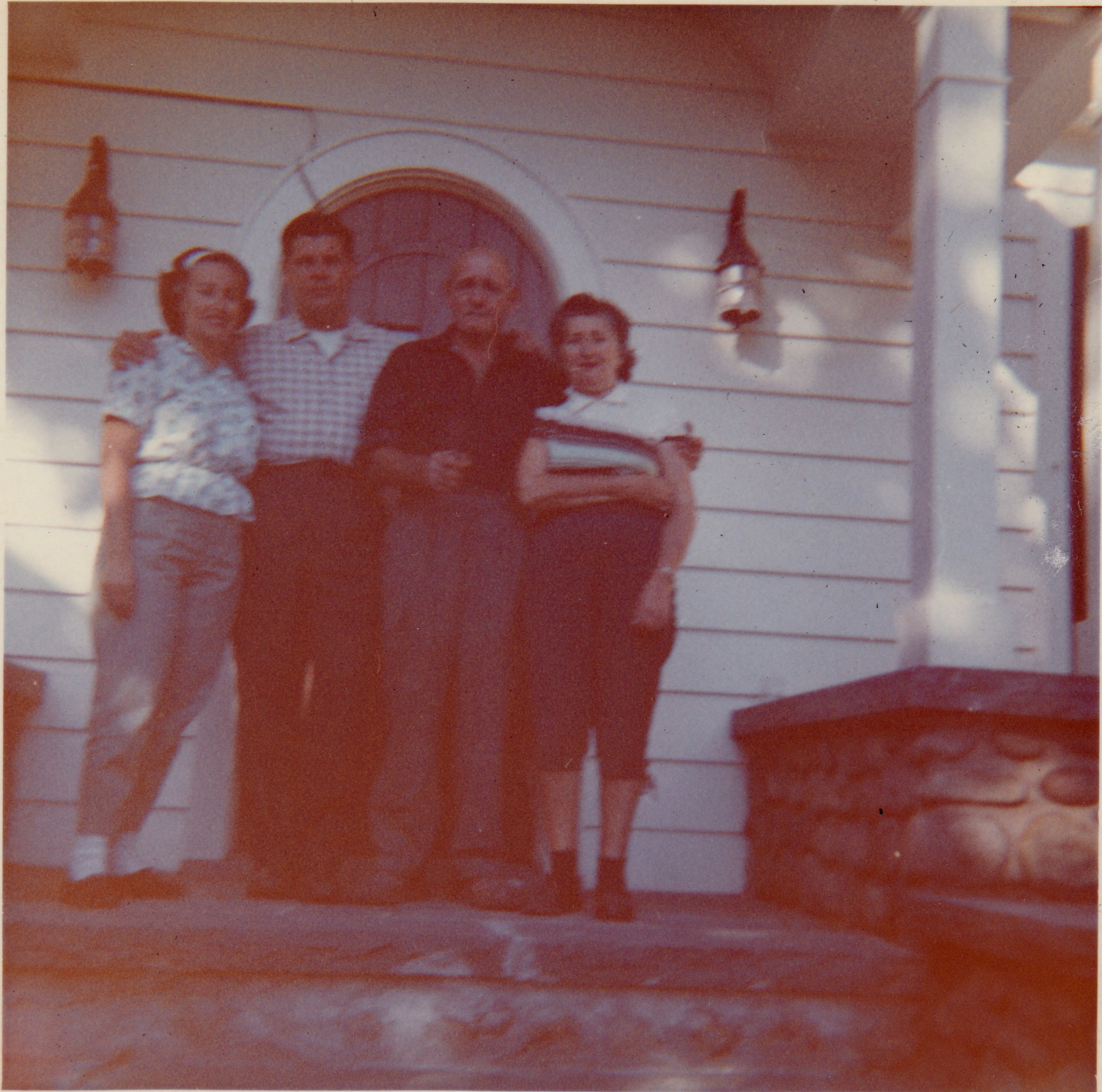
My parents and grandparents in front of the home in 1962.  My siblings and I now own it.

My parents and grandparents in front of the home in 1962. My siblings and I now own it.

I miss my summers in the Catskills. I am lucky as my siblings and I own our grandparent/parent’s home which our grandparents purchased in 1962. The house has so many happy memories.   We still have a place to stay and enjoy the peace. We are also lucky because our cousins have summer homes in Kauneonga Lake as well. When we go up, we create new memories, but we also have the history of experiences shared.

Next summer I plan to bring the DVDs up to the Catskills. I think my siblings, cousins and all the children would have a great time sharing these memories as we see our parents alive once again.